 |
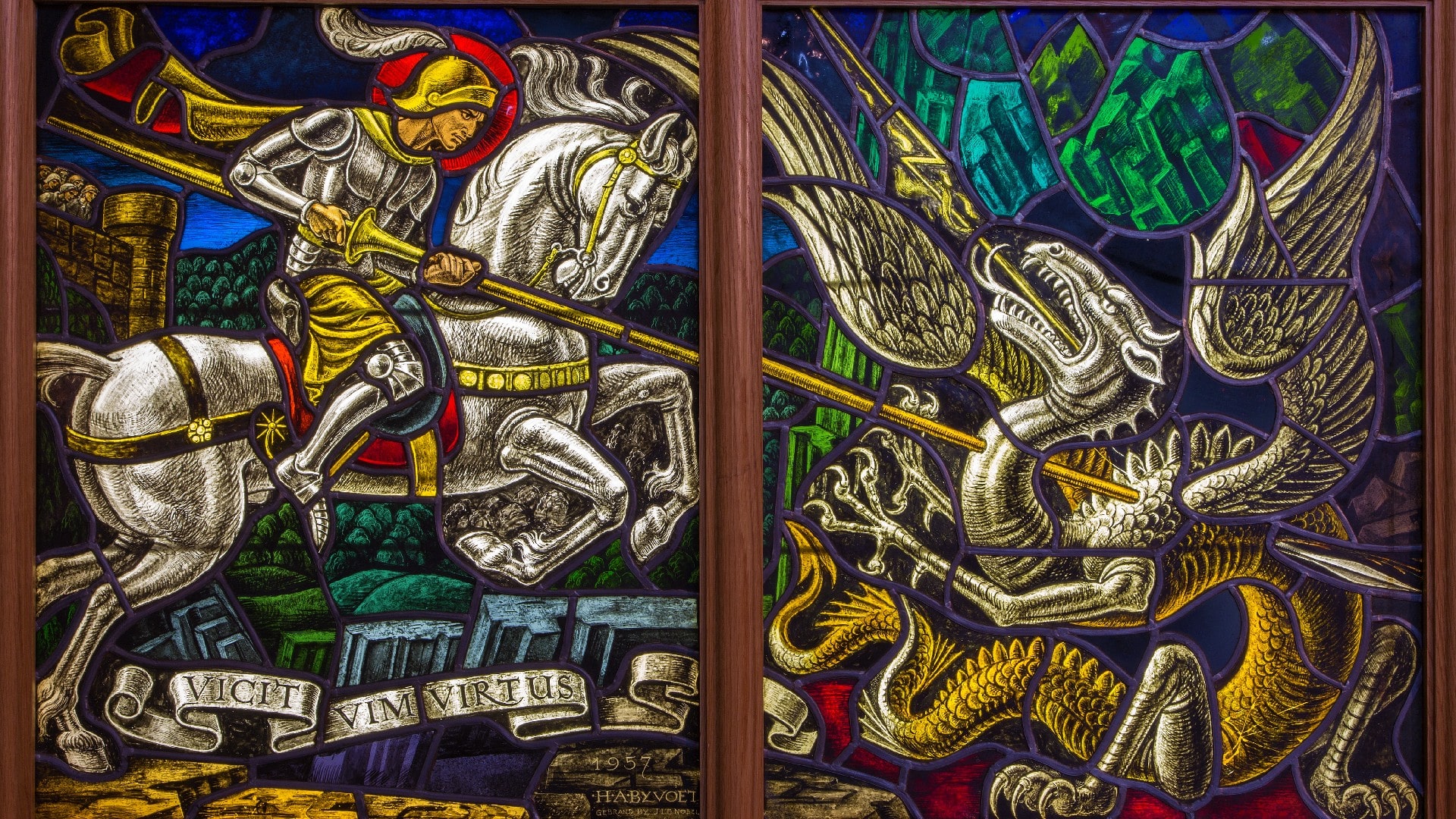
| St. George battling the dragon, Joriskerk, Antwerp. |
My dear brothers and sisters,
As we approach the great feast of Pentecost the lectionary for this Sunday already whispers to us about the wonderous coming of the Holy Spirit. In the Gospel our Lord promises the Advocate, the Spirit of truth who will come to those who love Him. In the first reading, from the Acts of the Apostles, the people of Samaria accepted the word of God, and welcomed the apostles, who, after laying hands on them, ensured that they received the Holy Spirit. The responsorial psalm sings of a wild, a delirious, joy for God, a joy that is possible only when we are filled with the Holy Spirit. Recollect for a moment the words of St. Paul in his letter to the Romans (8:26):
the Spirit helps us in our weakness, for we do not know how to pray as we ought, but that very Spirit intercedes with groanings too deep for words.
The second reading, from the first letter of St. Peter, concludes with St. Peter advising us:
Put to death in the flesh,
He [i.e. Our Lord Jesus Christ] was brought to life in the Spirit.
And this is the phrase that I would like to spend some time on today.
The dichotomy between the Spirit and the Flesh, a dichotomy that admittedly exists in the New Testament, especially in the epistles, is often misunderstood. A perfect example of this misunderstanding is in evidence in our own parish of St. Thomas the Apostle, especially in some of the responses to the suggestions for our spiritual lives that I made over the past few weeks.
Two of the suggestions I had made were that we dress up to mark significant occasions, that we ideally receive communion on the tongue and while kneeling. I thank those who communicated their discomfort with these suggestions to me, because this is the way in which the shepherd may appreciate the spiritual condition of his flock, and calibrate his ministrations to them. Indeed, I would like to recall the words of the letter of St. Peter we heard today, and hopefully use it as my guiding light as I continue this homily:
Always be ready to give an explanation
to anyone who asks you for a reason for your hope,
but do it with gentleness and reverence,
keeping your conscience clear
To the suggestion that a significant feast like Easter be marked by our wearing a suit, jacket, and tie, there were some of were of the belief that this was an unnecessary focus on externals. What mattered was our hearts and how we felt. A similar response marked my suggestion regarding the ideal way to receive the Body and Blood of our Lord. One friend suggested to me that our hands may be cleaner than our tongues, and what matters anyway is that we have clean hearts.
Indeed, it is true. What matters is that we have clean hearts, which is why I counsel against receiving communion unless you have made a recent confession and are thereby in a state of grace.
This focus on the clean heart and clean mind is typical of the modern thinking which ruptures the relationship between the mind and the body. The two are not separate entities, but indeed tied together. You cannot have one, without the other. Think of it this way, so important is the body, that the Son of God, who existed before time began, took flesh so that He could show us the way to salvation. Had our minds been so capable, He, who is wisdom, need not have taken human form. This is to say that the body is critical to our salvation. Thus, we are able to have the clean heart and clean mind, only if we train our bodies in particular ways to ensure that our heart and mind are clean.
So many of those I discussed the issue of dressing up for Mass with – people I love and hold dear – responded saying that it was too hot to consider wearing a suit for Easter Sunday. However, I ask you, would you not wear a suit if you went to a wedding? Or to some important business meeting? Why not then, to the most important thing you will do on Sunday.
However, let us concede the situation that it is inconvenient and bothersome to wear a suit in this heat. In such a case, take a lesson from the words of St. Peter in the reading today:
it is better to suffer for doing good,
if that be the will of God, than for doing evil.
If you wear a suit to a feast day Mass, and feel some amount of discomfort, be assured that you are doing it for good, i.e., stressing the importance of the event, and more importantly you are doing it so that so eventually avoid slipping into evil.
What might this evil be? According to St. Thomas Aquinas, evil is the lack of a due good. That is to say, evil is not doing something that is good to do. Thus, evil begins when we forget that we are participating in the representation of the sacrifice of Calvary, that we are in the presence of the Body and Blood of Christ and fail to act in a worthy manner.
Now, in an earlier homily I had recognised the legitimacy of receiving communion in the hand. However, the permission for reception in the hand comes with a strict protocol, precisely to remind us that it is no ordinary thing that we hold in your hand, and that we must treat it only with the greatest reverence.
And yet, these protocols are not followed, and the casual way in which the faithful take the Body and Blood that is given to them is horrifying to say the least. What is clear from this casual approach, however, is that we are not aware of what we hold in their hands.
This is precisely why Holy Mother Church privileges the reception on our tongues. Pronouncing on this matter, the Office for the Liturgical Celebrations of the Supreme Pontiff, i.e., the Pope, indicates:
From the time of the Fathers of the Church, a tendency was born and consolidated whereby distribution of Holy Communion in the hand became more and more restricted in favor of distributing Holy Communion on the tongue. The motivation for this practice is two-fold: a) first, to avoid, as much as possible, the dropping of Eucharistic particles; b) second, to increase among the faithful devotion to the Real Presence of Christ in the Sacrament of the Eucharist.
And so it is that we urge people to act in particular ways so that we may not forget who it is we are in the presence of, Christ Himself, of what it is we are required to do, take Christ to the world.
I must add that not too many years ago I was very much like those in the congregation today who are critical of my suggestions for improving our spiritual lives. But ever since I have started taking this issue of training the body to train the soul correctly, I have come to realise how unevenly we apply the arguments that we often pose when it comes to acting appropriately in our Christian lives.
Let us return to the argument “what matters is what I think”. This is an argument often applied to the reception of communion on the hand, but it is not an argument that we use when talking about relating to people we love. For, with the people we love, we do not say “it does not matter how I behave with them, what matters is how much I love them in my heart”. No, to those we love we physically show it! We touch them, we caress them, we use sweet words with them. All to make them know our love, and more importantly, so that our love for them may grow even more! And this is precisely the point, when we come to Mass, to church, we need to act in a way that will make our love for Jesus grow even more!
In the first line of the Gospel today we hear:
Jesus said to his disciples: "If you love me, you will keep my commandments.”
Remember that our Lord did not merely ask us to love our neighbours. He asked us to love God first! And it is only because we love God properly, and as He should be loved, that we are able to love our neighbours with the same love that He showed us. Too often, we stress the love of our neighbour, without stressing the love of God. And believe me, this focus on the neighbour before God is because Christ has been relativised. He is not, in fact, the central figure of our lives, but one more god among many other gods we worship. It is for this reason that we often do not feel the Spirit move us.
Behaving in a particular way is
important, and indeed necessary, if we are to make our bodies worthy
receptacles of the Holy Spirit. By virtue of our baptism the Holy Spirit is
already within us, but to allow it to move us, we have to open the doors and
windows in our soul which are currently shut. These doors and windows can be
opened not by simply thinking them into opening, but by training our bodies to
take part in certain practices, practices that have been sanctified by
tradition, and proved by the lives of the saints. Let us, therefore, this
morning go forth committed to rethink our attitudes so that we may more readily
prepare our hearts to allow the Spirit to move us.
(A version of this homily was first preached at the church of the parish of St. Thomas the Apostle, Aldona on 14 May 2023.)


