Many years ago,
while wandering through the seemingly unending galleries of artworks at the Alte Nationalgalerie in Berlin, I came upon the works of Adolf vonMenzel. Particularly striking among his works, and yet not among the more
celebrated, nor indeed among the larger canvasses he painted, was one titled
Kircheninneres (Barocker Altar). As the title suggests, the image is of a
Baroque altar, even though Menzel does not detail the altar, but only hints at
its complex forms through dark brush strokes. The altar is illuminated only
through tiny lights indicative of candles, while its bulk is illuminated from
the day light that pours from a window behind the altar, and onto the
worshippers who gather around the communion rail of the altar, like an
orientalist’s imagination of pagans before their idols. Indeed, the figure of
the Catholic priest at the altar is not very clear, and contributing to the
possibly ‘pagan’ nature of this image are the clouds of incense that rise from
the foot of the altar. The question I faced then, and which remains unresolved
is, what exactly was Menzel attempting with this image? Was he mocking the
Catholic faith? Or was he alluding to the profound devotion of the Catholics he
encountered?
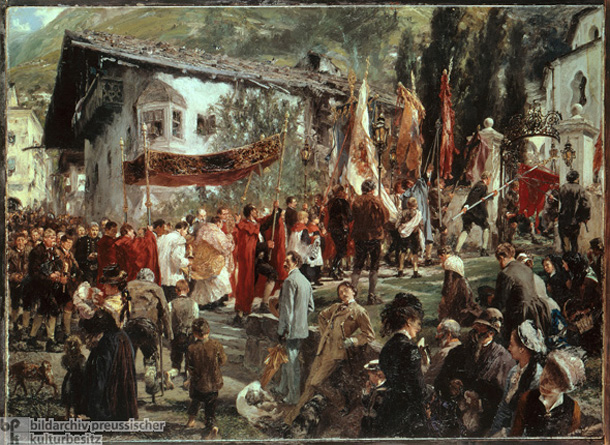 This image of
the Baroque altar is not the only image where Menzel captured the rituals of
the Catholic Church. Located in the Neue Pinakothek in Munich is a canvas
depicting the procession of the Blessed Sacrament celebrating the Feast of
Corpus Christi in the Austrian village of Hofgastein. Once again, along with
the images of persons devoutly engaged in the procession, Menzel has sneaked in
images of dandies and other lofty folk who are clearly spectators, but don’t
seem particularly interested in the scared ritual. Rather, they seem to mock
the ritual as some engage in conversation with each other, others stand apart
and stare at the procession, and one young man in particular, actually looks
out of the canvas and straight at the viewer.
This image of
the Baroque altar is not the only image where Menzel captured the rituals of
the Catholic Church. Located in the Neue Pinakothek in Munich is a canvas
depicting the procession of the Blessed Sacrament celebrating the Feast of
Corpus Christi in the Austrian village of Hofgastein. Once again, along with
the images of persons devoutly engaged in the procession, Menzel has sneaked in
images of dandies and other lofty folk who are clearly spectators, but don’t
seem particularly interested in the scared ritual. Rather, they seem to mock
the ritual as some engage in conversation with each other, others stand apart
and stare at the procession, and one young man in particular, actually looks
out of the canvas and straight at the viewer.
Regardless of
Menzel’s intentions, what definitely comes across from both these canvasses is
the devotion of the Catholics involved in the rituals being represented. In
both canvasses one finds people completely lost in the ritual that they are
participating. Indeed, it is perhaps for the fervour of the devotees around the
Baroque altar represented in Kircheninneres that this particular image is one
of my more favourite, returning to me over, and over again. One such occasion
was on a recent visit to Vienna.
 Competing for
attention with the displays of imperial power, were some of the Catholic
temples in various parts of the city’s core.
One of these churches was Michaelerkirche or the
Church of St. Michael the Archangel. Now
one does not expect to see tender displays of devotion in Europe anymore given
the extent to which European society has become secularized, but this church of
St. Michael, as indeed other churches within the historical core of Vienna,
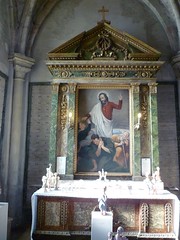
displayed a number of touching displays of devotion. Thus for instance, on my visit to St.
Michael's, I found a fresh little posy of flowers resting on the side altar in
front of the icon of St. Jude, and the wall behind it crammed with plaques of
stone thanking St. Jude for his intervention in the lives of these devout. This
was not the distant relationship with Catholicism that one would have expected
in this largely secular city, but something akin to the devotion of the women
one finds kneeling in front of the Baroque altar that Menzel depicted. At the
same time however, the altar to St. Jude was a simple altar located close to
the more ancient part of the Church and quite unlike the fancy alabaster
crafted high altar that would have probably formed the more obvious subject for
Menzel’s work. There is a profound lesson located somewhere in this
contradiction, but like the answer to the question about the artist’s
intention, I am quite unable to find it.
Competing for
attention with the displays of imperial power, were some of the Catholic
temples in various parts of the city’s core.
One of these churches was Michaelerkirche or the
Church of St. Michael the Archangel. Now
one does not expect to see tender displays of devotion in Europe anymore given
the extent to which European society has become secularized, but this church of
St. Michael, as indeed other churches within the historical core of Vienna,
displayed a number of touching displays of devotion. Thus for instance, on my visit to St.
Michael's, I found a fresh little posy of flowers resting on the side altar in
front of the icon of St. Jude, and the wall behind it crammed with plaques of
stone thanking St. Jude for his intervention in the lives of these devout. This
was not the distant relationship with Catholicism that one would have expected
in this largely secular city, but something akin to the devotion of the women
one finds kneeling in front of the Baroque altar that Menzel depicted. At the
same time however, the altar to St. Jude was a simple altar located close to
the more ancient part of the Church and quite unlike the fancy alabaster
crafted high altar that would have probably formed the more obvious subject for
Menzel’s work. There is a profound lesson located somewhere in this
contradiction, but like the answer to the question about the artist’s
intention, I am quite unable to find it.
(A version of this post was first published in The Goan, 24 Aug 2013)