 So profoundly has social media changed the ways in which we
communicate and form ourselves that to declare that the world of social media
has changed the manner in which we interact would be to state the obvious.
Social media has given many of us the option to define ourselves in new ways, granting
each of us access to resources that perhaps were scarcely imaginable even a
decade ago.
So profoundly has social media changed the ways in which we
communicate and form ourselves that to declare that the world of social media
has changed the manner in which we interact would be to state the obvious.
Social media has given many of us the option to define ourselves in new ways, granting
each of us access to resources that perhaps were scarcely imaginable even a
decade ago.
Like many others, I took to these new forms of moulding my
self-image like a duck to water. I was particularly fascinated by the possibilities
that Facebook’s cover picture options offered. For those not yet in the know,
the cover picture is what one would perhaps call the banner of the web page; it
is a block of space at the top of one’s personal page that can be customised to
fit in an image of one’s choice.

 The release of this option to Facebook users coincided with my
discovery of one of the features of the internal space of the Church of Saint
Roque in Lisbon. The central panel of the retable of the main altar in this
church is changed according to the liturgical season. Thus, the seasons of
Lent, Easter, Advent, Christmas, and Ordinary time have their own panels. The
effect on the largely illiterate faithful prior to times such as ours, when we
are bombarded with so much visual material, must have been dramatic, offering
an icon that was appropriate to the reflections of the season. Inspired by this
feature, I have constantly changed the cover picture on my Facebook wall to
suit the moment, whether it be a festival, a moment in history, an art work
that strikes my fancy, or suchlike.
The release of this option to Facebook users coincided with my
discovery of one of the features of the internal space of the Church of Saint
Roque in Lisbon. The central panel of the retable of the main altar in this
church is changed according to the liturgical season. Thus, the seasons of
Lent, Easter, Advent, Christmas, and Ordinary time have their own panels. The
effect on the largely illiterate faithful prior to times such as ours, when we
are bombarded with so much visual material, must have been dramatic, offering
an icon that was appropriate to the reflections of the season. Inspired by this
feature, I have constantly changed the cover picture on my Facebook wall to
suit the moment, whether it be a festival, a moment in history, an art work
that strikes my fancy, or suchlike. The Catholic Church commemorated the feast of St. Mary Magdalene on
the twenty-second of this month. Almost every Christian is aware that Mary
Magdalene is an important figure in the story of Christ’s life. She is
identified as the woman who anointed Christ with perfume, and wiped his feet
with her hair—an occasion that, according to the Gospels, caused quite a stir
and called for a rebuke from Christ. Subsequently, she is depicted as present
at the crucifixion and the resurrection of Christ, and finally, there are
representations of her as a penitent, living her life as a hermit.
The Catholic Church commemorated the feast of St. Mary Magdalene on
the twenty-second of this month. Almost every Christian is aware that Mary
Magdalene is an important figure in the story of Christ’s life. She is
identified as the woman who anointed Christ with perfume, and wiped his feet
with her hair—an occasion that, according to the Gospels, caused quite a stir
and called for a rebuke from Christ. Subsequently, she is depicted as present
at the crucifixion and the resurrection of Christ, and finally, there are
representations of her as a penitent, living her life as a hermit.  The occasion of her feast day, of course, called for a commemoration
of the event. I was unsure,
however, as to how to capture Mary Magdalene. Should I exhibit her before the Resurrection,
where she is depicted anointing the feet of
Christ, or wailing at the foot of the cross, or post resurrection, where
she is depicted as the penitent?
The occasion of her feast day, of course, called for a commemoration
of the event. I was unsure,
however, as to how to capture Mary Magdalene. Should I exhibit her before the Resurrection,
where she is depicted anointing the feet of
Christ, or wailing at the foot of the cross, or post resurrection, where
she is depicted as the penitent?
I was uncomfortable with the images of the anointing because of
their patriarchal character. One image in particular, displaying a woman and
her hair, and merely the feet of Christ, was quite horrifying. Focusing on a male foot, female hands and hair, despite the best intentions of the author, so much of the context had been removed to make the image seem vaguely pornographic. This image was
too far removed from the more mystical reading that Christ himself provided of
the action. Rather, it seemed to suggest the servitude of women to men.
 The images of Mary Magdalene as a penitent similarly displayed an often
lascivious male appreciation of her figure. Further, these images seemed to
stress not Mary the privileged disciple but the prostituted woman that she has
been identified with. Indeed, in these images, there was too much of an
obsession with the fallen woman, without any appreciation for her redemption
through Christ.
The images of Mary Magdalene as a penitent similarly displayed an often
lascivious male appreciation of her figure. Further, these images seemed to
stress not Mary the privileged disciple but the prostituted woman that she has
been identified with. Indeed, in these images, there was too much of an
obsession with the fallen woman, without any appreciation for her redemption
through Christ.
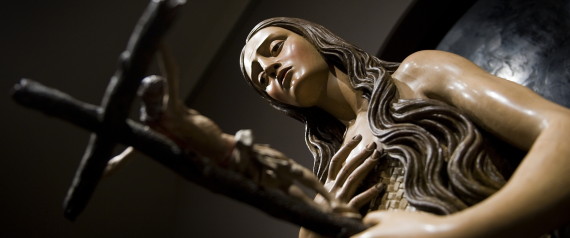
Of these many representations of Mary Magdalene as the penitent,
there was one image that kept suggesting itself insistently. This was a Baroque
period statute of the penitent Mary carved by the seventeenth century Spanish artist
Pedro de Mena. Belonging to the Spanish National Museum of Sculpture, currently
housed in the Colegio de San Gregorio in Valladolid, I had the privilege of
encountering the image when it was on loan to the National Museum of Antique Art in Lisbon between 2011 and 2012. There are no words that can quite capture
the sublime beauty of this image, whether in the care given to the coarse
garments of the penitent Mary, or the bliss of contemplation that animates her
face. Unfortunately, however, none of the images on the internet were quite
able to do justice to this image. In any case, as I will subsequently
elaborate, this moment of penitence was not the moment I decided on. Also,
there is good reason to believe that the penitent Mary is the result of the
conflation of Mary Madgalene with that of St. Mary of Egypt. This image,
therefore, just would not do.
I eventually settled on the moment when Mary encounters Christ after
his resurrection. This choice was determined largely because of the immense
importance of this moment, captured perfectly in the
words of Sr. Sandra Schneiders:
 “as three of the four Gospels record, she was
indeed the first witness to the Resurrection, and so then for those fateful
moments, hours immediately thereafter, there’s a deep sense in which Mary
Magdala was the Church. She was the only person who knew the story and could proclaim
it of the Resurrection.”
“as three of the four Gospels record, she was
indeed the first witness to the Resurrection, and so then for those fateful
moments, hours immediately thereafter, there’s a deep sense in which Mary
Magdala was the Church. She was the only person who knew the story and could proclaim
it of the Resurrection.”
There are times
when one is unable to understand the full import of the words one encounters.
And yet one is aware that something monumental has taken place. An entire
worldview has been shifted, and a new perspective has been born. In these few
words, Schneiders managed to convey the central importance of this female
figure in a world that predominantly focuses on male and patriarchal actors.
She repositioned Mary Magdalene, not as a fallen figure of immorality, nor as a
penitent (whose value I am not disputing, though penitence can be overemphasized so as to occlude grace), but as a person who, as a result of
Christ’s certain choice, was privileged to be the first to be made aware of the
key moment of the Christian message and, in conveying the message of new life
to the rest of the disciples, she embodied the Church in those initial moments.
(A version of this post was first published in the O Heraldo on 24 July 2015)


