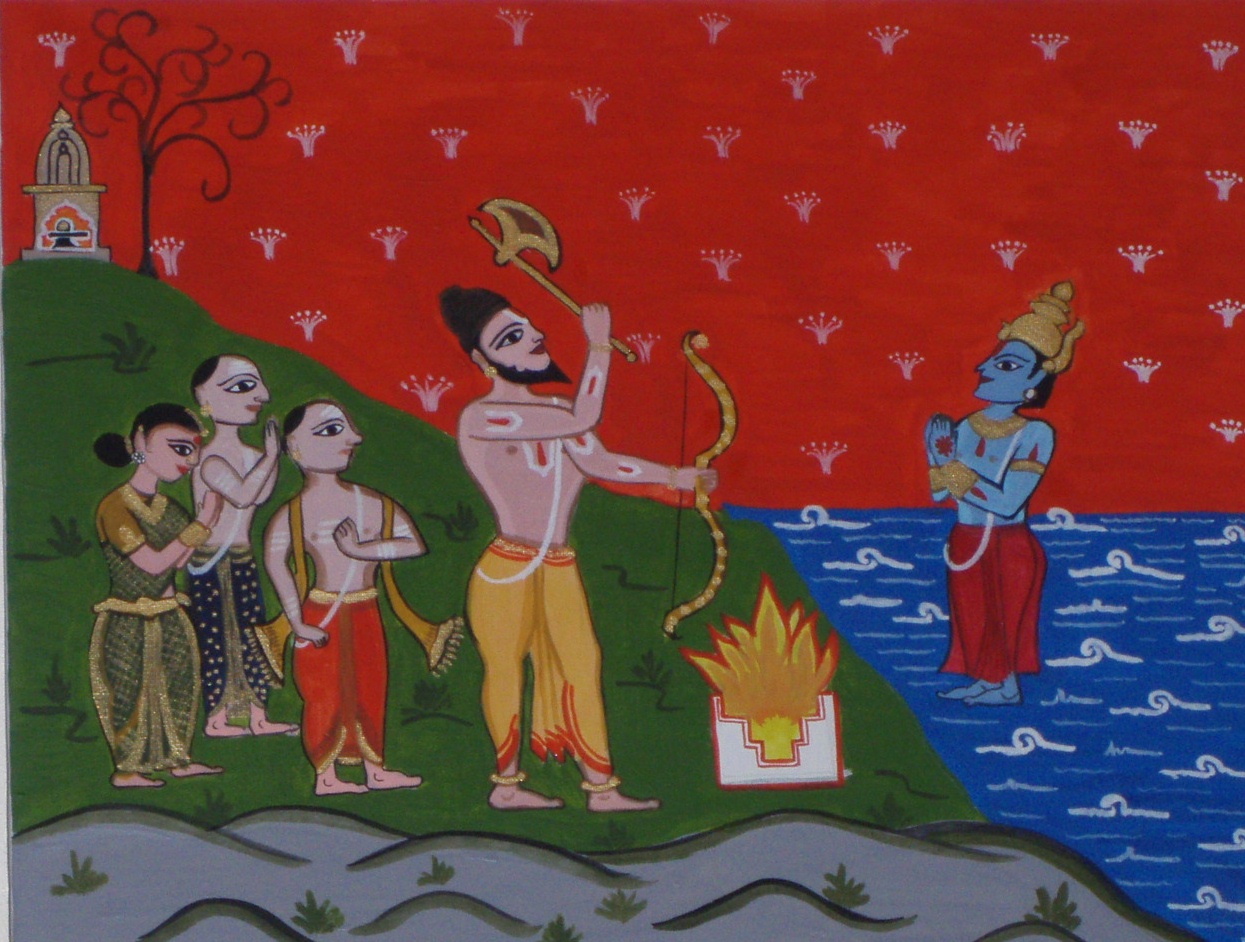
For some time
now I have been revisiting the myth recounted by Narayan Kondiba Mane, a
Dhangar shepherd from the district of Kolhapur in Maharashtra. The
myth tells of the birthing of the hero Parashurama and his relationship
with the Goddess Yellamma. Mane’s myth suggests that Parashurama was born of
the virgin Goddess Yellamma as a punishment for her violation of the sacred
grove of Mahadev. Saddled with a baby, the Goddess was given aid by the Shia
heroes Imam Hassan and Imam Hussein who built a residence for her on the hill
of Saundati not far from Belgaum. As the title of this series of columns
indicates, we can use this Dhangar narrative to rethink the central role that
is often given to a brahmanically-imagined Parashurama when recounting Goa’s
mythical origins
For some time
now I have been revisiting the myth recounted by Narayan Kondiba Mane, a
Dhangar shepherd from the district of Kolhapur in Maharashtra. The
myth tells of the birthing of the hero Parashurama and his relationship
with the Goddess Yellamma. Mane’s myth suggests that Parashurama was born of
the virgin Goddess Yellamma as a punishment for her violation of the sacred
grove of Mahadev. Saddled with a baby, the Goddess was given aid by the Shia
heroes Imam Hassan and Imam Hussein who built a residence for her on the hill
of Saundati not far from Belgaum. As the title of this series of columns
indicates, we can use this Dhangar narrative to rethink the central role that
is often given to a brahmanically-imagined Parashurama when recounting Goa’s
mythical origins.
 Rethinking the
now popular Parashurama myth requires that we recognize that the centrality that
the brahmanical, or Puranic, myth currently enjoys is perhaps only a century
old. Prior to this period the idea that Parashurama, son of the sage Jamadagni
and Renuka, created Goa by shooting an arrow into the sea was not widespread.
On the contrary, this was a Puranic version alone, and each Purana, or copy of
a Purana, had its own peculiar spin on the narrative. Take, for example, the fact that there is no unanimity as regards what it was that Parashurama used to push the sea back. Was it an arrow that he shot from his bow, as is believed in Goa, or an axe as is the case further down the west coast? Further those outside of
brahmanical society, and this included the vast majority of society, had
limited, or no access to these Puranic stories. As Mane’s recounting of the
myth of Yellamma and Parashurama indicates, there were a variety of other myths,
outside of the brahmanical sphere, that provided different life stories for
these personalities. How is it, then, that the Puranic myth gained the
popularity that it enjoys today?
Rethinking the
now popular Parashurama myth requires that we recognize that the centrality that
the brahmanical, or Puranic, myth currently enjoys is perhaps only a century
old. Prior to this period the idea that Parashurama, son of the sage Jamadagni
and Renuka, created Goa by shooting an arrow into the sea was not widespread.
On the contrary, this was a Puranic version alone, and each Purana, or copy of
a Purana, had its own peculiar spin on the narrative. Take, for example, the fact that there is no unanimity as regards what it was that Parashurama used to push the sea back. Was it an arrow that he shot from his bow, as is believed in Goa, or an axe as is the case further down the west coast? Further those outside of
brahmanical society, and this included the vast majority of society, had
limited, or no access to these Puranic stories. As Mane’s recounting of the
myth of Yellamma and Parashurama indicates, there were a variety of other myths,
outside of the brahmanical sphere, that provided different life stories for
these personalities. How is it, then, that the Puranic myth gained the
popularity that it enjoys today?  The key to this
question lies in the figure of the orientalist gentleman-scholar José Gerson da
Cunha (1844-1900), who operated from Bombay in the nineteenth century. Cunha’s contribution to history was to locate
a variety of the Parashurama myths and establish a single version that he would
publish and present as a scientific version, as the following extract from his
famous work, The Konkani Language and
Literature (1881), demonstrates:
The key to this
question lies in the figure of the orientalist gentleman-scholar José Gerson da
Cunha (1844-1900), who operated from Bombay in the nineteenth century. Cunha’s contribution to history was to locate
a variety of the Parashurama myths and establish a single version that he would
publish and present as a scientific version, as the following extract from his
famous work, The Konkani Language and
Literature (1881), demonstrates:"The edition of these fragments which I published in 1877, and the translation of which I have now completed, show the work to contain more mythology than history, more fiction than truth, and this embodied in a Sanskrit which has but little regard for orthography and grammar. Difficult as it is to disentangle the thread of truth from the confused web of fiction, or of those hopeless mazes of legends and myths which everywhere abound, there are still incorporated into the work some local traditions of more or less worth, treasured up for centuries by the Brahmans of the Konkan, who consider it to be their paladium. It may in consequence be utilized by patient and critical labour, obtaining some obscure hints, defective in chronological data though they be, from which grains of historical truth may be extracted." (p.8)
 But why was
Cunha so concerned with extracting history from this myth? The answer is pretty straight forward; Cunha
had an obsession with caste, establishing the antiquity of his own caste, and
his caste’s location as that equivalent to European nobility. Consider this
extract from George Moraes’ obituary of the man in the Journal of the Asiatic Society of Bombay (1964-64: 8): “Another
weakness of Dr. Da Cunha was his caste complex. In his Konkani Language and Literature he never misses an opportunity of
boosting the caste of the author if he happens to be of his caste, however
obscure may have been his work…” Earlier in this obituary (page 3), Moraes also
credits Cunha with providing an interpretative gloss that allowed the title of
Shenvi or Shenoy to be understood as that of aristocracy.
But why was
Cunha so concerned with extracting history from this myth? The answer is pretty straight forward; Cunha
had an obsession with caste, establishing the antiquity of his own caste, and
his caste’s location as that equivalent to European nobility. Consider this
extract from George Moraes’ obituary of the man in the Journal of the Asiatic Society of Bombay (1964-64: 8): “Another
weakness of Dr. Da Cunha was his caste complex. In his Konkani Language and Literature he never misses an opportunity of
boosting the caste of the author if he happens to be of his caste, however
obscure may have been his work…” Earlier in this obituary (page 3), Moraes also
credits Cunha with providing an interpretative gloss that allowed the title of
Shenvi or Shenoy to be understood as that of aristocracy.  Reflecting on Gerson da Cunha, the scholar Filipa Vicente (2012) points out that his
European-ness and his brahmin-ness were critical to the way in which he sought
to project himself. Both were absolutely essential to his identity and worked
in tandem. Where on one occasion, he was described merely as a brahmin, Cunha
manifested great discomfort because this fact of his identity was separated
from his Catholicism. Vicente points out
that “this declaration of his Europeanism does not necessarily signify a
rejection of his Indian identity. It was precisely his Goan origins that
enabled this combination of both his identities. Goa's ‘Portuguese nature’ and
his own personal and family history attributed to him with the Europeanism he
acknowledged, and which he wanted others to recognise in him, while also
recognising his Indian Brahman identity.” In other words, da Cunha’s
Catholicism allowed him to be seen as a European in European circles, while his
brahmanical identity allowed him to claim the ancient and noble pedigree that
he conferred on his caste fellows.
Reflecting on Gerson da Cunha, the scholar Filipa Vicente (2012) points out that his
European-ness and his brahmin-ness were critical to the way in which he sought
to project himself. Both were absolutely essential to his identity and worked
in tandem. Where on one occasion, he was described merely as a brahmin, Cunha
manifested great discomfort because this fact of his identity was separated
from his Catholicism. Vicente points out
that “this declaration of his Europeanism does not necessarily signify a
rejection of his Indian identity. It was precisely his Goan origins that
enabled this combination of both his identities. Goa's ‘Portuguese nature’ and
his own personal and family history attributed to him with the Europeanism he
acknowledged, and which he wanted others to recognise in him, while also
recognising his Indian Brahman identity.” In other words, da Cunha’s
Catholicism allowed him to be seen as a European in European circles, while his
brahmanical identity allowed him to claim the ancient and noble pedigree that
he conferred on his caste fellows.
José Gerson da
Cunha was writing in very volatile times, with new identities being
manufactured by a variety of groups and new orders emerging, alongside an
incipient Indian nationalism that privileged a brahmanical past. That Cunha’s
machinations worked and were acclaimed by so many is an indication that his
work fulfilled a need of a variety of persons, both Hindu as well as Catholic,
then as well as currently. Perhaps we cannot grudge them the social mobility
that they desired. However, it is important that we recognise that the
‘history’ that we babble about today was born from very peculiar circumstances
geared towards personal agendas of brahmanical groups. It is also important
that we recognise that the social mobility that these individuals and groups
sort was a mobility exclusive to themselves. It engendered a mobility at the
cost of that of others, namely the non-brahmanical groups. Mane’s Dhangar myth
of the Goddess Yellamma, Parashurama, and the Shia Imams indicates to us that
non-brahmins have different stories to tell, stories that deserve as much
credit as those told by brahmins, especially because they may engender a more
inclusive world.
(A version of this post was first published in the O Heraldo dated 10 July 2015)