Showing posts with label kunbi. Show all posts

Saturday, January 10, 2015

Rethinking Special Status 2: Origin Myths and Rights Claims


In our culture that is obsessed with symbols it is traditional that the first offerings in the new year contemplate the theme of freshness, new beginnings, and the like. And so it is that my first offering in the year 2015 will proffer some thoughts on the idea of origins.

Many years ago I had co-organised a reading group under the name Reading and Writing Goa. The idea of the group had been to think critically about the received wisdom about Goa and to rethink some of the intellectual frames through which Goa is thought about and represented. As a part of this exercise the group interacted with Gauda, Kunbi, Velip, and Dhangar activists from Goa who were asserting the rights of their communities within the state. In the course of our interactions one of the members of the group asked of these activists if they had any origins myths about Goa that would contest the more popular origin myth, that of Parashuram.
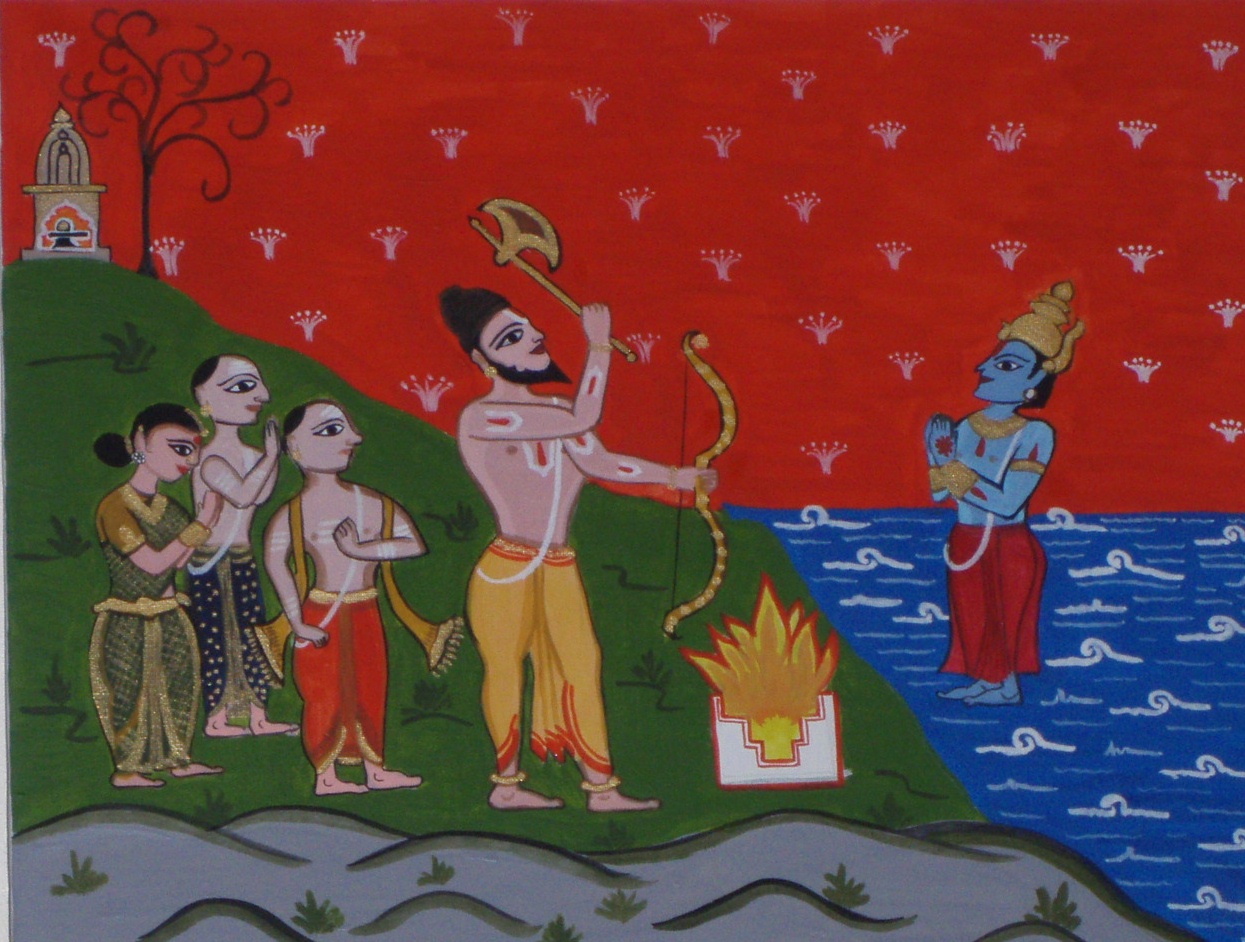
For those who are as yet unaware, the Parashuram myth suggests that the west coast of the peninsula of South Asia was created through the intervention of Parashuram, the sixth incarnation or avatar of the brahmanical deity Vishnu. There are a number of variations of this myth along the west coast, some suggesting that Parashuram threw the axe that he is named for into the sea, while others suggest that it was an arrow that he shot into the sea. In any case, all narratives are in agreement that having flung his weapon into the sea, the water receded to reveal landmass that was then used by Parashuramto settle brahmin communities. Given the penchant that Indians have for digging scientific facts out of  myth, this narrative has in recent times been interpreted to suggest that the story refers to the skills of the brahmin communities who were able to reclaim land from the tidal influenced rivers that mark the coastal territories of Goa. More suspect is the other use of this myth that suggests that since the lands were gifted to these brahmin communities by Parashuram, they may therefore operate as rulers of the territories created.

The visiting activists were flustered on being pressed for a Parashuram-like myth of origin for the territory. They could not offer a similar myth. What they could offer, however, is the narrative of their peoples that they had been systematically been cheated of their rights in the land. Where they were cosharers in the land, the brahmin and other dominant communities had ensured that the rights of the Adivasi groups were not recognised by law. In many cases the accounts the activists offered were more recent, from the time of the Portuguese administration where the dominant castes together with Portuguese administrators ensured that these already marginalised groups were further dispossessed.

Seeing the discomfort of the activists made me realise that an irrational demand that was being made of them. Despite the fact that they were offering a tangible fact, they were being forced to take their narrative of creation of land, possession and dispossession into a mythic past. Not every history needs to be ancient to have value. Histories can be recent, of only a few years and still be valid.

A recent column by Radharao Gracias in this newspaper offers a perfect example of how histories do not need to stretch back into myth or the ancient past. Intervening in the debate around the identity of Goans and the availing of the right to Portuguese citizenship, Gracias begins his discussion of the subject by referring to the Bahamani Sultanate. “Goans were the subjects of the Bahamani sultan, until the Portuguese defeated Adil Shah and replaced the Bahamanis” is the way Gracias phrases it.

I was delighted to see this framing of the debate because it seemed to meet my own views on the origin of Goa. While there are many who will read the history of our state into mythic times, the fact is Goa did not exist as a distinct nor legal entity prior to the Portuguese conquest of the city of Goa from the Bahamanis. Until the Portuguese crown gave it significance as a city state that annexed territory around it, Goa was just one more entity like the many port towns along the west coast of the peninsula. It was only after the territories around the city were ruled from this urban centre that it was possible to have a new and larger identity of Goa and consequently people called Goans. A Goan history, therefore, does not precede the conquest of the city in 1510. It was only after a combination of various factors, made possible by the assertion of the sovereignty of the Portuguese crown over the territory, the recognition of this sovereignty by local princes, and the vigorous socio-political environment that was jointly constructed by natives and colonials that Goa came into existence. This is not to say that the slate of history of the various territories that came to comprise Goa were blank before that. What I am suggesting is that a history of Goa as a distinct entity begins only from 1510. The histories of very many groups within contemporary Goa, as well as those outside of it, begin from 1510. There is no ancient history for these groups who were born subsequent to the birth of the city-state of Goa, and there is no reason for these groups to feel awkward about this apparent lack of history. The history that they do have is intense enough to provide reams of literature.

A shift in focus away from privileging a distant and mythic past allows us to shift attention to narratives that are based on rights and justice. Mythology, we must recognise, is not the realm of rights. It is only in more recent times that legal rights have been extended to all, and even today there are active impediments to ensure that these rights cannot be actively claimed. Furthermore, until recently it was only the dominant who could claim long recorded history. To privilege myth alone as the basis of history is to actively disempower persons and groups who cannot claim ancient myths of origin. Indeed, most Goans, who were born from the colonial encounter only claim histories that emerge from the colonial period.

Experience tells us that when ancient myths are recounted in the contemporary they work largely to bolster the image of, and invent a glorious history for groups that enjoy unfettered privilege. Another reason for recounting ancient myths is to dream up ancient and unsubstantiated wrongs that will be unfairly redressed in the present; but this is a different story. The contemplation of origins can be a cute exercise that may leave us feeling all warm and fuzzy, but it cannot be at the expense of compromising our commitment to the rights of marginalised groups.

(A version of this post was first published in the O Heraldo  dated 9 Jan 2015)

Wednesday, July 18, 2012

Reviewing Moda Goa: A story of how the choice of style makes a difference


Released early this year, Wendell Rodricks’ book Moda Goa: History and Style , a work that presents a history of Goan costume, clothing and accessories, has garnered a good amount of unstinted praise from the popular press.  This review will not however follow suit, but will attempt instead a more critical position on this work.

To begin with, one should recognize that in having consolidated the plethora of views on ‘Goan’ style and costume, Moda Goa has effectively created the foundation for a discreet line of study; style and costume in the areas around what has come to be called Goa. With the lavish images, and acknowledgement of sources, Rodricks provides future researchers with a starting point to commence their discussion of the themes that he attempts to consolidate. We should also acknowledge that unlike so many other books, a good number of the images in Moda Goa point to the identity of the individuals, who are otherwise unfairly left without mention. However, some credit for this democratic act should perhaps also be shared with Rajan Parrikar, given that these acknowledgements accompany Parrikar’s photographs in the book.

By popular accounts, Moda Goa would in fact live up to its promise, of presenting a narrative of History and Style. The book continues the grand tradition of understanding and writing about Goa that was first established by Goan public intellectuals in the late nineteenth -century. Toward that end, Rodricks must rightly be held to have joined that company, demonstrating also the continuity of intellectual traditions that Rodricks is heir to. The problem with this tradition however, is that it is one that is in severe need of updating in light of theories propounded by scholars working outside of the narrowly nationalist, orientalist and racist frameworks that marked nineteenth century scholarship. 

Rodricks’ work would have benefited immensely had he engaged with contemporary scholarship. Indeed, had he done so, it is more than likely that Rodricks would have crafted a remarkably different book. For example, Rodricks currently attempts an encyclopedic presentation of style and design, presenting a narrative of a linear history of Goan costumes, stretching from the prehistoric to the contemporary. The result is a work that is markedly thin in a number of areas, allowing him to suggest for example, it was the Emperor Ashoka’s Greek wife Helen who ‘set the style for Indian women who continue to drape their saris in much the same way even today’. While this may be a part of the story, failing to mention research that indicates the more contemporary origins of the story of the sari leaves us with the idea of a pristine garment that has come down to us. Contemporary research suggests that the contemporary Indian sari, along with the blouse and petticoat, was a Victorian era adaptation in nationalist Bengal, this model being popularized through Raja Ravi Varma’s wildly popular depictions of brahmanical goddesses. Another example is his suggestion that ‘The Muslims who traded with Goa after the Inquisition was lifted wore traditional fez caps’  challenging the suggestion from scholarship that the fez gained popularity in the sub-continent around the time of the Khilafat movement, the deliberate adoption of a fez cap being a mark of solidarity with the deposed Ottoman Sultan-Caliph. It is possible that, given the general disregard for the nuances of sub continental histories outside of British-India, Rodricks is in fact overturning established scholarship through reading the largely ignored Indo-Portuguese archive. However his failure in following standard academic norms of citations prevent us from ascertaining if this is the case, or if Rodricks is simply extending commonsense back into time.

Engagement with this body of research would also have ensured that at the very least Rodricks would have problematized the linear history he makes use of. Linear history is eminently suited to nationalist agendas that see the culmination of history in the idea citizen for the nation. Once this ideal citizen has been identified all else is held of dubious value. Given that the ideal citizen for the Indian nation is largely imagined as the upper-caste Hindu, the history that Rodricks crafts is an upper-caste history that often runs counter to the evidence that he himself provides. Thus for example, the departure of groups from Portuguese controlled Goa, was not necessarily that of Goans, but often of upper caste groups, especially those who had already, prior to the arrival of the Portuguese, established themselves as a dominant group along the length of the West coast. Further, the presence of the (Mangalorean) Catholics in Kanara was not merely the result of Goan Catholics fleeing Inquisitional terror, as Rodricks suggests, but also the result of combined factors of peasant abandonment of villages when faced with excessive taxes from the Portuguese State, and Maratha incursions into the same territory. It is not as if this fact is not recognized by Rodricks, but so great is his verve in telling a nationalist mythology that he fails to make this, and other facts, cohere with the larger narrative he weaves.

As a further result of following these nineteenth century patterns of historiography, and having marked the (upper-caste) Hindu as the central pole, the entry of Aryans into the subcontinent is clearly specified as not an invasion, but an arrival (though to be fair, this early clarification does not translate into consistency, given that the Aryans are saddled with invasion later in the text). Such a clarification however, is not in evidence in the case of the Persianised adventurers and dynasts in the subcontinent, who are simply brushed off as ‘the Muslims’. It is perhaps this dismissal, where he fails to distinguish between the Mughals, and the Deccan Sultanates that is the reason for the plethora of gross historical errors. Take for example the suggestion that  the Vijayanagara empire fell to the ‘merciless Tipu Sultan’, when it was in fact the Wodeyar dynasty that was effectively displaced around 1761 by Hyder Ali, the father of Tipu Sultan, whose throne Tipu inherited. The Vijayanagara polity fell much earlier, subsequent to the battle of Talikota in 1565. With this dismissal, and the following the nationalist common-sense of ancient Goa as a brahmanical seat, Rodricks misses the opportunity to engage in more nuanced understandings of the Islamicate impact on the evolution of Goan dresses, such as the pano baju and the cabai, that he discusses. Indeed, almost completely missing from the 'history' that Rodricks produces, is reference to the Deccan Sultanates, especially the Sultanate of Bjiapur that played a significant role, culturally as well as politically, in the development of the Goan aesthetic. All we have in the book are references to the Delhi Sultanates of the Tughlaks and the Khiljis; and subsequently the Mughals.

Finally, as a result of falling into the nationalist trap of seeing invaders as largely having a negative influence, and, especially in the case of the Portuguese, seeing their influence largely as a rupture from what ought to have been, Rodricks is forced to makes uncomfortable suggestions. Take for example the suggestion that “The Kunbis who were converted to Christianity by the Portuguese were forced to wear a blouse.” Rodricks would have done well to reference the literature that discusses the extensive battles that depressed groups in other parts of the subcontinent (one good example being Kerala) where women had to fight against upper-caste oppression, for the right (to cover their breasts) that the Portuguese state required by law. This is just one of the many places where one wishes that Rodricks’ otherwise detailed work had benefited from deeper reading to provide a more layered, nuanced, and perhaps responsible text. Devoid of an understanding of the power relations that mesh with costume practice, at times there is the danger that this book will slip into a mere coffee-table picture book recounting mythology, not history.

Perhaps most disappointing in the book, is that as a result of making this choice to present to us an encyclopedic narrative of Goan history, and choosing the nationalist frame in which to cast it, Rodricks spends more time on the ancient, medieval and early modern periods of history. As a result, he barely spends much time on the more exciting, and chronologically nearer period of the twentieth century. One would assume that as a trained stylist, conversant if not in active dialogue with the styles of the recent past, this would be Rodricks' area of expertise, one where he would be able to shine through. Furthermore, with the liberation of the Goan underclasses from feudal dependence, as they moved abroad, bringing up money and differing fashion sensibilities, a great many changes were introduced into society. This period is thus hugely interesting. How did these fashions create different ways of being? These are some questions that could have been asked and answered, a route that Rodricks unfortunately does not take. In a similar vein, some of the more interesting stories from the present remain untold. In his final chapter, Rodricks mentions the challenges and potential for a fashion industry in Goa, but fails to mention his own challenges as he made his, at the time laughed at, leap into setting up base in Goa. Some attempt at this is made in the stand-alone piece by Meher Castelino but it lacks the involvement of Rodricks' first hand telling, and given his elegant voice, mores the pity. 

However, to gain a comprehensive sense of the value of the book, we need to ask why it is that Rodricks is attempting this linear history? In this question lies the redemption of Rodricks’ attempt, which can be seen as the effort of the Goan Catholic to find and make space for himself within the largely upper-caste Hindu narrative for Goa and India set in place by nineteenth century intellectuals. In doing so, Rodricks has chosen one of two options, to negotiate space for himself, and others like him, according to the norms that have been laid down by the dominant forces within India and Goa; rather than fighting for a more democratic and open telling of a Goan history.  Rodricks is not the only Goan Catholic to go down this road, we need only refer to the review of Moda Goa by Maria Aurora Couto in the Outlook, to see that this affirmation of the Indian-ness of the Goan, as well as the space for the Goan Catholic within India is uppermost on her mind. Take for example, the deep concern for the Goan image, one that is born from a shame that most Goans feel when Goa is represented merely as a pleasure periphery with no valid 'culture', that is in evidence when Rodricks speaks of his interventions with the Kunbi sair; "if Gujarat can have its Patola and Maharashtra its Paithani, Goa too can proudly present its Kunbi sari in a new designer avatar." While we cannot therefore, fault Rodricks for his choice, we can nevertheless lament the fact that the fine voice that he possesses did not choose what could have proven to be, the more historic option.

(A version of this post was first published in the Gomantak Times dtd 18 July 2012)

Wednesday, July 1, 2009

A Kunbi Devi and a Secular Republic: Learnings from the Peoples’ Tribunal – III


At the concluding ceremony of the Peoples’ Tribunal, like all grateful organizers, GAKUVED presented the members of the jury and the expert panel with mementos. In this case, a classically-styled image of the Goddess Bhagvati Chimbelkarin as Mahishasura Mardini. That single moment threw into sharp focus the possible options that GAKUVED – the organizers of the Tribunal- have before them in their continuing quest for justice for Goa’s tribal people.

The presentation of the image of the Goddess was hugely problematic not only because it was the image of a Hindu goddess being presented to people who don’t necessarily share that faith. The first problem with the image of the goddess was her representation as Durga Mahishasura Mardini. As Durga, the demon slayer, what GAKUVED presented us was the image of a brahmanical goddess, killing the demon in the shape of buffalo. A number of Dalit activists, and other scholars have often pointed out that brahmanical myths operate to justify the subjugation of non-brahmanical groups, represented in these stories as asuras and demons. This story should be familiar to the organizers of GAKUVED who see the brahmanical myth of the advent of Parashuram as the story of their enslavement by brahmanical groups; an enslavement that eventually left them without control over land or their temples. It is for this reason that the presentation of a Brahmanical image of the Goddess was surprising and even troubling.

The brahmanical representation of the Goddess, as fair-skinned, tall and supple, with sharp northern (Aryan!) features is just one of many ways to represent the Goddess. A scholar friend who was researching the temples in the New Conquests, once recounted the visit of the Goddess to her in a dream. Not one to dismiss such visitations as nonsense, I asked her what the Goddess looked like, having in my own mind, the image of a fair, light-eyed woman, decked in gold and green. Imagine my surprise when with the deepest of conviction this researcher should indicate that the Goddess had appeared as a Kunbi woman!

This appearance of the Goddess in this form should not startle us, since it was the Kunbis who first discovered and recognized the presence of the Goddess in our lands. The original rocks and ant-hills, that were the primal mark of her presence, were worshipped for long without the brahmanical imagery that we today associate with her. In fact, this brahmanical imagery exists in a very interesting manner to the actual object that is held to be the deity. The images of the deities that we see today, are only coverings (masks) placed over the objects held to be the deity. These objects are either rough, misshapen rocks or ant-hills. The brahmanical decorations therefore, reject this original appearance, mask it, and present their own image as the acceptable image of the Goddess. At multiple levels therefore, the brahmanical image is a rejection of the tribal element of Goan culture and the tribal roots of our Goan-Hindu deities.

GAKUVED would do well to recognize this fact, and realize that the liberation of the servitude that Goan tribals find themselves hinges also on the creation of a counter-culture and an aesthetic that shuns the brahmanical and privileges the non-brahmanical. On receiving the image of the Goddess I inquired from a friend, why they would think that the image of Durga was appropriate as a memento. He explained to me that Chimbel was an area that was reputed to have the largest number of tribals and hence they were presenting an image of Bhagwati Chimbelkarin. Even more so therefore, the need for an image of the Goddess as a kunbi woman. To fashion the Goddess in this manner, would unleash a huge amount of self-respect within the community.

GAKUVED would also do well to take a leaf out of the history of the Bahujan samaj both in Goa and Maharashtra. By not challenging Brahmanism itself, but only fighting the Brahmins, they continue to be caught in the brahmanical trap, unable to get the respect they originally started out for, on the contrary, getting trapped as the foot-soldiers of Hindutva’s attack against the minorities of this country.

On this note, we can see how the presentation of the image of the Goddess (and use of other paraphernalia such as the ‘traditional lamp’ at the inauguration) stands to divide the tribal population of Goa, rather than unite them. Goa’s tribal population includes Catholics, and both groups would do well to combine to fight for their rights together rather than separately. The use of religious symbols however definitely acts as a deterrent to this unity.

Brahmanical seduction is however not the only barrier to tribal unity in Goa; the law does it fair share too, pointing to the brahmanical bias of the Indian state. GAKUVED is the association of Gawdas (GA), Kunbis (Ku), Velips (VE) and Dhangars (D). These groups stand to benefit from their mobilization, primarily because they are recognized by the State as Scheduled Tribes. This privilege is available only to Hindus, the non-Hindus among the tribals unable to benefit from State recognition. Until such time as this State-incentive to not renounce Hinduism is removed, it is difficult to see a collaborative demand for the correction of the systemic injustices that the tribal segments of our population encounter. Given that we work in a system where numbers count, it stands to reason that until such a time as tribals from all faiths come together, their demand will be that much easier to dismiss.

This legal obstacle toward the unity of the tribal demand, is one more evidence of the manner in which both State and society in India conspire to consolidate the existence of a Hindu community in brahmanical mould. Starting the Tribunal with the lighting of the lamp, and ending it with the presentation of an image of the Goddess, created the tribunal of a Hindu movement. Unless GAKUVED reflects carefully on the manner in which it mobilizes, it risks becoming the unwitting foot-soldier for the Hindutva movement. The challenging of Hindutva does not necessarily mean a conversion to Islam, Catholicism, or Buddhism. Neither should it be assumed to be a call to secular atheism. On the contrary, all that it calls for is a conscious articulation of a tribal identity that throws off the Brahmanical mask that stifles it. Recast the image of the Goddess as a Kunbi woman. Discard the brahmanical rituals that are seen as the only possible ritual. Rediscover, reinvent even, rituals and a religiosity that comes directly from the tribal experience. Babasaheb Ambedkar pointed out that “For a successful revolution it is not enough that there is discontent. What is required is a profound and thorough conviction of the justice, necessity and importance of political and social rights”. Such a thorough conviction of justice and the necessity and importance of political and social rights, would ensure that GAKUVED fights for the rights not only of those who have been recognized as Scheduled Tribes by the State, but also for the recognition of those who the State unjustifiably prevents from obtaining rights that they ought to have.

I wish you luck and strength my friends.

(Published in the Gomantak Times 1t July 2009)