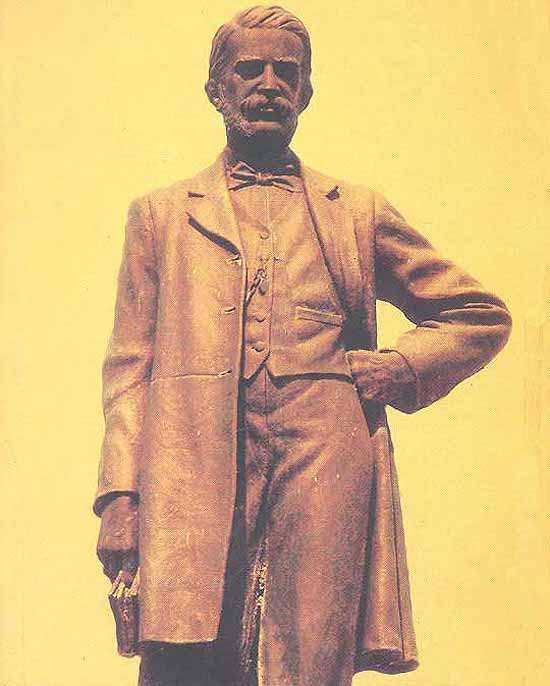
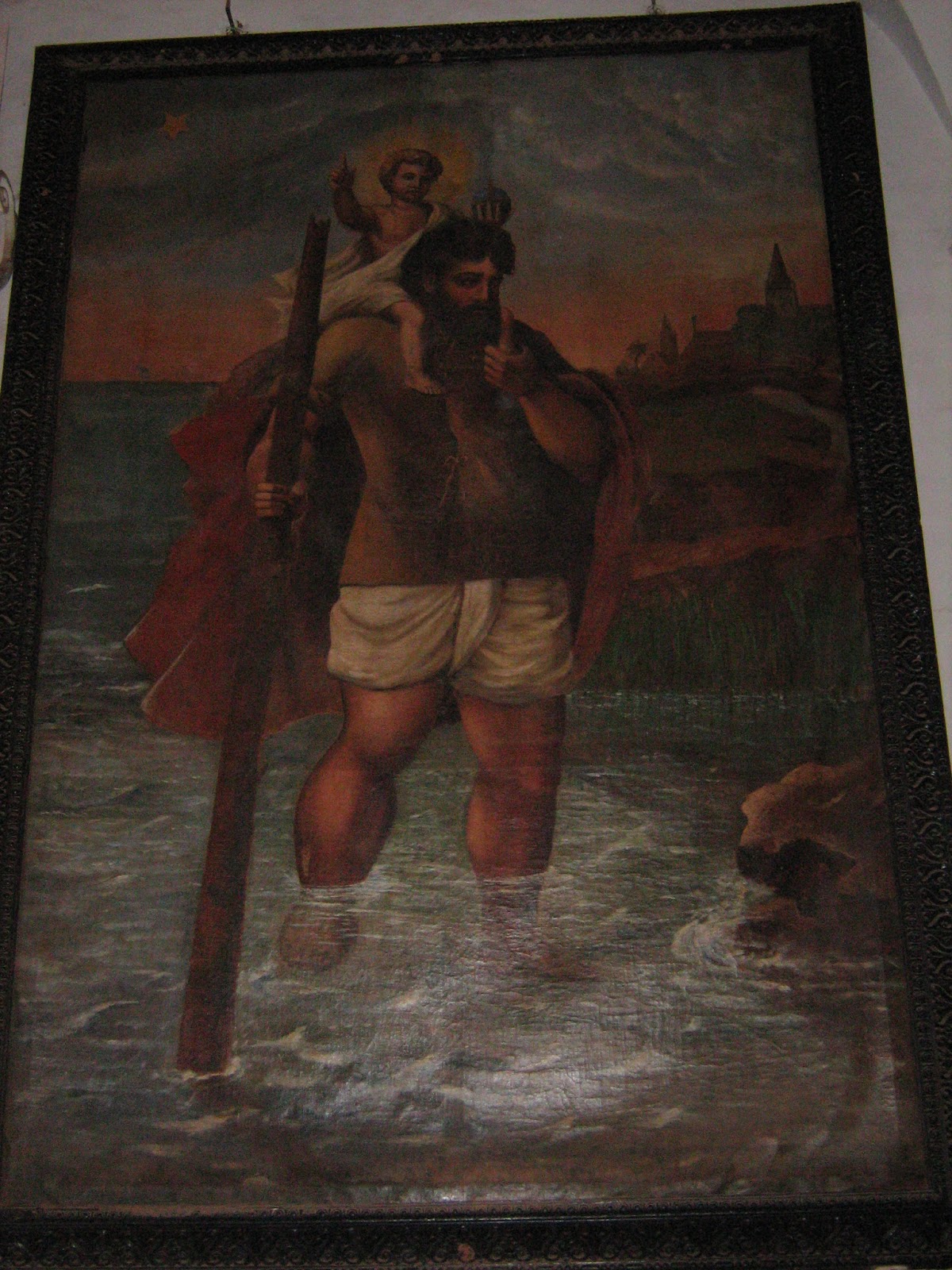
In his essay “The Lusitanian in Hind”
for the magazine Outlook India (2
September, 2013), novelist Aravind Adiga strives to situate the 19th
century Goan writer and politician Francisco Luis Gomes (1829-1869) as an
Indian patriot while decrying how “most Indians [have] not heard about Gomes,”
which to Adiga “speaks more about the narrowness of our present conception of
Indianness [...].” Yet, through his essay, Adiga further perpetuates the very
narrowness he warns against. In trying to resuscitate national and
nationalistic interest in Gomes, Adiga explores the possibility of the Goan
polymath’s canonicity solely within a prescriptive Indianness hemmed in by
Brahmanical, masculinist, Anglo-centric, and ethnocentric preconceptions of
what it means to be Indian. In Adiga’s estimation, Gomes can only be made
legible to the larger Indian imagination if, as a Goan of the Portuguese
colonial era, he can be seen as adequately Indian based on elitist
particularities of caste and other constricted views of proper national and
historical belonging.
In his essay “The Lusitanian in Hind”
for the magazine Outlook India (2
September, 2013), novelist Aravind Adiga strives to situate the 19th
century Goan writer and politician Francisco Luis Gomes (1829-1869) as an
Indian patriot while decrying how “most Indians [have] not heard about Gomes,”
which to Adiga “speaks more about the narrowness of our present conception of
Indianness [...].” Yet, through his essay, Adiga further perpetuates the very
narrowness he warns against. In trying to resuscitate national and
nationalistic interest in Gomes, Adiga explores the possibility of the Goan
polymath’s canonicity solely within a prescriptive Indianness hemmed in by
Brahmanical, masculinist, Anglo-centric, and ethnocentric preconceptions of
what it means to be Indian. In Adiga’s estimation, Gomes can only be made
legible to the larger Indian imagination if, as a Goan of the Portuguese
colonial era, he can be seen as adequately Indian based on elitist
particularities of caste and other constricted views of proper national and
historical belonging.
While Adiga notes how Goa generally
registers in popular Indian thought “as a landscape of fun,” he also pre-empts
any discussion of the history of the region apart from modern India, and the
impact of such historical regionality upon Gomes’ own oeuvre. Instead, when
citing Gomes as having written of himself that he “was born in India, cradle of
poetry, philosophy and history, today its tomb,” Adiga rushes to correlate such
sentiment with Gomes having penned those words in 1861 which, in turn, would
make one suppose “[naturally] enough that [the] author was a Bengali Hindu,
writing either in Calcutta or London.” However, as Adiga interjects, “[Gomes] was
a young Goan Catholic in Lisbon [...].” Clearly, Adiga endeavours to draw
attention to the biases that exist in how perceptions of patriotism connote an
Indianness circumscribed by location, coloniality, and religion. Nonetheless,
rather than striking a contrast for deeper critical reflection on difference,
Adiga’s purpose is to collapse all distinction into nationalist similitude as
if it were “natural.”And what is believed to be natural here is that Goa can be
a known quantity precisely because there allegedly is no difference between it
and British-colonised Hindu Bengal, which at once reveals what the historic,
religious, ethnocentric, and colonial default of the nation is as Adiga
predicates it in this ostensibly neutral reasoning.
 There is no denying that there were
overlaps, and even collusions, between British and Portuguese colonialisms, but
there were also marked differences. Although relegating it to a parenthetical aside,
even Adiga must admit that “[u]nlike Britain, Portugal gave its colonies the right
of representation.” This was an opportunity that was not available to the sub-continental
subjects of the British Crown, not even to Dadabhai Naoroji who even while he may
have been the first Asian in the British Parliament, was able to raise issues
about British India only while representing a constituency in London. In
contradistinction, it was from his position as a representative of Goa in the
Portuguese parliament that Gomes sought to speak about the effects of
colonialism on his Goan homeland and about India. Nowhere is this more apparent
than in his book Os Brahmanes, or The Brahmins, written in Portuguese and
published in Lisbon in 1866, making it one of Goa’s, if not India’s, first
novels. What might Adiga do with other divergences in histories between the
former British and Portuguese Empires in India? Not only was the latter a
longer colonisation, witnessing radically different forms of inclusion and
exclusion of the colonised, it also resulted in the decolonisation of Goa in
1961, much after British-occupied India. His essay can only sidestep the
fraught history of India’s “democracy” in which Goans were not allowed self-determination
despite much evidence of efforts in that vein. This is itself a political
trajectory within which one could arguably place Gomes’ own polemical writing.
There is no denying that there were
overlaps, and even collusions, between British and Portuguese colonialisms, but
there were also marked differences. Although relegating it to a parenthetical aside,
even Adiga must admit that “[u]nlike Britain, Portugal gave its colonies the right
of representation.” This was an opportunity that was not available to the sub-continental
subjects of the British Crown, not even to Dadabhai Naoroji who even while he may
have been the first Asian in the British Parliament, was able to raise issues
about British India only while representing a constituency in London. In
contradistinction, it was from his position as a representative of Goa in the
Portuguese parliament that Gomes sought to speak about the effects of
colonialism on his Goan homeland and about India. Nowhere is this more apparent
than in his book Os Brahmanes, or The Brahmins, written in Portuguese and
published in Lisbon in 1866, making it one of Goa’s, if not India’s, first
novels. What might Adiga do with other divergences in histories between the
former British and Portuguese Empires in India? Not only was the latter a
longer colonisation, witnessing radically different forms of inclusion and
exclusion of the colonised, it also resulted in the decolonisation of Goa in
1961, much after British-occupied India. His essay can only sidestep the
fraught history of India’s “democracy” in which Goans were not allowed self-determination
despite much evidence of efforts in that vein. This is itself a political
trajectory within which one could arguably place Gomes’ own polemical writing.
In his haste to employ a
one-nationalism-fits-all approach, Adiga’s lauding of Gomes as a forgotten
patriot occurs, furthermore, along the lines of an unquestioning maintenance of
religious and other supremacies as the default of proper Indianness. One way the
article effects this is by privileging narratives of upper caste loss. For
instance, Adiga posits the notion that it was “[t]he brutal start of Portuguese
rule in Goa in 1510” which caused Saraswat Brahmins “to flee their homeland in
order to protect their faith [...].” This according to him was a “boon for
modern India,” as the Saraswats “fertilis[ed] commerce and culture everywhere
they went.”
 Yes, under the leadership of Afonso de
Albuquerque, there was much bloodshed of the residents of the city of Goa by
the Portuguese in the early sixteenth century; strikingly, many of these
victims were the soldiers of Adil Shah who, like the Bijapuri ruler of the
city, happened to be Muslim. Albuquerque is in fact said to have declared that Muslims
were enemies and the “gentiles” friends, which is not surprising given that he
was aided in his conquest by the army of Saraswat chieftain Mhal Pai, after
being invited by Timayya, agent of Vijayanagara, to capture the city in the
first place. These allies buttressed the more preponderant contestation between
the Portuguese and the ‘Moors’ for trading rights and privileges in the Indian
Ocean. Some Brahmins did flee, as did members of other caste and religious
groups who do not factor into Adiga’s retelling; consequently, their
contribution to India is forgotten rather than celebrated as a “boon.” It must
be pointed out that some Brahmins and others even opted to convert to Christianity. As recent research has shown, not all conversions were forced,
but were calculated decisions taken by members of various groups. Moreover, in
the last few years, scholars like Pankaj Mishra and Goa’s Victor Ferrão have
questioned the idea that Hindus, as they are known today as a faith group,
pre-existed the orientalist efforts of colonisers to classify, and lump
together, discrete religious sects into one category. In addition, Adiga does
not reckon with how members of the upper caste echelon who lived on in Goa
sought to preserve their authority within the machinations of colonialism. As
in other parts of India, Goa too bore witness to the collaboration between
colonisers and higher caste groups in order to strengthen domination based on
existing hierarchies.
Yes, under the leadership of Afonso de
Albuquerque, there was much bloodshed of the residents of the city of Goa by
the Portuguese in the early sixteenth century; strikingly, many of these
victims were the soldiers of Adil Shah who, like the Bijapuri ruler of the
city, happened to be Muslim. Albuquerque is in fact said to have declared that Muslims
were enemies and the “gentiles” friends, which is not surprising given that he
was aided in his conquest by the army of Saraswat chieftain Mhal Pai, after
being invited by Timayya, agent of Vijayanagara, to capture the city in the
first place. These allies buttressed the more preponderant contestation between
the Portuguese and the ‘Moors’ for trading rights and privileges in the Indian
Ocean. Some Brahmins did flee, as did members of other caste and religious
groups who do not factor into Adiga’s retelling; consequently, their
contribution to India is forgotten rather than celebrated as a “boon.” It must
be pointed out that some Brahmins and others even opted to convert to Christianity. As recent research has shown, not all conversions were forced,
but were calculated decisions taken by members of various groups. Moreover, in
the last few years, scholars like Pankaj Mishra and Goa’s Victor Ferrão have
questioned the idea that Hindus, as they are known today as a faith group,
pre-existed the orientalist efforts of colonisers to classify, and lump
together, discrete religious sects into one category. In addition, Adiga does
not reckon with how members of the upper caste echelon who lived on in Goa
sought to preserve their authority within the machinations of colonialism. As
in other parts of India, Goa too bore witness to the collaboration between
colonisers and higher caste groups in order to strengthen domination based on
existing hierarchies.
These details fail to appear in
Adiga’s narration because he predominantly restricts his understanding of Goan
history to the mythologies of the Saraswat caste. In so doing, he also misrepresents
the fact that the Saraswat caste was already well established through the
length of the Konkan coast prior to the arrival of the Portuguese. It was this coastal
predominance that allowed the Saraswats to operate as interlocutors for the
Portuguese, as well as to ensure that those Brahmins who chose not to convert
were able to migrate to places where they were not entirely without some social
and cultural capital. The casting of Goa as a Saraswat homeland was a feature
of nineteenth century Goan politics, a politics supported in equal measure by
Catholic as well as Hindu Brahmin elites as they both sought to jockey for
greater power. For the latter group, in particular, their power struggle was to
secure a regional fiefdom in Goa against the supremacy of the Marathi-speaking
Brahmin groups in Bombay city.
As Adiga repeatedly points out,
despite the privileges accorded to some natives in the Portuguese colony, even
elite Goans found themselves “doomed to a second-class existence.” Of Gomes’
own trial by fire at the onset of his time in the Portuguese parliament, Adiga
states that the Goan politician “heard another member demand that the
government rescind the right given to colonial savages to sit in a civilised
parliament.” This caused Gomes to wax eloquently about the civility of Indic
cultures in educating his parliamentary counterparts, a group Adiga refers to
as “the carnivorous Europeans.” What is the purpose of such an authorial
statement other than to ascribe some notion of purity to one group over another
along the lines of casteist exclusion? While it serves to characterise
Europeans as uncouth because of their presumed dietary habits, it can only do
so by participating in the logics of defilement used against the many marginalised
peoples in India and, perhaps, meat-eating Goan Catholics, a group that Gomes
himself belonged to. Though that irony seems to escape Adiga, it nevertheless
continues to establish a sense of Indianness in the article that strongly veers
toward Brahmanical Hindu nationalism.
The bent of such nationalism is made
even more explicit when Adiga likens Gomes to Vivekananda. The essay purports
that the two had similar visions of emancipation: “Vivekananda saw education
and the renaissance of Hinduism as the answer. Gomes, who believed Hinduism was
spent, pointed to education and Christianity.” As one might expect of a novel titled Os Brahmanes, the book – like
Gomes’ own politics and thinking – is not without orientalist or elitist
notions. Albeit, in describing some of Gomes’ narrative as being “Orientalist
escapism,” Adiga spotlights the novelist’s indignation at the inherent
contradictions of European colonialism. The essay quotes Gomes’ novel as
declaring that if “the law of Christ governs European civilisation [...] [i]t
is a lie – Europe tramples upon Asia and America, and all trample upon poor
Africa – the Black races of Africa are the pariahs of the Brahmans of Europe
and America.” Idealism, no doubt, but it is in this regard for the oppressed
beyond the confines of nation and religion that one can locate the conspicuous
distinctions between Gomes and Vivekananda.

In “Dharma for the State?” - an
article that also appeared in Outlook
India (21 January, 2013) - writer Jyotirmaya Sharma begins by underscoring
the “one phrase [...] that effortlessly invokes the name and memory of
Ramakrishna,” who was Vivekananda’s mentor: “Ramakrishna’s catholicity.” The
article, which is an excerpt from Sharma’s book Cosmic Love and Human Apathy: Swami Vivekananda’s Restatement of
Religion (HarperCollins 2013), charges that “Vivekananda, more than anyone
else, helped construct [...] this carefully edited, censored and wilfully
misleading version of his master’s ‘catholicity’.” Like Gomes, Vivekananda travelled
beyond his homeland in the 19th century. Sharma records how “[i]n
1896, Vivekananda gave two lectures in America and England on Ramakrishna.”
Studying these lectures, Sharma finds “that they are placed entirely in the
context of the glorious spiritual traditions of India as contrasted with the
materialism of the West.” While on the one hand a decided subversion of the
universality espoused by Ramakrishna, the essentialism Sharma infers from
Vivekananda’s lectures may also be seen in Adiga’s aforementioned pronouncement
of an East-West dichotomy founded upon casteist notions of restrictive purity.
Of the lectures, Sharma goes on to
mention that “[t]here are frequent references to Hinduism’s capacity to
withstand external shocks, including the coming of materialism in the guise of
the West and the flashing of the Islamic sword. Despite all this, the national
ideals remained intact because they were Hindu ideals.” What should be
perceived here, then, is not only the conflation of nationalism with Hinduism,
but also the theorising of the religious state as needing to be masculinist in
order to withstand purported threat. Accordingly, it is not only Vivekananda
that Adiga troublingly aligns Gomes with, but also “Tilak and Gokhale” as if
the only way to understand the Goan’s place in the Indian context is by placing
him firmly within the male iconicity of nationalism.
 Gomes’s position is much more complex
that the easy binary of bad coloniser versus the suffering colonised that Adiga
seems to have adopted, and it is precisely Gomes’s Christianity that sharply
distinguishes him from the Hindu nationalism of Vivekananda, Tilak, and
Gokhale. As Adiga mentions, Gomes may have worn a dhoti to a reception, and
spoken of the hallowed wisdom of the East, as also of the hypocrisy of Western
civilisation. Even so, this should not be read as representative of Gomes’
overwhelming desire to cast off his European self and wholly embrace Indian
subjectivity. Rather it should be seen as a limited strategy that he, as a
member of the Goan Catholic elite seeking greater autonomy within the
Portuguese empire, was using against recalcitrant Europeans. If there was one
position that the Goan Catholic elite of the 19th century espoused,
it was that they were capable of managing the Estado da Índia Portuguesa without metropolitan oversight because
they were not only heirs of the millenarian Indian civilisation that spun the
Vedas, but were also reprieved by their Christian religion and European
traditions. They were not merely Indians superior to the Europeans; they were
Goans superior to both the Europeans, as well as the subcontinentals because in
either case they had a marker that trumped the other: ancient Indian culture against
the Europeans and Christianity and European culture against the subcontinentals.
Nor was the contest that Gomes was in necessarily a simple case of natives
versus those with foreign blood as Adiga seems to suggest when recounting the
case of Bernado Pires da Silva, who in 1835 was “[t]he first Indian to rule
colonial Goa.” In attempting to craft Goan history within the narrow frames of
nationalist British Indian history, Adiga fails to highlight that the Goan polity
of the time was the scene of a vicious battle for dominance among the local
dominant castes, that included the metropolitan Portuguese, the Luso-descendente
caste, the Catholic Brahmins, the Hindu Brahmins, and the Catholic Chardos
(Kshatriyas), with theatres spread over Goa and the metropole.
Gomes’s position is much more complex
that the easy binary of bad coloniser versus the suffering colonised that Adiga
seems to have adopted, and it is precisely Gomes’s Christianity that sharply
distinguishes him from the Hindu nationalism of Vivekananda, Tilak, and
Gokhale. As Adiga mentions, Gomes may have worn a dhoti to a reception, and
spoken of the hallowed wisdom of the East, as also of the hypocrisy of Western
civilisation. Even so, this should not be read as representative of Gomes’
overwhelming desire to cast off his European self and wholly embrace Indian
subjectivity. Rather it should be seen as a limited strategy that he, as a
member of the Goan Catholic elite seeking greater autonomy within the
Portuguese empire, was using against recalcitrant Europeans. If there was one
position that the Goan Catholic elite of the 19th century espoused,
it was that they were capable of managing the Estado da Índia Portuguesa without metropolitan oversight because
they were not only heirs of the millenarian Indian civilisation that spun the
Vedas, but were also reprieved by their Christian religion and European
traditions. They were not merely Indians superior to the Europeans; they were
Goans superior to both the Europeans, as well as the subcontinentals because in
either case they had a marker that trumped the other: ancient Indian culture against
the Europeans and Christianity and European culture against the subcontinentals.
Nor was the contest that Gomes was in necessarily a simple case of natives
versus those with foreign blood as Adiga seems to suggest when recounting the
case of Bernado Pires da Silva, who in 1835 was “[t]he first Indian to rule
colonial Goa.” In attempting to craft Goan history within the narrow frames of
nationalist British Indian history, Adiga fails to highlight that the Goan polity
of the time was the scene of a vicious battle for dominance among the local
dominant castes, that included the metropolitan Portuguese, the Luso-descendente
caste, the Catholic Brahmins, the Hindu Brahmins, and the Catholic Chardos
(Kshatriyas), with theatres spread over Goa and the metropole.
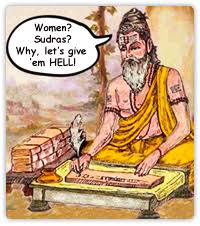
If Adiga really believes in the
project of securing visibility for those marginal regions and personages that
do not figure in usual conceptions of the Indian cultural and political
landscape, this cannot be achieved without accounting for both the peculiarities
of a location apart from the nation-state and the vexed relationship between
the two. It is not colonisation alone that chronicles a history of the marginalisation
of Goans, but also the contemporary postcolonial condition. Adiga asks if Portuguese,
“the language of the Inquisition” can “be called an Indian language” as it was
one of Gomes’ “mother tongues.” One could put this strange question to Sanskrit,
or indeed any language used by rulers anywhere: can the language of the Manu
Smriti, the language that advocated the horrifying oppression of Dalits, be
called an Indian language? By equating Portuguese language and culture with the
Inquisition alone, Adiga negates the formation and endurance of Portuguese
culture in the former colonies. He brushes aside a whole gamut of cultural
innovations by peoples, many of them subaltern, who still cherish their
traditions, even if he does allude to them in passing.
The memory of the Inquisition, as
Adiga posits it, either shames if one is a Catholic, or it hurts if one
professes Hinduism. This essentialist rationale proceeds to permit Catholics to
feel ashamed and Hindus to feel victimised, thereby leading to the
victimisation of their Other. The majoritarian Hindu politics in Goa with all
its trappings of casteist purity has made sure, quite successfully, with the
insensitive misuse of the history of the Inquisition, as well as conversion,
the perpetual marginalised status of the subaltern Goan Catholic, and those
seldom mentioned groups, like Muslims. Correspondingly, language is another
site of contention. Gomes’ other language, as Adiga indicates, was Konkani.
Adiga rightly offers that Konkani is “now Goa’s official language,” and also
that “Catholics, aware that their presence in Goa is diminishing [...], seek to
protect their heritage.” But what Adiga obscures is that the postcolonial state’s official recognition of Konkani is only in the Devanagri, and not the Roman script largely used by Catholics.
For the Goan in Goa and for the
marginalised elsewhere in the country, it is not useful to simply be squeezed
into a preset notion of Indianness, but for that very category to be critiqued
at every turn for its lack of inclusiveness by design.
(This essay was collectively written with R. Benedito Ferrão, DaleLuis Menezes, and Amita Kanekar
It was first published in Outlook India.com on 6 Sept 2013.)
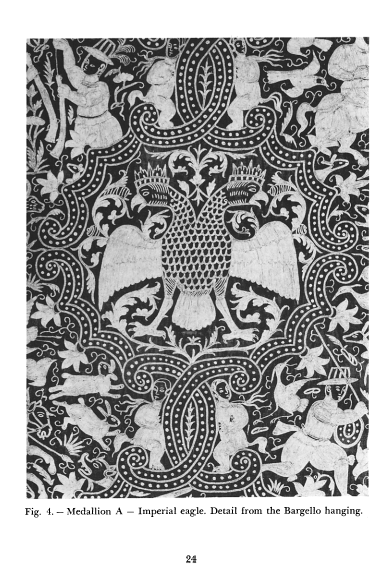 The last couple
of columns of the Itinerant have explored the meaning of the Indo-Portuguese
and the significance of what is held under this term. These columns challenged
the conception that Indo-Portuguese art should be seen as something from the
past with nothing to offer us in the present or the future. On the contrary, a
public collection of the art of the Indo-Portuguese stands to deepen the
aesthetic vocabulary of both artists as well as lay individuals living in the
state. It is this argument that this column will concern itself with.
The last couple
of columns of the Itinerant have explored the meaning of the Indo-Portuguese
and the significance of what is held under this term. These columns challenged
the conception that Indo-Portuguese art should be seen as something from the
past with nothing to offer us in the present or the future. On the contrary, a
public collection of the art of the Indo-Portuguese stands to deepen the
aesthetic vocabulary of both artists as well as lay individuals living in the
state. It is this argument that this column will concern itself with.