Showing posts with label Portuguese India. Show all posts

Monday, October 14, 2019

A Secular Indian's of Christianity in India


The publication of a number of books incorporating “the Idea of India” into their title recent times is indicative that this idea has been in a crisis for a while. Carpenters and Kings is one more response to this crisis of India, dealing with an oft-ignored population group. In an environment where the Hindu Right seeks to suggest the foreignness of Christianity and Islam in India, this book seeks to “set the record straight” and demonstrate that the history of Christianity in India is a nearly two-millennia-long story of great complexity. Divided into three sections that deal with Antiquity, the Medieval period, and finally the colonial, Siddhartha Sarma’s book admirably demonstrates that Christianity was present in India from its very inception.

Sarma writes that Christianity in India predated the conversion of the Syrian Christians who claim to be the first Christians in the subcontinent converted from local groups. Sarma points out that Christianity’s emergence was rather the result of the Gospel taking root among Jewish communities of the western coastal region, who may not have consciously broken from the religion of their ancestors.

The presence of these communities was the result of a network of Greek-speaking traders linking the subcontinent’s maritime commerce with Egypt, Persia, and Rome. Sarma´s book further challenges the popularly-held idea that the Latin Church, or the Church of Rome, was first established in the subcontinent via the Portuguese. Rather, Sarma writes, it was through the efforts of the Franciscan Giovanni of Montecorvino in the late 1200s, who, among other things, established a church at the tomb held to be that of St. Thomas in Mylapore. Sarma uses these facts to affirm that the subcontinent has “never been a land for a single people, or culture or religion” but populated by a diversity of groups, transient and settled, which were always in conversation with one another.

Carpenters and Kings is clearly a political history, locating early Christianity in the subcontinent among political processes, both local and global, be it Greek trade networks, the assertion of the Mongols, the rise of the Arabs, or the expansion of Western Europe. By dealing with the councils of Nicaea, Chalcedon, or the heresy of Manichaeism Sarma demonstrates that to explain contemporary Christianity in India it is necessary to go into the very foundations of the religion, and be familiar with the theological discussions within Christianity across the world. Given his desire to stress the foundational nature of dialogue to the idea of India, in various chapters Sarma stresses intercontinental and intercultural dialogues, pointing, for example in the chapter titled “The Fruits of the Wisdom Tree”, which discusses the legend of the saints Barlaam and Josaphat, to how the subcontinent impressed on Western Christianity.

Sarma is not focused only on how the East influenced the West and Christianity, however. His chapter “The Forge of the World” refers to how Tibetan Buddhism, in particular, seems to have interacted with Christ and Nestorian Christianity. The section that deals with the medieval world references in how the period of the Crusader states in the Middle East saw conversations between Franks and Arabs. All in all, the book is a delightful exercise in comparative history, which Sarma manages in elegant prose.

Nevertheless, the merit of Sarma’s work is compromised by the methodological nationalism that guides it, i.e. reading the existence of a contemporary nation-state back into time. For example, despite acknowledging that the ancients referred to a wide swathe of Asia, and at times even eastern Africa, as India, Sarma persists in referring to the subcontinent as if it were the same as the nation-state established in 1947. This ensures a number of erasures, like that of the contemporary states of Sri Lanka and Nepal which he subsumes into India, as well as the narratives and agency of Christians in India.

Another error flowing from Sarma’s methodological nationalism is the suggestion of the “natural multiculturalism of Indians”, which is not only mistaken, because it presumes the existence of an Indian society as if the polities in the subcontinent were an integrated, unified and relatively homogenous unit, but also a dangerous proposition since it erases the kinds of violence that have been engaged in but subsequent and prior to the founding of the Indian state in 1947.

An acknowledgement of caste, the foremost of these subcontinental violences, is glaringly missing from this reading of subcontinental history. Illustrating this is Sarma’s description of “an old man who had been born a Brahmin and had sailed across both the Arabian Sea and the Bay of Bengal” and then converting to Latin Christianity, leading Sarma to surmise that “apparently, caste restrictions on sea voyages were different in that period, or perhaps more relaxed.” He ignores the possibility that the brahmin converted precisely because he had lost caste. Like Islam in the subcontinent, Christianity has been the refuge of outcastes, and indeed Christians have often been treated as untouchable.

The presumption of an Indian society pre-existing 1947 does not strengthen the idea of India, but is in fact at the root of the contemporary problems that are unfairly laid at the feet of the Hindu Right alone. For example, this presumption of a society ensures that he argues that “the victory of the British over the French and their rapid expansion in India in the late eighteenth and early nineteenth centuries created its own form of disruption, which would have a long-term impact on the Indian society that was emerging in response to modernity”. To look at the British presence and colonialism in India as an disruption of a natural evolution is to go back to the same kinds of hiving that Indian, and Hindu, nationalists engage in, only his are limited to different periods. While Hindu nationalists see the “Muslims”, who Sarma correctly refers to as Turko-Afghans, as foreigners, Sarma accepts them as Indian, but excludes those who arrived in the subcontinent via the European expansion. The burning problem that contemporary Christians in India face is not that their history is improperly told, rather it is that their links with Christianity with the colonial period are seen as problematic. What is required is a history that accepts and naturalizes this, rather than harking back to an earlier, glorious past.

Unfortunately, having spent more time on antique and medieval Christianity, this is precisely what Sarma does not do, and perhaps because of his methodology is unable to do so.  Rather, Sarma engages in the kind of demonization of the Portuguese that is standard fare among nationalist historians of all shades. His description of the Inquisition as motivated by the need for “Faith … to be tested on the rack and by the fire” has all the marks of the dated Protestant and Northern European propaganda against the Iberian empires.

Given that contemporary Christians in India are held responsible for the factual and imagined actions of the Inquisition, this period and the institution deserves a more nuanced treatment, rather than the popular histories from which he has drawn his references. Such treatment drawing from contemporary international scholarship and Dalit histories of the subcontinent would have highlighted that the violence associated with Portuguese presence, inclusive of the Inquisition, was just one more violence in a subcontinent filled with violence, but one that allowed hitherto marginalized castes, both Catholic and otherwise, the options of social mobility.

Contemporary scholarship would have also pointed out that unlike what Sarma avers, it was not the Danish missionary Ziegenbalg who was one of the original Orientalists, but in fact, as Ângela Barreto Xavier and Ines Županov have pointed out in their recent book Catholic Orientalism (2015), it was Catholic missionaries and the Portuguese Estado da India, that laid the ground work for much that was then later appropriated without reference by later orientalists. That the empathy required missionaries to understand local cultures and attempt conversion through dialogue, a strategy attempted even by the Portuguese supported missionaries is not recognised, and that the Portuguese, despite their five-century-long stay in the subcontinent are not seen as belonging speaks of the unfortunate nationalist lens through which Sarma writes his history of Christianity in India.

Sarma’s history also suggests that Indian agitation against proselytizing and conversions were born from Portuguese violence and brutality or proselytism in the shadow of imperial British support. These suggestions, in fact, share much with the assumptions that undergird the ironically named Freedom of Religion legislation, which effectively prohibits conversion to Christianity or Islam. Sensitive histories of India and the British Indian anti-imperial nationalist struggle have already pointed out that, on the contrary, the Hindu sensitivity to conversion resulted from the savarna fear that Hindus would be reduced to a minority, ideally embodied by Gandhi’s opposition to separate elections for Dalits. Like Gandhi, Sarma seems to naturalize caste, suggesting in his brief reference to the Revolt of 1857 that had the British accommodated caste, things may have been resolved more amicably. Fortunately, this observation allows us to perceive that the violence in the subcontinent was the result of caste, rather than solely because of colonial intervention.

Despite its erudition, charming language and noble intentions, Sarma’s work does not eventually respond to the needs of Christians in India, rather it reveals that much of the battle around the idea of India is restricted to ideological battles between savarna Hindus, some who prefer secular nationalism, others who prefer religious nationalism. Both, it turns out, in one way or another minoritize non-Hindus.

Carpenters and Kings: Western Christianity and the India of India, Siddhartha Sarma, Hamish Hamilton.

(A version of this text was first published in Scroll on June 2, 2019.)

Tuesday, October 4, 2016

Portuguese citizenship and the debugging of Indian imaginations


I read with interest the recent opinion piece “The Portuguese nationality bug”  on the vexed issue of the rights of Portuguese Indians to Portuguese citizenship and was disappointed by the author’s refusal to see the larger picture. I suspect that this is because the author seeks to resolve the question within the narrow frames of Indian nationalism. As a result, the argument forwarded in the op-ed seems to buttress the rights of the state over those of citizens. Such legality will only strengthen the growing authoritarianism of the Indian state over subjects who, while formally citizens, increasingly lack the space to realize this condition.

In the opinion piece citizenship is presented as a status that is conferred by a state. This is not only a peculiarly lawyerly perspective but also a dated idea. Unsurprisingly, the argument refers to a judgment of the US Supreme Court from 1875. The wider field of contemporary citizenship theory recognizes that citizenship is more than a status, rather a condition to be realized. In these more recent understandings, as evidenced in the Universal Declaration of Human Rights (1948) for example, rights are not conferred by a state, but inhere in the individual. Even the Indian Constitution recognizes that it is the people who constitute the state as evidenced in the famous lines of the preamble “We the People of India….” Thus, a post-colonial political theory recognizes that states are actually constituted by the people, which formally recognize the rights of people. With the passage of time as our appreciation of the depths of rights grows, states are required to recognize these evolving rights. Indeed, this was very much the case with India as well when from about the 1950s the existing fundamental rights were dramatically expanded through the interpretations offered by the Supreme Court.

Of the many rights that inhere in individuals, surely the right of citizenship is the most fundamental.If there was one single right that the anti-colonial nationalist movements fought for, it was the right of citizenship. As in the case of British India, the initial demand was for the right to imperial citizenship, and it was only because the British, hobbled by a racist imagination, failed to recognize this right, that the Indian nationalists pressed forward for a national citizenship.

Citizenship must necessarily be distinguished from nationality. These are two distinct concepts and must theoretically be kept separate. While citizenship involves a gamut of rights that allow one to be a political subject, nationality is the status of belonging that the nation confers on some individuals, and restricts from others. This is to say, the first deals with rights, while the second is the realm of cultural belonging. One of the reasons why the debate on the Portuguese Indian rights to Portuguese citizenship is so vexed is because the various parties fail to recognize the fundamental differences between these two concepts. This is obvious even in the opinion piece where there is a constant switch between the terms nationality and citizenship as if they were the same.

This failure is not surprising given that the nation-state form that has been taken up across the world purposely seeks to conflate the concept of the state and the nation. The famous philosopher Hannah Arendt refers to this as “the transformation of the state from an instrument of the law into an instrument of the nation”. Taking up this idea, other scholars have pointed out that “It was this conquest that defined citizens of the state as nationals whether defined racially, ethically, culturally or even religiously”. There is, in fact, no good reason for the two concepts to be conflated. A state can compromise multiple nations, while nations need not have a state. Take the case of Belgium, which is composed of people that identify with two different nationalities, the Flemish and the Walloon. Or take India, which can be said to comprise different nationalities, but refuses to recognize, and in principle rightly so, that each of these nations needs its own state. Indeed, the foundation of the contemporary international order as an association of nation-states can be traced back precisely to the racist imaginations of the colonial order. To this extent, the assertions of Portuguese Indians to retaining their Portuguese citizenship while also accepting that of India stands to offer the world a model in terms of post-colonial citizenship precisely because it is born of an early modern experience that differs dramatically from the colonial experience rooted in late-modernity.

What does come out in striking clarity from the argument in the opinion piece referred to above is the legal position of the former citizens of Portuguese India in the Indian republic. In addition to the legal formulation that the argument the op-ed relies on, and the military action of 1961, this population is not a liberated population able to act on equal footing with other individuals from British India, but in fact a subjugated population whose “rights” depend on what the State of India grants them. The noted philosopher Partha Chatterjee has recently articulated a concept of political society that addresses precisely this point. He argues that not all who are formally recognized as citizens enjoy rights. Chatterjee suggests that these people are members not of civil society, but political society. Members of political society do not enjoy rights, which are permanent and inhere in the individual; they are merely extended temporary concessions when these excluded groups challenge the status quo. Once the status quo is secure these concessions can and often are revoked.

Reading the argument in “The Portuguese nationality bug” in the context of this framework, given that the citizenship rights of Portuguese Indians seem to depend on the whims of the Indian state, one can see that what the Portuguese Indians enjoy are not rights that inhere in the individual and are not granted by the state, but merely temporary privileges that can be, and are, rolled back when the State feels like. The privilege of Indian nationality was extended to these groups when the Indian state needed to consolidate its hold over the newly conquered territories creating the mirage of extension of citizenship when in fact the recognition of their pre-existing rights is what would have constituted acceptance into Indian civil society.  It needs to be noted that this is not the position of the Portuguese state that recognizes the continuing rights of citizens in territories over which it formerly claimed sovereignty.

The argument also fails to appreciate the federal nature of the Indian Union, a vision that is embodied in the Constitution. The Indian constitution patently allows for a diversity of legal regimes within the Indian Union. Take, for instance, Art. 370 of the Constitution that allows for Kashmir to have its own constitution. This particular article is the subject of much vituperation but the fact is that such resentment against Art. 370 has been the result of Hindu nationalist opposition. Ironically it is Hindu nationalism which is contrary to the constitutional mandate. Art. 370 must therefore be seen as embodying the basic structure of the Indian constitution that makes space for a federal structure that incorporates widely different polities within a single structure. Consider also the fact that Buddhist monks and nuns in Sikkim get a double vote to ensure the representative of the Sangha in the legislature. This argument for legal pluralism can also be buttressed by reference to the reports on the conclusion of the Indian state’s negotiations with the Naga activists. Though the terms of the agreement are still secret, if a dubious news report is to be believed it appears that the Indian state, under Prime Minister Modi, has agreed to the Naga demand for a separate Constitution, as well as a separate flag. Such an agreement, if true, would testify to the capacity of the Indian Union to accommodate legal difference within a single federal structure.

A resolution of the question of the Portuguese citizenship of denizens of the former Portuguese India could contribute to the failing health of the Indian Union. It would allow an assertion of the dignity of the rights-bearing individual in opposition to asserting the right of a potentially tyrannical Indian state. It would contribute to the constitutional imagination of a federal India, an imagination that has unfortunately been undermined by the desires of Hindu nationalists and successive central governments.

For too long a time the question regarding the legitimacy of Portuguese Indians holding on to both Portuguese and Indian citizenship is being debated in a dry and inspired manner. Given that the question is admittedly complex, the resolution cannot be obtained through a niggardly attention to the letter of the law. Rather, what is required is a reference not merely to the spirit that animates laws, but to the larger questions of postcolonial justice and the rights of individuals, this is to say a reference to political theory and the philosophy of law. What is required is not a debugging of Portuguese nationality, but Indian imaginations.

(A version of this post was first published in the O Heraldo dated 4 Oct 2016)

Monday, February 29, 2016

Let’s Talk About Rights!


Growing up in the 1980s in Goa from time to time I would hear the more vociferous men in my family swear: “These bloody Indians!” Attending school where a steady diet of Indian nationalism was a part of the curriculum, we youngsters would be horrified. Surely, these figures of parental authority couldn’t speak like they did? Besides, weren’t we Indian? It was at this early age that I realised that to be Goan is not the same as being Indian. And it was possible for Goan history to read Indian nationalism differently. I have spent the rest of my life trying to figure the differences out.

A politicised Goan, such as myself, looks on this season, where allegations of being anti-national are being flung like confetti, with some cynicism. Not unlike Muslims in India, Goans, and especially Goan Catholics, have been used to be seen as de-nationalised, if not anti-national, for a while now. This critical evaluation has only heightened since some years when it came to be understood that many Goans have been “giving up” Indian nationality for Portuguese citizenship.

A common misunderstanding of the situation in Goa is that this devolution of the Indian passport has to do with pride in their Portuguese connection, and an application for citizenship. Appreciating the nuances of the situation requires disabusing a number of misunderstandings.

To begin with, it is not merely Goans who are giving up their Indian citizenship, but persons from the larger Portuguese state of India or Estado da Índia (EI), which in 1961 included the territories of Goa, Daman, Diu, and Dadra and Nagar Haveli. These persons are able to acquire Portuguese citizenship not because of any continental ancestry, but because of a legal history that differs significantly from that of British India. Where residents of British India were merely subjects of the British Crown and never citizens, native Christian residents of Portuguese India were almost from the very beginning of the presence of the EI in the early 1500s, seen as equal subjects of the crown. With the inauguration of the Portuguese constitutional monarchy in the mid-1800s, citizenship of all subjects was formally recognised, and subsequently deepened when the Portuguese Republic was declared in 1910. As citizens of Portugal a restricted electorate of persons from Goa were able to elect persons to represent their interest in the Portuguese Parliament in Lisbon. This marked a significant distinction from the situation in British India where natives had no Parliamentary presence, and even Dadabhai Naoroji, the first Indian in the British parliament, was elected by Britishers to represent an English constituency.

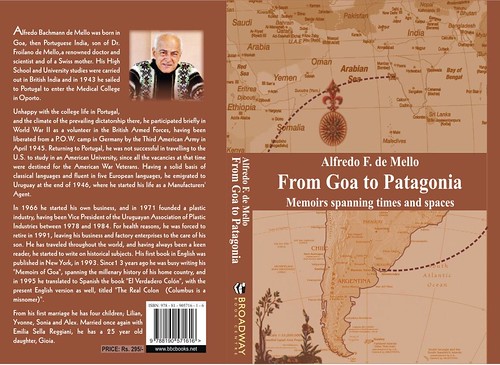
Indeed, so dramatically different was the situation in British India from that which obtained in Portuguese India that Goans were often able to assert themselves against the British. Take, for example, this anecdote from the city of Bangalore in the year 1940. In his memoirs, From Goa to Patagonia: Memoirs spanning times and spaces (2006: 146), Alfredo de Mello recounts his altercation with a Revered Xavier who had recently joined the staff of the famous Bishop Cotton’s school:
 
“One evening, while the Cotton's Cadets were drilling in the field with their 1914 vintage rifles and polished bots, Rev. Xavier and I were watching them and he remarked; ‘How come you are not marching with them?’, and I replied: ‘I am a foreigner, Sir, belonging to a neutral country’, and Rev. Xavier, in a tone that dripped with contempt, retorted: ‘Why don't you become a British subject? Don't you know that we are the salt of the earth?’

Trying to control my nerves and smarting under such a presumption, I said, ‘I am a Portuguese citizen, Sir, and not a subject like yourself. Furthermore …[e]very dog has its day. Portugal had its glorious quarter of an hour in History, as a world power, in the sixteenth century, and yours is about to end’.”

The situation where former citizens of the EI can continue to claim Portuguese citizenship is the result of the unorthodox manner in which Goa was integrated into India. Portugal was governed by an authoritarian regime from the mid-1930s until 1975 that refused to countenance the idea of Goa’s independence or integration into India, until India did so by force in 1961. When India annexed these territories in 1961 it failed to recognise that the residents were in fact Portuguese citizens and unilaterally extended Indian citizenship to them. Indian control over the territories that constituted the EI was not recognised by Portugal until the regime fell in 1975. At this point, the Portugal recognised the ancient constitutional rights of the residents of the now lost territories. Thus, when residents of the former EI renounce their Indian passport, they are not applying for Portuguese citizenship; merely asserting their pre-existing right to Portuguese citizenship. 

The recovery of this right lay somewhat dormant from 1975 until recently. It was with Portugal joining the European Union that a Portuguese passport gained a completely new significance. If there are so many persons queuing up to assert their right to a Portuguese passport, it thus has less to do with Portuguese nationalism, though this cannot be discounted in some cases, and more to do with making an economic choice.

The assertion of this right by citizens of the former EI has upset nationalists both in Portugal and in India. Some Portuguese nationalists desire that this right be curtailed or withdrawn entirely. Portuguese citizenship, they argue, should be given only to those who speak the Portuguese language, know something of Portuguese history, and have a love for Portugal. Like most nationalistic assertions often tend to be, these too are offensive. Citizenship is not a gift given for good behaviour, it is a fundamental right, and such rights are sacrosanct. They cannot be withdrawn on the basis of some petty excuse. Further, one could argue that the retention of the right to Portuguese citizenship is a part of post-colonial justice.


Most Indian nationalists are similarly unable to recognise the fact that the actions under discussion are the result of a law and a right. This should give some idea of how the operation of Indian nationalism has dulled Indian appreciation for law and rights. Indian nationalism crafts the recovery of this right as a treacherous betrayal of the motherland refusing to recognise that given the absence of a legally existing state of India before 1947, residents of Portuguese India in fact had Portugal as a legal motherland. As is often the case, Indian nationalism also comes with its communal twist. Even though the persons renouncing Indian citizenship belong to the various faiths that constituted the Portuguese empire, it is largely Catholics who are charged as anti-national for giving up Indian citizenship.

To the question what do citizens of the former EI think of nationalism, the response would be why should they think of nationalism? They are thinking of their economic futures, and asserting their rights, and this is far more important than any nationalism.


(A version of the post was first published in the Indian Express  on 28 Feb 2016)