Much opinion has already been generated of Tarun Tejpal’s alleged attempt to rape his junior colleague, and no doubt much more will be written. In addition to these diverse positions, it appears that it may be possible to also use this incident to gauge the nature of the Indian nation-state and its relationship with the peoples and territories that constitute its national peripheries.
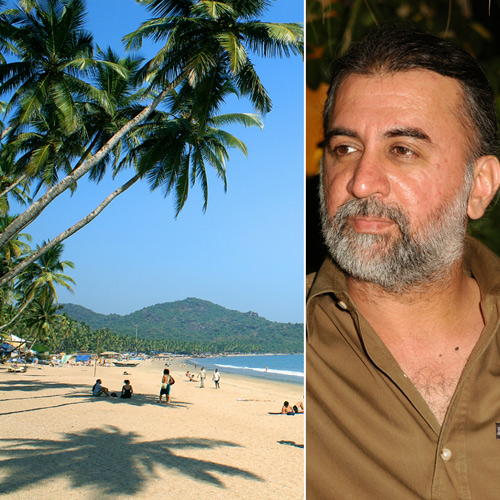 This gauging can begin
from what many commentators have dismissed as a “passing” statement from Tejpal
himself. In 2011, on the eve of ThinkFest’s first edition, Tejpal had suggested
to early birds at the event's plush venue: "Now you are in Goa, drink as
much as you want, eat... sleep with whoever you think of, but get ready to
arrive early at the event as we have a packed house."
This gauging can begin
from what many commentators have dismissed as a “passing” statement from Tejpal
himself. In 2011, on the eve of ThinkFest’s first edition, Tejpal had suggested
to early birds at the event's plush venue: "Now you are in Goa, drink as
much as you want, eat... sleep with whoever you think of, but get ready to
arrive early at the event as we have a packed house."
Then, as much as today,
the intense responses to this statement from Goans were seen by Indian
commentators as akin to making a mountain of a mole hill. To these media pundits
Tejpal’s statement was merely an off-the-cuff remark that should not be taken
too seriously. Indeed, some have gone as far as to say that it should still
not be taken too seriously, and in any case does not compare in severity with
the crime that Tejpal has been accused of.
This article does not
attempt to equate these two incidents involving Tejpal, but it would like to
suggest that the relationship between them is much deeper than these national commentators
would allow for.
To begin with, the very
fact that there is a disagreement over how to view this statement suggests the
widely divergent perspectives of Goans and the Indian elites who frame national
news. This dismissal of the Goan response also manifests another way in which
‘mainstream’ India sees Goans as simple, emotional and not given to balanced
thought. Further, it demonstrates how local contexts are not given enough
importance in the mainstream’s
evaluation of things.
 This occlusion is typical
of the way in which Indian secular nationalism has been argued to operate.
Secular nationalism has consistently sought to look at issues from a
purportedly objective position. However, this position is marked by the
privileged perspective and interests of a nationalist elite that is largely
North Indian, upper-caste, Hindu and male. It is the common-sense of this group
that largely determines what matters in the republic and what doesn't.
Perspectives from the margins, whether it is the south of the country,
non-upper caste, non-Hindu, female, or, simply, positions that do not fit into
the national imagination of what is appropriately Indian, are routinely
ignored. Thus, if Goan anger in 2011 was overlooked, it was because these commentators
also view Goa as a place of fun and frolic, much like Tejpal.
This occlusion is typical
of the way in which Indian secular nationalism has been argued to operate.
Secular nationalism has consistently sought to look at issues from a
purportedly objective position. However, this position is marked by the
privileged perspective and interests of a nationalist elite that is largely
North Indian, upper-caste, Hindu and male. It is the common-sense of this group
that largely determines what matters in the republic and what doesn't.
Perspectives from the margins, whether it is the south of the country,
non-upper caste, non-Hindu, female, or, simply, positions that do not fit into
the national imagination of what is appropriately Indian, are routinely
ignored. Thus, if Goan anger in 2011 was overlooked, it was because these commentators
also view Goa as a place of fun and frolic, much like Tejpal.
If there was a reason why
many Goans reacted at all it is because of the systemic manner in which their
state has been treated as a pleasure periphery of the nation. California-based
scholar Raghuraman Trichur has proposed that it is through tourism, rather than
politics, that Goa has been incorporated into the Indian imagination. This small state on the
country's Western coast is
indeed seen as part of its pleasure periphery , India’s very own piece of
locally available Europe.
The
roots of this image of Goa can
be traced back to colonial times. One of the primary sentiments motivating the British
Indian native elites’ demand for freedom was their failure to upgrade their
status from imperial subjects to that of imperial citizens. The latter would
have allowed them parity with the metropolitan British not only in British
India, but across the breadth of the Empire where Indians were a critical part
of the imperial machinery. At the root of their freedom struggle, therefore,
was the pique at not being considered equal to whites.
Procuring Goa subsequent
to Indian independence, and framing it as a piece of Europe, provided added
consolation. This was where British Indians could enjoy the privileges of
Europe as first class citizens and masters. The
active participation of the Goan state and the tourism industry only aided in
cementing this notion.
In the process, Goa has frequently been the subject of marketing campaigns suggesting it is on holiday 365 days a year, promising nothing short of surf,
sand, and sex.
In many ways Tejpal’s
personal association with Goa demonstrates all that is wrong with India's
relationship with this state.

Tejpal's 2011 statement
clearly demonstrates what he thought of Goa: a place where rules don't matter
and one can behave as one wishes. It would not be amiss to suggest that there
is a hint of that infamous American idiom, “What happens in Vegas stays in
Vegas”. People who live in Goa will testify that all too often, the behaviour
of tourists adheres to a similar belief. However,
it is evident from the explosion of responses to the charge against Tejpal that
this is not always true, that what happens in Goa, does not always stay in Goa.
And as if to prove he is not an exception but
the rule, no sooner did the International Film Festival of India (IFFI) begin
in Goa shortly after ThinkFest, that a festival official was charged with
sexual harassment.
In this particular incident, the official was accused by a female subordinate
of suggesting that they could have drinks and then engage in “all other things
(aur sab kuch)”. Where Indian culture is actively defined as a non-alcoholic
one, arrival in Goa, with its more balanced response to the public and
convivial consumption of alcohol, is seen as opening the doors for licence and
licentiousness.
Another way in which
Tejpal typifies the national elite’s colonial relationship with Goa is his
ownership of a property in the village of Moira.
Those familiar with the
Indian upper-middle classes will know that a second home in Goa is de rigueur. Ideally, it must be a
building that goes under the erroneous name of a “Portuguese house”. That these
properties are unlike anything in Portugal is hardly the point. Calling them
Portuguese homes denies a unique Goan identity, and allows the Indian elites to
produce the myth that they are in an Indian piece of Europe.
 One way in which
colonialism operates is to deny the local identity and assert only the
national, while simultaneously exploiting the local for the benefits that it
offers the colons. Possession of such
homes mirrors the holiday-making of contemporary Northern Europeans, but also
of English grandees from the nineteenth century. These grandees would own
properties in southern Europe, host their friends , and use these locations to
engage in romantic interludes and sexual practices that would have invited
disapproval in their own countries.
One way in which
colonialism operates is to deny the local identity and assert only the
national, while simultaneously exploiting the local for the benefits that it
offers the colons. Possession of such
homes mirrors the holiday-making of contemporary Northern Europeans, but also
of English grandees from the nineteenth century. These grandees would own
properties in southern Europe, host their friends , and use these locations to
engage in romantic interludes and sexual practices that would have invited
disapproval in their own countries.
Tejpal’s house in Goa
fits neatly into this model, given that it is also rented out as a Portuguese
villa when the Tejpals are away. It is not ironic that while this property is
marketed as one offering a taste of the openness that marks Goan society, locals have criticised the Tejpals
for erecting a 2-metre high boundary wall.
Once again, Tejpal's is
not the only infraction; numerous similar properties violate the regulation
capping the height of a boundary wall at 1.5 metres. What is striking is his
response to a public statement that challenged
his purported disregard of building regulations. After dismissing all
the allegations as false, in a tone reminiscent of the white man’s burden,
Tejpal suggested he was doing Goa a favour since “the house we bought was an old ruin
in an inner village”.
The final nail in the
coffin is how another one of Tejpal’s babies, ThinkFest, engages with Goa. This
year, a number of local activists protested the event, drawing attention to
the fact that the venue violated CRZ regulations, and that the event was
supported by corporations that not only made their profits from mining but were
known to have perpetrated significant human rights violations against indigenous
groups that opposed them.

More horrifying are
suggestions that the Tehelka editors procured financial support for ThinkFest
by suppressing investigative reports on mining scams in Goa that would have
implicated government officials. Most disturbing is that even as ThinkFest is
held in Goa amidst dubious circumstances, it hardly engages with the locals.
The passes for the event are priced beyond the reach of average middle class
Goans, let alone those of lesser economic means. Once again, Goa is merely a
location to be exploited for its
scenic beauty, another spot that marks the exotic social calendar of the
jet-set.
Debates in social media
have charged that this focus on Goa as a space is meant to effectively turn the
focus away from women and the alleged crime. A riposte to this would be to
point out that rape, in addition to being about the violation of women’s
bodies, is also about relations of power.
To limit the discussion
that flows from Tejpal’s alleged actions to rape and women alone is to fall
back into the trap of thinking along the agendas set by the national elite. As
pointed out above, this is an elite that would prefer that we forget the
particular and focus on apparently universal categories.
Looking at gender between
the binaries of male and female alone is the very strategy through which the
secular-liberal discourse ensures that the specificities of caste are
forgotten, such that the rape of Dalit women and men by upper caste groups are
often neatly left outside of national debates.
Focusing on location, as
this article has attempted to do, seeks to situate the various kinds of locales
within which women (and men) may be placed in a position where they are unable
to refuse the sexual advances of those above them in social-political
hierarchies. For example, does reducing the question in the present debate to
just the aggrieved woman alone not deem irrelevant the harassment that all
women in Goa, whether local or visiting, must face as a result of its
construction as a lotus-eater’s paradise?
A focus on locale also
allows us to see why certain kinds of behaviour are made to seem more
acceptable in some locations, like hotels or tourist destinations, and not
others. It could be argued then, that the scene for
the crime that Tejpal has allegedly committed was set on the day his statement
– which painted Goa as a place for sexual excess – was condoned by the national
press.
 Furthermore, Tejpal’s
initial response to the charge, where he smugly cast on himself the role of
judge, can be read as an extension of the egotistical way in which the elite
see themselves as entitled to bend regulations to their own advantage. The
licence to bend rules seems to operate especially when these elites can justify
their overall interventions in society as being in the public or national
interest.
Furthermore, Tejpal’s
initial response to the charge, where he smugly cast on himself the role of
judge, can be read as an extension of the egotistical way in which the elite
see themselves as entitled to bend regulations to their own advantage. The
licence to bend rules seems to operate especially when these elites can justify
their overall interventions in society as being in the public or national
interest.
(A version of this post was first published online at DNAIndia.com on 4 Dec 2013)


