Showing posts with label Goa University. Show all posts

Saturday, October 19, 2013

The Itinerant: They Do It Differently


In 1953 L. P. Hartley began his novel The Go-Between with the words, “The past is a foreign country: they do things differently there.” But it isn’t just the past that is a foreign country; the lifestyles of one’s next door neighbour may be so radically different as to ensure that every visit is a journey into the foreign.  There was occasion for just such a voyage of discovery while attending the lectures offered by ShubhaMudgal at the Goa University some weeks ago.

Trained in the Hindustani style of music Mudgal has also successfully ventured into what could be called pop demonstrating in this process a certain amount of fluidity. If this fluidity and willingness to engage with different concepts marked her lectures at the Goa University, it was the radical absence of these virtues that seemed to mark a good number of those who were casually attending the lectures. The questions posed to Mudgal demonstrated that some enthusiasts of Hindustani music are trapped within inter-twined layers of nationalism, racism, mysticism, and the anxieties that these produce. Take for example a question which inquired if Mudgal thought that persons from India or an Indian background were more adept than foreigners who might learn Hindustani music. Located at the core of this question was a belief that Indians are genetically equipped with the capacities to learn, appreciate and perform Hindustani music. To her credit Mudgal indicated her discomfort with such a suggestion, indicating that if a South-Asian was able to outperform someone from another continent, it was because the South Asian born and raised in the subcontinent had the added advantage of being introduced to the cultural codes within which cultural forms like Hindustani music are made sense of it. These skills had nothing to do with race.
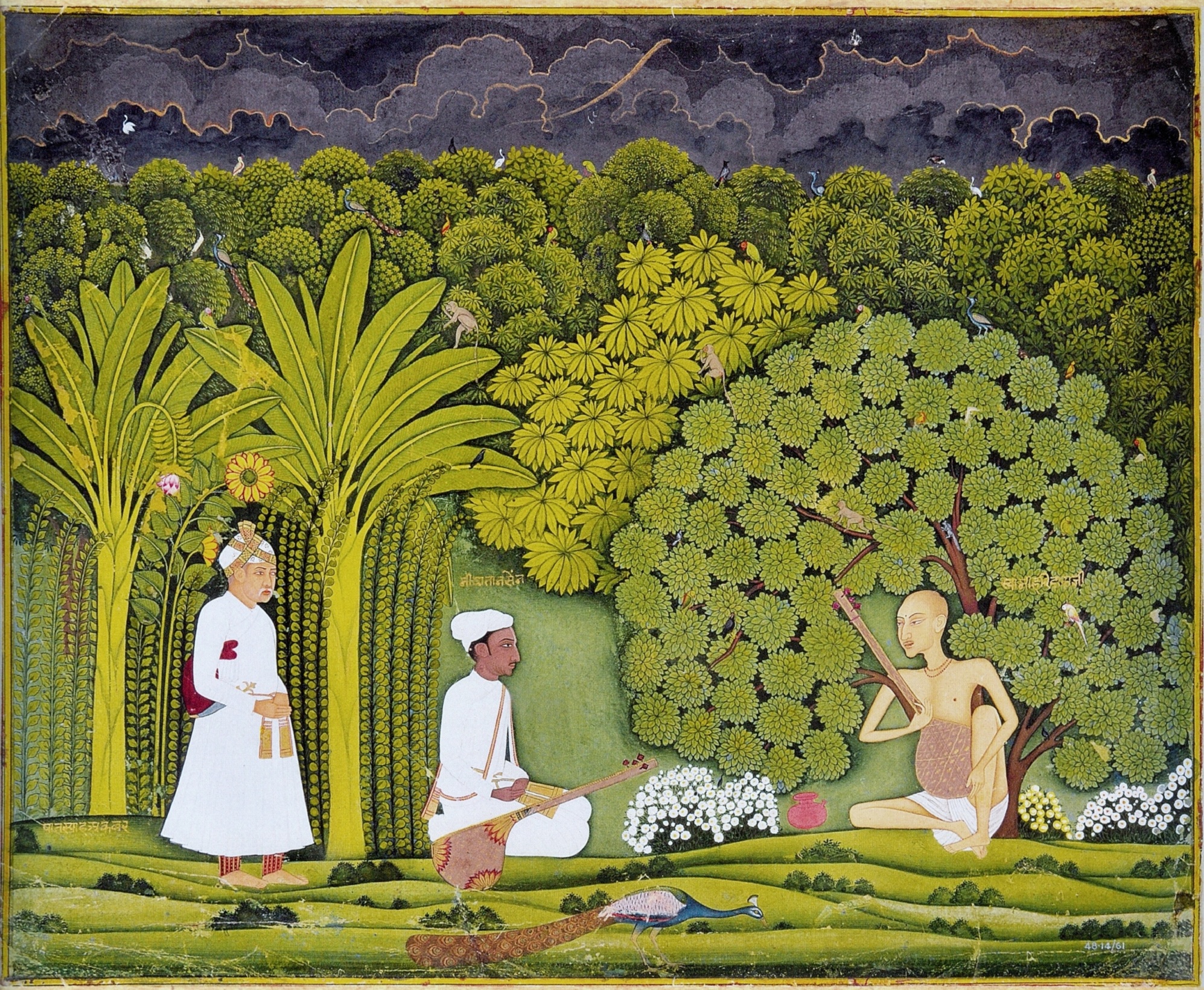
Another innocent question from the audience was the predictable one: “we have heard that spiritually powerful were able to make it rain when they sang the Malhar. Why is it that we do not see such occurrences today? Is it because we are of a lesser spiritual stature than those from the past?” The question revealed the extent to which some regard Hindustani classical music as closely twined with magic. The debate that Mudgal initiated attempted to explain to the audience that these images of persons like Miyan Tansen causing it to rain were really metaphors that should not be taken literally. The discussion suggested that raag system of music existed within a larger cultural universe that determined when they were to be sung and when not to. Within this universe the forms of praise were often exaggerated, leading us, who live in another time, to take these literally.

A more bothersome question was the typically Indian nationalist one which lamented that the audience for Hindustani music was depleting especially among the youth. Mudgal initiated a discussion that was able to give an uncommon response suggesting that Hindustani music had always been music that was restricted to an elite segment of Indian society. A good amount of the oeuvre of Hindustani music emerged from out of the patronage of the Islamicate courts of the northern part of the subcontinent. If anything, this discussion suggested that through the influence of nationalism and the democratising impacts of music companies, the market for Hindustani music had in fact been expanded. What could be added to this discussion is that if Hindustani music is restricted, then it is probably because of the restrictions that Indian nationalism and the restrictions of the caste system impose on it. The votaries of Hindustani music often display a certain snobbery, as was demonstrated by the persons who posed the questions in the course of Mudgal’s lectures. They see Hindustani music as one that had to be fixed within certain ways of singing, ways of dressing, devoid of change, tied to Hinduism and its spiritual practices. These fixities are intimately tied to the upper-caste locations of these individuals; and caste based skills, as we know, are necessarily restrictive and exclusive. Within such a self-imposed restrictive environment that is further limited by a belief in racism and magic, it is natural that the perception that Hindustani music is dying would emerge.

 (A version of this post was first published in The Goan on 19 Oct 2013)

Wednesday, April 29, 2009

Picketing the Revolution: 'Their' Revolution, Our Democracy and a Fascist Imagination

Portugal’s Carnation Revolution was a significant moment in global history because it marked the simultaneous liberation of both colonizers and colonized from dictatorial power. With the fall of the Salazarist regime, the Portuguese people were able to move into a system of democratic governance. At the same time the African colonies of Portugal saw a halt to the Portuguese colonial wars and were born into independent sovereign existence. For India the fall of the Salazarist regime saw Portugal recognize India’s claims over Goa. There is very little to protest therefore, at least from an Indian nationalist and standard anti-colonialist point of view.

It was for these reasons that the presence of a screaming mob from the Hindu Janajagruthi Samiti outside the Instituto Camoes in Panjim was something of a mystery to those attending the celebrations on the twenty-fourth.

To unravel this mystery we need to refer to the news report by the Navhind Times dated the twenty-fifth of April. The report indicates that earlier in the day a bunch of ‘freedom fighters’ led by Naguesh Karmali had approached the Vice-Chancellor of the Goa University demanding to know why the University was involved in the celebrations. These freedom fighters argued that “celebration of the national events of Portugal in Goa [are] an insult to the sentiments of freedom fighters as well as people…who fought for the Liberation of Goa from colonial rule”. To suggest why even the commemoration of an anti-colonial moment in Portugal’s history could nevertheless be odious to the Goan people, Karmali indicated that “those persons, who were active part of Portuguese dictatorship under Salazar regime, became integral part of democratic governance in that country after 1974 by sidelining the Communist, whose role in the Portuguese Revolution was undisputed”.

Karmali has never been known for logic, and this time his logic is just plain bizarre! It is clear that all he is trying to do is demonize Portugal and the Portuguese people. In the eyes of Karmali, the eyes through which he would like all Goans to see history and Portugal, the Portuguese are irredeemable. They are, forever evil, and we should sever all ties with Portugal. Karmali would be least concerned with the Portuguese however, if it were not for people in Goa who wish to continue having links with the Portuguese. It is these people that irk him the most, and it is really the links of these people with Portugal that he would like sever. “[V]arious activities previously held in Goa and linked to the erstwhile Portuguese rule as well as culture of that country, have a certain community as their focus, and are aimed toward creating a divide in Goan society”.

It sounds as if Karmali is suggesting, though admittedly not openly saying so, that it is the Goan Catholics that harbour a fondness for the Portuguese. Thankfully, we know this suggestion to be factually incorrect. A good number of the students at the Instituto bear such surnames as Tari, Chari, Khaunte, Bhobhe, Kamat, Pai, Vernekar, Amonkar, Naik. The students at the Instituto increasingly come from a variety of social and religious backgrounds making Karmali’s statements meaningless. As such we should study Karmali’s statements not for the community he means, but for the community he seeks to create, and the company he keeps.

Interestingly at the demonstration on the evening of the twenty-fourth, Karmali himself was not present. This seems to correspond to a larger pattern emerging in India, where the violent positions are by and large taken by lower-caste groups belong to such outfits as the Bajrang Dal, Shri Ram Sene, Hindu Janajagruthi Samithi, while the BJP, largely composed of upper-castes and the anglicized, toes the moderate line and makes soft, polite noises of disapproval. Nevertheless we should see both groups as acting in concert, playing that age-old game of ‘Good Cop – Bad Cop’. When the BJP is seen as the only group that can control these louts, it makes sense to the average citizen, to elect the BJP so that these elements are kept in place.

The demonstration outside the Instituto should be seen not as a peaceful demonstration but an active attempt to intimidate, both Goan citizens of India, as well as the Portuguese institutions in Goa. Cultural aspects apart, the systematic picketing and threatening of Portuguese related cultural events in Goa, should and must be seen as an attempt to hound the Portuguese institutions out of Goa.

If this is the intention, what possibly motivates this action?

On the cultural front, we do not have to fear that the Goan Catholic culture will die if we loose a link with Portugal. Large portions of the Goan Catholic have also had a robust relationship with British-India and the English-language cultures. These cultures, as well as the Konkani cultures of the Goan Catholic are throbbing with life; destruction of a Portuguese link would be a setback, but it will not destroy them.

The attempt of Karmali and gang is culturally much more serious than hitting out at the Goan Catholic. It attempts to create a collective forgetting of the Goan past. This forgetting will impact not just Catholics, but Hindus and Muslims as well, and their relations with each other. A good portion of the Goan past, its relation with the subcontinent, and the world, a full four hundred and fifty years of it, including commentaries on the past before this, is documented in Portuguese. Block the renewed cultural relations with Portugal and the Portuguese language and you will ensure the death of that heritage, and memory of those histories in Goa. Once that history is effectively unavailable, you open the doors for the rewriting of Goan history, to fill it with the poppycock that the Hindu Right excels at.

We already have a good amount of popular commentary, spinning myths and tales about the Goan past, passing off as history. The roots of this scenario could, I believe, be traced to the drought that hit Goa subsequent to Liberation and until diplomatic relations between Portugal and India were resumed after the April Revolution. During this time, access to Portugal was limited to a select few alone. When facts are unavailable, fantasy floods in. With the resuming of relations, access to Portuguese culture has become much more democratic, and it is this liberation from restrictions that bothers the Rightist groups in Goa. The more people can access information independently, the less they need mediators. It is this democracy that the Karmali and gang fear desperately, and it our imagination of the past, and our options for the future that they seek to control.

It’s funny, but celebrating their revolution, seems to have helped us flush out the fascists in our midst. 25 de Abril Sempre! (April 25 Forever).

(Published in the Gomantak Times 28 April 2009)