It seems almost lost in the mists of time now. That time when the idea of Goa Dourada, a Goa that was Lusitanian, or Portuguese, needed to be fought with another idea. The idea that eventually emerged to contest that of Goa Dourada was that of Goa Indica; the Goa that was Indian. If one idea pointed to a Lusitanian inspiration for Goa, the other pointed more properly to a brahmanical inspiration for Goa. The support for Goa Indica was found in geographical contiguity, in Puranic legend and sundry other clues.
Now this Indic connection for Goa was not unwarranted. There was a need to overact the rhetoric overdrive of the Estado Novo,and Goa Indica played its role in this ideological battle. The question remains however, if Goa Indica managed to capture the entire essence of Goa, or was it another incomplete cliché that needs to necessarily give way to another? Where would this new cliché come from if at all? Thankfully, Mother India in her variety provides the answer to that question. In the early 1980’s a group of scholars who had suckled right at the brahmanical breast of the Mother emerged with an interesting intellectual agenda. Styling themselves the Subaltern Studies Group, this group of scholars argued that there was much in the history of the subcontinent, and the manner in which we thought about it that had to change. We had to move away from the understanding of history as the progress led by great men, to a history that features the non-elite groups, the subaltern, as agents of social and political change. This focus on the hitherto small people of history, was matched by the independent growth in the Dalit movement in India. As a result, we can today actively think of crafting a history of India based on Dalit and subaltern experiences and push back brahmanical histories from the centre-stage it has occupied till date.
One of the many problems with Goa Indica is that when it thought of the pre-Portuguese past, it thought of Goa as a brahmanical centre. The history of this pre-Portuguese past was the history of the great men and groups in the brahmanical tradition. There was, and is, no space for the non-brahmanical groups in the imagination of a pre-Portuguese Goa. Having said this though, it must be pointed out that Goa Dourada, at least when used within the Goan context, was a reference to the self-image and perceptions of the Lusitanianised brahmanical and elite groups. Between the two cliches, you have the nationalist, and imperialist imaginations of the elite and the brahmanical. If one has to redress this understanding of Goa then, at the same time not fall into Lusitanian moulds for Goa, where should we go? Where do we find the trope that will allow us to place at the centre, the experiences and histories of the Goan subaltern?
Happily it appears that we may not have to go too far. Perhaps the answer was sitting before our very noses all the time and thanks to our elitist obsessions we just didn’t recognize it!
The eating of pork is essential to any Catholic feast or festive occasion, and many assume that the consumption of pork was something that was ‘imposed’ and introduced to the ancestors of today’s Catholics by the Portuguese and the accompanying missionaries. What if however, this was not quite the story? What if pork was already a part of the Goan diet before the Portuguese came in? Would that possibly change the way in which we look at the constituents of Goan Catholic culture?
It is possible, and no doubt documented, that the missionaries urged pork on to the populace that converted to Catholicism way back in the 1500’s. However, to assume that this was the first time the converts to Catholicism had ever consumed pork is to assume that the entire population that converted was possessed of brahmanical sensibilities. If one looks around, at social groups in the rest of Mother India, one realizes that there is a good portion of the non-brahmanical population of the sub-continent that quite enjoys eating pork. We can also safely assume that these groups were insulated from the rigors of that famed beast, the Holy Inquisition in Goa, and that their pork-consumption is not a savory leftover from their missionary-scarred past. The consumption of pork then, it turns out, is not in fact some Portuguese introduction to Goan cuisine, but in fact foundationally (pre-Portuguese) Goan!
A significant social scientist in Goa, was recently contemplating the fact that the social groups, at least in Catholic Bardez, who were professional cooks were groups that in other parts of India were seen an untouchable. What caused then, this scholar wondered, for the missionary priests, to attach cooking as the traditional occupation of this group on their conversion to Christianity? If one realizes that these groups were in any case consuming Pork, and that the missionaries came from Europe with a taste for porcine flesh, then voila! One sees a natural partnership being produced!This association begins to make more sense when one realizes that the first Christians in Goa, were not members of the Brahmanical castes, but in fact the non-brahmanical castes, no doubt eager to get away from the stuffy sensibilities of the brahmanical groups. The fact is that only after the enactment of penal legislations did segments of the brahmanical groups convert to Christianity.
Realizing that the consumption of pork was a part of the pre-Portuguese culture of Goa pushes us to realize that there is much that we assume to be Portuguese impacts on Goan culture that are in fact remnants from the elusive pre-Portuguese past. To be sure there was some amount of colonial influence in the manner in which pork consumption spread. But for that matter, most of the constituents of sub-continental cuisine, are the result of the intervention of the Portuguese. It was because of the colonial transportation of American spices that we have the Indian cuisine that we are familiar with today.
In sum then, while the idea of Goa Indica was relevant and helpful, it is time we started relooking the clichés we use to describe Goa. Looking at the practices of the non-brahmanical groups in Goa, would perhaps give us another interesting angle to enter the Goan experience.
(First published in the Gomantak Times 25 August 2010)
This column is often-times critiqued on the basis that it offers too complex a fund of words for the average Goan to understand. ‘Simplify!’ is the advice offered in the course of such handing out of critique. I am however, not convinced as to the intellectual inabilities of the ‘average Goan’, who is in any case a much sinned against creature. If on the one hand the Chief Minister of the State perpetrates his shenanigans in the name of this beast, then on the other you have kindly Samaritans requesting their intellectual burdens placed on this animal to be lightened. What is however most amusing, is that the Samaritan purveyors of this advice, invariably indicate that they themselves are perfectly comfortable reading what this column hands out. It is not for themselves that they request simplification, but for the ‘simple-minded’ ‘average’ Goan reader.
But given that this charge has been laid, one must, dutifully and conscientiously seek to respond. In the course of a public meeting the term fascism was used numerous times by the respected Konkani activist Eric Ozario. He was using the term to refer to the claims of the Nagari activists, who sought to unite all Konkani speaking people under the slogan of “One language, one script, one people”. Such a slogan he argued, was fascist!
What is fascism however? And how does one understand it? Eric Ozario used the term in the context of the totalitarian imagery of the Nagari activists. Totalitarianism may have been a feature of the fascist leaderships of Europe between the Wars, but this term does not exhaust the meaning of concept of fascism. In the context of the attack of the Hindu Janajagruthi Samiti (HJS) on the Xavier Centre for Historical Research (XCHR) a couple of weeks ago, dwelling on the articulation of the meaning of fascism by Walter Benjamin was, I thought, a suitable choice for this week’s column.
Benjamin argues that “Fascism attempts to organize the newly created proletarian masses without affecting the property structure which the masses strive to eliminate. Fascism sees its salvation in giving these masses not their right, but instead a chance to express themselves. The masses have a right to change property relations; fascism seeks to give them expression while preserving property. The logical result of fascism is the introduction of aesthetics into political life”.
Benjamin locates fascism in the history of capitalism that converted peasants who were rooted to their land, into workers for industries. With their traditional life-style changed, and deprived of their property in land, the peasant became the proletarian worker. While the human being is not necessarily inclined to absolute equality, radical inequality, such as was present in the industrial towns of Europe, and indeed in India today, is offensive to the human being. This is especially true, when these proletarian workers continued to hold not-so-distant memories of their more secure past. Once we understand the weight of the term proletarian, the force of Benjamin’s elaboration of fascism strikes home. Fascism seeks to organize the proletarian masses, and provide stability to the new (capitalist) order that has been formed. Fascism definitely speaks to the hungry, angry and deprived masses and in doing so effectively manages them. But it does so, not by recognizing their right to change property relations. On the contrary it distracts them from the demand of this right by providing them with an aesthetic that they are told gives expression to their inner being.
Is the membership of the HJS composed essentially, or even largely, of proletarians in the classical sense? Of this I am neither sure nor certain. However, if one has a look at the website of the HJS, and has a look at the string of protests that they have been involved in, you begin to see that their attack is on the aesthetic. There have been attacks on Dr. Jose Pereira, Dr. Subodh Kerkar, and support for the hounding of M. F. Hussain. All of these three dared to depict India and Hinduism in a manner that they disapprove of. The HJS has disapproved of the popular celebrations of Ganesh Chathurti on the basis that it is not sattvic or pure enough. Similarly their website, presents ‘sattvic’ interpretations of the Hindu pantheon that they approve of as valid.
This obsession with the aesthetic I believe tells us something about the HJS and the manner in which they must be dealt with. It would be possible, even to be sympathetic to them. Sympathetic, because you realize that the support they get, is because the passion which fuels their membership is drawn from the upset with the nature of property relations, both in Goa and India. If a segment of the Goan Catholic protests real-estate development, a segment of the Goan Hindu joins the HJS. Both are protesting property relations, but doing so via the aesthetic.
A focus on the aesthetic, also indicates to us why the HJS must be effectively dealt with, and their victims supported and protected The Goa Police has thus far instructed HJS victims to follow the HJS line and take down the ‘offensive’ artworks. To keep doing this will be to suffocate entirely, creative production in the State, and destroy any meaningful understanding of the Freedom of Speech and Expression. Bear in mind that control over the aesthetic is what the HJS seems to be gunning for. And because the aesthetic itself is not what bothers them, but property relations, the attack of the aesthetic will continue, till property relations are eventually addressed. But this too, as we can clearly see, will not be done.
This then is what the fascist turn in Goan society will look like. An obsession with the aesthetic, even while unjust and inequitable property relations are not addressed. Unless this inequity is dealt with, this tendency towards the fascist will continue. And while banning the HJS may seem desirable, it will not work, until the equity issues underneath it all are effectively addressed.
(First published in the Gomantak Times 18 Aug 2010)
The insight that this encounter presents to us is about the nature and character of Indian secularism, and the actions necessary to sustain it against the onslaught of groups such as the HJS. My problem with the practice of Indian secularism, has largely been that it is an invitation to become more Hindu. The crossovers from Islam, Jainism, Sikhism and Christianity to (upper-caste) Hinduism are more welcome than crossovers from Hinduism to any of these faiths, especially those faiths like Islam and Christianity. In fact, such crossovers are increasingly prosecuted by law and administration. Thus when I saw Dr. Pereira’s exhibition ‘Epiphanies of the Hindu Gods’ introduced as ‘a tribute to his Hindu ancestry’, I was somewhat displeased. To hark to your Hindu ancestry means a couple of things to me. It indicates that your present identity as Christian and Catholic, and the approximately 400 years of cultural experience as Catholic do not seem to count toward your being an Indian. To be authentically Indian, you need to dabble in imagined pasts that then come to you, quite literally as epiphanies. The second problem is that not all of us can claim Hindu pasts. Some of us (in Goa) came from African, Arabian, tribal and Muslim ancestry. When you celebrate your Hindu ancestry, drawing on the cultural capital of ‘Indian culture’ where does that leave us?
Subsequent to the incident with the HJS, I realized an error in my understanding of what it means to dabble in Hinduism, while being Catholic. It seems that Prof. Pereira does not enter the realms of Hinduism as an interloper. He enters Hinduism as a claimant of his patrimony. Catholicism may be his faith, but Hinduism is also, in his eyes, the faith of his fathers. Within the norms of patriarchy then, he has a right to the interpretations that he makes. But Prof. Pereira does not make his interpretations solely on the basis of his patrimonial right. When the HJS came to demand the removal of the art-works of Prof. Pereira they argued that he had misrepresented the facts of the myths of these deities. To this challenge, Prof. Periera leaned back, closed his eyes, and then recited, in the original Sanskrit, the verses from the Geeta Govinda that had inspired him. In doing so Prof. Pereira indicated his dominion over the faith of his fathers, as opposed to the ignorance of the HJS band. Indeed, so flummoxed were they in the face of this learning that the spokesperson admitted that “she was not a learned person”.
Dr. Pereira may be an extraordinary scholar, but his experience with, and claim on Hinduism is definitely not singular. Subsequent to this incident, a certain Catholic gentleman asserted his own claim to Hinduism. In an email broadcast this gentleman indicated that:
“The HJS, Sanatan etc must understand that we Goans are Christians …but first Hindu with a strong Hindu base….we shall not tolerate third rate outside(rs) …to dictate terms to us about our ancestral beliefs”.
He elaborated this by indicating that he had “always countered our 'settler' Hindus in Sontosgao that if at all they worship the Rawalnathkul deo at Vodlo bhat it is because it is the kul deo of our Sontosgao…ancestors who later chose to be converted to Christianity. …As (a) bonafide Sontosgaocar (I) have all the claim to the Rawalnath kul deo as it is my kul deo of my ancestors”. This argument he informed us had “been well taken by our Sontosgao settlers (who) respect this claim”. (Sontosgao is a fictional name inserted to protect the identity of this person).
The crossover to Hinduism then, is not always a crossover that necessarily results in rootlessness. On the contrary, roots in dominant caste groups are presented that allow for the assertion of patrimonial rights over Hinduism. At other times, one’s mere location in a socially and economically dominant position allowed one to gain claims on Hinduism. The mother of a friend once recounted how in earlier days, her father (a Muslim landlord) who loaned his grounds for the local Ram Lila, would be made the honorary President of the Ram Lila Committee.Today, with the displacement of both the Muslim and the landlord, such a scenario is unthinkable. To a large extent, this has been the basis of Indian secularism at the grass-roots of this country. To be sure this sort of secularism is not available to those outside of the dominant castes of the region, and while this is problematic, we need to recognize the value of this upper-caste discourse in creating secular frames that allow for the maintenance of communal harmony. In fact, this is the basis of Goa’s famed communal harmony, not some natural, genetic goodness that flows in Goan veins.
It is for this reason that the HJS pretensions are doubly troubling. The HJS histrionics do not appear to be about genuine “hurt feelings”.On the contrary, as in the Subodh Kerkar episode, it appears about seeking to establish HJS as the gatekeeper of contemporary Hinduism. (And yet, what kind of canonically illiterate gatekeepers are these?). Similar gate-keepers have attacked M. F. Hussain, trying to demarcate who is Hindu and who not, and who will decide (HJS and its ilk) and who not. This particular encounter displayed to me, that the result what the HJS and its friends are doing, is to end entirely the crossovers and experiences of non-Hindus with Hinduism. If you are a ‘Pereira’, you are assumed to have malice, and lack of knowledge. You are either Hindu, or you are not. The current practice of Indian secularism may not be ideal, but we have to acknowledge that it allows a certain bonding that creates the possibility of a tolerant atmosphere. The HJS and its ilk do not appear to be interested in such a scenario of tolerance. The involvement of their group members in the Margao blasts where they deliberately tried to incite violence is more evidence of their intentions. They are seeking to draw sharp lines, and then provoke violence, which they hope, owing to larger number the Hindus will triumph.
They will succeed if they manage to become representatives for Hinduism, which judging by the consistent actions of the police who acquiesce to their demands, they are becoming. It is for this reason, that the crossover to Hinduism is important. And it is for this reason, that the average Goan Hindu, must necessarily stand up and say loudly and clearly, “No! You do not speak for me!”
* Gãocars are male members of the dominant castes of villages, given an elite status. Literally translated, they are the Gão (village) makers (kar from the root kor to make)
** Goemcarponn - translates to Goan-ness.
(First published in the Gomantak Times, 4 Aug 2010)
On the 20th of July 2010, Roshni Rego, hurrying across the railway crossing at Comba in Margao, was hit by an oncoming train, dragged by the engine, and subsequently died from this encounter. Roshni was a student in Grade XII and the horrific manner of her death has quite naturally shocked the State.
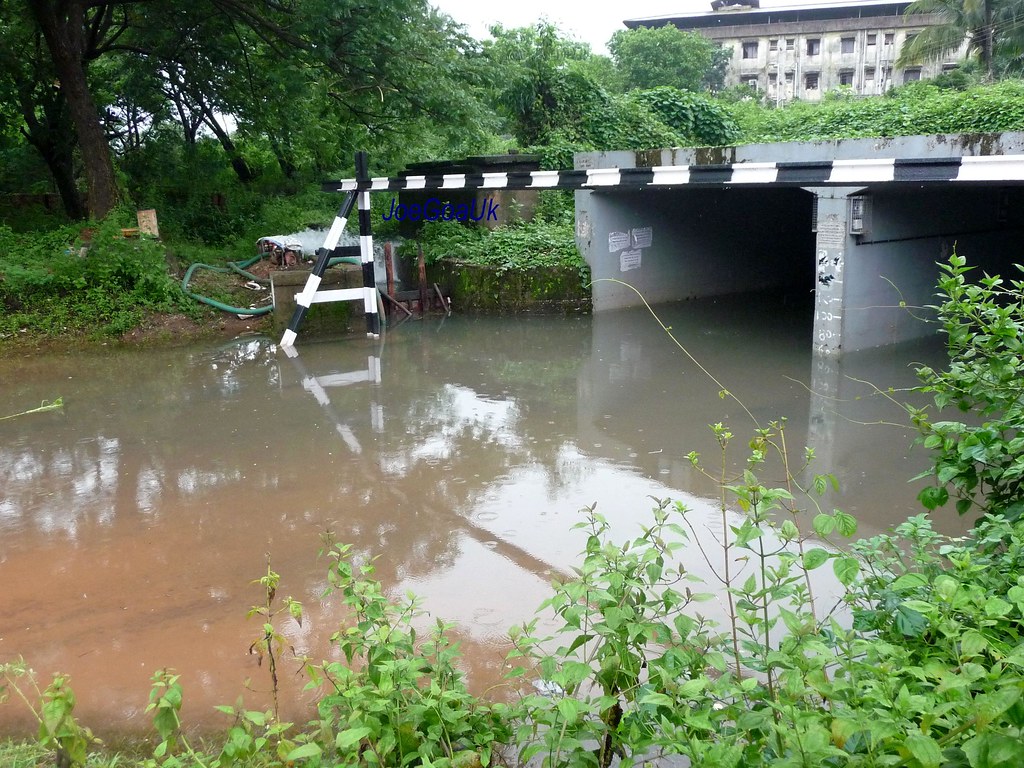
In the aftermath, there have been a number of voices raised in protest. Given the feeling of a lack of misgovernance in the State, the Chief Minister Digambar Kamat, and his political establishment has emerged as one of the top favourites in the list of thoseresponsible for this tragedy. There are however, other claimants for this role. There is the fact that the subway that should have been used by the rickshaw that normally dropped Roshni to school was flooded by rainwater. A case of bad and negligent design. There is the fact that the rickshaw driver ought to have dropped his load of school children directly at the school, and not left them to their own devices. There is the fact that the railway crossing across which Roshni ran was not manned and ought to have been.
A question that appears to have not been asked is; why was Roshni running across the railway tracks in the first place? Why not wait, peaceably, for the train to pass, and then casually walk to school? The answer, as per some of the newspaper reports, indicate that Roshni was in a hurry to get to school on time. A case of an unusually diligent and conscientious student? I think not.
I am unaware of the disciplinary practices that are favoured at the DamodarScienceHigherSecondary School, and the practices of this particular school are not the target of this column. Rather, it is the disciplinary practices of schools across the State in particular, and India in general that I would like to focus on. I recollect the days when I was a student of a school in Panjim town. The school had a peculiar practice for those students who arrived at school once the morning assembly was over. They were made to kneel down for a period of time. And if these late comings were repeated, they were then sent to detention, after school.
This particular practice never made sense to me. Let us ignore the fact that one is humiliating a child for a fact that may be beyond his or her control. As children, we are dropped to school, by our parents, by hired drivers, or we come to school by public transport. Most of these situations are beyond the control of the student. In which case, why punish the child? Perhaps a word with the parents, where we try to understand the reason for this delay?
The method of punishment that this particular school, that I use as example, adopted was particularly amusing and indicative of what exactly was going on. Granted that the student was late. But if punctuality to ensure that one does not miss the precious drops of wisdom that are being dispensed in the classroom is the point, why hold the child back longer? The point perhaps is that disciplinary practices in school are not about gaining knowledge, but about training students for life once they leave school. Just as a dog is trained with some harsh treatment as a puppy, we train children for life in general while at school. It becomes necessary then, to run schools as if they were military camps, where we churn out robots for the market.
The suicide of a student in Calcutta, after she was caned by her teacher, had segments of the country up in arms about corporal punishment in schools. I would argue that we need to go a step further and add a ban on humiliation to that list. We would also need to rethink our policies on students who arrive late to school. While there is a point to be made that students should be encouraged to arrive in time to school, surely there is no point in punishing students for things they have no control over? Especially when they are reliant on adults; especially when a parent racing through traffic to reach their child to school on time is courting disaster?
Tragedies are always a time when one reflects on the past that brought us to the present condition. While offering a prayer for the soul of Roshni, perhaps we could also ensure a dialogue that prevents schools from being the reasons for the death of innocents?
(First published in the Gomantak Times, 28 July 2010)
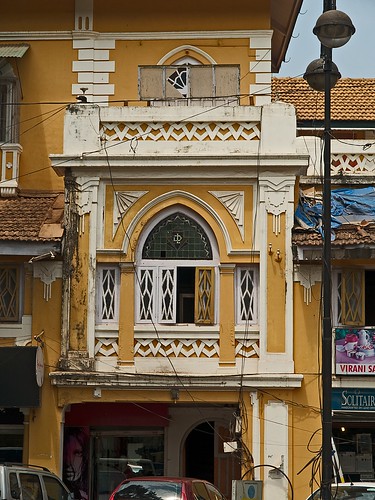
The first case struck me a couple of years ago as I was crossing the footbridge over the Patto creek toward the Rua do Ourem. Somewhere toward the left of my field of vision I caught sight of this multistoried building that looked like it had been built in the mid-1900s. I was convinced though, that that building had not existed a couple of years ago. On closer inspection it turned out that I was right. The building, an extension to the Panjim Inn, on one of the edges of Fontainhas, was in fact a new construction. The façade of this building had been constructed to be in harmony with the general style of the buildings in Fontainhas. The building, which is a ground-plus-two structure, soars above the buildings around it, and yet for reasons of maintaining the line of the street façade, and articulating its height within the architectural idiom of the neighbourhood suggests to the viewer that it has always been there.
A similar experiment, with not as spectacular results has been tried by the hotel Salida del Sol in Panjim. The Salida del Sol occupies a building whose earlier façade had nothing to recommend it. It was in fact quite like the rest of the offensive post-80’s concrete structures that have come up in Panjim and other parts of the State. In the course of the conversion of the building to the Salida de Sol, a newer façade has been pasted onto the building; giving it something of a European, if also kitsch, feel. While the Salida attempt may not be entirely aesthetically pleasing, it seems to have definitely been an attempt in the right direction.
In earlier columns I have argued that the opposition to ‘development’ that one sees in Goa, is to a large extent based on aesthetic considerations. Address these aesthetic concerns and one would see a substantial reduction in opposition to ‘developmental’ projects in the State. Thus you could still have multistoried apartment blocks rising if they attempted to articulate themselves within the architectural forms of the State. It is not as if these architectural forms have not been explored. In the Patto development there are a number of buildings that try to elaborate this aesthetic. One would be the proposed building for the Central Library. The main roof of the building that alludes to the sloping roofs of the West Coast is a joy to behold. Similarly articulated is the building in Patto that hosts a branch of the State Bank. In Porvorim, on the road to Mapusa, is another building, hosting the offices of DeltaPeninsula, which by playing with its façade has managed an interesting conversation with the larger body of Goan architecture. Similarly the South Goa district headquarters, that are still in construction, at the entrance to Margão town, promises to be an interesting addition to the body of contemporary architecture that manages a conversation with Goan building traditions.
Highlighting these constructions would beg the question of what exactly constitutes Goan architecture. This is no easy matter to get into, let alone discuss within the brief confines of a newspaper column. However by returning to the two examples that were cited earlier in this column we can make a brief start. This architecture is influenced to a large degree by European (more properly classical) traditions. (Upto this point the Salida experiment gets it right). However this European influence is not simply a cut-and-paste job. It meets existing west coast architectural traditions and is articulated within this idiom. Take for example the beautiful examples of modernist Art-deco architecture in Panjim that are articulated within the traditional format of the Goan architecture.
What is called for then, is a certain amount of creativity and sensitivity to the surrounding built-forms when building newer buildings. In the case of both the Panjim Inn extension and the Salida del Sol, it can be safely argued that heritage has augmented earnings rather than depleted possibilities. Rather than tear down the facades of earlier buildings, could it not be possible to maintain the street-side façade, and incorporate the shell of the older building into the new construction? This has been done with great success in other parts of the world.
How does one encourage the conservation of existing built forms while allowing for continued developmental work (that in any case seems unstoppable)? One way to do this would be to award those entrepreneurs, like the owners of Panjim Inn, who either put up new buildings that actively engage with Goa’s built heritage, or make additions to existing heritage structures while enhancing the value of the older structure. Could we, with heritage groups taking an active position, contemplate a biannual competition, with a substantial cash award to the architects and entrepreneurs who erect such buildings? A competition judged by critical design and architectural experts, with a substantial cash award would possibly be a useful strategy in the cause of heritage conservation in Goa. It would remind us that heritage is not static moment that prevents future development but a dynamic force in conversation with the past. It would encourage innovation, and by awarding such excellence, allow for such innovations to be replicated, and the design logic internalized by others. Such a competition and award would send a signal to such persons as the owners of the Panjm Inn, to the owners of the Salida del Sol, DeltaPeninsula and others, that their efforts have been noticed and appreciated, and encourage others to follow.
(First published in the Gomantak Times, 21 July 2010)
To a small but vocal minority in Goa, Goa’s Portuguese heritage is something to be castigated and cast into the dust-bin of history. To this shortsighted group Portuguese evokes only the continental European country that speaks the language, and they fail to see the linkages that Goa has had, and can continue to have via this language, with a larger Portuguese speaking world that extends across the world.
On the 12th of this month, the Xavier Centre’s History Hour played host to Constantino Xavier who made an argument along similar lines. Constantino Xavier is currently a Fulbright-sponsored Ph.D. candidate in South Asian Studies at the School of Advanced International Studies, Johns Hopkins University, in Washington DC and someone with a number of very interesting things to say. At the History Hour, his argument was that as India opens out to the world, there is space to carve out what he calls ‘diplomatic niches’ outside of New Delhi. Goa, he argued, can play a crucial role in facilitating India's burgeoning economic, political and cultural relations with the Community of Portuguese-speaking countries (CPLP) and the lusophone world. In line with Beijing's efforts to leverage Macau's potential, New Delhi could develop Goa into a strategic hub to foster relations with the emerging "Global South" and, in particular, with Brazil, Portugal, Angola, Mozambique, Macau, or East Timor. It need not be pointed out that Brazil and Angola are significant economic players in the emerging southern economies.
This column has on numerous occasions berated the point that economic capital is not the only capital that one has; rather one should also be alive to the cultural capital that we hold. For the Goan, this cultural capital of global worth includes the Portuguese language. Thanks to the machinations of this tiny group however, we are prevented from using or expanding on this capital.
A greater familiarity with Portuguese and the Portuguese-speaking world holds over benefits as well. This includes expanding our intellectual horizons. It was while reading Opus Dei, a book by John L. Allen Jr. about the Catholic organization of the same name that the truth struck home. Many of the prejudices and opinions that we often have of the world, are those moulded by the prejudices and opinions of the English-speaking world. Thanks to unfamiliarity with other dominant world languages, our opinions, perspectives, and options are in many ways restricted. Goa’s linguistic diversity ought to have been a route for us to introduce the larger Indian civil society space with different ideas from the larger Portuguese-speaking world. Happily, this route is not yet not closed to us.
An example of the manner in which familiarity with this non-English speaking world is useful was brought out by a recent essay by Vinod Vyasulu in the Economic and Political Weekly. Vyasulu who is the Director for the Centre of Budget and Policy Studies in Bangalore, has written a rather interesting essay on Brazil’s cash transfer systems that are a part of their strategy to reduce poverty and income inequality. Apparently the way the system works is that “Since poverty is lack of income, the federal government of Brazil transfers cash to families in poverty to help them meet basic needs, if the family agrees to send children to school and to get them vaccinated.” Similarly as part of the cash transfer system the “Fome Zero, or zero hunger” strategy has introduced the bolsa familia. The Bolsa Familia apparently is a family grant which is a direct income transfer to benefit families earning a monthly income of not more than Brazilian Real (R$) 120 per member per month in any municipality in Brazil. “The objective is to enable the poorest families to buy food and essentials and at the same time encourage these families to access health, education, and social welfare public services.”
Vyasulu reports that the cash transfer system has been largely successful in Brazil and “have not only served to reduce poverty, they have also contributed to a reduction in inequality”. He goes further to suggest that Brazil’s experience shows that when implemented properly, cash transfers, “are at best a necessary condition for poverty alleviation.” Vyasulu is clearly indicating that it would be worthwhile for India to follow a similar route.
It was not however merely this reference to the cash transfer system that caught my attention but the quotation extracted below;
“Inter-governmental Relations… is an area where India has a lot to learn from Brazil. In the 2009 elections to Parliament in India, many of the candidates seeking election to the Lok Sabha, fought on issues of garbage clearance, water supply and the like. These are municipal issues. The job of MPs is to legislate; this was one thing they were silent about. Members of the state assemblies also talk of transfers and local matters, when their job is to make policies for the state. Thus local representatives are denied their space; local government in India is a sham. And unless local government – which we denigrate by calling self-government – works, such policies which require higher level guidance and local integration cannot work. Many studies have shown that integration of programmes at the local level is the missing link in India’s development policy. Each level of government has its role and we must let it play that role. In this we need to find our way back to normalcy from where we are today.”
This observation would taste sweet for many of those in Goa who are fighting the battle for local governments to have greater autonomy in planning. Vyasulu in castigating the Indian practice of self government makes a striking point. In preventing the Goan panchayats from realizing the planning powers they are demanding, the MLA’s are not only wrongfully interfering in local issues, but they are not guilty of failing in their primary duty, i.e. legislating.
The anti-Portuguese lobby in Goa claims its opposition to things Portuguese on nationalist grounds. Both Xavier and Vyasulu however, seem to suggest that it is in fact a knowledge of Portuguese that could work to the Indian national interest. This point of view should give our right-wing nationalist friends some pause to think….let’s keep our fingers crossed!
(First published in the Gomantak Times 14 July 2010)
The name Manohar Malgonkar should be a name familiar to most literate Goans. In my own case, this is a name remembered from my childhood; from his columns in the magazine section of the Sunday Navhind Times. Those delightful pillars of prose that he constructed regularly were one of the many contributions to my early understanding of both Goa and India. It was thus with some poignancy that I purchased his book, Inside Goa, when I learned of his passing some weeks ago.
If I purchased this book however, I purchased out of a nostalgic desire for my own childhood. A time of simple and innocent frames within which to understand Goa and the world. As I grew into adulthood, I realized how terribly biased and structured by the brahmanical Malgonkar’s intellectual frameworks had been. I did not expect thereforeto appreciate much of the book, except for his prose style, even as I settled down to read the book and bid farewell to both Malgonkar and my childhood.
And yet, I was arrested by his description of the Saptakoteshwara temple in Narva. For those who are unfamiliar with the structure and its history, this temple houses a deity who used to formerly inhabit the island of Diwar. After the demolition of the original temple, the deity found its way to Narva where its home was subsequently renovated by Shivaji in the 1600’s. It was Malgonkar’s description of this temple, that I extract for you below, that made me stop in my tracks;
“Whatever really prompted Shivaji to have the temple restored, the important thing is that whoever carried out the work did so with restraint and good taste, and taking care that it did not clash wit the distinctive style of the inner shrine or with the environment.…the Saptakoteshwar temple is one of those rare structures that fit snugly into their natural settings, almost as though the hollow in the hills and the brooding jungle and the cluster of the temple buildings are part of some balanced artistic composition. There is very little scope for slapdash additions and alterations, and almost none for expansion. The slightest thing that is out of accord sticks out like a sore thumb. The electric pole put in an awkward angle in front of the traditional deepastambha or lamp-tower of the temple, might have passed muster in a city street; here it looks like an act of vandalism.”
Beautiful prose apart, one has to applaud the man for his aesthetic sensibilities. The fashion designer Wendell Rodricks has in a number of his writings indicated his horror at dresses that are embellished with bows, sequins and flounce, all piled in for good measure. Good architects will similarly tell you that when embellishing a building, one really needs to know where and when to stop. Shivaji’s architect, and who knows, Shivaji himself, knew when to stop, and this act of mercy was appreciated so many centuries later by Mulgonkar.
Mulgonkar’s words regarding the Saptakoteshwara temple could just as well apply to another building in the Goan ‘New Conquests’. My reference here is to the Church of the Holy Cross in Quepem. The façade of this church is deceptively simple and almost crude. But perhaps this is because it prepares you for the perfection of its interior. For indeed, there is nothing else that can describe the interiors of this building but perfection. The placement of its windows, their relationship with the body of the Church, the snug altars that while obedient to the restrictions of space do not compromise on elegance or grandeur. The church of Quepem is without doubt one of Goa’s finest undiscovered and uncelebrated treasures. It is a building where, to echo Malgonkar’s words, “There is very little scope for slapdash additions and alterations, and almost none for expansion”. It is a building where “the slightest thing that is out of accord” would “stick out like a sore thumb”.
If the temple of Saptakoteshwar is recognized by Mulgonkar as not just a triumph of architecture, but the result of the buildings relationship to the forest and mountains around it, then so too the Church of Quepem. Like the Taj Mahal that interacts not just with the gardens and the gateways and mosque around it, but also with the river and the now lost garden across the river, the Quepem church too sits at one end of a square framed by low-rise domestic buildings, intersected by a waterway and the Palacio do Deão at the other end of it. Indeed the entire township that the Dean of Quepem established is redolent of the romance of provincial Goa of the middle of the last century.
It is a pity therefore that the Church of Quepem is currently hostage to the well-intentioned designs of some of its parishioners. These parishioners would like to see the Church expanded to accommodate crowds that were not thought of when it was established. No matter how clever the architectural model for this expansion, it would destroy this jewel of a Church, as much an expansion, addition or change would destroy the abode of Saptakoteshwara.
But until such time as we have to mourn the death of these gems of Goan architecture, let us raise a toast to their continued existence, to the people who conceived them, built them and preserved them for us today to behold.
(First published in the Gomantak Times 7 July 2010)
Itinerant mendicant captures two aspects of my life perfectly. My educational formation has seen me traverse various terrains, geographical as well as academic. After a Bachelor's in law from the National Law School of India, I worked for a while in the environmental and developmental sector. Following a Master's in the Sociology of Law, I obtained a Doctorate in Anthropology in Lisbon for my study of the citizenship experience of Goan Catholics. Having worked some years at the Centre for Research in Anthropology at the University Institute of Lisbon, I am now a priest for the Archdiocese of Goa and Daman.I see myself as a mendicant largely because so many of my voyages have been funded by scholarships and grants.This blog operates as an archive of my homilies, and writings in the popular press.
 Goa Dourada, a
  Now this Indic connection for
  consumption of pork was something that was ‘imposed’ and introduced to the ancestors of today’s Catholics by the Portuguese and the accompanying missionaries. What if however, this was not quite the story? What if pork was already a part of the Goan diet before the Portuguese came in? Would that possibly change the way in which we look at the constituents of Goan Catholic culture?
 hat there is much that we assume to be Portuguese impacts on Goan culture that are in fact remnants from the elusive pre-Portuguese past. To be sure there was some amount of colonial influence in the manner in which pork consumption spread. But for that matter, most of the constituents of sub-continental cuisine, are the result of the intervention of the Portuguese. It was because of the colonial transportation of American spices that we have the Indian cuisine that we are familiar with today.