Showing posts with label Naguesh Karmali. Show all posts

Friday, August 25, 2017

Why don’t you see Fascism?


The bye-elections to select the representative for the city of Panjim are being seen as critical given that it will determine if the BJP-led coalition will continue to govern Goa, and will also determine the career of the BJP candidate Manohar Parrikar. It is for this reason, therefore, that most people are on edge and apprehensive about the outcome. Some of the tensions involved in this election were made evident in the article written by advocate F. E. Noronha and published in Renovação, the newsletter and magazine of the Archdiocese of Goa. In this article, Noronha all but urged the electorate to reject Parrikar at the polls, arguing that a Nazi-like atmosphere had arisen in Goa.

A newspaper article reported that Vijay Sardesai, leader of the Goa Forward party which is a member of the ruling coalition, dismissed this article as “hyperbole”. Sardesai is reported to have indicated that he thought the argument “a clear cut case of exaggeration. In Goa, where is the fascism? Which community is being discriminated or acted against by the state, through the state machinery?”

This report confirmed my own evaluation of the problems with the Indian polity, and the inability of elected representatives and politicians to either appreciate the nature of what exactly is at stake at this particular moment in Indian politics, or to ignore the implications in their drive to obtain political power.

To begin with is the sheer arrogance with which Sardesai dismisses Noronha’s argument. As a member of a Hindu dominant caste, Sardesai is in no position to idly dismiss others’ concerns.  How would he, who is under no threat - of life, or culture - be able to determine what is hyperbole or not? Rather than dismissing the concerns of a member of a minoritized group, he ought to have said, “yes, I hear you, and I will see what I can do to resolve this matter”. This dismissal is particularly callous given that Sardesai rose to power through the support of the many Catholic groups. 

It appears that Sardesai has either no idea how fascism actually operates, or is being disingenuous given that he has pledged his support to Manohar Parrikar’s election bid from Panjim. In any case, since Sardesai reportedly inquired which community is being discriminated against by the State, let us take him seriously and provide a response. This response will demonstrate the manner in which fascism has been growing, systematically pushing groups out of power and minoritizing them.

It needs to be noted that fascism does not emerge fully-grown, like some Athena from the head of Zeus. On the contrary, fascism grows through small, deliberate steps. One need only look at the discrimination against the Roman script of the Konkani language. Ever since 1981, when the Official Language Act (OLA) was legislated by the Congress party, the Roman script has been the target of hostility by the state-supported Nagri Konkani lobby. Not only have literary works in the Roman script been ignored for awards, these works have not even been admitted to competitions on the grounds that the Roman script is not an officially recognised script. This is the face of creeping fascism where the chief tool through which a social group, viz. that of the Bahujan Catholics, expresses itself is systematically and deliberately side-lined and suffocated. Indeed, given Sardesai’s claims of representing Goemkarponn, or Goanness, one would have expected him to take up the long-standing demand of such groups as the Dalgado Konknni Akademi, and the Romi Lipi Action Front to ensure that the Roman script is officially recognised. But this is not the only example of systematic minoritization and threat. There has been a stream of anti-Catholic abuse by persons not just from outside of Goa, like Sadhvi Saraswati, but persons within Goa such as Subash Velingkar, Uday Bhembre, with people like Naguesh Karmali having actually participated in the destruction of property as in Fontainhas in 2002. In all of these events, state governments of varying parties have literally looked on passively. One should also not forget the effective suffocation of the production of beef in the state a process initiated by the MGP in 1978.

One would have hoped that Sardesai would use his position in the ruling coalition to push forward agendas, like the official recognition of the Roman script, that will halt the systematic minoritization of various groups within Goa. However, Sardesai’s rhetoric demonstrates a troubling similarity with Hindu nationalists. Take, for example, that not only has Sardesai reportedly dismissed Noronha’s argument as hyperbole he has also dismissed “certain sections of Goan people” as being irrational. He suggests that such concerns are the result of “scepticism, pessimism among certain sections of Goan people” rather than rational opinion articulated after careful study and observation. Given that these comments were made in the context of Noronha’s article, one can safely assume that Sardesai means Catholics when he refers to “certain sections of Goan people.”

As should be obvious from the discussion above, fascism in our state is not limited to the actions of the BJP alone. Rather, it has had a long gestation period. Nevertheless, it is also true that the presence of the BJP, especially at the Centre, has allowed for the animosity towards non-Hindu groups to be asserted viciously. In this context we should take into consideration the words of the economist and former finance minister of Greece, Yanis Varoufakis. Speaking in the context of the recently concluded French presidential elections Varoufakis pointed out that it was important to rally around the problematic figure of Emmanuel Macron precisely because it was critical that the racist and right-wing Marie Le Pen be defeated. Speaking to those who did not see a difference between these two problematic figures he pointed out that one needed to be aware of the implications of what happens when a “fascist, racist party” gets its “hands on the levers of the deep state, the levers of the police, and of the army.” This article will appear too late for it to have any impact on the outcome of the election to the Panjim legislatve seat. However, the larger point that needs to be made is to underline how fascism operates, and how it is, in fact, very much a threat in Goa.

(A version of this text was first published in the O Heraldo on 24 Aug 2017)

Friday, February 5, 2016

The Church in Goa and the assembling of Konkani culture


Towards the end of last year Naguesh Karmali alleged that Church in Goa is doing what the Portuguese could not do to finish Indian culture.  “The suppression by Church today is much larger than the way Portuguese suppressed it in the 16th and 17th century”, he is reported to have said.

The souls of hundreds of dead Catholic priests must have begun clamouring for justice when they heard this baseless and hateful assertion. For, the fact is that a good amount of “culture”, Indian, Goan, or otherwise, in Goa today, was either formulated by Catholic priests in the sixteenth and seventeenth centuries and then more assiduously developed since the 1960s.

Nationalism and its child, post-colonialism have assumed – often erroneously – that Christianization under the aegis of European expansion resulted in the destruction of culture. However, this was not necessarily the case. Much local culture is the result of European intervention and interpretation. This position derives from larger arguments that suggest that the need to understand local cultures, customs, and laws, in order to govern the territories, and the subsequent misunderstanding by the British, or the misrepresentation by local groups, especially elite groups, resulted in the Indian cultures that we are witness to today.

Going by this understanding, in Goa too, local culture, and in fact Konkani culture was developed by the missionaries.  Prior to the coming of the Europeans, it would be difficult to suggest that there was such a thing as society, in the sense of a community committed to the care of its constituents. There was a caste polity, and while the castes could understand each other, they did not share a common culture as we understand it today. For example, the language of the dominant castes, was definitely not the language of the oppressed castes. Konkani, as a single language spoken, and eventually written, by a wide variety of groups was created by missionaries trying to preach the Christian faith to locals. By this understanding, Konkani was the result of missionary intervention and seen as the language of untouchable Christians. It was for this reason that poor Varde Valaulikar had to struggle so hard to convince his caste fellows to abandon Marathi and claim Konkani as their own.

The Church’s patronage of Konkani in the Nagri, Sanskritized variant, became even more aggressive in recent times. This was soon after the Vatican Council II. Spurred on by the permission to translate the liturgy into vernacular languages, the hierarchy of the Catholic Church in Goa lost no time in switching over to Konkani. They produced a liturgy, songs, music. Read through the issues of Renovação, the bulletin of the Archdiocese, and one can sense the systematic way through which they went about installing Konkani in the liturgical life of Goan Catholics.

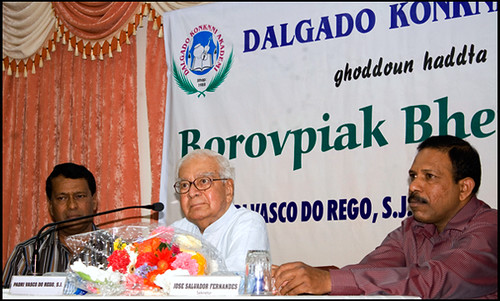
Their interventions were not restricted to the spiritual lives of Catholics alone. Rather, they also supported secular initiatives to promote Konkani in Goa. Take, for example, the fact that it was Diocesan schools that first made the switch to the Konkani medium in the Nagri script. In 1964 Fr. Vasco do Rego pioneered Konkani primary education by getting four schools in the vicinity of Loyola High School, Margão, to introduce Nagari Konkani as the medium of instruction in the primary section. Later, in the 1990s, when the State government refused to support English as a medium of instruction, the Archdiocese adopted Nagari Konkani despite vociferous and sustained protests from parents.

Some have argued that this was because the Diocese had no choice in the matter. This is but one side of the story. The other side of the story is that there were a great number of linguistic nationalists within the Church, and they rubbed their hands with glee at this opportunity. What is also true is that even before the pronouncements of the Vatican Council II, the universal Catholic Church had been priming itself to make space for vernaculars alongside Latin.

Uncharitable voices often argue that the Catholic Church did so because the Vatican was trying to suck up to the newly independent nations. While this may be true in part, what must not be discounted is that already, from the early 1900s, a number of Catholic thinkers were committed to producing distinct national Catholic cultures. The Church has always been producing nuanced vernacular versions of Christianity, as can be seen in Goa. However, in the twentieth century, a world in the grip of racist ideologies, ultimately traceable to the Romantic movement, was unable to appreciate these nuances. The forms of the Catholic Church were seen as European, rather than universal, and sought to be replaced wholescale with “native” culture. In doing so, these Catholic leaders played along with nationalist forces. However, they did this out of conviction that they were doing the right thing, not out of fear of the nationalists.

As I have suggested, the clergy in Goa were no different, and have played a significant role in assembling a more sanskritic Konkani identity for Goa.  It is a shame that this selfless yeoman service, even if misguided, not only goes unsung by their former collaborators, but worse, is neatly swept under the carpet to suit the interests of a wicked cabal.

(A version of this post was first published in the O Heraldo dated 5 Feb 2016)

Saturday, January 9, 2016

Konkani Stalwarts and the Archdiocese


The hierarchy of the Archdiocese of Goa must not know what has hit it. While used to accolades from the leadership of the Nagari Konkani movement, more recently the same leadership has been subjecting the Archdiocese to the most vicious attacks. A month ago Naguesh Karmali made the bold suggestion that the Catholic Church in Goa was suppressing Indian culture in a manner that exceeded that of the sixteenth and seventeenth century Portuguese. Uday Bhembre has directed ire against the Catholic Church on other occasions. For his part, Raju Nayak, editor of the Marathi daily Lokmat, indicated that the Archbishop’s choice to address his guests at the Christmas reception in English rather than Konkani demonstrated a certain lack of Indian-ness of the Catholic Church in Goa.

In this column I would like to examine the manner in which Sandesh Prabhudesai, another Konkani stalwart, positions the Church in his book Clear Cut: Goa behind the Glamour (2014). Clear Cut is a collection of the op-eds Prabhudesai has written over a period of years. While the writing is uneven it nevertheless demonstrates the nature of his concerns, the most constant of which is securing a Goan identity through Konkani.

Reading Prabhudesai’s musings, one gets a sense of his opinion of the Catholic Church. Take, for example, the following sentence from the article ‘Medium of Destruction’ (p. 20), written originally on 29 March 2011. Not explicitly referring to the schools managed by the Archdiocese, he says that “the Konkani medium has been ‘exploited’ purely to get salary grants for the teachers and not to impart education in proper Konkani” (p. 21). Nonetheless, he admits in another article titled ‘What does Parrikar's MoI Policy Mean?’ (originally written in 2012 ) that “only Konkani medium schools run by the Church are shifting to English medium” (p. 35). What Prabhudesai seems to be suggesting, therefore, is that the Konkani medium was “exploited” by the Archdiocese way back in 1990, and that the Archdiocese had no inherent love for Konkani, but switched to Konkani only to financially sustain its schools. Incidentally, his suggestion is not very different from that of the opinion expressed by Raju Nayak in his recent editorial, who went so far as to suggest that the Archdiocese was in fact in favour of English right from the very beginning. Indeed, if one reads Clear Cut carefully, one is struck by the similarity between Nayak’s opinion and Prabhudesai’s as regards the Archdiocese’s relationship to Konkani.

What one gets from these writings, is of the Archdiocese as a manipulative institution. The idea of a manipulative Archdiocese is further elaborated in ‘What does Parrikar’s MoI Policy Mean?’ Here Prabhudesai writes: “As expected, Chief Minister Manohar Parrikar followed the suit [sic] of  his predecessor Digambar Kamat and surrendered his Bharatiya Janata Party (BJP) before the Church, to work out a ‘political’ solution to the long-pending controversy over Medium of Instruction (MoI).” The critical words to focus on here are “surrendered…before the Church”. There are a number of objectives that Prabhudesai seems to accomplish in this one phrase.

The first objective is that these words seem to suggest that the Archdiocese is an institution that can make or break governmental decisions whenever it wishes. To suggest that the Catholic Church is a major force in local politics is a common trope in Goan reportage. While it sometimes enjoys this power, this is not always the case. The fact is that the Catholic Church in Goa, just as in India, is in fact pinned, as it has been for some decades now, in the grip of Hindu majoritarian politics. All too often, as has been the case of the Archdiocese’s action in the post-colonial history of the Konkani language, the Archdiocese has gone out of its way, and in fact contrary to the wishes of many Catholics, to please the leaders of the Nagari Konkani establishment.

The second objective of the use of “surrender” seems to be Prabhudesai’s intention to shame the BJP into pursuing the anti-minority position that they are popularly identified with. Prabhudesai’s recourse to this strategy of shaming is particularly troublesome because it appears to insist that the BJP not respond pragmatically, but hold on, come hell or high water, to its ideological position. Using the metaphor of a war, tt seeks to provoke the rank and file to shame and anger so that they may prevail on their leadership.

Even more important, this phrase suggesting surrender seems to ignore the fact that the power-brokers of the Archdiocese are not acting on their own accord, but rather responding to the firm demands of hundreds, if not thousands of bahujan Catholics have indicated in no uncertain terms that they wish to have their children educated in English, not the brahmanised Nagari Konkani invented early in the twentieth century. Left to themselves, I have no doubt that the brahamnical leadership of the Archdiocese would have continued to pander to their brahmin cousins in the Nagari leadership. If Parrikar were surrendering, therefore, he would have been surrendering before the wishes of citizens represented in this case by the Archdiocese. No shame in this.  Once again, this denial that the Diocesan leadership is in fact acting in line with the desires of large sections of the laity, is a line taken more recently by Nayak.

It should be observed that I am not engaging in a blanket defence of the actions of the Archdiocesan leadership. There is much evidence to suggest that all is not well in many cases of the sale of church properties. Even if made in good faith, the fact is that various groups within the Church in Goa do not see eye to eye on the issue of the sale of properties. What is interesting, however, is that Prabhudesai, in particular, does not seem to problematize this democracy deficit in operation of the Archdiocese. His single point of critique is limited to his understanding of the Konkani issue.

In a recent op-ed taking issue with Nayak’s editorial, Kaustubh Naik suggests that Nayak’s stance denies “the minorities the agency to make their own life choices”. Naik is spot on in this analysis. In portraying the Church as a manipulative and dictatorial institution, and seeking to shame Parrikar for negotiating with the Archdiocese, what Prabhudesai appears to do is to prevent Catholic groups in Goa from using the Archdiocese as one more representational body to get their legitimate rights recognized by the government. Indeed, the thought of shame gains traction only if there is the suggestion that the Church or Archdiocese has no legitimacy being an actor, or representing Goan Catholics, in Goan politics. As the recent shenanigans of the BBSM demonstrates, politics is not determined solely by the ballot. In such a circumstance, there is no harm in the Goan Catholics utilising the structures of the Archdiocese to organise and articulate their demands. In denying them this choice, Prabhudesai denies political agency, or choice, to the Catholic communities in Goa, forcing them into a field that is dominated entirely by apparently secular liberal, or soft Hindutva rhetoric and politics; a politics that Sandesh Prabhudesai seems to subscribe to.

(A version of this post was first published in the OHeraldo on 8 Jan 210)

Friday, October 23, 2015

The Hypocrisy of Goa’s Protesting Awardees


In the context of a number of Sahitya Akademi awardees across India returning their respective awards in protest against the growing intolerance in India, in Goa around fourteen Sahitya Akademi awardees together with Padmashri awardees Maria Aurora Couto and Amitav Ghosh came together and issued a joint statement on 15 October, 2015. One would be struck by the hypocrisy contained in their press note released were it not for the fact that their politics of intolerance is so blatantly displayed all over the same note.


In their statement these local notables condemn “the rising trend of intolerance in the country which threatens freedom of expression… [and] the age-old liberal and all-encompassing philosophical traditions of this country.” One would take this concern seriously were it not for the fact many of these notables have been complicit not only in acts of intolerance themselves, but also physical violence.

For some years now there have been demands from many quarters that Konkani literature written in the Roman script also be given governmental recognition. But Sahitya Akademi awardees like Pundalik Naik and N. Shivdas, who have presided over the Goa Konkani Academy, have not felt it necessary to take up this cause and ensure that a Konkani tradition with a longer history than that in the Nagari script one is recognised. On the contrary, all of these protesting Sahitya Akademi awardees and Padmashri Couto have watched silently while Roman-script Konkani has been officially ignored and excluded from all kind of state recognition, including awards and grants.

In addition, these persons have maintained a studious silence while their associates, such as Uday Bhembre and Nagesh Karmali, have engaged in the most vicious hate speech against the Catholic community in the course of the Medium of Instruction controversy (that has raged from 2011), when Goan parents demanded the right to determine the manner in which their children are educated. Where was their concern for the alleged liberal traditions, and traditional bonhomie, of Goa then?

To make matters worse, these same notables watched silently when in 2005 Naguesh Karmali, a member of this very group of protestors, led a violent mob in destroying public and private property on the grounds that such property was encouraging Portuguese (read as Catholic) culture in Goa. Given that Goa has had a long and historical relationship with Portugal, doesn’t the violent smashing of manifestations of this relationship amount to an act of the very same rabid communalism that these worthies profess to protest against?

In light of these inconsistencies, and the equally amusing announcement that they will hold on to their awards until the meeting of the executive committee of the Sahitya Akademi, it appears that these awardees seem more interested on jumping onto the bandwagon of political trendiness, than for any desire to stand against the growing intolerance in the country, and indeed, Goa itself.

We would like to stress that while it is true that the government of Mr. Modi has definitely presided over a rise in intolerance in the country, the roots of this intolerance lie deeper in the country’s history. As we have already pointed out, a number, if not all, of these Goan awardees are complicit in this intolerance. Their complicity is further evident in the manner in which they phrase their protest within the language of Hindutva. Why, for example, are the recent acts compared to ‘talibanism’, instead of calling them Hindutva, or Hindu nationalism? Talibanism is a phenomenon situated outside the country, when Hindutva is the problem actually at hand, given that Kalbargi, Pansare and Dabholkar lost their lives as a result of their opposition to this ideology. Indeed, Hindu nationalism has been a problem since before Indian independence. In referencing the Taliban, these awardees continue the refusal to recognize Hindu nationalism as the single greatest cause of concern in this country since 1947.

In conclusion, we would be more convinced of the genuine concerns of these state awardees from Goa if we heard them also protest the exclusion of Konkani in the Roman script from legislative recognition, also the violent condemnation of the Goans who are simply asking for English as a state-supported medium of instruction for their children, and also the lack of implementation of constitutional guarantees for education and jobs to historically discriminated-against Goan communities. Such protests would go further in establishing norms for the respect of fundamental rights, and the establishment of law and order in our state and country.

This statement was first published in the DNA web edition of 23 Oct 2015 and was penned along with  Amita Kanekar, Dale Luis Menezes, Kaustubh Naik, and Vishvesh Kandolkar.)