Showing posts with label Manohar Parrikar. Show all posts

Friday, August 25, 2017

Why don’t you see Fascism?


The bye-elections to select the representative for the city of Panjim are being seen as critical given that it will determine if the BJP-led coalition will continue to govern Goa, and will also determine the career of the BJP candidate Manohar Parrikar. It is for this reason, therefore, that most people are on edge and apprehensive about the outcome. Some of the tensions involved in this election were made evident in the article written by advocate F. E. Noronha and published in Renovação, the newsletter and magazine of the Archdiocese of Goa. In this article, Noronha all but urged the electorate to reject Parrikar at the polls, arguing that a Nazi-like atmosphere had arisen in Goa.

A newspaper article reported that Vijay Sardesai, leader of the Goa Forward party which is a member of the ruling coalition, dismissed this article as “hyperbole”. Sardesai is reported to have indicated that he thought the argument “a clear cut case of exaggeration. In Goa, where is the fascism? Which community is being discriminated or acted against by the state, through the state machinery?”

This report confirmed my own evaluation of the problems with the Indian polity, and the inability of elected representatives and politicians to either appreciate the nature of what exactly is at stake at this particular moment in Indian politics, or to ignore the implications in their drive to obtain political power.

To begin with is the sheer arrogance with which Sardesai dismisses Noronha’s argument. As a member of a Hindu dominant caste, Sardesai is in no position to idly dismiss others’ concerns.  How would he, who is under no threat - of life, or culture - be able to determine what is hyperbole or not? Rather than dismissing the concerns of a member of a minoritized group, he ought to have said, “yes, I hear you, and I will see what I can do to resolve this matter”. This dismissal is particularly callous given that Sardesai rose to power through the support of the many Catholic groups. 

It appears that Sardesai has either no idea how fascism actually operates, or is being disingenuous given that he has pledged his support to Manohar Parrikar’s election bid from Panjim. In any case, since Sardesai reportedly inquired which community is being discriminated against by the State, let us take him seriously and provide a response. This response will demonstrate the manner in which fascism has been growing, systematically pushing groups out of power and minoritizing them.

It needs to be noted that fascism does not emerge fully-grown, like some Athena from the head of Zeus. On the contrary, fascism grows through small, deliberate steps. One need only look at the discrimination against the Roman script of the Konkani language. Ever since 1981, when the Official Language Act (OLA) was legislated by the Congress party, the Roman script has been the target of hostility by the state-supported Nagri Konkani lobby. Not only have literary works in the Roman script been ignored for awards, these works have not even been admitted to competitions on the grounds that the Roman script is not an officially recognised script. This is the face of creeping fascism where the chief tool through which a social group, viz. that of the Bahujan Catholics, expresses itself is systematically and deliberately side-lined and suffocated. Indeed, given Sardesai’s claims of representing Goemkarponn, or Goanness, one would have expected him to take up the long-standing demand of such groups as the Dalgado Konknni Akademi, and the Romi Lipi Action Front to ensure that the Roman script is officially recognised. But this is not the only example of systematic minoritization and threat. There has been a stream of anti-Catholic abuse by persons not just from outside of Goa, like Sadhvi Saraswati, but persons within Goa such as Subash Velingkar, Uday Bhembre, with people like Naguesh Karmali having actually participated in the destruction of property as in Fontainhas in 2002. In all of these events, state governments of varying parties have literally looked on passively. One should also not forget the effective suffocation of the production of beef in the state a process initiated by the MGP in 1978.

One would have hoped that Sardesai would use his position in the ruling coalition to push forward agendas, like the official recognition of the Roman script, that will halt the systematic minoritization of various groups within Goa. However, Sardesai’s rhetoric demonstrates a troubling similarity with Hindu nationalists. Take, for example, that not only has Sardesai reportedly dismissed Noronha’s argument as hyperbole he has also dismissed “certain sections of Goan people” as being irrational. He suggests that such concerns are the result of “scepticism, pessimism among certain sections of Goan people” rather than rational opinion articulated after careful study and observation. Given that these comments were made in the context of Noronha’s article, one can safely assume that Sardesai means Catholics when he refers to “certain sections of Goan people.”

As should be obvious from the discussion above, fascism in our state is not limited to the actions of the BJP alone. Rather, it has had a long gestation period. Nevertheless, it is also true that the presence of the BJP, especially at the Centre, has allowed for the animosity towards non-Hindu groups to be asserted viciously. In this context we should take into consideration the words of the economist and former finance minister of Greece, Yanis Varoufakis. Speaking in the context of the recently concluded French presidential elections Varoufakis pointed out that it was important to rally around the problematic figure of Emmanuel Macron precisely because it was critical that the racist and right-wing Marie Le Pen be defeated. Speaking to those who did not see a difference between these two problematic figures he pointed out that one needed to be aware of the implications of what happens when a “fascist, racist party” gets its “hands on the levers of the deep state, the levers of the police, and of the army.” This article will appear too late for it to have any impact on the outcome of the election to the Panjim legislatve seat. However, the larger point that needs to be made is to underline how fascism operates, and how it is, in fact, very much a threat in Goa.

(A version of this text was first published in the O Heraldo on 24 Aug 2017)

Friday, April 29, 2016

AAP: A Clear and Present Danger?


With the elections to the state legislature in the not so distant future the Aam Aadmi Party (AAP) in Goa has begun its campaigning in earnest. As is well known, AAP has been projecting itself as a credible choice on the basis of its promise to deliver good, i.e. corruption free, governance. The question, however, is whether the AAP should be judged merely by its rhetoric, or should it be examined against a broader canvas?

Recent history demonstrates that electoral decisions determined solely by the theme of corruption have ensured that we have moved from the frying pan into the fire largely because we have failed to examine the politics that these electoral options practice. Take the example of the Modi government now wreaking havoc across India. Modi was elected into power because so many people, rightly fed up with the Congress, decided that the man was a good administrator and deserved a right to govern the country. Closer home in Goa, fatigue of the never-ending corruption scandals presided over by the Congress enabled the BJP to come to power.

We now realize that in addition to merely continuing the corrupt practices of the Congress, the BJP is also committed to a kind of fascist agenda that is difficult to undo even after they have been removed from power. This is a kind of moral corruption that is difficult to undo largely because, as I will go on to show, Hindu nationalism itself is never challenged. As such, when evaluating AAP in Goa it is imperative that their proximity to the agents and logics of Hindu nationalism must be strictly evaluated.

An evaluation of the AAP along this axis must begin with a statement by Dr. Dattaram Desai, the AAP candidate for North Goa in the previous Lok Sabha elections in 2014. At that time, Desai indicated in a local newspaper along the lines that he saw no problem with the RSS and that it was just another nationalist organization. When Desai was confronted on this matter at a public meeting conducted by the AAP he denied that he was a part of the RSS, and denounced the RSS as a communal organization. However, it seemed that he did so largely because he had been hounded into that position after being asked a series of leading questions. Desai had been asked at that meeting to issue a public statement to the effect that he did not approve of the RSS, something he agreed to, but one that, to the best of my knowledge, was not issued. Desai continues to be a leading member of AAP in Goa, and in light of his past comments, this fact should be a cause for concern.

At the above mentioned meeting Dr. Oscar Rebello, also a prominent member of the AAP in Goa, sought to clarify issues regarding the links between the RSS and AAP. Using characteristically simplistic logic, Rebello pointed out that he had friends in the RSS, but that did not necessarily make him a member of the RSS. Rebello’s logic may be simplistic, but it is often winning in its presentation. Of course one cannot, especially in a small place like Goa, deny people entry into a party because they were once members of the BJP. Perhaps they may have, as is suggested in the case of Desai, realized that the BJP will not deliver.  But the problem with the RSS, and more importantly Hindu nationalism, lies in the logics that we internalize owing to a lifetime of being immersed in it. If these logics are not actively challenged we too become part of the Hindutva machine.

In this context, the decision of the AAP in Goa to name its outreach program the Goa Jodo campaign is quite disturbing. Why privilege Hindi in a state with no lack of local languages? Because a non-Hindi Goan-ness is suspect? How is this position different from that of most Hindu nationalists and the implicit understanding that it is primarily Hindi and Hindu culture that defines Indian nationalism? One should bear in mind that Hindi nationalism, as one can surmise from the old slogan “Hindi-Hindu-Hindustan” has never been far away from Hindu nationalism. This desire to run with the Hindi-wallas can also be seen  in the video of Desai’s response discussed earlier, where it appears that Rebello refers to Desai as Dr. Desaiji. Now one is entirely at liberty to add honorifics to people’s name. The problem emerges when one realizes that the ji has become popular in Goa with the rise of Hindu nationalism in the past couple of years. The question emerges therefore, can we rely on such a group to assert the rights of Goans which necessarily runs against Hindi and Hindu nationalism, such as the demand of Special Status, and assert our right to be different within India?

But it is not merely the local AAP that has disturbing connections with the RSS or is blasé about Hindu nationalism. Pamela D’Mello writing for an on-line magazine pointed to the disturbing relationship of Dinesh Waghela to Hindu rightist outfits. Waghela was charged with setting up AAP in Goa, and at that point just like Desai went on record, to suggest that he did not see what was wrong with people from the RSS joining the party.

What also needs to be pointed out is that AAP’s insistence on its promised good-governance as a central reason for being a choice in the upcoming elections partakes in the Hindu Right’s pushing of strong administrators, whether Modi or our very own Parrikar. This is not to suggest that good governance is not an important issue. It is. However, we need to recognize that a limited understanding of corruption, and governance emerges from the very upper-caste and middle-class reasonings that have generated the Hindutva upsurge in the country. It is this kind of unthinking of, and challenge to Hindutva logics that is critical and necessary if AAP in Goa should emerge as a safer option than it currently seems to be.


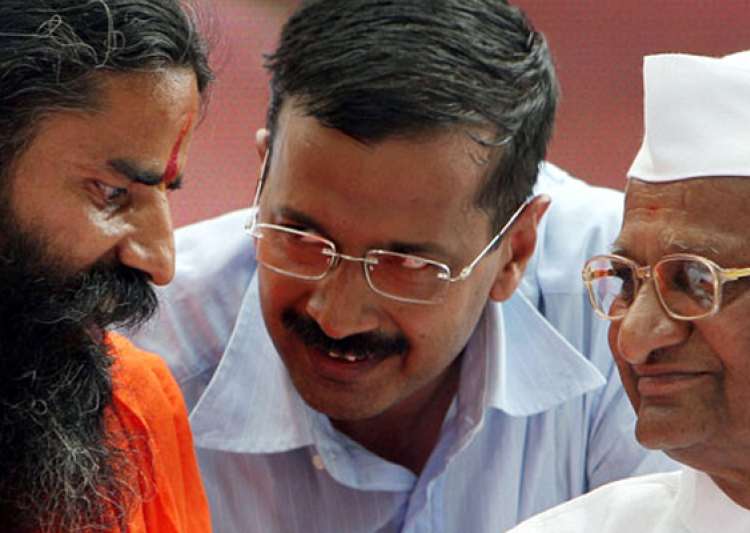
Most disturbing of all, however, are the actions of the party supremo, Arvind Kejriwal. Kejriwal has had no problem in the past drawing such Hindu spiritual leaders like Sri Sri Ravi Shankar and Baba Ramdev into his movement. Right from the get go therefore, Kejriwal has violated secularism by mingling the Hindu religion with his politics. More recently, despite the livelihood and environmental violations involved in setting up the venue for the World Culture Festival on the banks of the river Yamuna, and in contravention of his own position on corruption, Kejriwal saw it fit to attend the event, and kowtow before Ravi Shankar.  As distasteful as this may be to some, it is not necessarily out of character for unprincipled political leaders who need to engage in populist measures if they are to stay in power. It is, therefore, precisely because AAP Goa will have to play by established rules of the game once it is in power, that we need to evaluate them stringently before they get into power. In light of this, AAP Goa’s connections to soft Hindu nationalism present a clear and present danger.

(A version of this text was first published in the O Heraldo dated 29 April 2016)

Friday, December 26, 2014

The Grinch who steals Christmas: Holidays and the Hindutva state


Original illustration by Angela Ferrao
We live in interesting times. Sometime around the middle of this month the press broke reports that the Union Government wanted to mark the twenty-fifth of December, birthdays of Hindu nationalist leaders Atal Behari Vajpayee and Madan Mohan Malaviya, as ‘Good Governance’ day. Towards this end, the media informed us, schools would remain open, and students would be encouraged to participate in a national essay writing competition. Howls of protest rang out across the country, and the Ministry of Human Resource Development hurriedly rubbished these reports. There was no question of having schools open on Christmas Day, they assured the country and added that the competition was voluntary and entries could be submitted virtually.

For the moment then, the crisis seemed to have receded. Nevertheless, the episode refreshed my memory over two earlier episodes involving holidays. One is an event that lies within the public domain, the other a personal memory that I would like to share and reflect on.

The first episode dates back a number of years, when the government of the then Chief Minister of Goa, Manohar Parrikar, contemplated withdrawing the public holidays on the Good Friday and the feast of St. Francis Xavier. As can be expected, there was a hue and cry then too, until this controversial move was undone, with Parrikar later suggesting that the move had been an error.

The second episode dates from the time when I was working with an NGO in Hyderabad. I realised with some shock that this corporate-funded entity had not declared Eid (I forget which of the two Eids it was) a holiday. On the contrary, it was marked as an optional holiday. If one chose, for religious reasons, one could take the day off, but the rest of the office would continue working. I also recall being told that one could take the day off, but I would be merely eating into my own stock of optional holidays. I recollect sensing the suggestion of the threat that I would be compromising my days of Christian celebration were I to take the day off to commemorate the feast.

I was quite upset by this scenario. I had recently returned from Patna where I had a number of Muslim friends and had been sucked into a series of Eids, weddings, and other celebrations. Even though I was bereft of this network in Hyderabad, I could not contemplate an Eid that was to be spent working, instead of feasting with friends. It hurt, but rather than create trouble and stand up for a principle I was not yet sure of, I went to work that Eid day, mournfully walking past masses of men praying at the mosques along the route I took to work.

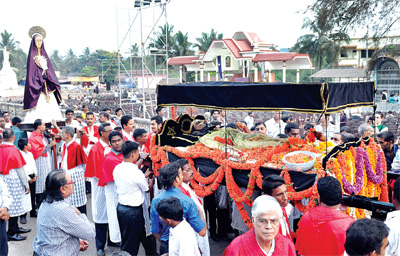
These memories were swirling around my head these past couple of days I realised that the issue of cancelling holidays, or restricting these holidays is much more important than showing disrespect or disregard for religious minorities. On the contrary, such governmental actions ensure that religious boundaries are hardened and religions are formed into water tight compartments. The learning from Hyderabad was just that, you can choose to be a Catholic and take your holiday, or you can choose to show solidarity with Muslims. We are not preventing you from celebrating Eid, but you need to make a choice. Similarly, had the feast of St. Francis Xavier continued to have lost its holiday, a great number of Catholics would have still taken the day off to visit Old Goa and venerate the relics of the saint. This option would perhaps not have been so definite for those Goans who are not practicing Catholics but still venerate St. Francis Xavier. It is possible that they would have continued with their daily routines. Similarly had the holiday on Good Friday been cancelled it would not only have complicated the possibility of having clear roads for the public processions that mark Good Friday, it would also have complicated the participation of non-Catholics, who light up the streets, and offer incense to perfume the funeral path of Christ. 

We must remember that we live in an environment where thanks to the threat of an aggressive Hindu nationalism, all religious groups have been hardening their identities and castigating what are called syncretic practices. When a government restricts a holiday, therefore, or fails to provide one, it is lending its own strength against these already existent social pressures. The issue of cancelling holidays therefore does not merely impact on the group for whom it is most significant. It impacts all, preventing communal celebrations, visits, exchange of sweets. It goes towards creating a fractured society.

It is in this context that we should evaluate the clarifications of Smriti Irani, Minister for Human Resources Development, on the issue of celebration of ‘Good Governance’ day, as well as the subsequent note from the Prime Minister’s Office that mandated various officers to mark ‘Good Governance’ day.  What is clear is that rather than let Christmas day be, the Central Government has identified the twenty-fifth of December as the day to commemorate ‘Good Governance’ day. The essay competition will continue apace even though the event will be restricted to submissions over the internet. Further, various officers of the Government were expected to attend and conduct commemorations linked to the theme of good governance.

What this effectively amounts to is providing an alternative to the celebrations of Christmas that have become a major feature across India. One does not need to be Christian, nor indeed have Christian friends to celebrate the day. Regardless of their religious persuasion, people engage in secular celebrations of this feast by organising Christmas parties, arranging visits from Santa Claus and the like. The fact is that thanks to a variety of factors, a number of Indians, and especially urban and upwardly mobile Indians are ‘culturally Christian’. They have imbibed many Christian and/or western cultural traditions and celebrate them as if these traditions are their own. That these aspects are not strictly religious is not important, it is in fact exactly the point, that the festival has ceased to be religious alone, but is a cross-communal secular festival. Indeed, if one is to take the historical novel, The Mirror of Beauty seriously, Christmas, or Bada Din was a significant festival in Delhi by the time of the last Mughal emperor, and avidly celebrated by the Mughal elites.

Given the kind of pressure that Indian society places on students to excel and gain laurels, one can imagine that children would be encouraged, if not pressured, to take part in a national competition that could get them national recognition. Remember we live in a country where even a certificate of participation is regarded as useful. As such, having a competition at the time of the Christmas holidays, with a submission on Christmas day, no matter that the submission can be made virtually, ensures that one has created a substantial diversion from the pleasures, and significance, of Christmas. In addition to these competitions, the low-key government commemorations of good governance  that continued even while the holiday was still officially on clearly indicate that the conspiracy to steal Christmas is, therefore, still on.

It should be noted, however, that it is not only the BJP government that is engaged in a project that dismisses Christmas. A variety of organisations in India, including academic and non-governmental, as well as those patronised by the nominally secular-liberals think nothing of hosting significant retreats immediately prior to, or soon after Christmas day. This scheduling ensures that very often Christians have to either opt out of Christmas, or the event, or spend a good part of Christmas day in travel. And, as I pointed out earlier, this callous scheduling does not impact Christians alone, but fractures the possibility of non-Christians in participating in what is a wonderful feast of familial gathering. The loss is communal.

We live in a country where the plethora of holidays we enjoy is often castigated. Over the year these holidays have been vilified merely as days free from work. What this vilification does not recognise is that holidays are a way for us to indicate that an event is important enough for us to take time off work and engage with each other. Even if we choose to not engage with other communities, the holiday continues to be a mark that this other community is important. It is this tradition of honouring those who are unlike us that is at stake when holidays are so callously countermanded.

Feliz Natal! Have a blessed and joyous Christmas season!

(A version of this text was first published in the O Heraldo dated 26  Dec 2014)


Friday, September 5, 2014

Rights trump culture: Lessons in fighting Hindutva


There was a significant amount of virtual rejoicing some weeks ago when the vice-president of the state BJP unit, Wilfred Mesquita, announced that "Prohibition cannot come to Goa... because Goa's culture is to drink." Mesquita’s statement came in the wake of a number of recent controversies involved with moral policing both within the country and also in Goa. Both Chief Minister Parrikar and his colleague Sudhin Dhavalikar had expressed opinions about the need to ban the consumption of alcohol in public. Given that the state government of Kerala had announced a decision to enforced a gradual prohibition of alcohol in that state, and the abandon with which the Hindu right has been going about its agenda of cultural rectification of the country the Dhavalikar-Parrikar comments understandably unnerved many in the state.
We owe a debt of gratitude to Dr. Mesquita for having had the moral courage and the good sense to point out that prohibition is out of the question when alcohol is a part of the social rituals among a good portion of the Goan public. May he live long and prosper.
As relieved as we may be by Misquita's statement, it needs to be pointed out that basing the decision to not ban the consumption of alcohol on the basis of its presence in “culture” is not a reassuring fact. Indeed, such a logic is problematic because it is still very much within the Hindutva realm of reasoning.

Hindu nationalism is a cultural nationalism. This is to say that it is a nationalism that privileges culture (as defined by Hindu nationalists) first. All else, including rights, comes after this definition of culture. The opposition to prohibiting an act on the basis of culture is to give primacy to culture, not to rights. Thus, what would happen if there was no culture of social drinking in Goa? Would it be ok to ban drinking then?

This question is important because it is at the root of determining the extent of the censorship powers of the State. The question is one of the extent of the powers of the state to curtail activities of persons, and of the recognition of right of the individual to choose. If I choose to drink, then regardless of whether it is a part of our culture or not, I should be able to drink, and have the right to purchase alcohol for consumption.

Phrasing the question in terms of alcohol, whose consumption is marred by instances of alcoholism, is not the best way to phrase a question of rights. Indeed, members of the right often use the most extreme example to make their case and carry through decisions. If we replaced alcohol with skirts, for example, we may see the dangers involved in invoking culture as the basis to allow, or prohibit an activity. If the wearing of skirts were not commonplace among women in Goa, would it be legitimate to ban the wearing of skirts? Of course not, because one would then be treading on the rights of women to wear skirts should they choose to do so. The law is known to place reasonable restrictions on the rights that citizens enjoy. Should one gravely inconvenience others provisions already exist to remand persons causing a nuisance through drunken behaviour. In the presence of this reasonable restriction the introduction of prohibition does nothing more than allow for the state to exercise unreasonable authority over the ordinary lives of people.

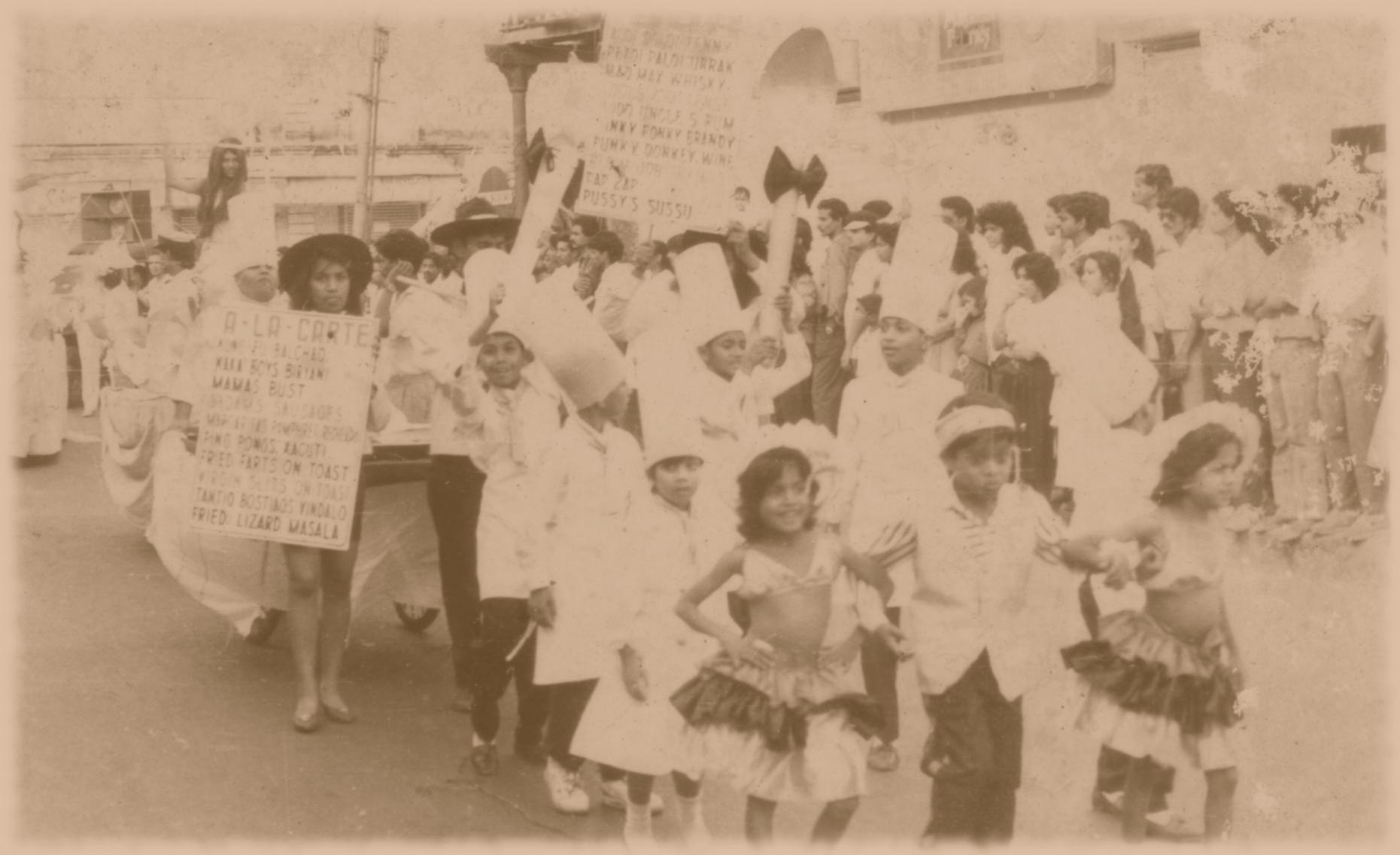
Problematising culture as a way to attack or defend culture also helps to make us aware how institutions that are today crying foul, have been a part of the gradual drift towards the right. Back in the 1980s, the hierarchy of the Catholic Church in Goa came out strongly against the celebration of Carnaval insisting that it was not a Catholic celebration. Indeed, it did so more recently, once again when Parrikar waded into debates on what is or is not appropriate local culture. In doing so the hierarchy sought to delegitimise Carnaval celebrations. In doing so they were committing a number of errors that haunt us today and will no doubt haunt us in the future. The hierarchy was effectively suggesting that only the religious lives of the Catholics in Goa was worthy of respect. The rest could be dismissed and done away with. They were also setting themselves up as the determiners of all cultural activities that persons who confess the Catholic faith engage in. This was, and continue to be a dangerous position. As much as the Catholic Church has a right to advise its members on the manner of their comportment, it cannot determine what is, or is not part, of the activity of Catholics in Goa. While the hierarchy of the Catholic Church in Goa may not be fond of carnival, it ought to have taken a broader perspective and indicated that while Carnaval was not a Catholic religious feast, and the hierarchy had reservations with regard to some of the ways in which it is celebrated, it would not deny that Carnaval is a significant celebration with historical roots in Goa, and especially among Catholics in Goa. We live in a complex world and the only way in which we can prevent institutions, both statal and otherwise, from becoming autocratic monsters is by paying close attention to the rights of individuals.

Despite making culture the basis on which he dismissed the prohibition of alcohol, Mesquita also needs to be congratulated for not making the social consumption of alcohol a feature of Catholics alone. Almost all reports indicate that his statement was “Goans drink at wedding and parties. How can it be banned?” Thus, it was not Catholics drink at social events, but Goans.  This makes sense given that it is not merely Catholicism that determines whether people drink alcohol socially or not, since people were fermenting and producing alcohol long before both Europeans and Christians came to this territory. The European, and possibly Christian, origins of the consumption of alcohol is just one strand in the history of alcohol consumption in the territory.

To return to the thrust of my argument, making culture the basis on which decisions are made will also push us further into the ire of the Hindutva tiger. Given that it is the non-brahmanical culture of Goa that they see as a problem, decisions to protect certain social activities on the basis of culture will work to only strengthen the resolve of these groups to attack the cultural manifestations of Catholics, and other non-brahmanical groups, in Goa. We need to turn the tables on the forces of the right (which includes not merely the forces of Hindutva) and assert that rights are the basis of public policy.

Mesquita's statement may have won us the battle therefore, but will it win us the war?

(A version of this post was first published in the O Heraldo on 5 Sept 2014)