Showing posts with label corruption. Show all posts

Tuesday, May 31, 2016

Thinking About Babush


Mapping the terrains of the operation

On the 23rd of March 2009, despite opposition to 10 of the 11 seats being contested at the Panchayat elections, the panel floated by Atanasio Monserrate won all 11. How does one make sense of the results of the recently concluded elections to the Taleigão Panchayat? The dominant view within the opposition is that Monserrate is the embodiment of evil, and that all of Taleigão cowers in fear. Other views would argue that he has filled Taleigão with migrants who blindly vote in his favour. Others argue that some sold their vote for the gifts of a thousand rupees, a bicycle or a sewing machine. I believe that the story of Monserrate is a little more complex than this, and we need to necessarily rethink our evaluation of him.

Countering the allegations that he bribed the voters, Monserrate reportedly responded that we should not insult the voters. Monserrate makes a valid point here. As with any allegation of corruption, there is a certain political point that Monserrate’s opposition is trying to score. The point is to undermine the individual decisions of those persons who voted for Monserrate. The suggestion is that they are not free-thinking, concerned and responsible citizens. It is scornfully suggested that they are merely opportunists who will vote for the highest bidder. While I have no doubt that in fact money did exchange hands and that gifts of cycles and sewing machines, drink and chicken were in fact made, I would choose to look beyond the allegation that the votes of the people were purchased. The reason I choose to refute the argument that votes can be purchased is because this scornful position refuses to recognize that the persons who accepted these gifts were in fact making calculated political decisions. Just like the ‘apolitical’ stance taken by Goa and Taleigão Bachao Abhiyan, the argument that votes can be sold, refuses to appreciate and engage with the politics of the people.

To begin with, whose is this scorn? Clearly it is the scorn of those who do not need a thousand rupees a vote, or cycles or sewing machines. It is the scorn of the haves for the have-nots, the haves presuming that it is only they who well and truly appreciate what democracy is all about. The gifts were accepted because these gifts, as petty as some of us may consider them, did make a difference to the economy of the households that they were presented to. Further, the gift-taking is in fact a rather complex participation in democracy. The gift-takers recognize that the politician cares for them only to the extent of their votes, that the system will not address their condition. Thus, if they have to vote, they will vote only if you pay (gift) them to do so. It is thus, through this gift-giving, and their construction of themselves as a vote-bank, that they force the electoral process to in fact work. If they didn’t vote, then given the fact that most of the middle class does not vote, the electoral process would grind to a screeching halt! The scorn for the gift-taking therefore, is extremely problematic and ironically, politically naive!

This political naiveté is built on the incredulousness of the upper orders who are convinced of their own political maturity and the corresponding immaturity of the labouring classes. They reason that it is because these labouring classes, which often correspond with the Dalit-bahujan groups, are so immature that our democracy is today malfunctioning the way that it is. These orders refuse to see that these ‘malfunctionings’ of democracy are in fact the result of the deeply problematic socio-economic divides that persist in our society, and that we repeatedly refuse to address. It is because we refuse to recognize this fact, and persist in our confounded arrogance, that a good portion of the opposition to the development lobby in Goa is primarily engaged in ‘creating awareness’. These members of the upper orders of our society are firmly convinced that the only reason for the silence of the majority is because this majority is not aware. It is because we stubbornly refuse to consider the alternative, that they are politically astute individuals making carefully calibrated decisions that the tide we seek to stem continues to inundate us.

If we recognized the maturity of these gift takers and recognized that gifts are accepted because these gifts made a difference to the economies of the households that accepted them, our positions and our strategies would change instantly. We would recognize that the presence of ‘outsiders’ in our villages, and their transformation into vote-banks for the unscrupulous, can be addressed if, and when, we address the issue of the poverty of these outsiders. If we are able to ensure that their working conditions are better, the salaries they are paid are higher, and that social welfare extendable to any worker, we would see a significant drop in the arrival of these outsiders. This for two primary reasons; first, because it would make employing ‘external’ labour more expensive (especially if one is talking of housing migrant construction-labour); and secondly, with an increase in pay-scales and benefits, the Goan, who in facts demands a more mature work environment, would begin seeking employment within Goa. As is increasingly becoming clear to me though, much of the oppositional space in Goa is captured by elites, who do not want to see radical change, but want only a return to the status-quo. Secondly, when the non-elites among this opposition take charge, they unfortunately don’t seem to be able to articulate their demands in broader terms. On the contrary, they too get caught in the whirlpools of the discourse established by the elite. As a result, rather than seeing solidarity with the ‘outsider’, they too begin outsider-bashing. As a result, there is no substantial progress towards resolving Goa’s crisis.

To return to this matter of respecting the voter though, while Monserrate’s objection may have helped us see a valid point, he too is guilty of disrespecting the voter. There is a certain perversity, when one hands scraps to the needy, even as the socio-economic and ecological base of these needy are being destroyed. In addition, it is clear that while Monserrate may share scraps, it is a lion’s share that he keeps for himself.

What I will try to elaborate in the next segment is how, while Monserrate has offered his constituency a political dream that they can identify with, in reality he offers them only a mirage, one that will never be realized substantially. What clinches the deal for him however, is the fact that he has managed to offer concrete glimpses of this mirage. This is enough for the hopefuls of our land. On the other hand though, his opposition offers no dream at all. It offers only a return to a fast-disappearing status-quo. And NO-ONE wants to return to that, except the elite. If the opposition to Monserrate (and the rest of the brokering political establishment) are serious, then they need to not only present to the people of Goa a dream, but put their actions where their talk is and working toward presenting a concrete example of the dream that they offer.

The Dream that Won Babush the Election

Persist to think of Babush Monserrate as the embodiment of evil, and it will be impossible to understand the reasons for his victory in the recently concluded Panchayat elections. If one is to provide a counter to him, then one has to come up with another, more plausible explanation for the victory. Demonizing him serves no purpose other than to blindly hate him and provide a bonding among the various groups opposed to him for their own varied reasons. In the previous segment of these reflections, I had suggested that the key to Monserrate’s victory was not the fear that he allegedly instills in the people of Taleigão, but because he is in congress with them for reasons of a dream that he offers them. One cannot capture votes merely by handing out gifts. One has to also capture the imaginations of the people one is gifting. Monserrate seems to have done exactly this. He offers the people of Taleigão a dream. He offers them the dream, and the promise (even if it is a false promise) of modernity.
This modernity is has a definite physical location, and that location is the city. More particularly, it is the city of Bombay. As the Delegate of Fundacao Oriente, Paulo Varela Gomes, has convincingly demonstrated on a number of occasions, Bombay has, at least since the mid-nineteenth century, been the goal for the Goan, and especially for the Goan dalit-bahujan. It was the city that promised them employment, the city where their culture blossomed and found mature expression, it was the location where they were able to escape the vice-like grip of their village and feudal elite, and if not wholly escape it, contest these elites on a somewhat equal footing. The city, with its broad avenues and high-rise buildings, offers not just the chic aesthetics of modernity, and we have to recognize that Monserrate has oodles of oomph [style] as evidenced from the public works carried out under his stamp, but also the promise of liberation through the destruction of the landscape and hierarchies of the village and the introduction of the anonymity of the urban environment.
What dream does his opposition, the forces that cry 'Save Goa' have to offer instead? By and large, they offer the people of Taleigão, and Goa, the dream of the village. They do not point to them the way forward, but look back with fondness to the aesthetics and relationships of the village. What 'Save Goa' offers them is a return to the status-quo. But as is clear from the voices of the people in Taleigão, the people don't want a status quo, they want change, and they will grab at change any which way they get it.
The village is not necessarily the ideal place we imagine it to be. To the vast majority of people it is a place marked by the absence of facilities and most importantly glitz. In addition, it is a place that is intimidating for anyone who is Queer. It is a suffocating location for the wife who refuses to be raped by her drunken husband and returns single and pregnant to her parents' home, the homosexual son or daughter, the unemployed person who refuses to have employment if it means his daily humiliation, a member of the former ‘servant castes’ who chafes at the attitude of the former dominant castes. I have written much about the need for a revolution in Goa. Silly me, I didn’t recognize the revolution when I saw it. Babush Monserrate and his ilk represent the revolution and they have with them the masses of the people. Unfortunately however, Monserrate does not represent the revolution which I imbue with the positive notions of establishing a commonwealth. His agenda represents what I have earlier termed a fitna, an upheaval without the necessary renewal of society. Which is why, the task before the opposition to Monserrate and his ilk is not merely the presentation of the dream of the village, but the dream of the village radically renewed.
Thankfully however, the opposition to the politico-business lobby is not all composed of the elites interested in a return to the status-quo. Some of us are opposed to this desertification through concrete, and hold up the model of a village because we are animated by the knowledge that the concrete industrial city that has become the model for Goa promises only a temporary relief from oppression. It breaks the bonds of village hierarchies, but simultaneously creates oppressions of other sorts. It destroys ecological independence. In a few years time, there will be no fields in Taleigão capable of producing food. The hills of Dona Paula covered with constructions will no longer soak up rainwater; the village wells will run dry or turn saline. Others will be fed by raw sewage rather than fresh water. The rich will be able to up and leave; what of the poor? Where will they get water from? Will they be able to purchase food at exorbitant prices? Monserrate’s strategy may destroy the spatial and social relationships of the village, but it is not producing sustainable employment. Lastly, the concrete city destroys intimate bonds of the village to create the anonymous spaces and relationships of the city that encourage crime. How many of the faces in São Paulo – Taleigão’s market area- do we recognize anymore? The liberation of the city that Monserrate offers therefore, is in fact a mirage. It promises a liberation that it cannot in fact deliver. At some level, I doubt that Monserrate even realizes the damage he is doing. As I will elaborate in the last segment of this series, it is possible that he too, as a member of the society he leads, shares in the misplaced assumption that the trappings of modernity (the roads, high-rises and conspicuous consumption) alone, rather than a concomitant commitment to the social values of modernity, will ensure deliverance from the curse of our caste-bound society. It is therefore quite possible, that Monserrate actually believes that his vision will bring deliverance and liberation.
It is for this reason that I have been arguing for long that we need a revolution, an inquilab in Goa. We don’t require a return to the village of old, or the creation of the concrete industrial city, but a radical re-founding of our communities. We need to present to the citizenry of Goa, which now clings piteously to the promises of the false prophets of our age, tangible and material evidence of what this new commonwealth will look like. It calls for a change in the way in which we do and imagine politics and associations. It calls for a demonstration of the possibilities of eco-friendly and community-friendly business ventures. At present the elite groups who lead the opposition both in Taleigão and in Goa seem rather reluctant to commit themselves to this radical refounding. It is not that they don’t have the imagination, but that they refuse to entertain any scheme that will radically change the status-quo. They too are committed to a fitna, a mere superficial management of society.
It is this vacuum then, which Monserrate has filled, and will continue to fill until such time as we are ready to talk equity and equality. Until such time as we are ready to establish a radically equal society in Goa, the biblical New Jerusalem, Sant Tukaram’s Pandharpur, or St. Augustine’s City of God, the city of Monserrate will be the paradise which the citizenry of Taleigão and Goa will determinedly walk toward. And I can’t say that I blame them.

Moving the ‘Devil’ from out of the shadows, into the Light of the Faith

The express intention of the Thinking About Babush series was to move away from the position that demonizes Babush Monserrate. The intention was not to essay an uncritical celebration of the legislator from Taleigão, but to present a hypothesis that would allow us to better understand the dynamics at work in the constituency. To demonize Monserrate goes beyond doing him a disservice; it prevents us from recognizing the socio-economic and political conditions of the constituencies that he manages to represent.

In the first part of the series I suggested that the eyes that demonize Monserrate were in part, also eyes of the elite that refused to see the political motivations of those they alleged were either bribed, or were blindly voting for him. The second segment suggested that in addition to lavish gifts to his constituents, Monserrate also presented them with a vision. This vision was one of the City where the hierarchies of the village would be dissolved, and all would be able to participate in a genuinely modern existence. In this segment, I would like to suggest that in many ways Monserrate is trapped within his modus operandi, both for reasons of his own personal location in society, as well as the kind of society he lives in. However, I would suggest that for these reasons, he is also a possible repository of hope for the future.

As I suggested earlier, Goan society can be very punishing, if you don’t fit the rules it lays down. Despite his nominal position among the landlords and gãocars of Taleigão, the vicious whispered rumours about his ancestry give Monserrate a just and understandable reason to want to destroy the social hierarchies of the village. As discussed in the last column, one way to destroy these hierarchies is through the fashioning of the village into the city. What I am suggesting therefore, is that the dream that Monserrate peddles could be more than an evil plan he has for lining his nest at the expense of the people of Taleigão. He could actually be emotionally invested in it, believing that it would provide deliverance as much as the others who believe in this dream.

India’s encounter with modernity is peculiar. Rather than being understood to be the values of equality and respect, reasoned acceptance as opposed to acceptance by diktat, modernity has been understood primarily as the acquisition of technology, the material benefits that come with it, and the associated aesthetic styles. The intellectual foundations of modernity have been rejected in favour of the purely material. In focusing primarily on the material, it is possible to spin the web of meritocracy and argue that if one does not gain the material benefits of modernity, it is because one has not worked hard enough for it. Thus only the upper-castes and classes benefit from modernity, while the rest slave under it. Even worse, the myth of meritocracy, destroys tendencies toward solidarity with the marginalised and allows the creation of a (slum)dog eat dog world, where it is each one for oneself. To gain respect in this faux modern world, one has to garner as much wealth as one possibly can. In the process, one must necessarily cut personal ties to climb the ladder of achievement. As a result our interests are now seen to lie with those who are already in the big game, not with those one is leaving behind. In India, this automatically has caste implications. The caste implications are at their most stark when we expect Dalit leaders to somehow be Colossi of morality, while other leaders who feather their nests are somehow exempt from this harsh social judgment. A perfect example would be the vicious criticism that has so often been leveled against Mayawati, the leader of the Bahujan Samaj Party, for her alleged corruption even as others get away relatively easily.

It is in this context that I would like to see Monserrate. In addition to the social agenda he may have, he is also as hostage to the skewed understanding of modernity as the rest of us. Thus in his race for respect, feathering his own nest is but a natural outcome. While this is under no circumstances excusable, the question we should ask is why we reserve such scorn for the acquisitions of Monserrate, or indeed the similar figure of Churchill Alemão, even as we excuse the sins of others in the political establishment. Why for example are we more accepting of the tactics of the Rane establishment, in particular the father? It has always been rumoured that it was he that initiated the land scams with the late R. N. Ray when the latter was Chief Town Planner. Is it his ‘noble’ birth and cultivated charm that allows us to look the other way, not investigate these rumours? Perhaps. It is therefore, in the social exclusions and hypocrisy practiced by our society that the only route open to Monserrate is to continue to line his own nest, and open up his own path for a radically different social order.

It is this and other reasons then that are at the basis of our demonizing of Babush Monserrate. We fear the social reality whose coming he represents. We would prefer to keep him and the classes he represents entirely out of our perfumed consciousness.

In addition to this though, there is another, possibly communal angle to the whole game. I don’t believe that it is entirely by accident that Monserrate, like Alemão, is demonized, is Catholic, and effectively occupies the lower-caste, bahujan position in our society. This has been a pattern of our society, where among the Catholics, only the upper-caste is feted and the rest of them are expected to just follow suit. Thus when J. B Gonsalves had a chance at being Chief Minister, the glitterati on Panjim scoffed, ‘the baker wants to be Chief Minister!’ In recent times the communalization of our society has taken a more serious turn. As unchallenged Rei de Taleigão, the demonization and destruction of this man, theoretically opens up the way for the unchallenged romp of the BJP into the village.

There are therefore multiple reasons for us to view with suspicion the demonization of Babush Monserrate. And yet, none of this should be taken to endorse the manner in which he funds his agenda. In the final sum, his modus operandi is going to give us only skin-deep modernity and a resulting social, political, economic and ecological mess. With so much power in his hands, undoubted access to cultivated minds (as his urban projects show, he definitely has talented architects working with him) Monserrate’s failure to engineer a more egalitarian and sensitive politics cannot be condoned. Our opposition to Monserrate’s modus, real estate funded social change, must therefore continue. It must, however, be a principled opposition. Principled opposition is not a notional, do-nothing, and think much opposition. Firm and unyielding when no quarter can be given, it is also cognizant of the benefits he may possibly bring. It is necessarily marked by action. In the long run, such an unyielding but principled opposition will force him to necessarily adopt, even if in slow and reluctant measures, a more sustainable route toward the agenda that we support. A neighbour of mine prays for the conversion of Babush just like Sta. Monica did for the conversion of her son, St. Augustine, who would go on to become a Doctor of the Church. In many ways, I join her in her prayers. I do so because I believe that such a conversion is possible; Monserrate does in fact have what it takes to be the Augustine of our age. Until such conversion however, this principled opposition, the physical evidence of our prayers, in favour of the village refounded must continue.

(This post is the consolidated version of a three piece op-ed that was first published in the Gomantak Times in April 2009)

Friday, April 29, 2016

AAP: A Clear and Present Danger?


With the elections to the state legislature in the not so distant future the Aam Aadmi Party (AAP) in Goa has begun its campaigning in earnest. As is well known, AAP has been projecting itself as a credible choice on the basis of its promise to deliver good, i.e. corruption free, governance. The question, however, is whether the AAP should be judged merely by its rhetoric, or should it be examined against a broader canvas?

Recent history demonstrates that electoral decisions determined solely by the theme of corruption have ensured that we have moved from the frying pan into the fire largely because we have failed to examine the politics that these electoral options practice. Take the example of the Modi government now wreaking havoc across India. Modi was elected into power because so many people, rightly fed up with the Congress, decided that the man was a good administrator and deserved a right to govern the country. Closer home in Goa, fatigue of the never-ending corruption scandals presided over by the Congress enabled the BJP to come to power.

We now realize that in addition to merely continuing the corrupt practices of the Congress, the BJP is also committed to a kind of fascist agenda that is difficult to undo even after they have been removed from power. This is a kind of moral corruption that is difficult to undo largely because, as I will go on to show, Hindu nationalism itself is never challenged. As such, when evaluating AAP in Goa it is imperative that their proximity to the agents and logics of Hindu nationalism must be strictly evaluated.

An evaluation of the AAP along this axis must begin with a statement by Dr. Dattaram Desai, the AAP candidate for North Goa in the previous Lok Sabha elections in 2014. At that time, Desai indicated in a local newspaper along the lines that he saw no problem with the RSS and that it was just another nationalist organization. When Desai was confronted on this matter at a public meeting conducted by the AAP he denied that he was a part of the RSS, and denounced the RSS as a communal organization. However, it seemed that he did so largely because he had been hounded into that position after being asked a series of leading questions. Desai had been asked at that meeting to issue a public statement to the effect that he did not approve of the RSS, something he agreed to, but one that, to the best of my knowledge, was not issued. Desai continues to be a leading member of AAP in Goa, and in light of his past comments, this fact should be a cause for concern.

At the above mentioned meeting Dr. Oscar Rebello, also a prominent member of the AAP in Goa, sought to clarify issues regarding the links between the RSS and AAP. Using characteristically simplistic logic, Rebello pointed out that he had friends in the RSS, but that did not necessarily make him a member of the RSS. Rebello’s logic may be simplistic, but it is often winning in its presentation. Of course one cannot, especially in a small place like Goa, deny people entry into a party because they were once members of the BJP. Perhaps they may have, as is suggested in the case of Desai, realized that the BJP will not deliver.  But the problem with the RSS, and more importantly Hindu nationalism, lies in the logics that we internalize owing to a lifetime of being immersed in it. If these logics are not actively challenged we too become part of the Hindutva machine.

In this context, the decision of the AAP in Goa to name its outreach program the Goa Jodo campaign is quite disturbing. Why privilege Hindi in a state with no lack of local languages? Because a non-Hindi Goan-ness is suspect? How is this position different from that of most Hindu nationalists and the implicit understanding that it is primarily Hindi and Hindu culture that defines Indian nationalism? One should bear in mind that Hindi nationalism, as one can surmise from the old slogan “Hindi-Hindu-Hindustan” has never been far away from Hindu nationalism. This desire to run with the Hindi-wallas can also be seen  in the video of Desai’s response discussed earlier, where it appears that Rebello refers to Desai as Dr. Desaiji. Now one is entirely at liberty to add honorifics to people’s name. The problem emerges when one realizes that the ji has become popular in Goa with the rise of Hindu nationalism in the past couple of years. The question emerges therefore, can we rely on such a group to assert the rights of Goans which necessarily runs against Hindi and Hindu nationalism, such as the demand of Special Status, and assert our right to be different within India?

But it is not merely the local AAP that has disturbing connections with the RSS or is blasé about Hindu nationalism. Pamela D’Mello writing for an on-line magazine pointed to the disturbing relationship of Dinesh Waghela to Hindu rightist outfits. Waghela was charged with setting up AAP in Goa, and at that point just like Desai went on record, to suggest that he did not see what was wrong with people from the RSS joining the party.

What also needs to be pointed out is that AAP’s insistence on its promised good-governance as a central reason for being a choice in the upcoming elections partakes in the Hindu Right’s pushing of strong administrators, whether Modi or our very own Parrikar. This is not to suggest that good governance is not an important issue. It is. However, we need to recognize that a limited understanding of corruption, and governance emerges from the very upper-caste and middle-class reasonings that have generated the Hindutva upsurge in the country. It is this kind of unthinking of, and challenge to Hindutva logics that is critical and necessary if AAP in Goa should emerge as a safer option than it currently seems to be.


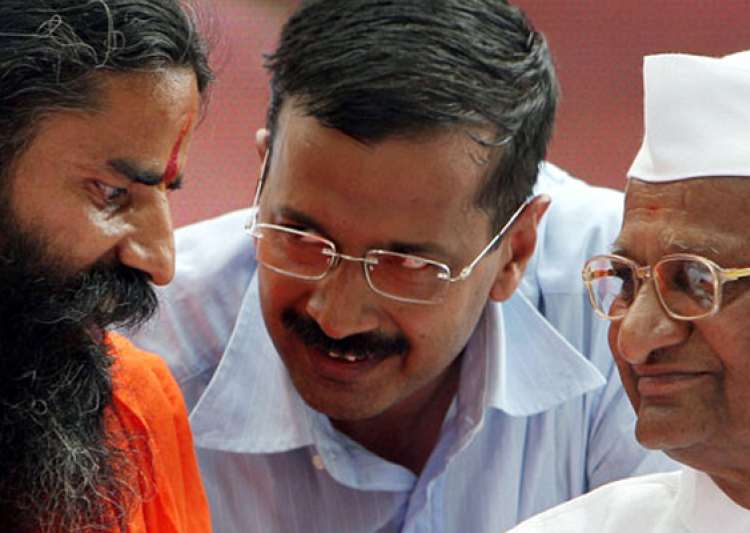
Most disturbing of all, however, are the actions of the party supremo, Arvind Kejriwal. Kejriwal has had no problem in the past drawing such Hindu spiritual leaders like Sri Sri Ravi Shankar and Baba Ramdev into his movement. Right from the get go therefore, Kejriwal has violated secularism by mingling the Hindu religion with his politics. More recently, despite the livelihood and environmental violations involved in setting up the venue for the World Culture Festival on the banks of the river Yamuna, and in contravention of his own position on corruption, Kejriwal saw it fit to attend the event, and kowtow before Ravi Shankar.  As distasteful as this may be to some, it is not necessarily out of character for unprincipled political leaders who need to engage in populist measures if they are to stay in power. It is, therefore, precisely because AAP Goa will have to play by established rules of the game once it is in power, that we need to evaluate them stringently before they get into power. In light of this, AAP Goa’s connections to soft Hindu nationalism present a clear and present danger.

(A version of this text was first published in the O Heraldo dated 29 April 2016)

Wednesday, February 29, 2012

Heads or Tails? : This farce of good governance vs. corruption


And so it has come to pass, that the contest for the constitution of the Goa State legislative assembly, has been cast as the choice between corruption and its alleged polar opposite of good governance. We should bear in mind, that this ridiculously simplistic and erroneous equation has been made possible as a result of that tainted agitation of some months ago, the Hazare drama. This equation is ridiculous not because the Congress-wallas are lambs bleating at the altar of the common good; after all, who can deny that they are, almost to the last of them, wolves. This equation is ridiculous because ‘corruption’ emanates not from a party, but from the political and executive process in which we are all immured. Should the BJP be elected, there is no doubt that one will be witness to similar levels of hand-over-fist looting of the public treasury. It is hilarious infact, that the BJP can make it sanctimonious positions when some of its candidates are not just miners, but builders as well, when some of the individuals contesting on the BJP-alliance tickets, were in fact indicted in the PAC reported tom-tomed by Mr. Parrikar.

To certain segments of the population, the BJP’s claim to Good Governance rests on the unsullied reputation (in matters of graft that is) of its ‘Chief Ministerial candidate’ Mr. Manohar Parrikar. They present a list of impressive developmental works that he undertook for the city of Panjim, both during his stint at CM and subsequently as MLA. In the course of his term (or was it reign?) as CM too, they point to the simplicity of his life-style and his blemish-less personal track record. Commonspeak has it that indeed Mr. Parrikar is above reproach, not a single paisa entered his personal estate. The same commonspeak however suggests that his position as CM influenced the coffers of the Party. On this front, there is a lot of suggestion that indeed, figures were hiked, and contracts offered to party favourites, so that the party coffers and favourites might prosper.

The issue that emerges therefore, and one that we should take seriously, if corruption is being made the issue, is not only of fiscal corruption, but moral corruption as well. While the above scenario, of using his public office to benefit the party would come under such scrutiny, one must also examine the political ideology of the BJP, which in itself is fairly corrupt. The reference ofcourse is to the saffron agenda of making India a Hindu state.

Now Mr. Parrikar has been reported to have publicly acknowledged that the sectarian actions of his previous tenure as CM, was the result of ‘bad advice’. He vows not to repeat this ‘mistake’again. This is a rather large herring to swallow however. Given the manner in which we sneer at the ‘uneducated’ persons getting tickets on the Congress train, one does not expect a focused and educated individual such as Mr. Parrikar to be so easily swayed by ‘advice’. Perhaps Mr. Parrikar is using a euphemism, and what he means by advice, is in fact pressure; from his associates, both from within the BJP as well as his parent organization, the RSS.

Let us change track for just a moment and have a look at the track record of the BJP in one of the two states that have been racked by communal tensions; Gujarat and Karnataka. A recentreport on the saffronisation in Karnataka in the Tehelka points out that in 2008, “Once the BJP government was installed, it had a choice between broad-based development of the state and consolidation of the Sangh structure. Four years on, it’s obvious which path was chosen. In its first year itself, the government had given evidence of its agenda. Bajrang Dal activists attacked churches, with the administration scarcely taking stern action. The question of whether the government would rein in extremist elements was answered in the negative.”  There is every fear of such a systematic consolidation of the Sangh structure taking place in Goa if it comes within the shade of the saffron umbrella. Hark back to episode, where on the course of his tenure as CM, government-run schools were handed over to the ‘NGO’ Vidya Bharathi. Vidya Bharati it turned out was an RSS outfit. An outfit prone to tailoring the teaching of history towards Hindutva designs, and cultivating all manner of sectarian myths about non-Hindus. Such actions are hardly the result of bad advice that one can ignore. It is the result of a deliberate, calculated policy of the entire Sangh structure that the BJP is a part of. Such a careful scheme of deliberately poisoning the social environment of the state and country, cannot be excluded from the ambit of corruption. On this count, the BJP cannot, under any circumstance excuse itself from the charge of being corrupt.

There is another count on which when examining the reputation of Mr. Parrikar, the BJP fails to match up to its rhetoric of good governance. Mr. Parrikar’s term in office was likened to a reign. Like absolute monarch, Mr. Parrikar is reported to have done exactly what he felt needed to be done. Of course, given our ‘democratic’ times, he would be more likely compared to a fast and efficient, CEO. Good governance however, is emphatically not only about efficiency, it is also about consultation and partnership, values that are widely felt to have been markedly absent in the course of Mr. Parrikar’s term in office. Indeed, it is not surprising that it is precisely the Catholic business (and feudal) classes that feel attracted to Mr. Parrikar, and would be willing to overlook his rightist tendencies. The larger neo-liberal environment within which we live privileges such autonomous action that favours technical and authoritarian resolutions of problems, forgetting the more important fact that institutions alone cannot resolve problems.  Take the naïve claims of the India Against Corruption, an in effect right-leaning association, that seems to think that corruption is some switch that people turn on to get jobs done, and all we need is a Lok Ayukta to turn that switch off and resolve the corruption problem. Social problems emerge from a plethora of social issues, and these must be addressed, one problem at a time.

A continued interaction between individuals and associations is fundamental to the elaboration of good governance. No matter how loathsome the politics of Mr. Digambar Kamat, the man has always remained approachable. One may not get a response, but one gets a hearing; a scenario which has markedly absent from the workings of Mr. Parrikar. This lack of a hearing bears out, given the kind of cultic image that has been built around the man. All-knowing, all-capable (and all-powerful) why was there a need for civil society when he knew what you needed and how it needed to be done? The absence of a space for civil society and the dominance of the cult figure is not a mark of good governance; it is a mark of the fascist polity.

There is another argument that needs to be made in light of this building up of a personality cult around Mr.Parrikar. The man is no longer addressed as just a man, but per force becomes, as in this column, the target for the large claims that are being made on his behalf. Such a depersonalisation is deeply unfortunate, tragic even, given that Parrikar the man, as I would personally be able to attest, when relating with an individual in need, is a profoundly generous person.
In conclusion, the point has to be stressed that this column is not an argument in favour of the Congress (I), it is a plea against reducing the upcoming election to just good –governance or corruption. To quote a friend, ‘elections are fought and won on multiple considerations which go beyond communalism or corruption’. This is to say that an election is not an either-or game decided between good governance and corruption. There are plenty of other considerations that we need to consider. To ignore these considerations, is to engage in a very dangerous game of simplification. A game that later generations will eventually hold us accountable for.


(A version of this post was first published in the Gomantak Times 29 Feb 2012)

Thursday, January 12, 2012

The Sweeper: Hazare, brooms and the culture of corruption


There was a rather shocking newsreport in The Hindu a couple of days ago. The report indicated that the sad story of the widows of Vrindavan often does not end with their death. On the contrary it continues beyond, since there are no provisions, at least in two of the Government sponsored institutions, for the last rites of these destitute women. The result of this gap is that their corpses are carried away by sweepers, cut into pieces, and then disposed of in jute bags.

What was also shocking however was the tone of the first of paragraphs of this report, that, after reporting on the fact, thought fit to mention, that “This, too, is done only after the inmates give money to the sweeper!” In making this statement, the report added one more figure to the list of villains of the piece. There was, the families of these women, who abandoned or forced these women to destitute existence; the proprietors of the homes they live in; the organizations set up to care for these women; and finally, the sweepers who dispose of the bodies. And yet, because they are the final link of this chain of shame, the sweepers appear as the greatest villains of all. The sweepers are villainous here, since they seem to lack the basic humanity of disposing of the body without asking for what, this sentence suggests, is essentially a bribe.

The question that we need to ask however is why is it that the sweeper is being effectively asked to bear the burden of humanity that has been shrugged off by the rest of society? Why was no thought given to the fact that in addition to take on a responsibility that is not a part of the services they offer as part of their contract of employment, by taking on the responsibility to discard the corpse the humanity of the sweeper is in effect compromised by the fact of their having to cut up a human corpse like it were that of an animal? Catering to the dead is often seen as a mark of respect to the dead. However, it can also be thought of as catering to the sentiments of the living. By treating the dead as if they were still alive, we renew in the living the sense of value to life and the human body. By having to dispose of the bodies of the widows in this manner, it is not just the widows, but the sweepers as well who are effectively being dehumanized.

The reason these questions were not asked by the reporter who penned the story, is perhaps because of the space the wielder of the broom holds in our society. The position of the sweeper is not an open category job opportunity. It falls within the reserved category. It is reserved often for those that are deemed untouchable, or nearly untouchable. This fact was strikingly demonstrated in the course of the protests by upper-caste participants against the Mandal Commission’s recommendations, as well as general protests against reservation. The message they sought to transmit, was that thanks to this policy of reservations, they would be unable to gain respectable jobs as engineers and doctors, and have to take up the shameful jobs of being sweepers. The broom then, was a mark of shame, while at the same time indicating that there exists no need for us to necessarily respect, or treat as humans, those who generally wield the broom.

There have been other uses of the broom however, where there is an attempt to use the symbol of the broom as a positive element. Very often though, these uses have not detracted from the generally negative symbolic value of the broom. On the contrary, they rely on the negative connotation that the broom generally holds in our society. An example of this was the use of the broom in a recent art installation by Raj Bhandare, a Goan artist, in favour of Hazare’s movement against corruption. Titled ‘Anna Logue’ the installation referenced the ‘shit’ that the country was in, and incorporated into the work, a number of elements necessary for us to resolve the problem. One of these elements was the broom, incorporated as an ‘an appeal to one and all that we need to take it up upon us to Cleanse the System.’ In this arrangement, the broom gains importance primarily because it is ‘us’ respectable folk, who are taking it up. It is clear from the installation’s phrasing of the broom element, that the citizens do not normally take up the broom, that the taking up of the broom is an extra-ordinary circumstance, and it is for the general benefit of society that we must now debase ourselves to clean up the shit that we may have contributed to. In sum, the power of our action lies because of the negative value that is normally associated with the broom and the everyday, or ordinary, wielder of the broom.

The wielder of the broom then is often not understood to be human. The place of the wielder of the broom is to do their job, and their job is not regarded as the list of duties set out within a contract of employment. No, their job is to serve, without question. If this servant asks for reimbursement for extra services rendered, that is to say, demand their right, the response of the rest of the system is to sit back in shock. This demand is seen as the demand for a bribe, it is seen as corruption.

Since the past few weeks, it appears as if the Hazare saga has come, or will eventually come to an end. However, regardless of the presence of Hazare, the unquestioning attitude as to what comprises corruption continues. At the height of the Hazare mania that overtook the country, asking these questions was tantamount to justifying corruption. Perhaps it would now be a more convenient time to interrogate ourselves on what is our understanding of corruption, and if our notions of corruption, like those of the reporter for TheHindu, are not twined with a morality that stems from our own limited upper-strata of society locations.

(A version of this post was first published in the Gomantak Times 12 Jan 2012)