Showing posts with label elections. Show all posts

Saturday, May 18, 2013

Who rules? - Determining the extent of the Panchayat’s power


Chief Minister Manohar Parrikar was recently reported to have indicated in the course of legislative debate that he would rather have a referendum than let Gram Sabhas take a decision on the much contested developmental plans that form part of the Regional Plan. Subsequently, the Chief Minister has been reported to have suggested that Gram Sabhas are only advisory in nature, said the Chief Minister, their decisions cannot be legally binding on the panchayat.

Given that that the Chief Minister is not alone in his observations, and his opinion is shared by many developers I would like to first reference, and then engage with, the arguments presented by similarly inclined commentator in the public sphere.

Speaking in the context of migrants, Prabhakar Timble felt obliged to also suggest that, “…we notice the Gram Sabhas and Village groups of Goa opposing almost all proposals of investment or development in the village.  To a large extent, the opposition at the Gram Sabha is from those members who are defeated at the Panchayat elections. In a multi-cornered contest at Panchayat elections, the aggregate number of defeated candidates is sizeable in relation to the elected members of the Panchayat.  It is really a funny situation wherein the elected Panchayat is held hostage by the Gram Sabha under the domineering influence of the candidates who are rejected by the village electorate and who later form the active component at the Gram Sabha. I have not heard of Gram Sabha directing and recommending the Panchayat “to do” specific projects or encourage a set of economic activities in the village.”
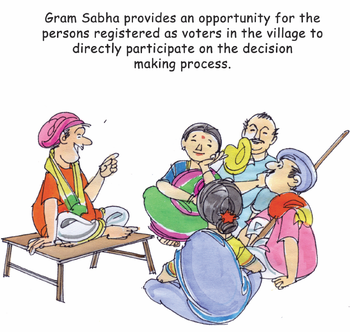
Rather than address the issue of the legality of the Gram Sabha’s capacity to direct the Sarpanch and council, I would like to deal with the logic displayed above that attempts to undermine the validity of the discussions that take place in the Gram Sabha. Timble’s logic suggests that the candidates who have won the election are approved by the electorate, and those who have lost the election are rejected by the same body. In making this suggestion, Timble could not be further from the truth.

The “first-past-the post” method that Indian electoral system uses to determine the winner in an election is but one of several ways of doing so. In this method, the person with the highest votes wins, even if the number of these votes do not constitute a majority of the electorate, and it is possible that as a result of the multi-cornered contests that Timble draws our attention to, the winner in fact enjoys the confidence of just a minority of the electorate. Indeed, as has been pointed out, the first-past-the post method is ideally used in elections between two parties. In such a case, where electoral contests are contested by beyond three parties, it would be highly illogical to assume that the winner holds the confidence of the majority and has the right to take decisions on agendas that will hold significance beyond the five year period that they are elected for.

In a situation where the winner of an election may hold the confidence of only a minority of the electorate, it makes sense to read the result of the elections as securing the right of the successful candidate to lead deliberations in the panchayat and Gram Sabha, but definitely not to make unilateral decisions. The multi-cornered fights in the Gram Sabha are evidence of the complex nature of the Panchayats and a testament to the vibrancy political life of the electorate. The Gram Sabha then, is not only a crucial space where the tensions, and ideas can be debated and then independently voted on, but a critically important one if we are to ensure that the Panchayat is genuinely representative of democracy.

Having said this, there is a need to recognize two valid criticisms that are leveled against the operation of Gram Sabhas. The first is the criticism that given the number of persons with strong opinions, these Gram Sabhas often descend into chaos, where everybody is screaming, no one is listening, and nothing gets done. The second criticism is that oftentimes decisions can be taken that violate fundamental principles of law.

The first criticism is really a testament to the fact that a culture of debate has not yet taken solid root in our political life. The blame for this lies as much at the feet of persons outside of power, as those who hold power. Sarpanches should be required to acquire a training in how to effectively conduct debates where all sides are allowed space to present and rebut arguments. Where persons fail to cooperate with the process, the law provides for the presence of police who can be called to restore order. Unfortunately, when the police are called, it is usually to intimidate persons with opinions opposite to that of the Sarpanch who seeks to push his agenda through.

In the second case, if, and when Gram Sabha decisions have been taken in violation of basic principles of law, this opens up space for the decisions of the Gram Sabha are adjudicated by the superior courts that exist both within the panchayat system as well as outside of it. Rather than see adjudication of these allegedly faulty decisions as a problem, once more this process should be seen as a way to build up precedents for Gram Sabhas to follow, and harmonize this system of local self governance with the larger systems of state and central governance that have until date received far more importance.

The problem however seems to be that rather than allow for a more democratic state, business interests and the interests of the MLAs are working together to deny this possibility by writing off the Gram Sabhas as failures even before these institutions have been allowed to work in an ideal environment.

(A version of this post was first published in the Gomantak Times 18 April 2013)

Wednesday, February 29, 2012

Heads or Tails? : This farce of good governance vs. corruption


And so it has come to pass, that the contest for the constitution of the Goa State legislative assembly, has been cast as the choice between corruption and its alleged polar opposite of good governance. We should bear in mind, that this ridiculously simplistic and erroneous equation has been made possible as a result of that tainted agitation of some months ago, the Hazare drama. This equation is ridiculous not because the Congress-wallas are lambs bleating at the altar of the common good; after all, who can deny that they are, almost to the last of them, wolves. This equation is ridiculous because ‘corruption’ emanates not from a party, but from the political and executive process in which we are all immured. Should the BJP be elected, there is no doubt that one will be witness to similar levels of hand-over-fist looting of the public treasury. It is hilarious infact, that the BJP can make it sanctimonious positions when some of its candidates are not just miners, but builders as well, when some of the individuals contesting on the BJP-alliance tickets, were in fact indicted in the PAC reported tom-tomed by Mr. Parrikar.

To certain segments of the population, the BJP’s claim to Good Governance rests on the unsullied reputation (in matters of graft that is) of its ‘Chief Ministerial candidate’ Mr. Manohar Parrikar. They present a list of impressive developmental works that he undertook for the city of Panjim, both during his stint at CM and subsequently as MLA. In the course of his term (or was it reign?) as CM too, they point to the simplicity of his life-style and his blemish-less personal track record. Commonspeak has it that indeed Mr. Parrikar is above reproach, not a single paisa entered his personal estate. The same commonspeak however suggests that his position as CM influenced the coffers of the Party. On this front, there is a lot of suggestion that indeed, figures were hiked, and contracts offered to party favourites, so that the party coffers and favourites might prosper.

The issue that emerges therefore, and one that we should take seriously, if corruption is being made the issue, is not only of fiscal corruption, but moral corruption as well. While the above scenario, of using his public office to benefit the party would come under such scrutiny, one must also examine the political ideology of the BJP, which in itself is fairly corrupt. The reference ofcourse is to the saffron agenda of making India a Hindu state.

Now Mr. Parrikar has been reported to have publicly acknowledged that the sectarian actions of his previous tenure as CM, was the result of ‘bad advice’. He vows not to repeat this ‘mistake’again. This is a rather large herring to swallow however. Given the manner in which we sneer at the ‘uneducated’ persons getting tickets on the Congress train, one does not expect a focused and educated individual such as Mr. Parrikar to be so easily swayed by ‘advice’. Perhaps Mr. Parrikar is using a euphemism, and what he means by advice, is in fact pressure; from his associates, both from within the BJP as well as his parent organization, the RSS.

Let us change track for just a moment and have a look at the track record of the BJP in one of the two states that have been racked by communal tensions; Gujarat and Karnataka. A recentreport on the saffronisation in Karnataka in the Tehelka points out that in 2008, “Once the BJP government was installed, it had a choice between broad-based development of the state and consolidation of the Sangh structure. Four years on, it’s obvious which path was chosen. In its first year itself, the government had given evidence of its agenda. Bajrang Dal activists attacked churches, with the administration scarcely taking stern action. The question of whether the government would rein in extremist elements was answered in the negative.”  There is every fear of such a systematic consolidation of the Sangh structure taking place in Goa if it comes within the shade of the saffron umbrella. Hark back to episode, where on the course of his tenure as CM, government-run schools were handed over to the ‘NGO’ Vidya Bharathi. Vidya Bharati it turned out was an RSS outfit. An outfit prone to tailoring the teaching of history towards Hindutva designs, and cultivating all manner of sectarian myths about non-Hindus. Such actions are hardly the result of bad advice that one can ignore. It is the result of a deliberate, calculated policy of the entire Sangh structure that the BJP is a part of. Such a careful scheme of deliberately poisoning the social environment of the state and country, cannot be excluded from the ambit of corruption. On this count, the BJP cannot, under any circumstance excuse itself from the charge of being corrupt.

There is another count on which when examining the reputation of Mr. Parrikar, the BJP fails to match up to its rhetoric of good governance. Mr. Parrikar’s term in office was likened to a reign. Like absolute monarch, Mr. Parrikar is reported to have done exactly what he felt needed to be done. Of course, given our ‘democratic’ times, he would be more likely compared to a fast and efficient, CEO. Good governance however, is emphatically not only about efficiency, it is also about consultation and partnership, values that are widely felt to have been markedly absent in the course of Mr. Parrikar’s term in office. Indeed, it is not surprising that it is precisely the Catholic business (and feudal) classes that feel attracted to Mr. Parrikar, and would be willing to overlook his rightist tendencies. The larger neo-liberal environment within which we live privileges such autonomous action that favours technical and authoritarian resolutions of problems, forgetting the more important fact that institutions alone cannot resolve problems.  Take the naïve claims of the India Against Corruption, an in effect right-leaning association, that seems to think that corruption is some switch that people turn on to get jobs done, and all we need is a Lok Ayukta to turn that switch off and resolve the corruption problem. Social problems emerge from a plethora of social issues, and these must be addressed, one problem at a time.

A continued interaction between individuals and associations is fundamental to the elaboration of good governance. No matter how loathsome the politics of Mr. Digambar Kamat, the man has always remained approachable. One may not get a response, but one gets a hearing; a scenario which has markedly absent from the workings of Mr. Parrikar. This lack of a hearing bears out, given the kind of cultic image that has been built around the man. All-knowing, all-capable (and all-powerful) why was there a need for civil society when he knew what you needed and how it needed to be done? The absence of a space for civil society and the dominance of the cult figure is not a mark of good governance; it is a mark of the fascist polity.

There is another argument that needs to be made in light of this building up of a personality cult around Mr.Parrikar. The man is no longer addressed as just a man, but per force becomes, as in this column, the target for the large claims that are being made on his behalf. Such a depersonalisation is deeply unfortunate, tragic even, given that Parrikar the man, as I would personally be able to attest, when relating with an individual in need, is a profoundly generous person.
In conclusion, the point has to be stressed that this column is not an argument in favour of the Congress (I), it is a plea against reducing the upcoming election to just good –governance or corruption. To quote a friend, ‘elections are fought and won on multiple considerations which go beyond communalism or corruption’. This is to say that an election is not an either-or game decided between good governance and corruption. There are plenty of other considerations that we need to consider. To ignore these considerations, is to engage in a very dangerous game of simplification. A game that later generations will eventually hold us accountable for.


(A version of this post was first published in the Gomantak Times 29 Feb 2012)

Wednesday, April 1, 2009

Thinking About Babush – I : Mapping the terrains of the operation

On the 23rd of March, despite opposition to 10 of the 11 seats being contested at the Panchayat elections, the panel floated by Atanasio Monserrate won all 11. How does one make sense of the results of the recently concluded elections to the Taleigão Panchayat? The dominant view within the opposition is that Monserrate is the embodiment of evil, and that all of Taleigão cowers in fear. Other views would argue that he has filled Taleigão with migrants who blindly vote in his favour. Others argue that some sold their vote for the gifts of a thousand rupees, a bicycle or a sewing machine. I believe that the story of Monserrate is a little more complex than this, and we need to necessarily rethink our evaluation of him.


Countering the allegations that he bribed the voters, Monserrate reportedly responded that we should not insult the voters. Monserrate makes a valid point here. As with any allegation of corruption, there is a certain political point that Monserrate’s opposition is trying to score. The point is to undermine the individual decisions of those persons who voted for Monserrate. The suggestion is that they are not free-thinking, concerned and responsible citizens. It is scornfully suggested that they are merely opportunists who will vote for the highest bidder. While I have no doubt that in fact money did exchange hands and that gifts of cycles and sewing machines, drink and chicken were in fact made, I would choose to look beyond the allegation that the votes of the people were purchased. The reason I choose to refute the argument that votes can be purchased is because this scornful position refuses to recognize that the persons who accepted these gifts were in fact making calculated political decisions. Just like the ‘apolitical’ stance taken by Goa and Taleigão Bachao Abhiyans, the argument that votes can be sold, refuses to appreciate and engage with the politics of the people.


To begin with, whose is this scorn? Clearly it is the scorn of those who do not need a thousand rupees a vote, or cycles or sewing machines. It is the scorn of the haves for the have-notes, the haves presuming that it is only they who well and truly appreciate what democracy is all about. The gifts were accepted because these gifts, as petty as some of us may consider them, did make a difference to the economy of the households that they were presented to. Further, the gift-taking is in fact a rather complex participation in democracy. The gift-takers recognize that the politician cares for them only to the extent of their votes, that the system will not address their condition. Thus, if they have to vote, they will vote only if you pay (gift) them to do so. It is thus, through this gift-giving, and their construction of themselves as a vote-bank, that they force the electoral process to in fact work. If they didn’t, then given the fact that most of the middle class does not vote, the electoral process would grind to a screeching halt! Our scorn for the gift-taking therefore, is extremely problematic and ironically, politically naive!


This political naiveté is built on the incredulousness of the upper orders who are convinced of their own political maturity and the corresponding immaturity of the labouring classes. They reason that it is because these labouring classes are so immature that our democracy is today malfunctioning the way that it is. These orders refuse to see that these ‘malfunctionings’ of democracy are in fact the result of the deeply problematic socio-economic divides that persist in our society, and that we repeatedly refuse to address. It is because we refuse to recognize this fact, and persist in our confounded arrogance, that a good portion of the opposition to the development lobby in Goa is primarily engaged in ‘creating awareness’. They are firmly convinced that the only reason for the silence of the majority is because this majority is not aware. It is because we stubbornly refuse to consider the alternative, that they are politically astute individuals making carefully calibrated decisions that the tide we seek to stem continues to inundate us.


If we recognized the ‘maturity’ of these gift takers and recognized that gifts are accepted because these gifts made a difference to the economies of the households that accepted them, our positions and our strategies would change instantly. We would recognize that the presence of ‘outsiders’ in our villages, and their transformation into vote-banks for the unscrupulous, can be addressed if, and when, we address the issue of their poverty. If we are able to ensure that their working conditions are better, the salaries they are paid are higher, and that social welfare extendable to any worker, we would see a significant drop in the arrival of these outsiders. This for two primary reasons; first, because it would make employing ‘external’ labour more expensive (especially if one is talking of housing migrant construction-labour); and secondly, with an increase in pay-scales and benefits, the Goan, who in facts demands a more mature work environment, would begin seeking employment within Goa. As is increasingly becoming clear to me though, much of the oppositional space in Goa is captured by elites, who do not want to see radical change, but want only a return to the status-quo. Secondly, when the non-elites among this opposition take charge, they unfortunately don’t seem to be able to articulate their demands in broader terms. On the contrary, they too get caught in the whirlpools of the discourse established by the elite. As a result, rather than seeing solidarity with the ‘outsider’, they too begin outsider bashing. As a result, there is no substantial progress towards resolving Goa’s crisis.

To return to this matter of respecting the voter though, while Monserrate’s objection may have helped us see a valid point, he too is guilty of disrespecting the voter. There is a certain perversity, when one hands scraps to the needy, even as the socio-economic and ecological base of these needy are being destroyed. In addition, it is clear that while Monserrate may share scraps, it is a lion’s share that he keeps for himself.

As I will try to elaborate in the next segment of these reflections, while Monserrate has offered his constituency a political dream that they can identify with, in reality he offers them only a mirage, one that will never be realized concretely. What clinches the deal for him however, is the fact that he has managed to offer concrete glimpses of this mirage. This, is enough for the hopefuls of our land. On the other hand though, his opposition offers no dream at all. It offers only a return to a fast-disappearing status-quo. And NO-ONE wants to return to that, except the elite. If the opposition to Monserrate (and the rest of the brokering political establishment) are serious, then they need to not only present to the people of Goa a dream, but put their actions where their talk is and working toward presenting a concrete example of the dream that they offer.

(Published in the Gomantak Times, 1 April 2009)