Showing posts with label Panchayati Raj. Show all posts

Saturday, May 18, 2013

Who rules? - Determining the extent of the Panchayat’s power


Chief Minister Manohar Parrikar was recently reported to have indicated in the course of legislative debate that he would rather have a referendum than let Gram Sabhas take a decision on the much contested developmental plans that form part of the Regional Plan. Subsequently, the Chief Minister has been reported to have suggested that Gram Sabhas are only advisory in nature, said the Chief Minister, their decisions cannot be legally binding on the panchayat.

Given that that the Chief Minister is not alone in his observations, and his opinion is shared by many developers I would like to first reference, and then engage with, the arguments presented by similarly inclined commentator in the public sphere.

Speaking in the context of migrants, Prabhakar Timble felt obliged to also suggest that, “…we notice the Gram Sabhas and Village groups of Goa opposing almost all proposals of investment or development in the village.  To a large extent, the opposition at the Gram Sabha is from those members who are defeated at the Panchayat elections. In a multi-cornered contest at Panchayat elections, the aggregate number of defeated candidates is sizeable in relation to the elected members of the Panchayat.  It is really a funny situation wherein the elected Panchayat is held hostage by the Gram Sabha under the domineering influence of the candidates who are rejected by the village electorate and who later form the active component at the Gram Sabha. I have not heard of Gram Sabha directing and recommending the Panchayat “to do” specific projects or encourage a set of economic activities in the village.”
Rather than address the issue of the legality of the Gram Sabha’s capacity to direct the Sarpanch and council, I would like to deal with the logic displayed above that attempts to undermine the validity of the discussions that take place in the Gram Sabha. Timble’s logic suggests that the candidates who have won the election are approved by the electorate, and those who have lost the election are rejected by the same body. In making this suggestion, Timble could not be further from the truth.

The “first-past-the post” method that Indian electoral system uses to determine the winner in an election is but one of several ways of doing so. In this method, the person with the highest votes wins, even if the number of these votes do not constitute a majority of the electorate, and it is possible that as a result of the multi-cornered contests that Timble draws our attention to, the winner in fact enjoys the confidence of just a minority of the electorate. Indeed, as has been pointed out, the first-past-the post method is ideally used in elections between two parties. In such a case, where electoral contests are contested by beyond three parties, it would be highly illogical to assume that the winner holds the confidence of the majority and has the right to take decisions on agendas that will hold significance beyond the five year period that they are elected for.

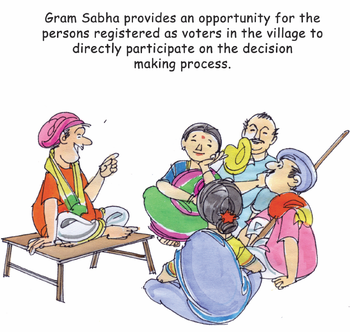
In a situation where the winner of an election may hold the confidence of only a minority of the electorate, it makes sense to read the result of the elections as securing the right of the successful candidate to lead deliberations in the panchayat and Gram Sabha, but definitely not to make unilateral decisions. The multi-cornered fights in the Gram Sabha are evidence of the complex nature of the Panchayats and a testament to the vibrancy political life of the electorate. The Gram Sabha then, is not only a crucial space where the tensions, and ideas can be debated and then independently voted on, but a critically important one if we are to ensure that the Panchayat is genuinely representative of democracy.

Having said this, there is a need to recognize two valid criticisms that are leveled against the operation of Gram Sabhas. The first is the criticism that given the number of persons with strong opinions, these Gram Sabhas often descend into chaos, where everybody is screaming, no one is listening, and nothing gets done. The second criticism is that oftentimes decisions can be taken that violate fundamental principles of law.

The first criticism is really a testament to the fact that a culture of debate has not yet taken solid root in our political life. The blame for this lies as much at the feet of persons outside of power, as those who hold power. Sarpanches should be required to acquire a training in how to effectively conduct debates where all sides are allowed space to present and rebut arguments. Where persons fail to cooperate with the process, the law provides for the presence of police who can be called to restore order. Unfortunately, when the police are called, it is usually to intimidate persons with opinions opposite to that of the Sarpanch who seeks to push his agenda through.

In the second case, if, and when Gram Sabha decisions have been taken in violation of basic principles of law, this opens up space for the decisions of the Gram Sabha are adjudicated by the superior courts that exist both within the panchayat system as well as outside of it. Rather than see adjudication of these allegedly faulty decisions as a problem, once more this process should be seen as a way to build up precedents for Gram Sabhas to follow, and harmonize this system of local self governance with the larger systems of state and central governance that have until date received far more importance.

The problem however seems to be that rather than allow for a more democratic state, business interests and the interests of the MLAs are working together to deny this possibility by writing off the Gram Sabhas as failures even before these institutions have been allowed to work in an ideal environment.

(A version of this post was first published in the Gomantak Times 18 April 2013)

Wednesday, July 14, 2010

Portuguese in the Indian national interest: Expanding horizons beyond the English speaking world

To a small but vocal minority in Goa, Goa’s Portuguese heritage is something to be castigated and cast into the dust-bin of history. To this shortsighted group Portuguese evokes only the continental European country that speaks the language, and they fail to see the linkages that Goa has had, and can continue to have via this language, with a larger Portuguese speaking world that extends across the world.

On the 12th of this month, the Xavier Centre’s History Hour played host to Constantino Xavier who made an argument along similar lines. Constantino Xavier is currently a Fulbright-sponsored Ph.D. candidate in South Asian Studies at the School of Advanced International Studies, Johns Hopkins University, in Washington DC and someone with a number of very interesting things to say. At the History Hour, his argument was that as India opens out to the world, there is space to carve out what he calls ‘diplomatic niches’ outside of New Delhi. Goa, he argued, can play a crucial role in facilitating India's burgeoning economic, political and cultural relations with the Community of Portuguese-speaking countries (CPLP) and the lusophone world. In line with Beijing's efforts to leverage Macau's potential, New Delhi could develop Goa into a strategic hub to foster relations with the emerging "Global South" and, in particular, with Brazil, Portugal, Angola, Mozambique, Macau, or East Timor. It need not be pointed out that Brazil and Angola are significant economic players in the emerging southern economies.

This column has on numerous occasions berated the point that economic capital is not the only capital that one has; rather one should also be alive to the cultural capital that we hold. For the Goan, this cultural capital of global worth includes the Portuguese language. Thanks to the machinations of this tiny group however, we are prevented from using or expanding on this capital.

A greater familiarity with Portuguese and the Portuguese-speaking world holds over benefits as well. This includes expanding our intellectual horizons. It was while reading Opus Dei, a book by John L. Allen Jr. about the Catholic organization of the same name that the truth struck home. Many of the prejudices and opinions that we often have of the world, are those moulded by the prejudices and opinions of the English-speaking world. Thanks to unfamiliarity with other dominant world languages, our opinions, perspectives, and options are in many ways restricted. Goa’s linguistic diversity ought to have been a route for us to introduce the larger Indian civil society space with different ideas from the larger Portuguese-speaking world. Happily, this route is not yet not closed to us.

An example of the manner in which familiarity with this non-English speaking world is useful was brought out by a recent essay by Vinod Vyasulu in the Economic and Political Weekly. Vyasulu who is the Director for the Centre of Budget and Policy Studies in Bangalore, has written a rather interesting essay on Brazil’s cash transfer systems that are a part of their strategy to reduce poverty and income inequality. Apparently the way the system works is that “Since poverty is lack of income, the federal government of Brazil transfers cash to families in poverty to help them meet basic needs, if the family agrees to send children to school and to get them vaccinated.” Similarly as part of the cash transfer system the “Fome Zero, or zero hunger” strategy has introduced the bolsa familia. The Bolsa Familia apparently is a family grant which is a direct income transfer to benefit families earning a monthly income of not more than Brazilian Real (R$) 120 per member per month in any municipality in Brazil. “The objective is to enable the poorest families to buy food and essentials and at the same time encourage these families to access health, education, and social welfare public services.”

Vyasulu reports that the cash transfer system has been largely successful in Brazil and “have not only served to reduce poverty, they have also contributed to a reduction in inequality”. He goes further to suggest that Brazil’s experience shows that when implemented properly, cash transfers, “are at best a necessary condition for poverty alleviation.” Vyasulu is clearly indicating that it would be worthwhile for India to follow a similar route.

It was not however merely this reference to the cash transfer system that caught my attention but the quotation extracted below;

“Inter-governmental Relations… is an area where India has a lot to learn from Brazil. In the 2009 elections to Parliament in India, many of the candidates seeking election to the Lok Sabha, fought on issues of garbage clearance, water supply and the like. These are municipal issues. The job of MPs is to legislate; this was one thing they were silent about. Members of the state assemblies also talk of transfers and local matters, when their job is to make policies for the state. Thus local representatives are denied their space; local government in India is a sham. And unless local government – which we denigrate by calling self-government – works, such policies which require higher level guidance and local integration cannot work. Many studies have shown that integration of programmes at the local level is the missing link in India’s development policy. Each level of government has its role and we must let it play that role. In this we need to find our way back to normalcy from where we are today.”

This observation would taste sweet for many of those in Goa who are fighting the battle for local governments to have greater autonomy in planning. Vyasulu in castigating the Indian practice of self government makes a striking point. In preventing the Goan panchayats from realizing the planning powers they are demanding, the MLA’s are not only wrongfully interfering in local issues, but they are not guilty of failing in their primary duty, i.e. legislating.

The anti-Portuguese lobby in Goa claims its opposition to things Portuguese on nationalist grounds. Both Xavier and Vyasulu however, seem to suggest that it is in fact a knowledge of Portuguese that could work to the Indian national interest. This point of view should give our right-wing nationalist friends some pause to think….let’s keep our fingers crossed!

(First published in the Gomantak Times 14 July 2010)