With the elections to the state legislature in the not so
distant future the Aam Aadmi Party (AAP) in Goa has begun its campaigning in
earnest. As is well known, AAP has been projecting itself as a credible choice
on the basis of its promise to deliver good, i.e. corruption free, governance. The
question, however, is whether the AAP should be judged merely by its rhetoric,
or should it be examined against a broader canvas?
With the elections to the state legislature in the not so
distant future the Aam Aadmi Party (AAP) in Goa has begun its campaigning in
earnest. As is well known, AAP has been projecting itself as a credible choice
on the basis of its promise to deliver good, i.e. corruption free, governance. The
question, however, is whether the AAP should be judged merely by its rhetoric,
or should it be examined against a broader canvas? 
Recent history demonstrates that electoral decisions
determined solely by the theme of corruption have ensured that we have moved
from the frying pan into the fire largely because we have failed to examine the
politics that these electoral options practice. Take the example of the Modi
government now wreaking havoc across India. Modi was elected into power because
so many people, rightly fed up with the Congress, decided that the man was a
good administrator and deserved a right to govern the country. Closer home in
Goa, fatigue of the never-ending corruption scandals presided over by the
Congress enabled the BJP to come to power.

We now realize that in addition to merely continuing the corrupt
practices of the Congress, the BJP is also committed to a kind of fascist
agenda that is difficult to undo even after they have been removed from power.
This is a kind of moral corruption that is difficult to undo largely because,
as I will go on to show, Hindu nationalism itself is never challenged. As such,
when evaluating AAP in Goa it is imperative that their proximity to the agents
and logics of Hindu nationalism must be strictly evaluated.
 An evaluation of the AAP along this axis must begin with a
statement by Dr. Dattaram Desai, the AAP candidate for North Goa in the
previous Lok Sabha elections in 2014. At that time, Desai indicated in a local
newspaper along the lines that he saw no problem with the RSS and that it was
just another nationalist organization. When Desai was confronted on this matter at a public
meeting conducted by the AAP he denied that he was a part of the RSS, and
denounced the RSS as a communal organization. However, it seemed that he did so
largely because he had been hounded into that position after being asked a
series of leading questions. Desai had been asked at that meeting to issue a
public statement to the effect that he did not approve of the RSS, something he
agreed to, but one that, to the best of my knowledge, was not issued. Desai
continues to be a leading member of AAP in Goa, and in light of his past
comments, this fact should be a cause for concern.
An evaluation of the AAP along this axis must begin with a
statement by Dr. Dattaram Desai, the AAP candidate for North Goa in the
previous Lok Sabha elections in 2014. At that time, Desai indicated in a local
newspaper along the lines that he saw no problem with the RSS and that it was
just another nationalist organization. When Desai was confronted on this matter at a public
meeting conducted by the AAP he denied that he was a part of the RSS, and
denounced the RSS as a communal organization. However, it seemed that he did so
largely because he had been hounded into that position after being asked a
series of leading questions. Desai had been asked at that meeting to issue a
public statement to the effect that he did not approve of the RSS, something he
agreed to, but one that, to the best of my knowledge, was not issued. Desai
continues to be a leading member of AAP in Goa, and in light of his past
comments, this fact should be a cause for concern.
At the above mentioned meeting Dr. Oscar Rebello, also a
prominent member of the AAP in Goa, sought to clarify issues regarding the
links between the RSS and AAP. Using characteristically simplistic logic,
Rebello pointed out that he had friends in the RSS, but that did not
necessarily make him a member of the RSS. Rebello’s logic may be simplistic,
but it is often winning in its presentation. Of course one cannot, especially
in a small place like Goa, deny people entry into a party because they were
once members of the BJP. Perhaps they may have, as is suggested in the case of
Desai, realized that the BJP will not deliver.
But the problem with the RSS, and more importantly Hindu nationalism,
lies in the logics that we internalize owing to a lifetime of being immersed in
it. If these logics are not actively challenged we too become part of the
Hindutva machine.

But it is not merely the local AAP that has disturbing
connections with the RSS or is blasé about Hindu nationalism. Pamela D’Mello writing for an on-line magazine pointed to the disturbing relationship of
Dinesh Waghela to Hindu rightist outfits. Waghela was charged with setting up
AAP in Goa, and at that point just like Desai went on record, to
suggest that he did not see what was wrong with people from the RSS joining
the party.
 What also needs to be pointed out is that AAP’s insistence
on its promised good-governance as a central reason for being a choice in the
upcoming elections partakes in the Hindu Right’s pushing of strong
administrators, whether Modi or our very own Parrikar. This is not to suggest
that good governance is not an important issue. It is. However, we need to
recognize that a limited understanding of corruption, and governance emerges
from the very upper-caste and middle-class reasonings that have generated the
Hindutva upsurge in the country. It is this kind of unthinking of, and
challenge to Hindutva logics that is critical and necessary if AAP in Goa
should emerge as a safer option than it currently seems to be.
What also needs to be pointed out is that AAP’s insistence
on its promised good-governance as a central reason for being a choice in the
upcoming elections partakes in the Hindu Right’s pushing of strong
administrators, whether Modi or our very own Parrikar. This is not to suggest
that good governance is not an important issue. It is. However, we need to
recognize that a limited understanding of corruption, and governance emerges
from the very upper-caste and middle-class reasonings that have generated the
Hindutva upsurge in the country. It is this kind of unthinking of, and
challenge to Hindutva logics that is critical and necessary if AAP in Goa
should emerge as a safer option than it currently seems to be.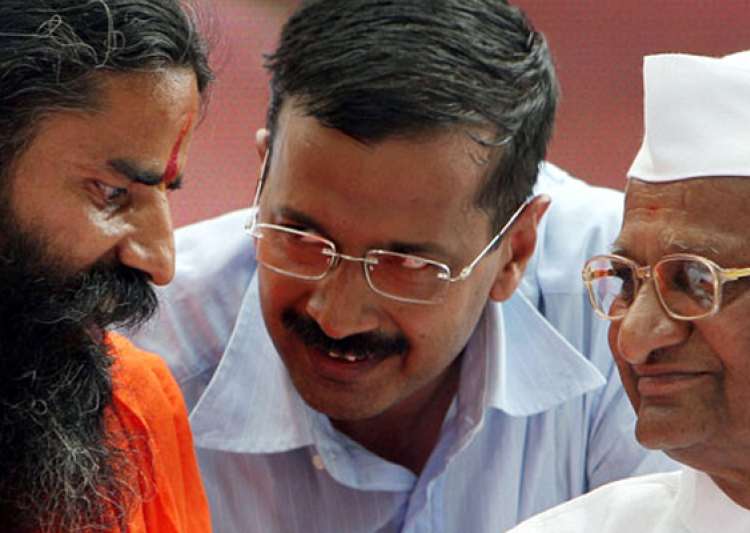
Most disturbing of all, however, are the actions of the
party supremo, Arvind Kejriwal. Kejriwal has had no problem in the past drawing
such Hindu spiritual leaders like Sri Sri Ravi Shankar and Baba Ramdev into his
movement. Right from the get go therefore, Kejriwal has violated secularism by
mingling the Hindu religion with his politics. More recently, despite the livelihood
and environmental violations involved in setting up the venue for the World
Culture Festival on the banks of the river Yamuna, and in contravention of his
own position on corruption, Kejriwal saw it fit to attend the event, and kowtow
before Ravi Shankar. As distasteful as
this may be to some, it is not necessarily out
of character for unprincipled political leaders who need to engage in
populist measures if they are to stay in power. It is, therefore, precisely
because AAP Goa will have to play by established rules of the game once it is
in power, that we need to evaluate them stringently before they get into power. In light of this, AAP Goa’s connections
to soft Hindu nationalism present a clear and present danger.
(A version of this text was first published in the O Heraldo dated 29 April 2016)