Showing posts with label Pedestrian. Show all posts

Tuesday, April 23, 2013

The Itinerant: From Pais Vasco to Panjim


If you were a student, living in the mid 2000s in Oñate, a mountain town of the Basque country, then your entry into San Sebastián would be via train. As you pulled into the station, and then subsequently headed out of the station into the city you would pause for a moment. Was there not a faint resemblance to Panjim city? Did it not feel as if the train station was located where the Patto development now is? Did the bridges across the Rua do Ourem not correspond to the bridges across San Sebastián’s Urumea river?


The resemblance of Panjim to this Basque city can be quite confounding. Not only do both cities lie at the mouths of rivers, but they both also encompass a stretch of beach that is actively used by its denizens for recreation. Add to these coincidences the Miramar palace that sits above the city’s famous beach, echoing Panjim’s own Miramar. Like Panjim, the city too is marked by a number of elegant promenade spaces. This latter feature however, dates back to the royal patronage that it enjoyed in the not too distant past, laying the basis for much that is spectacular in the city.
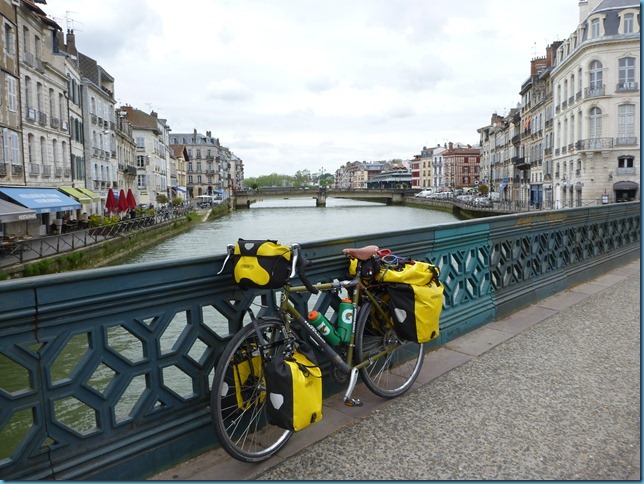
What makes San Sebastián truly breath-taking however is not the drama of its geographical location, a combination of being encircles by beach, river, sea and hills. Neither is it the food; Basque tapas (pintxos) are arguably the finest in Spain. Nor is it the spectacular architecture that constitutes a good amount of the centre of the city. What makes the city breath-taking is when you realise that a good amount of effort and energy has gone into making the city accessible to users of non-motorized vehicles. It is perhaps this reaching out in multiple senses that makes this city all the more enjoyable. 
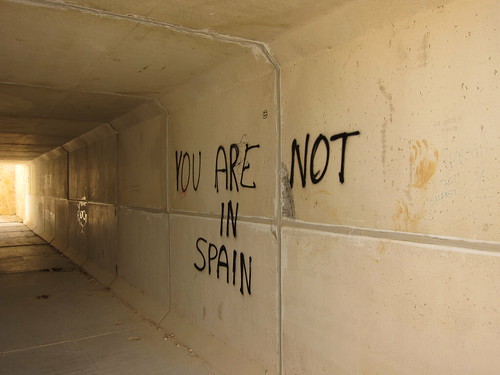
It is, however, more than spatial features that create the sense of similarity between these two widely separated towns. Indeed, both San Sebastián and Panjim share an uneasy relationship with the country within which they are today located. If Goa superficially rests easy within the embrace of Mother India, then the same need not necessarily be said for San Sebastián. Part of the restive Basque country (Euskal Herria), one could, in the period of this itinerant’s visit, find much graffiti on the streets that testified that not all Basques thought themselves Spanish. Slogans like “Gora Euskadi” cheered on a sense of a distinct Basque identity, while other slogans (Euskal Presoak Euskal Herrira) dragged ones attention to the fact that all too often political prisoners were incarcerated outside of the Basque country, so as to make visits by their families a complicated affair.

Another feature that both San Sebastián and Panjim share is that they both enjoy more than one name. San Sebastián also has a Basque (Euskera) name Donostia, while Goa’s capital is known as Panjim in English, Ponnje in Konkani, and Pangim in Portuguese. What perhaps distinguishes San Sebastián from Panjim, is that the former city, following a feature common in the rest of the Basque country, provides space for both versions of the name. This usage is a result of Spain’s efforts to accommodate a variety of regional identities, and indeed nationalisms into the idea of the Spanish nation-state. Now here is something that one would want to see replicated in Goa! This replication would make sense given that in recent days there has been some talk of sharpening the similarity between the two cities. If this is a project that is to be taken seriously, then this is not a project that should end with physical infrastructure. On the contrary, this is a project that must include an agenda that will balance the skewed directions of Goa, and Panjim’s cultural policy.

(A version of this post was first published in The Goan on 23 March 2013)

Saturday, June 2, 2012

Fighting for space: Streetside vendors and urban design


This column on an earlier occasion remarked on the absolute frustration with the lethargy, cynicism and callousness that marked the Kamat model of governance that gave the current government its lease of life. With the election of the Parrikar government there has also been unleashed, as a result of the same frustration, a variety of utopian initatives, not least of which is perhaps the Non Motorized Zone (NoMoZo). This column will deal with two other expressions of this utopian drive, both of which are, like the NoMoZo, concerned with urban design, and the experience of life within the city. The first of these expressions is the suggestions contained in the O Heraldo column of Daniel F. De Souza on the twenty-fourth of May, and the second, a YouTube video petition articulated by Joegoauk Goa, an anonymous visual archivist.

De Souza begins his column by pointing to some of the very real traffic problems that plague the city of Vasco da Gama. He points to the disregard for parking rules that see two-wheelers using space reserved for four-wheelers, and to the unsettling tendency to overtake from the left. It seems however that De Souza saves his best ire for last, when he takes on the presence of roadside garages and makeshift repair shops on the streets of Vasco, charging them with not only being eye-sores but also with posing an inconvenience and hardship to the general public. De Souza argues that by conducting their business on the sidewalk, these shops are forcing the pedestrians off of their rightful space on the footpaths and onto the road and the path of the disorderly traffic and endangering the lives of these pedestrians. 

The video petition of Joegoauk has a similar problem with persons that make a living on the sidewalks and by the sides of roads. His video draws the attention of the Panjim Municipal Corporation the Chief Minister (also MLA of the city of Panjim) to the number of hawkers vending everything from fish, vegetables and plastic toys, amidst the buses and commuters at the Kadamba bus terminus in Panjim.

Both these interventions in the public sphere are motivated by a similar logic, suggesting that the roads are for traffic, the side-walks for the pedestrians, and that the hawkers and vendors, and others making their livelihood off the streets ought to find some other place. Indeed, this is the suggestion that De Souza makes at the end of his column, indicating that the Mormugao Municipal Council ought to identify a location, and then relocate all the makeshift repair shops to that one single location. In making this suggestion De Souza is treading on a well-used path, given that this was a logic that was used in the relocation of the gadey from various parts of Panjim to one single location.

Before differing with the logic that both these gentlemen propose, it should be acknowledged that De Souza does have a point with problematizing the existence of the vehicle repair shops/ garages, though his logic differs from mine. It is true that these enterprises do interfere with the use of the sidewalk. However, the larger problem is that because their presence is not accounted for by the urban-planners or city-council, the highly toxic waste that they generate is unsuitably handled. Invariably the oils and grease they reject stain the ground and find their way into ground water and other water bodies, and other material waste fails to find a route for appropriate waste disposal. The most significant problem with these garages is that they externalize the costs of our usage of vehicles, since the environmental damage that is caused by aging vehicles is not accounted for. Were these garages forced to fulfill norms laid out by the State and municipal bodies, the cost for these norms would have to be borne by the owners of vehicles, giving us a sense of the real cost of our usage of private vehicles that currently dominate our streets.

For all his good intentions however, De Souza’s logic does not seem environmentally responsible. On the contrary, it appears that his logic, and that of Joegoauk, would in fact eventually result in a greater usage of vehicles and the associated environmental resources. In arguing for clearing the streets of street-side vendors, both these individuals subscribe to an urban-planning logic that has created the suburb in other parts of the world. This logic designs urban spaces by their usage, segregating shopping, business, residence from each other, and forcing people to use motorized transport to move from one location to another. Where there is no system of public transport, this results in high use of private vehicles. Simultaneously this same logic designates the street for vehicles able to move at high speeds, and sidewalks for pedestrians only.

There are many problems with this form of urban design, most significant of which is that it does not correspond with the realities of life in India. This reality is one that includes a history of densely populated, multi-use living spaces, as well as the poverty and markedly unequal distribution of wealth. Urban design models that segregate urban use from each other, assume the existence of a prosperous, and middle-class inclined toward high consumption. In forcing the use of private vehicles, this model also spells the death of integrated communities, creating the conditions for crime and social dysfunction.

Both De Souza and Joegoauk, probably have cities like Dubai and Singapore as their models for what our cities should look like. This is not an uncommon desire among the Indian (and Goan) middle-class. We should however keep in mind the words of the RahulMehrotra, and architect, urban studies academic and practitioner who recently authored “Architecture in India Since 1990.” In a recent interview he pointed out that “Looking at Dubai or Shanghai or Singapore as metaphors not only undermines the fact that we’re a democracy but it also undermines the fact that the poor even exist in our cities.”

Street-side garages and vendors exist in our cities not because we are an indisciplined nation, but because these are forms of urban life and commerce particularly suited to the manner in which our society is currently socially and economically structured. These vendors are those who cannot set up shops, and they cater to those who cannot or are unable to visit shops in the course of their daily life. Having a vendor, whose prices do not include a substantial overhead makes economic sense for these consumers. Indeed these vendors are making our society more productive and efficient, and exist only because there is a need for them.

Rather than hounding these vendors away from the streets therefore, rather than criminalizing their presence, there is a need to see how we can effectively integrate them into urban design. De Souza hits the nail bang on the head when he asks the municipal body to address these issues, stressing that the general public needs these services. However, we should be clear that the presence of street vendors is not a problem, that our cities and roads should be seen as spaces shared by pedestrians and vehicles and that urban models designed for undemocratic, wasteful societies are not blindly implemented to our collective loss.

(A version of this post was first published in the Gomantak Times  30 May 2012)

Wednesday, February 18, 2009

No Street-side stalls, No Sidewalks: Foundations for an unsafe and gridlocked Panjim City

There are two parallel processes currently on in the city of Panjim that paints for us a picture of the future of the city. The picture that emerges from these two processes is not very pretty.


The first of the two processes is the evacuation of the street-side stalls (gadas) from various parts of Panjim city. This evacuation of the stalls should not be seen as a bolt out of the blue. It is merely the conclusion of a process that was set in motion approximately half a decade ago when a group of ‘conscientious’ citizens pleaded before the High Court that the presence of these stalls impeded the free and unrestricted access of pedestrians in the city of Panjim. A whole vision was conjured up, one that compared Panjim city to the cities in the more developed parts of the world. It was argued that if we wanted a fair impression of our city, and a respect for the rights of pedestrians, then these stalls would have to be removed. In response to this petition, the stalls were removed from various parts of the city and concentrated in two areas; the first around the park behind the Printing Press and the second on the street by the Masano do Amorim. It is possible that these owners of these stalls thought that their miseries were over, however experience of the operation of the Indian developmental state, clearly indicates that these expectations were clearly foolish. Once you are pushed out of a location, then it is only a matter of time, before you are finished-off completely. This has been the experience of rural communities displaced for developmental projects, and the experience of other communities displaced in urban contexts for ‘the greater good of all’.


There doesn’t seem to have been any serious argument forwarded that the discrete location of these street-side stalls catered to the healthy functioning of the city, as it serviced small needs of homes and offices in the area, and the needs of persons of marginal economic means. The concentration of these stalls in two areas was in fact a displacement from their meaningful context. Setting the owners of these stalls up in the new market complex may address the issue of their livelihood, but what will it do to the economic and social life of the city? Will it force us to travel (not walk) longer distances for the small essentials that these shops sold? Will it kill the activity on our streets thereby creating empty roads that are the perfect setting for criminal and anti-social activity?


Before I move on to the next point, I would like to stress that a main plank of the arguments against these stalls was that they were encroaching on to public space and preventing easy pedestrian access to the side walk on which they were located.


The second process that is unfolding in Panjim city is the covering over of the road-side gutters with cement grilles. This process should normally be welcome, except that the process of covering the gutter, has resulted in the erasure of difference between the road and the side-walk. The two areas, once clearly demarcated by the presence of an open gutter have in many places merged into one single area. The result of this merging is that we already have vehicles encroaching onto the sidewalk, vehicles being parked on the side-walk leaving no space for the humble pedestrian. In addition, it has created the context to create rouge traffic in the city.


If the displacement of the street-side stalls was about the opening up of space for pedestrians, then the second process is clearly operating contrary to this logic. It appears that, as is the case with most Indian cities, Panjim too is giving way to the cancer that is eating up our cities. The road is eating away at the city to create the city as a space for the new deity of our age, the automobile. The logic of the automobile is dictating our decisions, even as we see our cities morphing into spaces that are unlivable thanks to the cancerous growth of the road.


The two processes ongoing in Panjim make sense if we examine the whole issue from a class-sensitive point of view. The persons who initially moved the petition against the street-side carts are not those who normally walk or cycle through the city, they are elites who are more used to driving through the city and making their purchases at either upmarket stores, or at the central market in Panjim. The street-side stall therefore operated only as an eye-sore to them, a place where the lower order gathered. The rhetoric of the pedestrian was therefore merely a tool to mask their cosmetic agenda of creating a pretty view of the city as they drove past. The simultaneous process of the widening of the roads to include the sidewalks only serves to underline the truth of my suggestion. There is a disdain being displayed here for the rights of pedestrians, disabled, children, aged and cyclists, who use the side-walks and rely on boundaries between the road and the side-walk for their safety. The expansion of the road benefits only the automobile owner, who is by and large, a member of the middle class.


The picture that emerges for Panjim city is a city that operates to service the automobile and the classes that can access the automobile. This does not augur well either for the aesthetics of our city, nor for the safety of the denizens of the city. The city would be much better served if the city catered to all segments of the citizenry, catering to them via street-side stalls, central markets and up-market stores. The city would be a much safer place if it were made pedestrian (and disabled person) friendly. The city would be much safer if it encouraged a street-life that ensures a public eye on the streets at almost all times of the day. This public eye is generated through the provision for street-cafes and pedestrian zones. The city would be much healthier if it created a movement-network that encouraged walking, cycling in association with reliable and (disabled) people-friendly public transport, rather than catering to the all(oil)-consuming, pollutant-spewing private automobile.


There is a certain refusal to share that marks our times. In this case a refusal to share public space with the economically and socially marginal. What is unfolding in Panjim is a part of this process. We would all be better served if we stood up in defence of the rights of street-side stalls to discreetly place themselves on our streets. We would be better served if we stood up and demanded that our side-walks be made secure for pedestrians, that segments of roads be marked out for cyclists and for public transport that has right of way. In so many ways Goa is lucky to still have these options before us. If we don’t seize these options now, we will wind up making our cities and towns unsafe and impersonal spaces, full of smog-belching vehicles in grid-lock.


(Published in the Gomantak Times 18th Feb 2009)