This column on an earlier
occasion remarked on the absolute frustration with the lethargy, cynicism and
callousness that marked the Kamat model of governance that gave the current
government its lease of life. With the election of the Parrikar government
there has also been unleashed, as a result of the same frustration, a variety
of utopian initatives, not least of which is perhaps the Non Motorized Zone
(NoMoZo). This column will deal with two other expressions of this utopian
drive, both of which are, like the NoMoZo, concerned with urban design, and the
experience of life within the city. The first of these expressions is the
suggestions contained in the O Heraldo column of Daniel F. De Souza on the
twenty-fourth of May, and the second, a YouTube video petition articulated by Joegoauk
Goa, an anonymous visual archivist.
De Souza begins his column by
pointing to some of the very real traffic problems that plague the city of
Vasco da Gama. He points to the disregard for parking rules that see
two-wheelers using space reserved for four-wheelers, and to the unsettling
tendency to overtake from the left. It seems however that De Souza saves his
best ire for last, when he takes on the presence of roadside garages and
makeshift repair shops on the streets of Vasco, charging them with not only
being eye-sores but also with posing an inconvenience and hardship to the
general public. De Souza argues that by conducting their business on the
sidewalk, these shops are forcing the pedestrians off of their rightful space
on the footpaths and onto the road and the path of the disorderly traffic and
endangering the lives of these pedestrians.
The video petition of Joegoauk
has a similar problem with persons that make a living on the sidewalks and by
the sides of roads. His video draws the attention of the Panjim Municipal
Corporation the Chief Minister (also MLA of the city of Panjim) to the number
of hawkers vending everything from fish, vegetables and plastic toys, amidst
the buses and commuters at the Kadamba bus terminus in Panjim.
Both these interventions in the
public sphere are motivated by a similar logic, suggesting that the roads are
for traffic, the side-walks for the pedestrians, and that the hawkers and
vendors, and others making their livelihood off the streets ought to find some
other place. Indeed, this is the suggestion that De Souza makes at the end of
his column, indicating that the Mormugao Municipal Council ought to identify a
location, and then relocate all the makeshift repair shops to that one single
location. In making this suggestion De Souza is treading on a well-used path, given
that this was a logic that was used in the relocation of the gadey from various parts of Panjim to
one single location.
Before differing with the logic
that both these gentlemen propose, it should be acknowledged that De Souza does
have a point with problematizing the existence of the vehicle repair shops/
garages, though his logic differs from mine. It is true that these enterprises
do interfere with the use of the sidewalk. However, the larger problem is that
because their presence is not accounted for by the urban-planners or
city-council, the highly toxic waste that they generate is unsuitably handled.
Invariably the oils and grease they reject stain the ground and find their way
into ground water and other water bodies, and other material waste fails to
find a route for appropriate waste disposal. The most significant problem with
these garages is that they externalize the costs of our usage of vehicles,
since the environmental damage that is caused by aging vehicles is not
accounted for. Were these garages forced to fulfill norms laid out by the State
and municipal bodies, the cost for these norms would have to be borne by the
owners of vehicles, giving us a sense of the real cost of our usage of private
vehicles that currently dominate our streets.
For all his good intentions
however, De Souza’s logic does not seem environmentally responsible. On the contrary,
it appears that his logic, and that of Joegoauk, would in fact eventually result in a greater
usage of vehicles and the associated environmental resources. In arguing for
clearing the streets of street-side vendors, both these individuals subscribe
to an urban-planning logic that has created the suburb in other parts of the
world. This logic designs urban spaces by their usage, segregating shopping,
business, residence from each other, and forcing people to use motorized
transport to move from one location to another. Where there is no system of public
transport, this results in high use of private vehicles. Simultaneously this
same logic designates the street for vehicles able to move at high speeds, and
sidewalks for pedestrians only.
There are many problems with this
form of urban design, most significant of which is that it does not correspond
with the realities of life in India. This reality is one that includes a
history of densely populated, multi-use living spaces, as well as the poverty
and markedly unequal distribution of wealth. Urban design models that segregate
urban use from each other, assume the existence of a prosperous, and middle-class
inclined toward high consumption. In forcing the use of private vehicles, this
model also spells the death of integrated communities, creating the conditions
for crime and social dysfunction.
Both De Souza and Joegoauk,
probably have cities like Dubai and Singapore as their models for what our
cities should look like. This is not an uncommon desire among the Indian (and
Goan) middle-class. We should however keep in mind the words of the RahulMehrotra, and architect, urban studies academic and practitioner who recently
authored “Architecture in India Since 1990.” In a recent interview he pointed
out that “Looking at Dubai or Shanghai or Singapore as metaphors not only
undermines the fact that we’re a democracy but it also undermines the fact that
the poor even exist in our cities.”
Street-side garages and vendors
exist in our cities not because we are an indisciplined nation, but because
these are forms of urban life and commerce particularly suited to the manner in
which our society is currently socially and economically structured. These
vendors are those who cannot set up shops, and they cater to those who cannot
or are unable to visit shops in the course of their daily life. Having a
vendor, whose prices do not include a substantial overhead makes economic sense
for these consumers. Indeed these vendors are making our society more
productive and efficient, and exist only because there is a need for them.
Rather than hounding these vendors
away from the streets therefore, rather than criminalizing their presence, there
is a need to see how we can effectively integrate them into urban design. De
Souza hits the nail bang on the head when he asks the municipal body to address
these issues, stressing that the general public needs these services. However,
we should be clear that the presence of street vendors is not a problem, that
our cities and roads should be seen as spaces shared by pedestrians and
vehicles and that urban models designed for undemocratic, wasteful societies
are not blindly implemented to our collective loss.
(A version of this post was first published in the Gomantak Times 30 May 2012)
This occurrence is largely representative of good news. The news report suggested that Panjim’s Mayor, Ms. Po has asked for assistance of the Lisbon Municipal Council in areas like city’s internal public transportation and preservation of some heritage buildings in the city. All very good news, there is a need for us to deal with the mounting pressure of traffic in our little town, and nothing would be more sensible than introducing a decent public transportation system within the city; one that would link up efficiently with the public transport that connects other parts of the state to the town. Indeed, perhaps as in Lisbon, we could also work out a system where we have cycle lanes and pedestrian paths that would bring some measure of civility back to the streets of Panjim. Ms. Po suggested as much, when she specifically referred to trying to do something about Panjim’s footpaths. Given that Panjim’s topography is not uniformly level, it might not be a bad idea to introduce buses that allow cycles to be carried, either inside the bus, or outside of it.
Mr. Po seems to have other wonderful ideas as well, and this includes garbage management. For those who are as yet unaware, a good amount of Panjim’s garbage now finds its way to an abandoned quarry site on Taleigão plateau. The quarry is now almost full up to the brim, if not nearing its capacity. Getting an efficient waste management system would not be a bad idea. Except that we know that Goa’s waste management crisis is not the result of a lack of technology. It is the lack of political will; both at the level of the common person, as well as that of the administrative bodies. Nevertheless let us give credit where it is due and note that the initial efforts of such persons as Clinton Vaz, who initiated the system and idea of the segregation of waste is slowly gaining ground. When the Mayor of a city indicates the need for it, you know that we are headed somewhere. For this initiative, thank you Ms. Po, Clinton and the many other activists who were responsible for initiating the idea of waste separation as a solution to Goa’s garbage crisis.
There was a point though when the meeting between this ‘High level delegation’ and the City Corporation seemed to carry in it the seeds for urban disaster. The director of international relations at the Camara Municipal de Lisboa is reported to have indicated that “… we have even offered to extend help in building technical bridges like flyovers in Panaji.” Perhaps this is where we need to smile and get a grip on reality. Panjim is not Lisbon, and perhaps it will never be. Lisbon is the capital city of a country and hosts a population of about 564,402 people. Goa while a capital, caters to a much smaller region and a smaller population. There is no reason for us to assume a need for flyovers when we have not begun to contemplate effective mass transit options.
There was another issue that suggested a need for horrified reaction in the news report, and that was where Ms. Po observed that “the new generation families in the Portuguese capital are asked to construct their houses outside Lisbon, and as an incentive offered free transport to the city, besides their house tax and school fees of the children being borne by the municipality.”
Lisbon is a wonderful and charming city, and surely we should associate with it. However, not all is well with Lisbon. In fact one could go to the extent of suggesting that Lisbon and Goa suffer from similar ills. One significant problem that Lisbon suffers from is that the centre of the city is largely empty of residences and hence shut up. There is a flight from the charming centre of town, and a number of buildings are run down. One of the reasons for this flight and abandoning of buildings are the rental regulations that somehow stand in the way of urban renewal. The problem however is that when these buildings are renewed, they are priced out of the range of the lower to middle class populations. Richer Portuguese and foreigners on the other hand purchase these buildings as investments and holiday homes. (Does this story sound familiar yet?) There is a distinct process of gentrification on in Lisbon’s centre and this is not necessarily a good thing to happen. What is worse, is that the real estate lobby in Lisbon is no worse from that in Goa. There are hundreds of newly built residential buildings in greater Lisbon that are going empty. Some of them have been empty for years now. Thus one has a push out of the historic urban centre, but a greater destruction of the environment in the outlying areas, than there is demand for homes.
There is already a similar process of sorts at work in Goa. A greedy real estate lobby encouraging urban sprawl, and the conversion of Goan homes where real people live, into showcases for the lifestyles of the (largely non-Goan) rich and famous. City improvement does not mean getting people out of the city; it involves getting people to have a better experience in the heart of the city. Ms. Po has already got a part of the equation right, investment in heritage buildings, in public infrastructure like public transport and walkable footpaths. Having people within the city allows for us to have a public and civic life. Shunt people out to suburbs and the civic and public life manages to die.
While conversations and exchanges between Goa and Portugal are something that we should encourage, we should remember that we are not in the game of blindly copying. We need to take from Portugal what we need. Thanks to Portugal’s participation in the EU process, there are a number of participatory governance mechanisms that we could learn. Not least of which is the notion of a service state, where the State serves, if not services it citizens.
Let us a raise a cup to the possibility of a new venture then, and keep our fingers crossed for healthy developments! Or as the lyrics of Lorna’s Lisboa go…
Chintlelem chintop purem zalear puro re Deva
(Subsequent to the publication of this column, it was brought to my attention by a member of the Portuguese delegation that visited the Panjim City Corportation, that Ms. Judice, Director of international relations at the Camara Municipal de Lisboa had been misquoted in the article by the Navhind Times. She did not make any reference to the issue of 'flyovers', and secondly, given that there was no representative from construction and infrastructures integrated into that delegation, a proposal would make not have made any sense at that moment.)
(A version of this column was first published in the Gomantak Times dated 10 Nov 2010)
This column should have appeared on the 12th of May 2010, to accompany the bandh called by the Mapusa Merchants Association (MMA), and to show solidarity with their cause. Failing that however, this column may still have some purpose, to assert the legitimacy of the demand of the MMA and renew attention to the larger issues that the MMA was drawing attention to.
The MMA organized their bandh to protest the step-motherly treatment that they allege (and is evident for all to witness) has been meted out to the once proud market complex. The association of merchants made another important observation however when they argued that it was not just the treatment that was the problem, but the manner in which the ODP (Outline Development Plan) for the town had been created. The ODP proposes expanding roads around the market complex, in a manner that would demolish large sections of this complex. The roads are designed to provide access to the communidade fields beyond the market so as to open these up for development as locations for high-rise apartments.
Given this second threat to the market it is little wonder that the MMA extended its support to the protests of other citizen groups against the Mapusa ODP. Indeed, given the centrality of the weekly Friday market to Mapusa’s contemporary identity, it is significant that a challenge to the ODP has emerged from the merchants of the market. It is indicator to all of us that it is time Mapusa makes a determined departure from the future it seems to be hurtling toward.
There was a time when people from Panjim would sniff when referring to Mapusa. Mapusa was the provincial hick town when compared to its Mandovi-bank cousin. And yet, even today if one looks closely, there is an architectural charm to Mapusa that cries out for recognition. The entire area of Feira Baixa, Feira Alta present a veritable map of the kinds of architectural trends that have passed through Goa and this trading town. Where the harmony of these stylistic jostlings is interrupted is in the high rise buildings that have come up in the past half-decade. The harmony is disrupted not because they are contemporary buildings, but because these high-rise buildings are entirely out of scale with the buildings around them, sticking out, quite literally, like sore thumbs.
Another charming area, one that deserves to be preserved as a heritage space is the residential locality of Dattawadi. Nestled around the Datta temple, the charm and heritage value of this largely Hindu middle-class locality has been unfairly ignored for way too long. Ignore someone or something long enough and they will begin to believe their lack of value. This has been Mapusa’s unfortunate fate. The destruction of Mapusa’s architectural and urban heritage will however, be not just this town’s, but Goa’s at large.
There are a number within Goa’s tourist industry who are waking up to the fact that Goa’s tourism cannot be sustained merely by the beach-bums we have so far been catering to. We need to innovate and expand, even as the beach belt continues to be a major revenue earner. In such a context, the concerted preservation and subsequent utilization of Mapusa’s heritage potential could be the next logical and crucial step. Despite being the logical option to service the beach belt, and elaborate Goa’s tourist industry it is unfortunate that Mapusa’s role has been restricted to a largely utilitarian use.
There is a little lesson for us to be learned from the protest of the Mapusa Merchants, even though it may be an unintended one. Just a very small group stands to gain from the developmental pattern of the high-rise buildings. This group is those associated with the building lobby. As evidenced by the concerns of the MMA, this development pattern hits not just the common man, but even such comfortable groups such as the middle to upper class market merchants.Taking cue from the Mapusa market as a heritage building, we can begin to sense that building from heritage benefits a larger segment. Heritage is after all what everyone already has as capital, it requires only a supporting Governmental framework (like a decent urban plan and tourist industry support) and everyone can cash in on the golden goose. Looking at existing urban settlement patterns and structures as capital allows us to realize another lesson. To pull down priceless heritage buildings is a case of killing this golden goose. It also highlights the poverty of entrepreneurial imagination. But then this is perhaps why Mapusa has gone from a charming provincial town to a dusty trading town; a total lack of entrepreneurial imagination!
The real tragedy of Mapusa however, is that this apparent lack of entrepreneurial imagination is conveying the impression of an absolute lack of a middle class in the city. Where most heritage structures in Goa have been converted to cater to high-end or middle class consumption, the almost absolute lack of such structures in Mapusa seems to suggest the lack of such a class inhabiting the city. This assumption has serious consequences for Mapusa in that it could result in a total lack of any future investment, a flight of capital, eventually turning the town into a large slum catering primarily to the lower income classes. This is not a suggestion that heritage or urban infrastructure is or ought to be restricted to the upper classes, but merely a sad recognition of the manner in which our priorities (especially urban planning) seem to stand. Indeed, one way to display commitment to egalitarian development, and heritage together would be to use the now abandoned building formerly used by St. Anne’s convent as the new location for the Mapusa Municipal Reading room, converting it into a state-of-the-art library and resource centre.
There is a time and season for everything an old lyric tells us. And so it is that if there is a time and season for something in Mapusa, it is one for urban regeneration, based on a recognition of its heritage value. To do so will ensure not just more equitable development, but also rescue the town from the dark future it seems to have consigned itself to.
(First published in the Gomantak Times 30 June 2010)
Last Thursday (5 March 2009), Azad Maidan in Panjim was the site for a protest demonstration organized by the All Goa Scrap Dealers Association. The reason for demonstration was to draw attention to and protest the sealing of scrap-yards in various parts of Goa, as well as the harassment that they face at the hands of the police, various authorities as well as village organizations and panchayats in the State.
The scrap dealers at the meeting recounted a tale which indicated that though they have been harassed since at least 1999, this official harassment has now become unbearable. Their scrap yards are being summarily sealed, without notice, based on the argument that these sites are hazardous and the breeding ground for disease. Now this is a bizarre argument and needs to be addressed.
It is true that scrap-yards are sites of potential hazards and disaster. However, this is only when scrap-yards are not subject to controls and not properly managed. To their credit, the Scrap Dealers Association has itself indicated that there is a need for a law under which the operation of the scrap yards could be recognized, managed and monitored. There is no law they argue that can deal with us and our livelihoods, and rather than just shut us down, the State needs to actively create a system and framework through which we can be regulated and monitored.
The Draft Regional Plan on 89 indicates that there is a legal framework for solid waste management, the Municipal Solid Wastes (Management and Handling) Rules 2000. It also indicates however, that “it now needs to be addressed at the implementation end. It is here that the institutional framework and the “will” to tackle the problem seems to be lacking”. However, this is where the brilliance of the Draft Plan ends. It makes no reference to the clearly widespread network of scrap dealers across Goa who would be a useful ally in the attempt to keep Goa clean and green. This gap merely reiterates the point that I, and others, have been consistently making; that the Draft Regional Plan, needs a lot more work before it can be presented to the population as a serious effort at Regional Planning. What is even worse is that the absence of any process to actually involve groups in discussing these policy issues (since the pro-developer State government is only interested in spatial planning issues) has meant that this and other crucial issues are being left unattended to. As the Scrap Dealers Association warns us, a failure to attend to issues of scrap, and on the contrary to attack those who deal with it, will result in Goa being awash in a sea of highly hazardous waste materials. The crucial point that we have to grasp is that while scrap yards are hazardous, they can be managed. To leave industrial waste just lying around, is to invite large scale pollution and health risks over generations.
Where does one locate these scrap yards is a crucial question that even the Association tries to deal with. They point out that when the scrap yards were started they were located at the edges of towns and villages. However, with the expansion of the cities, these scrap yards are now surrounded by dwelling places. The Association suggests to the government that they allocate sites for scrap yards in remote locations, and that those managing these places be licensed and that there be regular and frequent inspections of these sites within the framework that needs to be articulated.
I would however differ with the scrap dealers, and I suspect with most of the Goan population, on this point. One of the fundamental problems with industrial and consumeristic society is that it seeks to hide the unpleasant aspects of production so that we can continue to consume by focusing on only the pretty stuff. As a result, we continue to generate waste and problematic social relations. I would argue that scrap-yards must be allowed to exist within the limits of villages and towns. Such a location would resolve a number of issues. By placing it within the limits of these areas, it would generate a natural system of monitoring where the residents of the area are themselves interested in the systematic maintenance of the scrap yard. It is such stimuli that produce the socio-political context for effective local self governance. Further, such a location would impose on the now rather unaesthetic scrap yards, the requirement to improve their aesthetic appearance. An aesthetic location also holds the possibility of being a more labour-friendly location. Too often the issue of waste-management is not seen from the perspective of the labour employed there. To include such a perspective and focus would generate a more holistic and sustainable waste management system.
It is possible that these scrap-yards would need spaces outside of towns and villages as well. My argument is that in placing these scrap yards within habitations, we also create a more effective system of collection, where merely by the locating the scrap yard within the village or urban neighbourhoods, people realize that throwing tube lights or batteries outside the house, is not only a waste management problem, but also an economic waste that also lays the foundation for health problems of future generations. In one shot the majority of waste-management problems in Goa could be resolved by integrating the Scrap dealers Association into the attempt to keep Goa garbage free.
Locating the scrap yard within the village and town, would allow us the opportunity to prevent the demonisation of the communities engaged in scrap-collection. Lets face it, one of the fundamental problems with the opposition to the scrap dealers is the fact that they are largely ‘lower-class’ Muslims. Building an integrated system of waste management, and marketing the same, would also help us resolve the communal tensions that are being produced, by showing how Muslims in fact contribute to the safety and economic well-being of the villages and towns in our State.
Rather than extract payment from the scrap-dealers, the State ought to subsidize their efforts by providing them land, providing them at subsidized rates the necessary technology to maintain responsible scrap-yards. In return for this State support, the scrap yards could be required to ensure basic labour standards within their establishments, and also further their outreach into the communities that they already service.
There can be no doubt that the Scrap dealers perform a valuable function to Goan society. To hound them, is to lay the logs for our own funeral pyre. What we need to do, is to involve them into the Regional Plan process, so that we can emerge out of the process with a legal framework, an administrative setup and social engagement that would ensure a lack of mistrust, misinformation and a healthier (both economically and physically)
(Published in the Gomantak Times, 11th March 2009)
There are two parallel processes currently on in the city of Panjim that paints for us a picture of the future of the city. The picture that emerges from these two processes is not very pretty.
The first of the two processes is the evacuation of the street-side stalls (gadas) from various parts of Panjim city. This evacuation of the stalls should not be seen as a bolt out of the blue. It is merely the conclusion of a process that was set in motion approximately half a decade ago when a group of ‘conscientious’ citizens pleaded before the High Court that the presence of these stalls impeded the free and unrestricted access of pedestrians in the city of Panjim. A whole vision was conjured up, one that compared Panjim city to the cities in the more developed parts of the world. It was argued that if we wanted a fair impression of our city, and a respect for the rights of pedestrians, then these stalls would have to be removed. In response to this petition, the stalls were removed from various parts of the city and concentrated in two areas; the first around the park behind the Printing Press and the second on the street by the Masano do Amorim. It is possible that these owners of these stalls thought that their miseries were over, however experience of the operation of the Indian developmental state, clearly indicates that these expectations were clearly foolish. Once you are pushed out of a location, then it is only a matter of time, before you are finished-off completely. This has been the experience of rural communities displaced for developmental projects, and the experience of other communities displaced in urban contexts for ‘the greater good of all’.
There doesn’t seem to have been any serious argument forwarded that the discrete location of these street-side stalls catered to the healthy functioning of the city, as it serviced small needs of homes and offices in the area, and the needs of persons of marginal economic means. The concentration of these stalls in two areas was in fact a displacement from their meaningful context. Setting the owners of these stalls up in the new market complex may address the issue of their livelihood, but what will it do to the economic and social life of the city? Will it force us to travel (not walk) longer distances for the small essentials that these shops sold? Will it kill the activity on our streets thereby creating empty roads that are the perfect setting for criminal and anti-social activity?
Before I move on to the next point, I would like to stress that a main plank of the arguments against these stalls was that they were encroaching on to public space and preventing easy pedestrian access to the side walk on which they were located.
The second process that is unfolding in Panjim city is the covering over of the road-side gutters with cement grilles. This process should normally be welcome, except that the process of covering the gutter, has resulted in the erasure of difference between the road and the side-walk. The two areas, once clearly demarcated by the presence of an open gutter have in many places merged into one single area. The result of this merging is that we already have vehicles encroaching onto the sidewalk, vehicles being parked on the side-walk leaving no space for the humble pedestrian. In addition, it has created the context to create rouge traffic in the city.
If the displacement of the street-side stalls was about the opening up of space for pedestrians, then the second process is clearly operating contrary to this logic. It appears that, as is the case with most Indian cities, Panjim too is giving way to the cancer that is eating up our cities. The road is eating away at the city to create the city as a space for the new deity of our age, the automobile. The logic of the automobile is dictating our decisions, even as we see our cities morphing into spaces that are unlivable thanks to the cancerous growth of the road.
The two processes ongoing in Panjim make sense if we examine the whole issue from a class-sensitive point of view. The persons who initially moved the petition against the street-side carts are not those who normally walk or cycle through the city, they are elites who are more used to driving through the city and making their purchases at either upmarket stores, or at the central market in Panjim. The street-side stall therefore operated only as an eye-sore to them, a place where the lower order gathered. The rhetoric of the pedestrian was therefore merely a tool to mask their cosmetic agenda of creating a pretty view of the city as they drove past. The simultaneous process of the widening of the roads to include the sidewalks only serves to underline the truth of my suggestion. There is a disdain being displayed here for the rights of pedestrians, disabled, children, aged and cyclists, who use the side-walks and rely on boundaries between the road and the side-walk for their safety. The expansion of the road benefits only the automobile owner, who is by and large, a member of the middle class.
The picture that emerges for Panjim city is a city that operates to service the automobile and the classes that can access the automobile. This does not augur well either for the aesthetics of our city, nor for the safety of the denizens of the city. The city would be much better served if the city catered to all segments of the citizenry, catering to them via street-side stalls, central markets and up-market stores. The city would be a much safer place if it were made pedestrian (and disabled person) friendly. The city would be much safer if it encouraged a street-life that ensures a public eye on the streets at almost all times of the day. This public eye is generated through the provision for street-cafes and pedestrian zones. The city would be much healthier if it created a movement-network that encouraged walking, cycling in association with reliable and (disabled) people-friendly public transport, rather than catering to the all(oil)-consuming, pollutant-spewing private automobile.
There is a certain refusal to share that marks our times. In this case a refusal to share public space with the economically and socially marginal. What is unfolding in Panjim is a part of this process. We would all be better served if we stood up in defence of the rights of street-side stalls to discreetly place themselves on our streets. We would be better served if we stood up and demanded that our side-walks be made secure for pedestrians, that segments of roads be marked out for cyclists and for public transport that has right of way. In so many ways Goa is lucky to still have these options before us. If we don’t seize these options now, we will wind up making our cities and towns unsafe and impersonal spaces, full of smog-belching vehicles in grid-lock.
There we sat down, Yea. Yea we wept, When we remembered Zion.
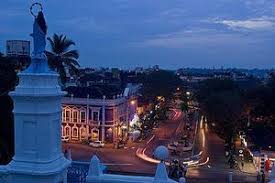
Growing up in Panjim, at the foot of Altinho in the 1980’s, Panjim was my Zion, Altinho, my Temple Mount. Ever so often a bunch of us kids would climb up to this spot on the hill and gaze down onto Panjim, catch a view of the river and Betim on the other bank. The scape is one that will remain forever in my minds eye. It was a pretty sight, of tiled roofs, a few apartment buildings going down to the river. In which my childish imagination, I would see dhows sail in up the river, from across the Arabian sea. There was a lyrical element to it all.
Fast forward to 2000, I climbed back to this spot from my childhood and gazed out again over Panjim. This time round, I sat down, and wept, as I remembered Zion. The city of my childhood and imagination had disappeared almost completely. There were now many more apartment blocks than I remembered from the 80’s. Irregular and flat roofed, with strange boxes sticking out of them, they marred the sky line of the city, ruined the view of the river. I would have to rely on my imagination hence forth to recreate the Zion of my childhood.
While I dare not return to that spot again, for fear of my fragile heart, as I ride and walk through Panjim, I notice signs of change. Over the past few years, the older of the flat-roofed apartment buildings in Panjim (and in other parts of the state as well I imagine) have begun erected pitched roofs over their flat concrete roofs. I would imagine that this latest development would change the skyline of Panjim a great deal; would prove to be an improvement, taking us back to an era when the skyline of Panjim was dominated by pitched (and tiled) roofs. Viewed from the ground, these new roofs soften the heaviness and harshness of the concrete apartment block. The building doesn’t seem weighed down anymore by the weight of a thick concrete slab, but wears its crown as it were, lightly.
These roofs present underline a significant home-truth; the architectural model represented by the old Goan homes, and public buildings, is relevant even today, for reason of working within the environmental matrix of the local area. The upper-storey of these buildings are clearly going to be much cooler through the summer and the building less prone to water-seepage, as the rain slides off the roof, not collecting on the ‘terraces’ of these buildings. Aesthetically too, they manage to hide the irregularities of the design of these buidings. For example, the water-tanks that pop up on the roofs of these buildings, the box on the roof that shelters the entrance to the terrace. One primary reason the contemporary building does not appear as pleasing to the eye as the older Goan buildings, is that these newer buildings have too many design elements sticking out all over them, and secondly they are composed of too many broken lines. The pitched roof over the apartment building manages to tie together some of these incomplete lines, and integrate them altogether through the meeting of various lines at the top of the roof.
Having after many decades ‘completed’ the buildings, these pitched roofs also suggest to us a new agenda for urban dressing – in crude terms for the builder’s lobby, urban redevelopment. Having resolved the issue of the roof, the façades of these buildings can now be altered; to first integrate all those broken lines that mark the apartment block. For example, the balconies that stick out of the façade, and seem to hang in mid-air, without presenting any vertical line that links all of them together, from bottom to top. Secondly, get rid of those excessive elements that clutter the building façade. Example, the concrete chujjas over windows. Finally, it could also present us an opportunity to once more have a street face that is composed of harmonious elements. Buildings which retain their unique personality but through the common elements of the pitched roof, and harmonized façades are in conversation with each other, rather than pursing a radically independent direction.
Ofcourse none of this is going to emerge from merely erecting a pitched roof over the contemporary apartment block. A good number of these pitched roofs still need to have regard to the manner in which they also contribute to the façade of the building. A good number of these roofs do not merely rise from the edge of the terrace, they provide a roof to the terrace, thus requiring us to have regard to the integration of the roof with the façade as well.
For those who can see, there is clearly a good amount of money to be made for pushing for an urban renewal policy that seeks to re-develop existing buildings and harmonise them with an earlier building aesthetic; an aesthetic that in fact draws tourists to Panjim. In such a policy, perhaps we also need to contemplate the wisdom of the current setbacks, that disrupt the street façade, do not contribute to pedestrian comforts since the reason for the setback is largely to accommodate street widening for automobiles. But this is another matter. Development in Goa today is by and large a bad word, primarily because it is absolutely unimaginative and quite frankly ugly. How do we generate profits while also contributing to the larger benefit of society, while not necessarily being philanthropic? One way I would argue, would be a rethinking of urban design in the manner only vaguely suggested here.
Subsequent to the destruction of the Temple in Jerusalem, the dispersion of the Jewish peoples all across the globe, there arose among them (and their other brethren in faith) the belief in the re-establishment of Jerusalem through the hands of the Messiah. The New Testaments ends with the Revelations and the vision of the coming of the New Jerusalem, shining brilliantly like a diamond. While I continue to mourn the destruction of my own Zion, perhaps the new pitched roofs of Panjim give reason to await the second coming of the city?
Itinerant mendicant captures two aspects of my life perfectly. My educational formation has seen me traverse various terrains, geographical as well as academic. After a Bachelor's in law from the National Law School of India, I worked for a while in the environmental and developmental sector. Following a Master's in the Sociology of Law, I obtained a Doctorate in Anthropology in Lisbon for my study of the citizenship experience of Goan Catholics. Having worked some years at the Centre for Research in Anthropology at the University Institute of Lisbon, I am now a priest for the Archdiocese of Goa and Daman.I see myself as a mendicant largely because so many of my voyages have been funded by scholarships and grants.This blog operates as an archive of my homilies, and writings in the popular press.