Showing posts with label heritage. Show all posts

Wednesday, May 16, 2012

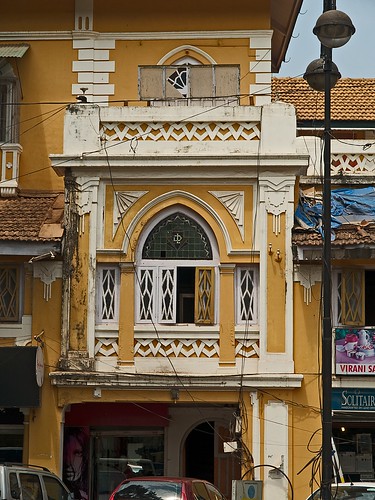
Out with the old? Advocating a measured approach to built heritage


That we ought to tear down ‘ugly’ and ‘old’ buildings was the suggestion of Mr. Armando Gonsalves in a recent column in the O Heraldo dated the third of May. Mr. Gonsalves was careful to specify however that when he recommended this demolition, he did not mean ‘heritage’ structures, but buildings that have come up in post-Liberation Goa. Among some of the buildings that Mr. Gonsalves recommends that we pull down, is the building that houses the Department of Health in Campal, as well as the Junta House in the centre of Panjim, that is home to a number of Government offices.

The Dept. Of Health, Campal.
These suggestions are hugely problematic ones to make for a variety of reasons. To begin with, there is the assumption that the idea of beauty is one that is universally held by all. The argument assumes that there is something that one can look at and immediately pronounce, ‘ugly’ or ‘beautiful’. Unfortunately, this is not quite the case. Because, as is well known, but little reflected on, beauty lies in the eyes of the beholder; beauty is not intrinsic to an element, but depends on the appreciation of the beholder. Thus, beauty is reckoned by a canon, or code or rules. If we do not know the rules to appreciate the building, or image, then we would simply fail to realize in what manner the building is an interesting, or uninteresting contribution to built heritage. Thus for example, one may look at the Junta House, or indeed the Department of Health, or the similarly styled Department of Education building in Panjim city and marvel at their ridiculousness. However, if one sees them within the context of modernist design that they were being articulated from, then they become very interesting buildings in themselves. Add to the fact that these are government buildings and the State that built them, whether it was the Portuguese State (as may be in the case of the Junta House) or the Indian State, and you realize that a statement was being made. These buildings were not meant just to house governmental departments, but were built to make a statement. Of new times, of the will and determination of the State. Once again, for these reasons alone, these buildings gain an interesting perspective, and grow in beauty in the eyes of the beholder, as well as the heritage activist.

Dept. of Education, Panjim.
If we have so far been unable to appreciate the beauty of these (and other like) buildings however, it is perhaps because of the odd contours of the word ‘heritage’ that is being provided both by Mr. Gonsalves as well as others within the area of built heritage in Goa. What Mr. Gonsalves at any rate is doing in his argument, is to limit the scope and terrain of heritage to solely buildings built before the ‘Liberation’ of Goa. While it is surely not his conscious attempt, what Mr. Gonsalves is doing is to stop Goan history with the period of Portuguese sovereignty over Goa. The rest of Goa’s architectural evolution, does not really matter. This is not an uncommon position unfortunately, and the process of selling Goa (both by State and non-State actors) as a Portuguese-Indian paradise has compounded this trend. Unfortunately, what is often seen as Indo-Portuguese heritage are often the homes of the more privileged members of Goa’s colonial society. Even more unfortunate has been the manner in which buildings from before Liberation, often articulating international styles like Art Deco have been stripped of their ornament and distinctness, to be rearticulated in a new form that seems to be slowly emerging, figuring azulejos, pastel earth tones, and harking to a rural ideal. Post-Liberation architecture, from the homes of people who got rich via tourism and earnings from the Gulf, to the apartment blocks erected by the fledgling real-estate developers, tells us a critical story of the rise of formerly subaltern groups, out of a restrictive social environment, to a more liberating one. These buildings, as ‘ugly’ as they may appear to us, even when we understand their internal vocabulary, are a proud moment in Goan history, and we cannot simply brush them aside and order their demolition! To cast only a particular genre of Goan built heritage as heritage, would result in our effective freezing of a definite kind of social relations, one that sustained the colonial presence in Goa, and this would be simply obscene!

Rearticulating an urbanTaleigao Indo-Portuguese style
More than obscene however, they will lead to a whole lot of social strife, because the association of Goa with Indo-Portuguese styles alone, and this freezing of time sometimes relied upon by heritage enthusiasts, is opposed not just by the Hindu nationalists, but a wider swathe of the Goan population than we would imagine. Take for example the incredible support that Mr. Monserrate, the MLA formerly of Taleigão, gained for projects in the constituency that scandalized one segment of Goa’s population. These projects, aimed at destroying the rural structure of Taleigão, by inserting roads and the like, was supported primarily because the rural setting, a particularly privileged locale for the Indo-Portuguese aesthetic, is not particularly appealing to those native-Goans who form Mr. Monserrate’s vote-base. That Mr. Monserrate nevertheless used elements of Indo-Portuguese design, drawing on conventions of certain kinds of European design, and interestingly rearticulated these in the projects that he initiated, however, is another matter, and one that points us in the direction of lessons that we ought to take note of.

Mr. Gonsalves’ arguments are scarier than they prima-facie appear to be, because they draw on a logic that once approved for use in the manner in which we determine which buildings can stay, and which have to go, the logic can be extended to other areas of social life as well. Take for example, the fact that Mr. Gonsalves suggests that the building of the Department of Health ought to be demolished because it does not fit in with the rest of the ‘Heritage’ zone of Campal. The logic that lies below this facile suggestion is that if something, or someone, does not fit in with the larger group, out they go. This sort of exclusivist logic is the very basis on which the vegetarian ghettos of Indian cities have, and are, been formed; where difference is absolutely not tolerated. This is the logic that eventually led to the European Holocaust that saw the calculated murders of Gypsies, homosexuals, Jews and Communists; simply because they did not fit in into the larger scheme of things. This is ofcourse not the intention of Armando Gonsalves who has led many a charitable and philanthropic event, but these are the implications of the logic that he has perhaps unwittingly used in making his suggestions.

Mr. Gonsalves also makes the error of assuming that if the buildings are ‘spanking new’ then they will replace the older buildings that he finds ugly, with a more interesting urbanscape. His assumption is that “Architecture was not such a developed art a few decades ago”. The sad truth is that, none of this is true. Architecture was just as developed a few decades ago, as it is today. There were some buildings that were perhaps more provincial or clumsy followers of international trends, and others that manifested international trends interesting. But we would know this only if we developed our understanding of the vocabulary that architects and designers have been using. Furthermore, some of the problems with the built environment in Goa, as in other places, is not simply that they are ugly, but because increasingly, every architect seems to want to make a statement; because street facades are not being maintained, because the skyline (or the roof façade of the city) is increasingly out of control, and the sense of scale is being violently disrupted, the larger sense of order that we experienced is being lost. The answer to our built heritage woes therefore, is not necessarily to pull down anything that is old, but to spend some more time figuring out what exactly is the problem, educating ourselves in larger issues of urban design, management and styling, and once we do that, to address the issue advisedly.

(A version of this post was first published in the Gomantak Times dtd 16 May 2012)

Thursday, May 12, 2011

Of Saints and Men: The Royal Wedding and the Goan connection

Having decided to skip the hoopla surrounding the wedding of Kate and William of Cambridge, and not watch the wedding live, I was glad I changed my mind and saw a recording of the event later that day. You could perhaps call me jaded, but the finest part of that wedding was the sermon preached by the Bishop of London. Particularly striking were the opening words of that sermon, where quoting St. Catherine of Sienna, whose feast day it was, he said Be who God meant you to be and you will set the world on fire.”

I was particularly taken up by those opening words because they seemed to echo the observation, that I am particularly fond of using, of St. Ireneaus another saint of the Christian tradition who said that, “The glory of God is a human being full alive.” It seems that there is a common thread that connects these two sentiments; they both connect the human being to God through the individuals’ discovery of their self and the actualization of their potential. It seems that both these lines of advice require the individual to first turn inwards on oneself, contemplating and discerning, before they may discover their potential, that will make them ‘truly alive’ and ‘on fire’. The key lesson here seems to be that the turn inward, is simultaneously both a turn toward God and a turn toward the world.

This observation managed a rather more material turn a couple of days after the sermon was delivered. As it turned out, I was in London a couple of days before the wedding, and with an afternoon to spare, lost myself in the borough of Kensington and Chelsea. It was a wonderful decision, since those streets, offer you something of the experience of what an urban paradise could mean, with its pretty buildings, thin traffic, all enveloped in the green embrace of urban gardens newly leafy with the coming of spring.

Walking through this delightful neighbourhood, one notices from time to time, little blue plaques placed by the doors of some homes, announcing their provenance. These plaques announce that the building once served as home to this or that personage from history, someone who undoubtedly, ‘set their world on fire.’

These two experiences, that of the sermon and of the walk through Kensington must have remained in my mind, for a couple of days ago I realized that there was a lesson in this for us. First that the charm of Kensington did not stem from a naturally occurring property (pardon the pun) but from a turning inward to find out what made it burn. The plaques on the front of these buildings represent a turning to its history, a respect for those who had moved on. It is this in part that contributes to Kensington’s charm, or indeed the charm of any of the historical parts of London that invest in highlighting their linkage to significant personages from the past. The spaces are no longer just any ordinary space, but special, and made important by their linkages with those who were truly alive. Something of the charisma rubs off, not in some magical way, but because of our respect for the individual, that drives us to build an aura around the space she or he inhabited.

It seems that there is a lesson for those of us in Goa who are interested in preserving the architectural heritage we believe is being rapidly erased from existence. As this column has pointed out at other times when dwelling on this theme, heritage is important not merely for the building, but for the people around it. Recognizing the value of a building then, by recognizing the presence of significants who have since moved on, is another way of placing the individual at the center of the heritage conservation exercise.

There would be a number of benefits to our heritage activities if we were to mark Goan buildings with little plaques indicating their connections to significant people from the past. To begin with it makes a building that much more difficult to tear down, when you can create an argument that it is a materially significant part of history. On the other hand, you are also simultaneously creating a history, a history that is thick with local detail, and that strangely enough, does not as yet exist. Too often our history is obsessed with the long dead dynasties whose links to our present we struggle to suggest. We forget the hundreds of men and women, closer in time, who have contributed both internationally and locally in no insignificant way. We forget for example the achievements of the men who manned the orchestras of Bollywood in the old days, when Goan men crafted the music that India continues to sing. We forget the examples of women who ventured on to stage and Konkani film. The list could go on.

This ignoring of the more proximate individual is not surprising. Goan society lacks mechanisms through which it can recognize the merit of its members either when they are alive, or when they are dead. This is unfortunate for a plethora of reasons, not least of which is that we lack the challenge to ‘set the world on fire’ when we feel that there is no one who will recognize the light we bring to the world with our fire. The turn inward, is not merely an individual decision, it must also be supported by a social framework that allows us to do so.

This column has on multiple occasions attempted to suggest that heritage is not about our past, or at least not only about our past. Neither is it about our future. Most importantly it is about our present, and the recognition and valuing of people in this present. Thus just as an individual requires to turn inward, to contemplate before he or she can become fully alive, after having discerned what God wants them to be, so much we as a society turn inward, to recognize those in our past who have contributed to our collective present. This turn, this recognition of others, will set our social community, on fire.

(First published in the Gomantak Times 11 May 2011)

(Comments welcome at www.dervishnotes.blogspot.com)

Tuesday, July 20, 2010

Heritage, Development and Business Sense: Awarding entrepreneurs in architectural heritage

A fortnight ago, contemplating the sad state of Mapusa town, this column suggested that Mapusa’s woes were, in addition to the apparent neglect of their duties by the town’s officials, also a result of a lack of entrepreneurial imagination. The suggestion was that if older buildings are being pulled down to erect the multistoried monstrosities that are entirely out of sync with the rest of the town, it is because the entrepreneurs in the town (and the State at large) are entirely lacking in imagination to see the possibilities present in the older styles of Goan architecture. This week, this column will try to buttress that earlier argument by presenting a couple of cases to the contrary, where ‘heritage’ has been produced to enhance business prospects.


The first case struck me a couple of years ago as I was crossing the footbridge over the Patto creek toward the Rua do Ourem. Somewhere toward the left of my field of vision I caught sight of this multistoried building that looked like it had been built in the mid-1900s. I was convinced though, that that building had not existed a couple of years ago. On closer inspection it turned out that I was right. The building, an extension to the Panjim Inn, on one of the edges of Fontainhas, was in fact a new construction. The façade of this building had been constructed to be in harmony with the general style of the buildings in Fontainhas. The building, which is a ground-plus-two structure, soars above the buildings around it, and yet for reasons of maintaining the line of the street façade, and articulating its height within the architectural idiom of the neighbourhood suggests to the viewer that it has always been there.


A similar experiment, with not as spectacular results has been tried by the hotel Salida del Sol in Panjim. The Salida del Sol occupies a building whose earlier façade had nothing to recommend it. It was in fact quite like the rest of the offensive post-80’s concrete structures that have come up in Panjim and other parts of the State. In the course of the conversion of the building to the Salida de Sol, a newer façade has been pasted onto the building; giving it something of a European, if also kitsch, feel. While the Salida attempt may not be entirely aesthetically pleasing, it seems to have definitely been an attempt in the right direction.


In earlier columns I have argued that the opposition to ‘development’ that one sees in Goa, is to a large extent based on aesthetic considerations. Address these aesthetic concerns and one would see a substantial reduction in opposition to ‘developmental’ projects in the State. Thus you could still have multistoried apartment blocks rising if they attempted to articulate themselves within the architectural forms of the State. It is not as if these architectural forms have not been explored. In the Patto development there are a number of buildings that try to elaborate this aesthetic. One would be the proposed building for the Central Library. The main roof of the building that alludes to the sloping roofs of the West Coast is a joy to behold. Similarly articulated is the building in Patto that hosts a branch of the State Bank. In Porvorim, on the road to Mapusa, is another building, hosting the offices of Delta Peninsula, which by playing with its façade has managed an interesting conversation with the larger body of Goan architecture. Similarly the South Goa district headquarters, that are still in construction, at the entrance to Margão town, promises to be an interesting addition to the body of contemporary architecture that manages a conversation with Goan building traditions.


Highlighting these constructions would beg the question of what exactly constitutes Goan architecture. This is no easy matter to get into, let alone discuss within the brief confines of a newspaper column. However by returning to the two examples that were cited earlier in this column we can make a brief start. This architecture is influenced to a large degree by European (more properly classical) traditions. (Upto this point the Salida experiment gets it right). However this European influence is not simply a cut-and-paste job. It meets existing west coast architectural traditions and is articulated within this idiom. Take for example the beautiful examples of modernist Art-deco architecture in Panjim that are articulated within the traditional format of the Goan architecture.


What is called for then, is a certain amount of creativity and sensitivity to the surrounding built-forms when building newer buildings. In the case of both the Panjim Inn extension and the Salida del Sol, it can be safely argued that heritage has augmented earnings rather than depleted possibilities. Rather than tear down the facades of earlier buildings, could it not be possible to maintain the street-side façade, and incorporate the shell of the older building into the new construction? This has been done with great success in other parts of the world.


How does one encourage the conservation of existing built forms while allowing for continued developmental work (that in any case seems unstoppable)? One way to do this would be to award those entrepreneurs, like the owners of Panjim Inn, who either put up new buildings that actively engage with Goa’s built heritage, or make additions to existing heritage structures while enhancing the value of the older structure. Could we, with heritage groups taking an active position, contemplate a biannual competition, with a substantial cash award to the architects and entrepreneurs who erect such buildings? A competition judged by critical design and architectural experts, with a substantial cash award would possibly be a useful strategy in the cause of heritage conservation in Goa. It would remind us that heritage is not static moment that prevents future development but a dynamic force in conversation with the past. It would encourage innovation, and by awarding such excellence, allow for such innovations to be replicated, and the design logic internalized by others. Such a competition and award would send a signal to such persons as the owners of the Panjm Inn, to the owners of the Salida del Sol, Delta Peninsula and others, that their efforts have been noticed and appreciated, and encourage others to follow.

(First published in the Gomantak Times, 21 July 2010)

Wednesday, June 30, 2010

Muddling about in Mapusa: Why Mapusa deserves a second chance…

This column should have appeared on the 12th of May 2010, to accompany the bandh called by the Mapusa Merchants Association (MMA), and to show solidarity with their cause. Failing that however, this column may still have some purpose, to assert the legitimacy of the demand of the MMA and renew attention to the larger issues that the MMA was drawing attention to.

The MMA organized their bandh to protest the step-motherly treatment that they allege (and is evident for all to witness) has been meted out to the once proud market complex. The association of merchants made another important observation however when they argued that it was not just the treatment that was the problem, but the manner in which the ODP (Outline Development Plan) for the town had been created. The ODP proposes expanding roads around the market complex, in a manner that would demolish large sections of this complex. The roads are designed to provide access to the communidade fields beyond the market so as to open these up for development as locations for high-rise apartments.

Given this second threat to the market it is little wonder that the MMA extended its support to the protests of other citizen groups against the Mapusa ODP. Indeed, given the centrality of the weekly Friday market to Mapusa’s contemporary identity, it is significant that a challenge to the ODP has emerged from the merchants of the market. It is indicator to all of us that it is time Mapusa makes a determined departure from the future it seems to be hurtling toward.

There was a time when people from Panjim would sniff when referring to Mapusa. Mapusa was the provincial hick town when compared to its Mandovi-bank cousin. And yet, even today if one looks closely, there is an architectural charm to Mapusa that cries out for recognition. The entire area of Feira Baixa, Feira Alta present a veritable map of the kinds of architectural trends that have passed through Goa and this trading town. Where the harmony of these stylistic jostlings is interrupted is in the high rise buildings that have come up in the past half-decade. The harmony is disrupted not because they are contemporary buildings, but because these high-rise buildings are entirely out of scale with the buildings around them, sticking out, quite literally, like sore thumbs.

Another charming area, one that deserves to be preserved as a heritage space is the residential locality of Dattawadi. Nestled around the Datta temple, the charm and heritage value of this largely Hindu middle-class locality has been unfairly ignored for way too long. Ignore someone or something long enough and they will begin to believe their lack of value. This has been Mapusa’s unfortunate fate. The destruction of Mapusa’s architectural and urban heritage will however, be not just this town’s, but Goa’s at large.

There are a number within Goa’s tourist industry who are waking up to the fact that Goa’s tourism cannot be sustained merely by the beach-bums we have so far been catering to. We need to innovate and expand, even as the beach belt continues to be a major revenue earner. In such a context, the concerted preservation and subsequent utilization of Mapusa’s heritage potential could be the next logical and crucial step. Despite being the logical option to service the beach belt, and elaborate Goa’s tourist industry it is unfortunate that Mapusa’s role has been restricted to a largely utilitarian use.

There is a little lesson for us to be learned from the protest of the Mapusa Merchants, even though it may be an unintended one. Just a very small group stands to gain from the developmental pattern of the high-rise buildings. This group is those associated with the building lobby. As evidenced by the concerns of the MMA, this development pattern hits not just the common man, but even such comfortable groups such as the middle to upper class market merchants. Taking cue from the Mapusa market as a heritage building, we can begin to sense that building from heritage benefits a larger segment. Heritage is after all what everyone already has as capital, it requires only a supporting Governmental framework (like a decent urban plan and tourist industry support) and everyone can cash in on the golden goose. Looking at existing urban settlement patterns and structures as capital allows us to realize another lesson. To pull down priceless heritage buildings is a case of killing this golden goose. It also highlights the poverty of entrepreneurial imagination. But then this is perhaps why Mapusa has gone from a charming provincial town to a dusty trading town; a total lack of entrepreneurial imagination!

The real tragedy of Mapusa however, is that this apparent lack of entrepreneurial imagination is conveying the impression of an absolute lack of a middle class in the city. Where most heritage structures in Goa have been converted to cater to high-end or middle class consumption, the almost absolute lack of such structures in Mapusa seems to suggest the lack of such a class inhabiting the city. This assumption has serious consequences for Mapusa in that it could result in a total lack of any future investment, a flight of capital, eventually turning the town into a large slum catering primarily to the lower income classes. This is not a suggestion that heritage or urban infrastructure is or ought to be restricted to the upper classes, but merely a sad recognition of the manner in which our priorities (especially urban planning) seem to stand. Indeed, one way to display commitment to egalitarian development, and heritage together would be to use the now abandoned building formerly used by St. Anne’s convent as the new location for the Mapusa Municipal Reading room, converting it into a state-of-the-art library and resource centre.

There is a time and season for everything an old lyric tells us. And so it is that if there is a time and season for something in Mapusa, it is one for urban regeneration, based on a recognition of its heritage value. To do so will ensure not just more equitable development, but also rescue the town from the dark future it seems to have consigned itself to.


(First published in the Gomantak Times 30 June 2010)

Wednesday, December 16, 2009

Garden Restorations: Panjim’s Jardim Municipal, somewhere, beyond the green and the heritage, there lies a rainbow

The degraded state of the Panjim Municipal Garden, the Jardim Garcia d’Orta has been a sore point for some time now. However, on hearing news of the plans for the re-development of the park, my heart sank further. What new travesty would this latest venture bring? As if to prove these fears true, there was sometime last week, news of a confrontation with the powers vested with re-developing the Park. It appears that a number of the trees in the Jardim were slated to be cut, to make way for lawns and flower beds. Before the debate degenerates into an argument for the value of trees and a green lung, I would like to place the issue with a larger context.


Earlier columns have grumbled about the manner in which a Northern European understanding of the garden has colonized our mentality. In addition our understandings of the garden space have also been frozen within domestic frameworks, resulting in a narrowing of our garden-vocabulary. To place the Jardim in context therefore, we need to affirm that it was not just a ‘garden’ but a Public garden. Within the various types of public gardens one may find, the Jardim was an Alameda, a promenade garden meant for walking, and shaded by a variety of trees. Like Alamedas across the Iberian world, this garden too was (and continues to be) marked by commemorative monuments. The monument in this case being the column formerly dedicated to Vasco da Gama and now crowned by the Ashokan lions. The shading of the paths and the benches of this Alameda however were not randomly arranged, but followed, as is still visible if one looks closely, a formal symmetrical pattern. This feature of the Mediterranean garden drew from Islamicate sensibilities, that itself drew from the Roman. This formal arrangement however, was only the center of a much larger symmetry, represented by the buildings that enclosed the rectangle of the Jardim.


The Mediterranean public garden however, is not simply a space for relaxation; it is also a ritual political space. It is the symbolic representation of the public space, where the citizens gather, affirm their commitment to order in civil society and where the State affirms its commitment both to the citizens and to the notion of public order. This would be one way to think of the band-stand that stands at the centre of the Jardim. Every Sunday the Jardim hosted the band of the armed forces which played to the citizenry of Panjim who gathered there in their numbers, to see and be seen. In this ritual action, week after week, the notion of a civil society, and citizenship therein, would be reaffirmed, by State and citizen alike.


It is important to note this fact, a few days prior to the commemoration of the integration of Goa into the Indian Union. Very often forgotten in our celebration of the end of colonial rule, are the political specificities of the territory of Goa. Despite being a colonized space, Goa was nevertheless marked by citizenship. This status, peculiar to the Goan within a colonized sub-continent, emerged for the Catholic native elite from early colonial rule, and was open to all, regardless of religion from 1910. It is in this context that we should see and cherish this (and other Goan) public garden(s). We should also remember that this garden was a product not of some colonial mind, but of the local sons who were on the Camara Municipal. These local sons burned with the same zeal for independence, that Indian nationalists did, but owing to their political location as citizens, were able to articulate this desire within the confines of the Portuguese Empire.


Viewed in this manner, the Jardim Garcia d’Orta emerges as heritage garden with strong indigenous roots. These indigenous traditions of democracy and politics have however, largely been forgotten as they have been overlaid by the political traditions and understandings of the former British-India. This is perhaps nowhere as tellingly demonstrated as in the fate of the Jardim; first ravaged by the bureaucratic masturbation of the (British-Indian inspired) Forest Department’s tree plantation drives, and subsequently left to ruin as all wholesome notions of democracy have gone to mud.


The re-development of this garden and its structure, then, cannot simply be initiated de novo, nor can the debate be restricted to the need for a green space in the urban city. The re-development must necessarily be undertaken in the spirit of a Restoration. I capitalize the R here, for this Restoration is not to mean merely a physical restoration that one submits an edifice to, but a Restoration in the sense of a socio-political renewal as well. The Restoration must take the ritual space and history of the Municipal garden seriously, keeping the citizen once more at the centre of the development. If under the Portuguese regime the real (as opposed to the legal-theoretical) benefits of citizenship were restricted to the culturally equipped and bourgeois denizens of the city, then this Restored garden must ensure that those unfairly labeled ‘anti-social elements’ are not excluded. The garden as it did in the old days, must allow citizens to interact with each other, renewing both the use of the garden and civil society at large.


Incorporating this political dimension into our viewing of the garden as a heritage structure makes the word heritage bear more weight than it normally does. The formal stylistic arrangement of the park is no longer a mere aesthetic fetish, nor a fancy obsession with our past. It is a testament to a way in which we would like to see our democracy. It is also a testament to the fact that our colonial difference is worth embracing for it has something very valuable to contribute to the Indian democracy. In both these cases, the Alameda styling of the garden is critically tied to a definite kind of public and political culture. In addition, as opposed to the Northern European inspired garden of British-India, which stresses sun-kissed expanses that guzzle water, the Mediterranean inspired Alameda garden works with the local environment to provide the shade within which tropical life thrives.


If there is a debate around the development of the Municipal garden in Panjim, then that debate cannot and must not be restricted just to the issue of green cover and lung space. There is as I have laboured to point out, a much larger context within which it must necessarily be seen.

(Published in the Gomantak Times, 16 Dec 2009)

Credits
Image of the newly planted Jardim Municipal courtesy Dr. Paulo Varela Gomes

Image of scene in the Alameda Gibraltar Gardens from Wikipedia

Wednesday, August 26, 2009

Learning from the Ganesh fiasco: Temples, Churches, their demolition and reconstruction

The issue of the demolition of older structures, be they temples or churches and the erection of new buildings is a topic that causes much consternation in heritage sensitive circles. The attempt at demolition, renovation is invariably opposed by heritage circles leading to a standoff between the demolitionists and the conservationists. As with all standoffs, neither side will blink first, there is no communication, leaving all of us that much poorer for the situation. Given that the Ganesh fiasco from last week was framed along the lines of the right to the freedom of expression (of artistic sensibilities) I wonder if it would not be instructive to study the heritage debate from this angle.

If the argument of the Hindu Janajagruthi Samiti (HJS) is that the appropriate form of Ganesh has been fixed in the past and we would do better to turn back to the past for inspiration, then the argument of the Kerkar supporters was that artistic creativity is constantly evolving and must be allowed to flower. The issue of creation of new temples and churches over older structures can similarly be looked at from this angle. These new temples and churches stem from the innate desire of people to create. This creation does not necessarily stem from an older idiom, but it nevertheless represents their aspirations, their emotions and their vision of themselves.

None of these arguments should be construed to imply a personal validation of these projects of demolition and reconstruction however. On the contrary I would find myself on the side of the heritage activists on the issue of preservation. And yet, there is another point of view that I believe needs to be understood and respected.

The issue was perhaps captured best when the priest of some slated-for-demolition temple told this prominent heritage activist “So! You’re the one they call Deshmukh? You guys are very xana! You live in Panjim, in bungalows, and drive cars and you want our God to live in a hut!!” The problem with most approaches to heritage is the strange relationship it has with the past. While appreciative of the past, a good number of heritage activists are not willing to use it to mount a critique of the present. Thus the preservation of heritage is the preservation of a few artifacts as representative of the past, while ‘development’ is allowed to rumble on undisturbed. The problem with the temples is that for the managements of these temples, as captured by our priest above, the deity is not apart from modern and contemporary life, S/He lives in it. As such, as the most esteemed member of the community, it cannot do that the rest of us live in concrete homes, tiled with granite and marble, lit with electric light, and the deity be made to live in a tiled mud house, red cement flooring and oil-fed lamps. The management of these temples does not recognise a distinction between the modern and the archaic, that the heritage activists do, for them the temple and ‘real life’ are a continuous part of one whole and the temple has to be articulated within the idiom of the contemporary. The new temples that are coming up therefore, are an expression of contemporary creativity, and our engagement with it needs to be along lines similar to what we proposed in the Ganesh fiasco.

It is for this reason, that these kinds of heritage activists would do well to perhaps rethink their relationship to the past, using their fascination for the past to mount a stout critique of present practices of development. To the credit of some of our activists in Goa, going by their participation in the movements of our times, this is already being done. However there is perhaps one more engagement that is possibly necessary before we can persuade communities across Goa to not pull down their temples and churches. This would be an active engagement with the larger public in Goa, communicating the basis on which we see structures of the past as beautiful and worth preserving.

Another one of the possible reasons why these structures are coming down, is that communities in charge of their management are unable to read the buildings for the statement that they were (and are) making. Or perhaps the statement that needs to be made is changing. There is clearly, a break with tradition in a manner that the new development does not speak to the older. One possible way to remedy the first situation is to flood the public domain with information regarding the manner in which one can read Goan structures. Dr.Paulo Varela Gomes, the soon-to-depart Delegate of the Fundacão Oriente has done a wonderful job of proposing a manner in which we can read the specificities of the Goan Church. He argues that the Goan Church is not merely a reproduction of foreign elements thrown together, but a confident articulation of a local sensibility, not found anywhere else in the world. Subsequent to his explanation of the buildings, it is impossible not to look at the Churches and chapels across Goa with new eyes. Indeed, the very placement of stones start to tell you elaborate and complex stories! With such knowledge, the destruction, or even an alteration of a Church becomes an extremely difficult proposition.

How does one supply this knowledge to people across the Goan territory, such that they the language of the stones is made comprehensible to all, and not just an erudite few? This perhaps is the challenge for heritage activists, and the lesson from the Ganesh fiasco, that there is a need for active dialogue and conversation, not merely at the time of the confrontation, but as a part of daily life itself. The responses at the time of confrontation are invariably not amenable to dialogue. The time is too late for that. Indeed, what we often resort to are legalistic responses. These responses may use official force to prevent a punch-up but nevertheless leave gaping wounds in our psyche, making us prime ourselves for another confrontation. The challenge before us then is, to we create viable options and systems for dialogue that are not one-off events, but perpetual engagements. Such engagements would allow for creativity to continue to march forward, but always in a healthy engagement with the past.

(Published in the Gomantak Times August 26 2009)