Growing up in
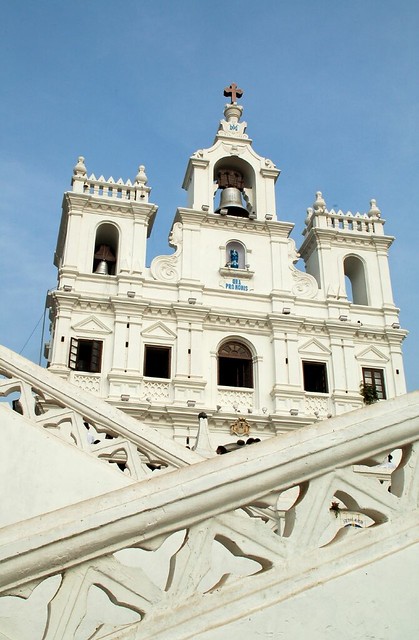
Panjim those who knew would tell you that the monumental staircase that adds so
much drama to the façade of the church of the Immaculate Conception was an
imitation of a similar staircase in the church of Bom Jesus in the Portuguese
city of Braga. These suggestions of ‘colonial’ productions being imitations are
always disturbing. It suggests that all innovations happen only in the
metropole and those in the provinces and colonies are capable only of
imitation. A more favourable reading would suggest that both metropole and
provinces are engaged in conversations with a similar model but express
themselves differently, as they should.
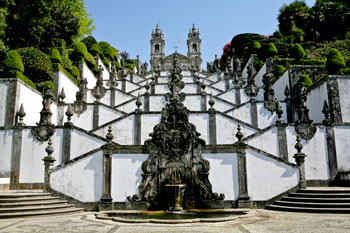
In any case, the
staircase that gives access to the church of Bom Jesus in Braga is of an
entirely different scale.Where Panjim’s
stairway is largely composed of a couple of sets of mirroring steps, the
stairway in Braga is composed of two elements. The first is a stairway that is
not symmetrical, but initiates the visitor to the stations of the cross that
form the central element that binds these two staircases together, uniting them
with the church whose main altar is given to the crucifixion of Christ. It is
the second staircase that is composed, like that in Panjim, of a number of
steps that mirror each other. And this is where the difference lies, for while
the stairs leading to the Panjim church seek to impress with bulk, those of the
Bom Jesus are composed of dizzying repetition of elements finally emerging like
filigree.
A number of
tourists to the church choose to drive up to the church and then walk down the
staircases. Or, they choose to motor it up part of the way, and then walk up
the second, more impressive staircase. In my enthusiasm to get the whole
experience I began to engage with the staircase well before the more
symmetrical portion of the stairway began. Walking through a tree lined avenue
I passed through the baroque gates that announced the beginning of the
staircase and began the ascent. In addition to the chapels that host
sentimental terracotta images of Christ in the course of his passion, there are
a number of fountains through the length of this part of this stairway. If the
chapels of the stations provide a sombre Christian element to this walk, the
fountains that mark the path add an oddly pagan twist given that each of them
is dedicated to a planet.
Taking this part
of the walk and not zipping up the motorable road was a brilliant decision. Having
weaved and puffed up to the start of the formally arranged staircase, a vision
of the plaster and granite baroque staircase complete with statues and
fountains and gardens just exploded before my very eyes. Indeed, so sumptuous
is the entire staircase that one wonders whether the whole exercise of
constructing this stairway was to direct our faculties towards the passion of
the good Lord, or create diverse spaces for a good party. As one ascends
towards the church one encounters statues of prophets from the old testament
and the persons from the new and little terraces off to the side that suggest
that at one time they were carefully tended gardens. There are also two
different sets of fountains, one set that highlights the various senses, the
other the virtues.
The one feature
that really caught my eye, however, were two fountains that stood at the start
to this second ascent. They were not in operation on the day I visited, but the
principle of their working was obvious enough. The fountain was crafted to
represent a serpent twined around a pillar, water shot out of the mouth of the
serpent into a basin and then spun around the body all around the pillar to
finally continue its way down the hill. How brilliantly over the top was that!
Looking at this
entire production, statuary, fountains, and the whole nine yards, it was clear
as the light of day. The stairs of the church of the Immaculate Conception in
Panjim are no imitation of the staircase in Braga. This latter edifice was in a
completely different order altogether. No, the authors of the work in Panjim
were working toward a similar but definitely different project.
The degraded state of the PanjimMunicipalGarden, the Jardim Garcia d’Orta has been a sore point for some time now. However, on hearing news of the plans for the re-development of the park, my heart sank further. What new travesty would this latest venture bring? As if to prove these fears true, there was sometime last week, news of a confrontation with the powers vested with re-developing the Park. It appears that a number of the trees in the Jardim were slated to be cut, to make way for lawns and flower beds. Before the debate degenerates into an argument for the value of trees and a green lung, I would like to place the issue with a larger context.
Earlier columns have grumbled about the manner in which a Northern European understanding of the garden has colonized our mentality. In addition our understandings of the garden space have also been frozen within domestic frameworks, resulting in a narrowing of our garden-vocabulary. To place the Jardim in context therefore, we need to affirm that it was not just a ‘garden’ but a Public garden. Within the various types of public gardens one may find, the Jardim was an Alameda, a promenade garden meant for walking, and shaded by a variety of trees. Like Alamedas across the Iberian world, this garden too was (and continues to be) marked by commemorative monuments. The monument in this case being the column formerly dedicated to Vasco da Gama and now crowned by the Ashokan lions. The shading of the paths and the benches of this Alameda however were not randomly arranged, but followed, as is still visible if one looks closely, a formal symmetrical pattern. This feature of the Mediterranean garden drew from Islamicate sensibilities, that itself drew from the Roman. This formal arrangement however, was only the center of a much larger symmetry, represented by the buildings that enclosed the rectangle of the Jardim.
The Mediterranean public garden however, is not simply a space for relaxation; it is also a ritual political space. It is the symbolic representation of the public space, where the citizens gather, affirm their commitment to order in civil society and where the State affirms its commitment both to the citizens and to the notion of public order. This would be one way to think of the band-stand that stands at the centre of the Jardim. Every Sunday the Jardim hosted the band of the armed forces which played to the citizenry of Panjim who gathered there in their numbers, to see and be seen. In this ritual action, week after week, the notion of a civil society, and citizenship therein, would be reaffirmed, by State and citizen alike.
It is important to note this fact, a few days prior to the commemoration of the integration of Goa into the Indian Union. Very often forgotten in our celebration of the end of colonial rule, are the political specificities of the territory of Goa. Despite being a colonized space, Goa was nevertheless marked by citizenship. This status, peculiar to the Goan within a colonized sub-continent, emerged for the Catholic native elite from early colonial rule, and was open to all, regardless of religion from 1910. It is in this context that we should see and cherish this (and other Goan) public garden(s). We should also remember that this garden was a product not of some colonial mind, but of the local sons who were on the Camara Municipal. These local sons burned with the same zeal for independence, that Indian nationalists did, but owing to their political location as citizens, were able to articulate this desire within the confines of the Portuguese Empire.
Viewed in this manner, the Jardim Garcia d’Orta emerges as heritage garden with strong indigenous roots. These indigenous traditions of democracy and politics have however, largely been forgotten as they have been overlaid by the political traditions and understandings of the former British-India. This is perhaps nowhere as tellingly demonstrated as in the fate of the Jardim; first ravaged by the bureaucratic masturbation of the (British-Indian inspired) Forest Department’s tree plantation drives, and subsequently left to ruin as all wholesome notions of democracy have gone to mud.
The re-development of this garden and its structure, then, cannot simply be initiated de novo, nor can the debate be restricted to the need for a green space in the urban city. The re-development must necessarily be undertaken in the spirit of a Restoration. I capitalize the R here, for this Restoration is not to mean merely a physical restoration that one submits an edifice to, but a Restoration in the sense of a socio-political renewal as well. The Restoration must take the ritual space and history of the Municipal garden seriously, keeping the citizen once more at the centre of the development. If under the Portuguese regime the real (as opposed to the legal-theoretical) benefits of citizenship were restricted to the culturally equipped and bourgeois denizens of the city, then this Restored garden must ensure that those unfairly labeled ‘anti-social elements’ are not excluded. The garden as it did in the old days, must allow citizens to interact with each other, renewing both the use of the garden and civil society at large.
Incorporating this political dimension into our viewing of the garden as a heritage structure makes the word heritage bear more weight than it normally does. The formal stylistic arrangement of the park is no longer a mere aesthetic fetish, nor a fancy obsession with our past. It is a testament to a way in which we would like to see our democracy. It is also a testament to the fact that our colonial difference is worth embracing for it has something very valuable to contribute to the Indian democracy. In both these cases, the Alameda styling of the garden is critically tied to a definite kind of public and political culture. In addition, as opposed to the Northern European inspired garden of British-India, which stresses sun-kissed expanses that guzzle water, the Mediterranean inspired Alameda garden works with the local environment to provide the shade within which tropical life thrives.
If there is a debate around the development of the Municipal garden in Panjim, then that debate cannot and must not be restricted just to the issue of green cover and lung space. There is as I have laboured to point out, a much larger context within which it must necessarily be seen.
(Published in the Gomantak Times, 16 Dec 2009)
Credits
Image of the newly planted Jardim Municipal courtesy Dr. Paulo Varela Gomes
Image of scene in the Alameda Gibraltar Gardens from Wikipedia
Itinerant mendicant captures two aspects of my life perfectly. My educational formation has seen me traverse various terrains, geographical as well as academic. After a Bachelor's in law from the National Law School of India, I worked for a while in the environmental and developmental sector. Following a Master's in the Sociology of Law, I obtained a Doctorate in Anthropology in Lisbon for my study of the citizenship experience of Goan Catholics. Having worked some years at the Centre for Research in Anthropology at the University Institute of Lisbon, I am now a priest for the Archdiocese of Goa and Daman.I see myself as a mendicant largely because so many of my voyages have been funded by scholarships and grants.This blog operates as an archive of my homilies, and writings in the popular press.

 In any case, the
staircase that gives access to the church of Bom Jesus in Braga is of an
entirely different scale. Where Panjim’s
stairway is largely composed of a couple of sets of mirroring steps, the
stairway in Braga is composed of two elements. The first is a stairway that is
not symmetrical, but initiates the visitor to the stations of the cross that
form the central element that binds these two staircases together, uniting them
with the church whose main altar is given to the crucifixion of Christ. It is
the second staircase that is composed, like that in Panjim, of a number of
steps that mirror each other. And this is where the difference lies, for while
the stairs leading to the Panjim church seek to impress with bulk, those of the
Bom Jesus are composed of dizzying repetition of elements finally emerging like
filigree.
In any case, the
staircase that gives access to the church of Bom Jesus in Braga is of an
entirely different scale. Where Panjim’s
stairway is largely composed of a couple of sets of mirroring steps, the
stairway in Braga is composed of two elements. The first is a stairway that is
not symmetrical, but initiates the visitor to the stations of the cross that
form the central element that binds these two staircases together, uniting them
with the church whose main altar is given to the crucifixion of Christ. It is
the second staircase that is composed, like that in Panjim, of a number of
steps that mirror each other. And this is where the difference lies, for while
the stairs leading to the Panjim church seek to impress with bulk, those of the
Bom Jesus are composed of dizzying repetition of elements finally emerging like
filigree. A number of
tourists to the church choose to drive up to the church and then walk down the
staircases. Or, they choose to motor it up part of the way, and then walk up
the second, more impressive staircase. In my enthusiasm to get the whole
experience I began to engage with the staircase well before the more
symmetrical portion of the stairway began. Walking through a tree lined avenue
I passed through the baroque gates that announced the beginning of the
staircase and began the ascent. In addition to the chapels that host
sentimental terracotta images of Christ in the course of his passion, there are
a number of fountains through the length of this part of this stairway. If the
chapels of the stations provide a sombre Christian element to this walk, the
fountains that mark the path add an oddly pagan twist given that each of them
is dedicated to a planet.
A number of
tourists to the church choose to drive up to the church and then walk down the
staircases. Or, they choose to motor it up part of the way, and then walk up
the second, more impressive staircase. In my enthusiasm to get the whole
experience I began to engage with the staircase well before the more
symmetrical portion of the stairway began. Walking through a tree lined avenue
I passed through the baroque gates that announced the beginning of the
staircase and began the ascent. In addition to the chapels that host
sentimental terracotta images of Christ in the course of his passion, there are
a number of fountains through the length of this part of this stairway. If the
chapels of the stations provide a sombre Christian element to this walk, the
fountains that mark the path add an oddly pagan twist given that each of them
is dedicated to a planet.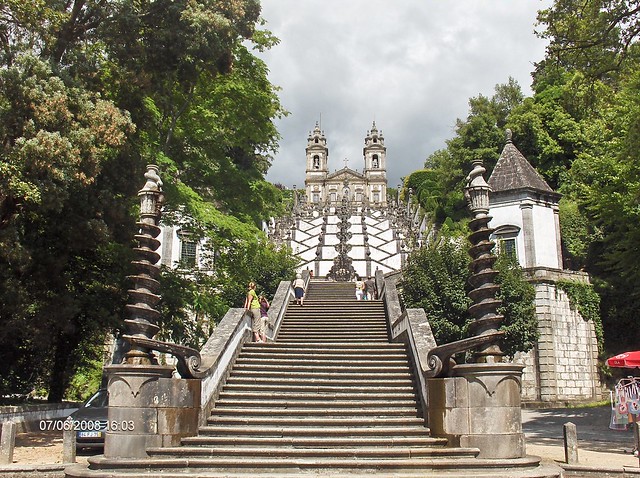
 Looking at this
entire production, statuary, fountains, and the whole nine yards, it was clear
as the light of day. The stairs of the church of the Immaculate Conception in
Panjim are no imitation of the staircase in Braga. This latter edifice was in a
completely different order altogether. No, the authors of the work in Panjim
were working toward a similar but definitely different project.
Looking at this
entire production, statuary, fountains, and the whole nine yards, it was clear
as the light of day. The stairs of the church of the Immaculate Conception in
Panjim are no imitation of the staircase in Braga. This latter edifice was in a
completely different order altogether. No, the authors of the work in Panjim
were working toward a similar but definitely different project.


