Showing posts with label Europe. Show all posts

Friday, July 25, 2014

Boycotting Israel: Fighting its propaganda machine


It is with a sense of mounting rage and upset that people from across the world have been witnessing the latest round in Israel’s persecution of the Palestinians. There have been a number of horrific reports, indicating the manner in which civilian innocents have been slaughtered, the manner in which new and unethical weapons have been used against these civilians, as Israel has bombarded Gaza day, after day, after day.
 

Even prior to this round of attacks, however, there has been a mounting call to impose broad boycotts and implement divestment initiatives against Israel similar to those applied to South Africa in the apartheid era. This call first emerged in 2005 in the face of the realisation that the state of Israel was carrying on with the project of building a wall around the West Bank despite the fact that the International Court of Justice found the Israeli project illegal. Since then the call to boycotts, divestment and sanctions (BDS) has been taken up and has been gradually increasing in strength as various groups have been to accede to this call. This call has not as yet, unfortunately, been carried over into the actions of members of the international order in a manner similar to the embargo enforced against apartheid South Africa.
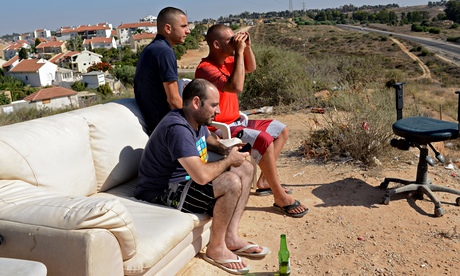


Even as efforts are on to push for statal responses to the call for BDS, the question still lingers as regards what we as individuals can do to address the daily, and historic, violence against the people of Palestine. One possible route presented itself when reading a particular disturbing news item that has emerged in the course of the current Israeli offensive on Gaza. This news item presented by The Guardian informs us that, “As the sun begins to sink over the Mediterranean, groups of Israelis gather each evening on hilltops close to the Gaza border to cheer, whoop and whistle as bombs rain down on people in a hellish warzone a few miles away.” The war on innocents, then, has been converted into a spectacle for entertainment for these settlers who have used “Old sofas, garden chairs, battered car seats and upturned crates” to convert the hillsides into an auditorium. Perversely, “On one hilltop, a swing has been attached to the branches of a pine tree, allowing its occupant to sway gently in the breeze”.


A friend who lives in Israel suggested that the news report was lacking in context. The report, she indicated, failed to mention that the assault on Gaza was a spectacle in the settlement of Sderot, a place where children typically play in bunkers.  Regardless of this fact, however, it was the realisation that a war has now become spectacle to some that forced a recognition of the fact that one of the fundamental ways in which the State of Israel is able to gain legitimacy for its existence as a Jewish state is through the scores of American and European films that have made a continuing spectacle of the Holocaust. Through these cinematic retellings, the Holocaust was the most recent genocide against the Jews and it is to ensure that such a horror never happens again that the State of Israel was set up. The complex histories that surround the Holocaust, which  indicate that the Holocaust was in fact directed against a variety of groups including Gypsies, Catholics, Communists, homosexuals and other groups that the Nazis saw as ‘freaks’ are  never elaborated to largely ignorant audiences across the world. Similarly the fact that these persecutions were largely a story of Jews in Europe is also never elaborated.  On the contrary, the establishment of Israel and its various acts of terror are celebrated as acts of heroism of a people who, once they had their own state, were determined to bring their violators to justice. In addition to the recent attacks against the people in Gaza, two other examples of this terrorism that come to mind are the hunting down of Adolf Eichmann, or the murder of those alleged to be responsible for the murder of the Israeli athletes at the 1972 Munich Olympics. Indeed, the Jewish dead of the Holocaust are converted into telegenic bodies to buttress the Israeli cause.

The simplified histories that these films tell prevents us from entering into the more complex world of the politics of Europe and Anglo-America that made it possible for Jews to be persecuted, and the essentially racist logic that allowed for the state of Israel to even be contemplated as a solution for what was essentially the problem of the (for lack of a better word) White world. In sum these movies encourage us to believe that there is such a thing as “the Jewish people” and that they suffered so much that they were justified in setting up a state in a place already inhabited by people for generations.

It is because these retellings of the Holocaust are critical to buttressing the terrorist activities of the state of Israel that I decided then to absolutely quite watching any films about the Holocaust. Further, I would also not watch any films that presented simplistic stories of European Jewry and caused the audience to feel sorry for them.

This decision was not without discomfort. Such a decision could be interpreted as the actions of a Holocaust denier. However, one can argue that rather than deny the Holocaust, such a boycott of films on the Holocaust is in fact a commitment to respect the facts of the Holocaust and bring to it the historicity that it deserves. The death of so many thousands of people deserves a better memoralization than the cheap sympathy that such films generate for a state that in fact operates no differently from pre-war Europe and the Nazi state.

At a personal level the boycott would give me the satisfaction that I am not participating in the justification of the Israeli state and its propaganda machine. If joined by others there is the hope that this otherwise individual action could have larger consequences, that we would encourage more honest tellings of this phase of European history.

In any case, any boycott against Israel must also necessarily include a boycott of those activities that operate as propaganda for what is currently a racist oppressor state.

(A version of this blog was first published in the O Heraldo dated 25 July 2014)

Monday, July 14, 2014

Culture in the U.S.A.


The lives of a number of English, and to an extent American, nobles and gentlemen from the 18th to the early 20th century was marked by a peculiar ritual called the Grand Tour. As a part of their education and exposure to the wider world, these men of wealth would leave their home shores for a tour of Europe, especially southern Europe, and in particular Italy. There they would immerse themselves in the artistic wealth generated by the Renaissance and after the passage of time, sometimes years, would come back home laden not only with experience but oftentimes books, statuary and works of art. On their return these men would go on to embellish their homes, society and the public spheres they occupied, converting a private learning into public wealth.

No Anglo-Saxon noble myself, but definitely with aspirations of being a cultivated gentleman, I recently ensured that I could turn the invitation to a university on the east coast of the USA into a Grand Tour of sorts. Over the period of a month I did what the White Anglo-Saxon Protestants of yore did, I went around main cities, accepted invitations to dinner, went to see collections of art, and drank in as much ‘culture’ as one could.
Somewhere along this voyage I met up with a friend from another continent, exchanging ideas, impressions as we strolled through the streets of New York. As is common among expats we soon got around to comparing notes about the local species. It was at this point that this friend suggested: “Oh these Americans. They have no culture. They are not like us with so many centuries of culture behind us.”

I was glad for that comment because it articulated an idea that I had been struggling with for the weeks while I was in the USA. Growing up Indian and fed on the cultural superciliousness that marks Indian nationalism this was exactly the idea that one had of Americans (from the US). They may have technological superiority and wealth, but we had a wealth of culture. My time on the East coast was disproving all of these early learnings and providing me a different way of viewing the United States.

True, this country is young, but then, so is India. Indeed, India as a state is younger than the USA. It is in fact the drawing of these random lines across history that obfuscates the way in which we perceive culture, history and the lack of it.

While the US is built largely on the memory of the white settlers of the continent, and not of the Native Americans, the cultural history of these white settlers includes the histories of the communities in Europe from which these settlers emerged. Indeed, if young American men (and some women) embarked on Grand Tours it was because of the recognition of this link, and because they were engaged in a cultural enterprise similar to that of their cousins across the pond in England. On this count, then, the United States has a long cultural history, one that gets richer and more diverse as more peoples come to its shores and assert themselves.

While much derisive attention is directed to the manner in which American history is fabricated, through the careful highlighting of any object of any significance there may be another way of looking at this cataloguing. While this emphasizing of importance may have to do with crafting a national history, it also has to do with building a public culture and a public sphere. There is the public esteeming of individuals who contribute, or have contributed to society. Museums set up by bourgeois families eventually worked to embourgeois others and create a standard public culture through non-formal education and committed both state and elites to a level of public engagement with culture that can only be emulated, not dismissed.

 (A version of this post was first published in The Goan on 12 July 2014)

Wednesday, June 13, 2012

Putting the citizen first: Creeks, forts, heritage and the citizen


The attempt to revive the creek that runs through Campal and Tonca, and sometimes erroneously called ‘Campal Creek’ is one of the many urban regeneration projects that animates Panjim’s citizens these days. This is a happy occurrence and we must all hope that the initiative will come to fruition. An earlier reflection on this column had observed that what marked Indo-Portuguese architecture, was not merely an interaction between Goa and Portugal, but in fact an interaction by Goa with Europe. In this context then, the inspiration that Amsterdam’s canals and bridges provide to the Campal Creek project is a continuation of this longer tradition. Given that the project is being led by citizens from the generally more well-to-do area of Campal, the project continues another tradition, in this case the Dutch tradition where the canals of Amsterdam were the product of an active initiative of the Dutch elites of centuries past.

However, what we need to also remember that Amsterdam, and its pretty canals and bridges were not always this pretty. On the contrary, for a very, very long time, and until fairly recently, the canals of the city were receptacles for the city’s sewage. Indeed, it was only in 1987 that the last house to send its sewage into the canals was connected to a sewerage system. What is important to note then, is that the Amsterdam project, if one can put it that way, is a continuing one. What is also important to note, is that this project was not motivated by the possibility of gaining tourist visits to the city. Rather, it was motivated by making the city more livable, providing a better quality–of-life to its citizens. Thus, in addition to the joy rides that tourists may enjoy on the canals, and walking around the streets, the canals are also used as a source of regular transport for its citizens.

This location of the citizen, rather than the tourist, is important for us to bear in mind in the course of engaging not only with urban regeneration projects, but also the variety of heritage restoration projects that one sees around our State.

This observation holds particular importance in the context of the recent completion of the restoration of the Reis Magos fort. In the past few years there have been a number of restoration works that have been carried out on heritage buildings that are the property of the State. These include the Forts at Tiracol, Reis Magos, Santo Estevam, as well as the premises of the former Escola Medica.  A news report in the Times of India on May 31 pointed out that the Government does not seem to have a policy that would cover adaptive reuse of heritage structures that belong to the State. A number of people, especially those intimately involved with heritage conservation, make the argument for adaptive reuse, stressing at the same time the need for “revenue generation through cultural tourism”.  Regardless of whether it is linked to cultural tourism or not, what has to be recognized is that once the question of the decay of the monument has been addressed, the issue of generating resources for its upkeep become important.

The question however, is to inquire into the manner in which the resources for this requirement will be generated. This is where the question of choice, between placing the citizen or the tourist, at the heart of the project comes into being. Given the manner in which tourism is such a critical part of the Goan economy, all too often tourism, cultural or otherwise, becomes a focus of our options for adaptive reuse. In this context, the words of the Chief Minister are somewhat disturbing. He is reported to have indicated that “the fort would have to find a way to make itself commercially viable” indicating that "The government is good at building, not maintaining." It was perhaps under similar logic that the location of a mall-shopping arcade was contemplated within the refurbished Escola Medica.

We must recognize however, that such logic is indication of an abdication of the responsibilities of the State, creating the grounds for the privatization of public resources. The argument that this column would make, an argument that is perhaps not different from those others in the heritage conservation groups are also making, is that it is possible for the monument to address the local community first, and simultaneously also address the larger interests of cultural tourism in the State.
 
It is in this context that Amsterdam in particular, and Europe in general can be used as an interesting case to learn from. Social spending, in catering to the citizen, educating them, and opening cultural options for them, is what simultaneously generates the options for cultural tourism. It was not catering to the tourist that generated its prettiness, but catering to the citizen first. Even though the European economy is now in crisis, it must be pointed out that this crisis should not be used to suggest that the model of social spending was the problem. On the contrary, to use the words from The New Yorker “social democracy in Europe, embodied by its union, has been one of the greatest successes in history.” And further “A continent torn by the two most horrible wars in history achieved a remarkable half century of peace and prosperity, based on a marriage of liberalism properly so called (individual freedoms, including the entrepreneurial kind) and socialism rightly so ordered (as an equitable care for the common good). Any pleasure taken in the failure of Europe to expunge all its demons threatens to become one more way of not having to examine our own.”

This advice was given to the USA, however, we in India, with our elitist biases in the working of democracy would do well to take heed and find the governmental resources to support adaptive reuse the works to make refurbished monuments, locations for the edification and personal growth of our citizens. This would only work as a wise investment, creating citizens who would be able to spin more creative concepts than perhaps the less-challenged governmental departments in charge of tourism. Such an option need not necessarily preclude entrepreneurial intervention, but we must be clear that high-end malls and boutique hotels do not seem to constitute the kinds of projects that can meet this larger end, given that they actively exclude, even as they may generate some revenue for the State. What we must bear in mind however, is that these investments should be evaluated not merely for commercial viability, but from the kind of human-resource generation that they provide.

In welcoming the Reis Magos fort back to life, and wishing the Campal project a similar trajectory, perhaps we should also make space for the citizen at the centre of our plans, and not only the tourist.

(A version of this post was first published in the Gomantak Times 13 June 2012)

Monday, May 21, 2012

Letters from Portugal: The Modernity Deficit Complex


The Portuguese suffer from what I call the modernity deficit complex. Let me explain this with an illustration. Some weeks ago, a friend of mine placed the link to a video on her Facebook wall. The message that accompanied the link, a message that received a fair number of “Likes”, suggested that one could “safely substitute the Portuguese flag for the Italian and you get a sense of life in Portugal...” The video itself is hilarious. It consists of a contrast of two kinds of experiences in various episodes in life; from attempting to cross the road at a zebra crossing, to waiting for a bus, attempting to find parking, to political engagement. The first experience is represented by a flag of the European Union, while the second, which demonstrates the difference in Italian experiences from “the rest of Europe” is represented by the Italian flag. The experiences of the EU flag are what we all associate with the European experience, orderly, systematic, the text-book case of what is ideal. The experiences of the Italian flag however are a complete disaster. While in the EU case, one waits for a bus around five minutes and then hops into it, in the Italian case, the bus takes well over an hour to arrive, when it does, it leaves without the waiting individual. When the politicians in the EU illustration systematically take their place in power and leave it once their term is up, the Italian politicians, the video suggests, refuse to let go, and grow tentacles to cling onto State power. The suggestion of the video then, as well as its adoption by my Portuguese friend, suggested that Italy and Portugal, were not really European, they were simply members of the European Union, and failed to act genuinely European.

What was amusing about the video however, was that one could have easily substituted the EU flag for a label which said “modern” or “civilized”, and replaced the Italian flag for the Indian to get a “a sense of life” in India according to a good number of India critics. When we do this then, we get a sense of how the EU, both in its self-representation and in its estimation by others, represents the civilized norm. Clearly however, this norm, that is perceived as European, is not uniformly experience by all Europeans equally. There are some Europeans, who feel that they are not really European, but are only European in name. The question that emerges then is, where exactly is this ideal Europe located? Which are the countries that represent, not just for those outside of Europe, but those within the EU as well, the European ideal, and in this process, ideal modernity? Who are these ‘real moderns’?

One does not have to live very long in Portugal to realize that these moderns are vaguely identified as ‘the countries of the North’. Press further however, and this vague idea begins to disintegrate, and one realizes that it isn’t even most of Northern Europe that these impressions of modernity belong to, but more specifically countries like Belgium, Holland, Germany, the Scandinavians. The scope of modernity therefore is rather limited to a small set of Northern European democracies, democracies that are marked by societies that are perceived to be rather well-ordered and disciplined.

To return to the Portuguese however, their self-flagellation about not being modern, continues in other forms. Thus for example, the suggestion received on numerous occasions, whether it be intimate conversations, or animated dinner discussions, that the Portuguese do not have an educated elite. The grumble is that, unlike other places, the Portuguese social elites, are not particularly educated, nor cultured. One of the ideas that circulates for example, is that these elites in a rather hierarchized society, are quite comfortable with not having to obtain higher education, or read outside of the prescribed course work when they do take up professional courses. The fact that they are well-born, and they are in possession of plenty of money, is quite sufficient. One will recognize in this description of the Portuguese, a possible description of Indian elites as well, but let us leave this discussion for another moment and focus on the fact that once more, the Portuguese imagine ideal norms of civilized, and hence modern, society being located elsewhere, and not in their own country.

This idea of not being modern enough however, can work both ways, both as self-criticism, and often strangely enough, as a suggestion that we should be grateful for not being so messed up like those societies that have achieved modernity. Take for example the rather astute observation by another Portuguese friend. This friend pointed out that the Portuguese translation of the popular American television comedy series, Modern Family, is not a literal translation. On the contrary, the Portuguese translation, which is Uma Familia Muito Moderna (A VERY Modern Family) has an interesting twist, given that it suggests, that it is not merely a modern family we are talking about, but a VERY modern family. It has to be stressed here, that this translation is peculiar not to the Portuguese language, but only to Portugal, since the Brazilian translation is simply Familia Moderna (Modern Family). The family we are speaking about then, is deemed in the Portuguese case, to be an example of an excess of modernity. The implicit suggestion then, is that too much of modernity can be bad for you.

A glance at the storyline of Modern Family may possibly help us identify what is this modernity that is deemed as too much. The drama revolves around three families, related to each other through Jay Pritchett, the patriarch of this family, and his children, Claire Dunphy and Mitchell Pritchett. Jay Pritchett commences this excess of modernity, not merely by being divorced, but being married, as a white older man to a much younger Colombian (hence coloured) woman Gloria. Together with Gloria, Jay raises her son Manuel (or Manny), who is a somewhat odd boy, eminently cultured, way too old for his years, and whose character partakes of an unsure sexuality. Will the boy grow up to be gay, we are forced to wonder, or is he just extremely cultured? Claire, Jay’s daughter, is a fulltime mother of three children and married to Phil Dunphy, a real estate agent and man who just tries too hard to be a ‘cool’ father. Being the only other heterosexual adult male in the drama, his character struggles with some kind of desire for his step-mother-in-law. The Dunphys have three children: Haley, the stereotypical teenager, Alex, the smart middle child, and Luke, the offbeat only son. Jay’s son Mitchell, who is a lawyer, and gay, brings to this ‘modern family’ his (male) partner Cameron, who while having grown up on a farm, and possessing various skills that we identify as hyper-masculine, is best described as a flaming queen. Together, they have adopted a Vietnamese baby, Lily, and together strive to be good parents.

One will admit to some amount of ambiguity to the name of the series in the US as well, but given that the ambiguity already exists in ‘Modern Family’, one could also suggestion that highlighting this ambiguity with ‘Very’ is a reference to the deep discomfort that Portuguese society is expected to experience with regard to this otherwise normal modernity.  The suggestion then, is that, this modernity is not us. We Portuguese, are not like this. We prefer to be not quite so modern. 

In light of all of this, surely then, the Portuguese can be said to experience a curious relationship with modernity, if not an outright Modernity deficiency complex?

(A version of this post was first published in the O Heraldo dtd. 21 May 2012)
In light of all of this, surely then, the Portuguese can be said to experience a curious relationship with modernity, if not an outright Modernity deficiency complex?
http://www.epaperoheraldo.in/Details.aspx?id=5211&boxid=23134328&uid=&dat=5/21/2012

Friday, October 7, 2011

Letters from Portugal: Little fascists in training

Last week this column discussed the peculiar traditions that mark the beginning of the academic term in the university and associated institutions in Lisbon, when students dress up in an antiquated dress (traje) and engage in ragging (praxe) the new students (caloiros).

Perhaps it is the wistfulness that comes with age, but there is something remarkably heart-warming about seeing young men and women, dress up and attempt to be adults. Traje it appears is also about self-importance, when these young people can shed their regular sneakers and clothes, and dress in capes, suits, and trot around in formal shoes. This self-importance however also comes at the cost of engaging in a sometimes disrespectful and humiliating manner with the caloiro. But all of this pales in comparison with the somewhat distressing features of the institutional format in which all of this praxe is carried out; elements that make it look, at least superficially, scarily fascist in appearance.

Fascism in its European version had an obsession with spectacle. Thus there is a concert between uniforms, a massing of people (or bodies), and the choreographing of ritual performances for this proto-mob to follow. Added to all of this, was the fascination with the medieval, and more particularly Roman imagery, thus salutes, banners and flags, oh yes, lots of flags.

Fast forward to an institute in Lisbon, that is the basis for the observations of this column, and you have a disturbingly similar correspondence to these elements of populism and fascism. The traje of the senior students is only part of the uniformed element of the praxe spectacle. The senior students in their black robes in fact operate as ‘officers’ to the recruits to the little armies of caloiros that they amass from their department. Each department enforces its own little ‘uniform’ onto their caloiros, of articulating a clever theme for the group. In addition to persecuting their individual brands of praxe, the senior students of the departments, also march the caloiros from time to time, to a courtyard in the institution, where caloiros and senior students from all the departments gather. Each department carries its own little Roman-standard-like banner, and one beholds the different groups, marked by their colours, yet united in the noisy ritual they perform together. It is an infernal din that they create together, each department yelling its chant, trying to outdo the other departments, giving the impression of a revolution or war at hand.

The most disturbing element of this entire performance however is the ‘Fuhrer balcony’ that gets incorporated into the process. The ‘Fuhrer balcony’ is the name given to the balconies that either got built on to buildings, or were used by the Fuhrer to address the adulating masses of the Nazi Reich. In any case, there is something profoundly hierarchical about a group of persons being addressed by a select elite located on an elevated platform, whether a stage or a balcony. In the case of praxe in this particular institution, in almost every setting they have chosen, a balcony has manifested itself. From this balcony, the directions for the entire performance are called out via a microphone, by a group of senior students in traje. Some of these are actively engaged in the process, others, lounge about ever so casually, marking their superiority by an apparently disinterested manner; the militarist manner of the whole drama terrifyingly obvious.

As pointed out in the last column, praxe, and the rituals that go with it, are subject of some debate in Portugal, many disapproving of it for its apparently rightist tendencies. From the manifestations in this particular Lisbon institute, these critics may have knocked a nail smack on the head!

(A version of this post was first published in the O Heraldo 2 October 2011)

Sunday, May 15, 2011

Letters from Portugal: Lisbon at the end of Europe

One of the joys of living in Lisbon at the current moment is getting the ring side view to watch the Europeans slug it out, as the continuing crisis causes the masks of decorum and dignity to slip off their collective faces. Take for example the manner in which the Danish government, forced by its right-wing partners, has decided to reinstitute customs control on its borders. The move does not apparently go against the spirit of the Schengen treaty that allows for passport free movement within the Schengen zone, but it does seem to militate against the spirit of the Treaty. In any case, there are also reports of a desire by France and Italy to see changes to the Schengen agreement itself.

A similar sort of discontent has been brewing in the past couple of weeks between Finland and Portugal. Portugal that held out until the last moment, is now desperate for a financial bailout from its partners in the EU. Finland however, thanks to the protests of the True Finns, another right-wing group, has threatened to not play ball by vetoing the parliamentary vote necessary for Finnish approval to the EU bailout.

For a country that may grind to a halt in June if funds do not flow into its coffers, to be put in a position where one is nakedly dependent on a third party for mercy, is fairly humiliating. The civil society response was not long in the coming, taking the form of a video. First screened at the Estoril Conferences, as a form of mild-mannered and tongue-in-cheek diplomacy, it then careened wildly onto the internet via You-Tube.

To be honest, the video, available on YouTube as ‘What the Finns need to know about Portugal’ is somewhat embarrassing. For despite the novel facts about Portugal that were peppered into the video (did you know there were more mobile phones than people in Portugal) it is awkward to say the least when one boasts about the size of one’s former colonial empire, or that the largest number of Portuguese speakers outside of Portugal live in Paris (leaving unsaid the fact that they immigrated thanks to a lack of opportunity in Portugal), or claims credit for things that one has had either no connection with, or the most tenuous of connections.

The interesting bit about the video for this post colonial Goan living in the former metropole was not the nationalist sentiment it could offend. On the contrary, this video was interesting because it was a direct statement to the Finns, ‘fellow Europeans’; hence all the stuff that a post colonial would find embarrassing or humiliating in fact revealed much about the European imagination. It told us something about how Europeans indicate to each other that theirs, is bigger (if you get my drift) than those of the others’.

A fortnight ago this column pointed out that in turning to Europe Portugal made a choice to be a junior partner in the European formation. The whole drama around the video validates that observation, indicating that indeed, what also informs the EU experiment is racial arrogance, one that is turned inwardly against the Southern (and Eastern) partners, as much as it is against the ‘Third World’. To be the junior partner then, is to be in a humiliating position, a position that one can get out of, by attempting a humiliation of others. But only just.

And yes, you absolutely MUST watch the video!

(A version of this blog was first published in the Herald dated 15 May 2011)