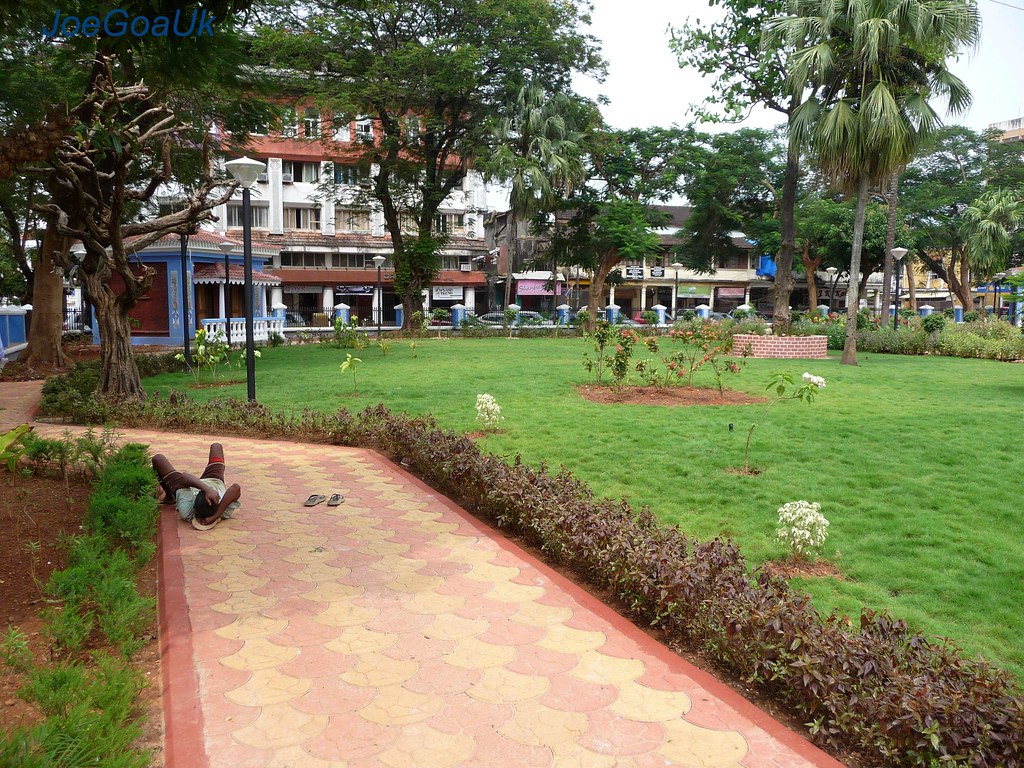
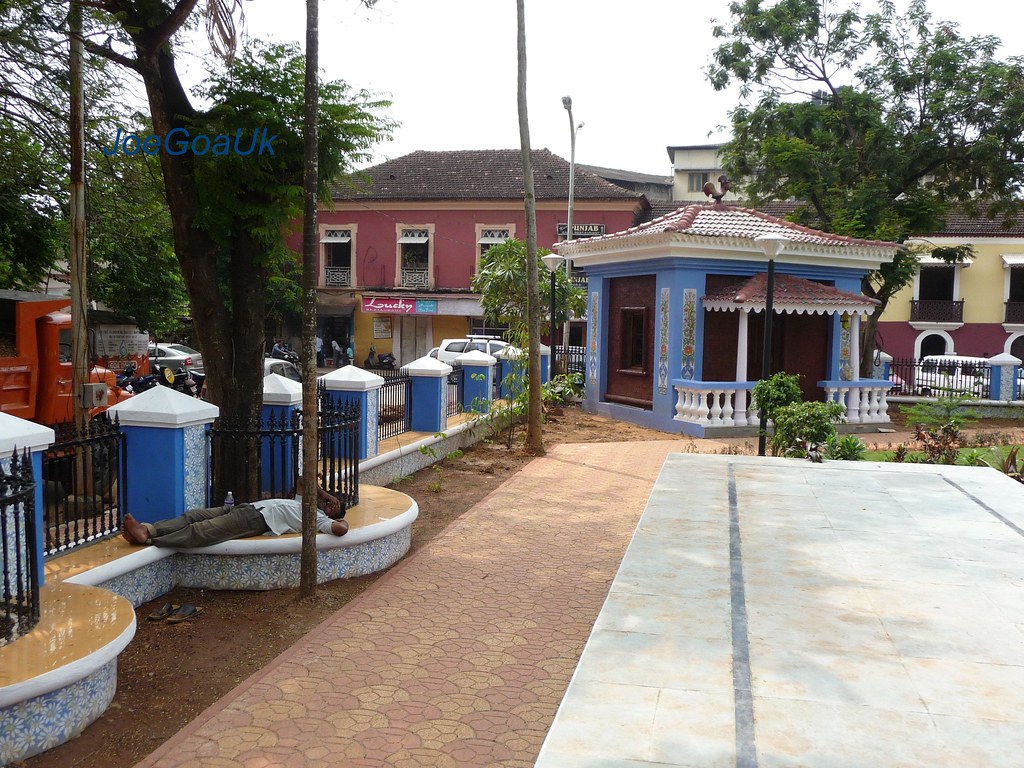
Not too long ago, Panjim’s long languishing Jardim Municipal was renewed and once more open to the public. For this action, we must give thanks to the Panjim Municipality and the other departments (and politicians) that engaged in the refurbishment. We have to be particularly thankful for this renewal because it was rumoured that a portion of the garden was to be converted into a multi-storey parking lot. One must give thanks for small mercies when they are afforded to us; and especially because the choice of renewal of the garden over the possibility of a multi-storied parking lot represents a commitment towards public spaces, rather than the trend towards the privatization of spaces that we are currently facing.
A day after the gala opening of the garden, a consistent visual archivist of Goa sprayed a couple of images of the garden in various Goa related cyber-groups on the internet. These images were not congratulatory images, but rather evidence for the complaint that he now mounted against the public uses of the garden. The images showed labourers sleeping on the newly planted lawns, and some men urinating in corners of the gardens. The images provoked the usual comments of rage, and chest-beating, both from Goans abroad and within Goa. It is to these comments that I would like to address this week’s column.
This column has often pointed out to the qalb or upheaval that Goan society is facing. ‘Save Goa’ is just one manifestation of a larger change. What is bothersome about this qalb is that it very often represents itself as progressive. It uses the language of decentralization, peoples’ democracy, need for public spaces even, to challenge the capitalist onslaught that Goa is facing. As valid as this battle and the arguments invoked may be (and they are!), very often these same valid critiques are employed by groups that are not particularly democratic themselves. While they embrace the ‘Save Goa’ slogan, what they seek to do is reaffirm the structural inequality in Goan society. I would argue that the complaints over the fact of labourers using the lawns of the Jardim Municipal for a siesta are in fact reflections of the social inequality that some of us would like to reinstate in Goa, under the guise of saving Goa. My interest does not lie in castigating these forces, but indicating why it is precisely in supporting the right of the migrant-labourer to sleep on the lawns, or indeed recognizing what makes us urinate on street corners, that we can lay the foundations for the Goa of our dreams.
 The first argument I would like to make is that by sleeping on the lawn, the migrant-labourer is being the unwitting foot-soldier for the Goan dream. He is staking our continued claim to the public open spaces that were a feature of the fast-disappearing Goan landscape. The public open spaces are available not merely to be cordoned-off pretty images that our archivist is suggesting. They are present so that they can be used by the people. And this use is not limited merely to labourers lying on the lawns, they also include little Goan children playing on these very same lawns. As long as the lawns are not destroyed in this process, why should people be denied this small luxury? Indeed, these labourers lying on the lawns are also a reality-check, indicating that there are still people in our Republic, who do not have access to decent standards of labour.
The problem that little Goan children face with regard to playing spaces was brought home to me by Cecil Pinto my fellow columnist, who pointed out the manner in which the guards (acting on orders) invariably prevent his children from running across the lawns of public gardens. The logic that this Goan visual-archivist and the guard share in common is a privatizing logic. Pretty spaces to look at and not use result when we do not feel the need to use the public space anymore but merely whiz past from one private space to another in our little private vehicles. This is part of a larger enclosure movement that is on-going in Goa – think back to the manner in which the Government was contemplating the conversion of the old premises of the Escola Medica (GMC) into a mall. I repeat therefore, that what the labourer, in taking his afternoon siesta on the lawns, is doing is to be the foot-soldier in the larger battle that the Goan is fighting against the system. Indeed, it is not just in sleeping on the lawns that the labourer extends this solidarity to the Goan cause. A priest-friend once remarked to me, that when he takes his post-dinner constitutional around the city of Panjim, invariably what he finds is that it is ‘outsiders’ who use the public spaces as ‘we Goans once did’. Indeed, the liveliest public spaces in Panjim, and perhaps the safest, are where the migrant workers congregate to meet with each other, and unwind after their day’s work. ‘They use the space like Goans’, was my priest friend’s assertion. If they use the space as Goans, then it appears that we gain a couple of insights into this whole Goan identity question. First, that Goa is composed as much of its urban spaces, as it is by the open spaces of the villages. Secondly, it is in using these public spaces that we became properly Goan. That is to say, we were not born Goan, we were socialized into being Goan, by the use of the constitution of public space in Goa. Thus, anyone can become Goan with their adoption of certain mannerisms and a public manner. Indeed, contrary to the helpless hand-wringing of the Konkani ‘lovers’ in the State, Konkani is adopted by ‘outsiders’ at as fast a rate as it is being abandoned by ‘Goans’. The final insight that we gain from this priest’s insight, is that the Goan is increasingly abandoning the public space and retreating into the private. This is not a good sign at all given that democracy and indeed group identities are produced through our presence in public spaces.
Finally, what of those men urinating in the corners of our spanking new park? Clearly I will not suggest that public urination is a shot in our continuing effort to ‘Save Goa’. If so, then as was suggested so long ago, we could have pissed all our troubles away! However as with lying on the lawn, the public urination is indication of the absolute lack of decent and hygienic public facilities on offer more generally. In fact even such sanitary facilities when placed have more recently been effectively privatized by requiring payment to use the toilet.
In sum, we need to watch out for the manner in which our unequal Goan past may push us toward neo-liberal strategies to manage our cities. These strategies while looking good, would infact spell the doom that we are struggling so hard against. In the meanwhile, we need to put together a medal for the blissfully unaware labourer who spurred this entire discussion! Viva Goa!
(First published in the Gomantak Times 20 Oct 2010)
 It is in this context that
Amsterdam in particular, and Europe in general can be used as an interesting case
to learn from. Social spending, in catering to the citizen, educating them, and
opening cultural options for them, is what simultaneously generates the options
for cultural tourism. It was not catering to the tourist that generated its
prettiness, but catering to the citizen first. Even though the European economy is now in crisis, it must be pointed out that this crisis should not be used to
suggest that the model of social spending was the problem. On the contrary, to
use the words from The New Yorker
“social democracy in Europe, embodied by its union, has been one of the
greatest successes in history.” And further “A continent torn by the two most
horrible wars in history achieved a remarkable half century of peace and
prosperity, based on a marriage of liberalism properly so called (individual
freedoms, including the entrepreneurial kind) and socialism rightly so ordered
(as an equitable care for the common good). Any pleasure taken in the failure
of Europe to expunge all its demons threatens to become one more way of not
having to examine our own.”