Showing posts with label Jew. Show all posts

Friday, July 25, 2014

Boycotting Israel: Fighting its propaganda machine


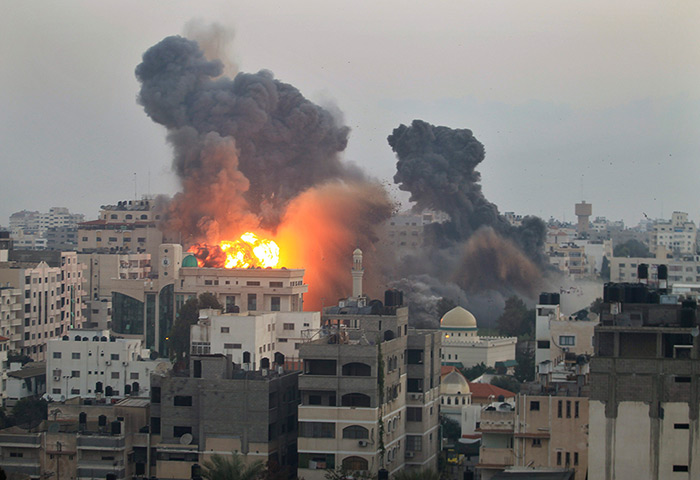
It is with a sense of mounting rage and upset that people from across the world have been witnessing the latest round in Israel’s persecution of the Palestinians. There have been a number of horrific reports, indicating the manner in which civilian innocents have been slaughtered, the manner in which new and unethical weapons have been used against these civilians, as Israel has bombarded Gaza day, after day, after day.
 

Even prior to this round of attacks, however, there has been a mounting call to impose broad boycotts and implement divestment initiatives against Israel similar to those applied to South Africa in the apartheid era. This call first emerged in 2005 in the face of the realisation that the state of Israel was carrying on with the project of building a wall around the West Bank despite the fact that the International Court of Justice found the Israeli project illegal. Since then the call to boycotts, divestment and sanctions (BDS) has been taken up and has been gradually increasing in strength as various groups have been to accede to this call. This call has not as yet, unfortunately, been carried over into the actions of members of the international order in a manner similar to the embargo enforced against apartheid South Africa.
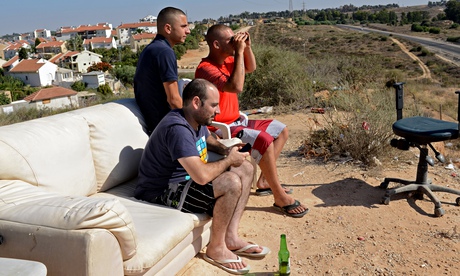


Even as efforts are on to push for statal responses to the call for BDS, the question still lingers as regards what we as individuals can do to address the daily, and historic, violence against the people of Palestine. One possible route presented itself when reading a particular disturbing news item that has emerged in the course of the current Israeli offensive on Gaza. This news item presented by The Guardian informs us that, “As the sun begins to sink over the Mediterranean, groups of Israelis gather each evening on hilltops close to the Gaza border to cheer, whoop and whistle as bombs rain down on people in a hellish warzone a few miles away.” The war on innocents, then, has been converted into a spectacle for entertainment for these settlers who have used “Old sofas, garden chairs, battered car seats and upturned crates” to convert the hillsides into an auditorium. Perversely, “On one hilltop, a swing has been attached to the branches of a pine tree, allowing its occupant to sway gently in the breeze”.


A friend who lives in Israel suggested that the news report was lacking in context. The report, she indicated, failed to mention that the assault on Gaza was a spectacle in the settlement of Sderot, a place where children typically play in bunkers.  Regardless of this fact, however, it was the realisation that a war has now become spectacle to some that forced a recognition of the fact that one of the fundamental ways in which the State of Israel is able to gain legitimacy for its existence as a Jewish state is through the scores of American and European films that have made a continuing spectacle of the Holocaust. Through these cinematic retellings, the Holocaust was the most recent genocide against the Jews and it is to ensure that such a horror never happens again that the State of Israel was set up. The complex histories that surround the Holocaust, which  indicate that the Holocaust was in fact directed against a variety of groups including Gypsies, Catholics, Communists, homosexuals and other groups that the Nazis saw as ‘freaks’ are  never elaborated to largely ignorant audiences across the world. Similarly the fact that these persecutions were largely a story of Jews in Europe is also never elaborated.  On the contrary, the establishment of Israel and its various acts of terror are celebrated as acts of heroism of a people who, once they had their own state, were determined to bring their violators to justice. In addition to the recent attacks against the people in Gaza, two other examples of this terrorism that come to mind are the hunting down of Adolf Eichmann, or the murder of those alleged to be responsible for the murder of the Israeli athletes at the 1972 Munich Olympics. Indeed, the Jewish dead of the Holocaust are converted into telegenic bodies to buttress the Israeli cause.

The simplified histories that these films tell prevents us from entering into the more complex world of the politics of Europe and Anglo-America that made it possible for Jews to be persecuted, and the essentially racist logic that allowed for the state of Israel to even be contemplated as a solution for what was essentially the problem of the (for lack of a better word) White world. In sum these movies encourage us to believe that there is such a thing as “the Jewish people” and that they suffered so much that they were justified in setting up a state in a place already inhabited by people for generations.

It is because these retellings of the Holocaust are critical to buttressing the terrorist activities of the state of Israel that I decided then to absolutely quite watching any films about the Holocaust. Further, I would also not watch any films that presented simplistic stories of European Jewry and caused the audience to feel sorry for them.
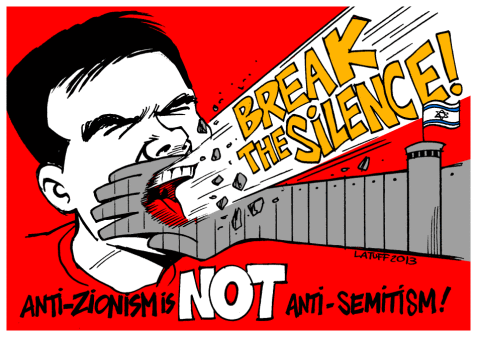
This decision was not without discomfort. Such a decision could be interpreted as the actions of a Holocaust denier. However, one can argue that rather than deny the Holocaust, such a boycott of films on the Holocaust is in fact a commitment to respect the facts of the Holocaust and bring to it the historicity that it deserves. The death of so many thousands of people deserves a better memoralization than the cheap sympathy that such films generate for a state that in fact operates no differently from pre-war Europe and the Nazi state.

At a personal level the boycott would give me the satisfaction that I am not participating in the justification of the Israeli state and its propaganda machine. If joined by others there is the hope that this otherwise individual action could have larger consequences, that we would encourage more honest tellings of this phase of European history.

In any case, any boycott against Israel must also necessarily include a boycott of those activities that operate as propaganda for what is currently a racist oppressor state.

(A version of this blog was first published in the O Heraldo dated 25 July 2014)

Friday, December 13, 2013

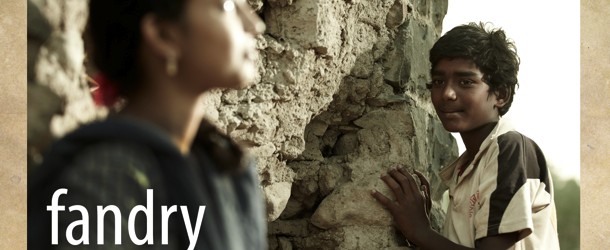
Fandry: The work of Shakespeare in our times


I am a Jew. Hath not a Jew eyes? Hath not a Jew hands, organs, dimensions, senses, affections, passions? Fed with the same food, hurt with the same weapons, subject to the same diseases, healed by the same means, warmed and cooled by the same winter and summer, as a Christian is? If you prick us, do we not bleed? If you tickle us, do we not laugh? If you poison us, do we not die? And if you wrong us, shall we not revenge? 

Shylock (The Merchant of Venice, Act 3, Scene 1)


  Where generations of urban and upper-class/caste Indians have been able to appreciate the pain articulated by Shakespeare in the Merchant of Venice, Fandry, the Marathi language film written and directed by Nagraj Manjule locates the sentiments of the grievously wronged Shylock within the setting of the Maharashtrian Deccan through the story of Jabya. Born into an untouchable caste, Jambavant (Jabya), demonstrates the universality of the human experience when he experiences a boyhood crush on his classmate Shalu. The problem, however, lies in the fact that not only does Shalu seem completely oblivious to Jabya’s feelings for her, but that this possibility does not even cross her mind since she belongs to the area’s dominant castes. What is heart-wrenching in this story is that Jabya recognises that the gulf between their social circumstances would play a role in Shalu refusing to consider his love for her, and yet, continues to hope against hope, that she will indeed fall in love with him. Given that there is no harm in seeking the aid of higher powers, Jabya is also engaged in a hunt for a black sparrow, since he has been convinced by his older friend, Chankya, played by Manjule, that sprinkling the ashes of this bird on the object of one’s affection will make ensure that they fall in love with their admirer.

There are a plethora of reasons why Fandry stands out as an exceptional film, the foremost of which is that it manages to turn our gaze on the ruthless operation of the caste system and the associated social structures by seducing us into following this universal story of first love, and empathising with Jabya’s situation. There is no preaching, no moralizing; Jabya’s story unfolds matter-of-factly, humorously even, with all the quotidian humiliation, and challenges that would face a young untouchable in any mofussil town or village. The film locates the school as the space for change, the space that will enable India to realise its republican dream and challenge the oppression of the caste system. It is the school that permits Shalu and Jabya to inhabit the same space and allow Jabya to be enamoured of his girl. It is also the fact of his going to school and being forced to interact with others as an equal that spurs Jabya to refuse to fulfil the traditional obligations of pig-catching that his caste, and his father (nicknamed Kachru, or rubbish, by the dominant castes of the village) in particular are forced to fulfil. Indeed, the film makes it quite obvious that if caste persists in India, it is not because it is a remnant of some ancient system, but because it is physically enforced by dominant castes across the country and acquiesced to by impoverished Dalits with no other option. Into this miserable reality, it is schooling that provides a possible way out.

It is not as if the school is without its problems. Jabya’s best fried Piraji is prevented from sitting next to an ‘upper’ caste boy because this boy pinches him. Jabya is similarly threatened, and humiliated, by an ‘upper’-caste classmate who sees Jabya’s interest in Shalu and makes it clear that this interest will not be tolerated. It is in fact this burden of curbing Jabya’s self-assertions that by this Patel boy that lays the ground for the dramatic conclusion of the film, when Jabya demands a revenge no different from that of Shylock.

This conclusion comes at the end of the capture of the village’s pig (Fandry) scavengers that Jabya’s family are required to engage in. After having captured the audience with the universality of the human experience it is this dramatic hunt that brings into sharp highlight the various institutions that operate against the Dalit. There is the humiliation of not merely individuals, but entire families as they are forced to do work that others consider degrading. Having engaged in such work for over a lifetime, individuals such as Kachru begin to lose their self-respect. It highlights the threat of rape by dominant caste men that continuously hangs over Dalit women. Most importantly, the film mocks the rituals of nationalism that rather than aiding the lives of Dalits, in fact add to their burdens.

Fandry is a marvellously thought-provoking film that must be seen, not merely for the manner in which it awakens the audience to the silent ways in which the caste system operates in this country, but for the manner in which it elegantly highlights the pain that results when we deny that the Jew and Dalit are as human as the European Christian and upper-caste Indian. 

(A version of this post was first published in DNAindia.com on 13 Dec 2013)

Wednesday, May 12, 2010

Critical Choices… When the soul of a nation hangs by a thread

There is a moment from the Steven Spielberg film Munich that I cherish. In this particular moment, the bomb maker Robert is beginning to have doubts about the morality of killing the persons whom the Mossad held as responsible for the brutal killings of Israeli athletes at the Munich Olympics in 1972. And so it is that Robert says ‘We're Jews…Jews don't do wrong because our enemies do wrong….Suffering thousands of years of hatred doesn't make you decent. But we're supposed to be righteous. That's a beautiful thing. That's Jewish. That's what I knew, that's what I was taught and I'm losing it. I lose that and that's everything. That's my soul.’

This cinematic moment has been replaying itself in my head over and over again ever since the drama around Kasab’s punishment erupted in the Indian media space. It would be worthwhile for us to examine this issue of capital punishment for Kasab from the doubts that Robert has in Munich. Robert captures the dilemma perfectly in his phrasing. Suffering, even if for a thousand years, does not make us and our actions righteous. Thus the real sufferings of those who lost family and friends through the violence in Bombay, and the alleged sufferings of the Indian nation are not reason enough to justify the Indian state’s killing of Kasab. What we should be the real focus of our debate is what the killing of Kasab will do to all of us as Indians. This is what should be the focus of our discussion. And this is what Robert realizes after he has sufficient blood on his hands; that all that killing is making him loose his soul. And at the end of the day, the loss of his soul is too much to bear.

The loss of our collective souls and the loss of the humanity of the Indian nation-state is what we stand to loose through the State killing Kasab. The Indian judicial system assures us that capital punishment is to be awarded only in the ‘rarest of rare cases’. This may in fact be true, where a higher court may hold that a decision granted by a lower court was irresponsible and overturn the sentence of capital punishment. But this is not the point. The point is what does the presence of the death punishment do to us as a people of the legal system.

The Kasab case is a wonderful example of what is being done to us. No one will deny that we have been turned into an audience in this particular case.And the audience in this particular case has been turned into a blood thirsty mob, crying and screaming for the blood of this man. This audience is presented with actors, such as the prosecutor in the case, Ujjwal Nikam, who argues, contrary to the supposed ‘rarest of rare cases’ principle, that all terrorists should be given the death penalty. In the environment that has been generated in this particular drama event, what has been done is to convince so many Indians that indeed terrorists should be given the death penalty. What we do not realize though, is while in Kasab’s case it can be proven that he was stomping around Bombay spraying people with bullets, this is not necessarily the case with every alleged ‘terrorist’. The justice delivery system can sometimes go wrong, the wrong person implicated, the reasoning of courts clouded by fear and nationalist sentiment, and innocent blood can be shed.

Further, a situation where we start baying for blood and believe that all terrorists should be given the death penalty allows for State killings outside the law. Take for example the case of the Batla House ‘encounter’. We know now that the boys killed in the Batla House shootout, were innocents, and victims of a fake encounter. Fake encounters are a fact of life in India, where numerous Muslim boys are routinely dragged and shot. Tribal boys too, under the suspicion that they are Naxals. And let us not forget the trouled areas of the north-east. Allowing for the death penalty creates a certain callousness in our souls, where we shrug off these deaths. Even if we do not shrug these off however, we should remember that we are responsible for these deaths, in allowing for the existence of the death penalty.

What we should constantly keep reminding ourselves is that Kasab is not the point in the debate that is emerging. The point is the soul of the Indian population. The point is not what we can or will do to Kasab, or what he deserves. The point is what will become of us after he is gone. The attempt of the criminal mastermind is to breed bad blood between peoples. Thus either Kasab, or the forces that sent Kasab on his mission, intended that there be tension and escalating violence between the people of India and Pakistan. The idea is to create a state of permanent tension within India. If we kill Kasab, and do so after the kind of frenzied calls for his blood that have marked his trial, then Kasab will not have died in vain. He and his directors will have succeeded in the larger campaign that they have in mind. What we will have done, is to convert the peace loving people of India into a blood thirsty mob. Create a by-and-large gentle, trusting people into a suspicious collective of witch-hunters. The real victor of any battle is the one who winds up with the options. The option still rests in our hands, and we can determine the real extent to which Kasab has impacted on us. To allow Kasab and the forces he has been made to represent to transform us in this manner is to allow them to win and have the final laugh.

It is true that we have to deal with Kasab one way or the other. The way the system operates is to punish him. If one is thinking of punishment, and the inclination is towards death, then allow me a suggestion. The suggestion is that of social death. Let his name be struck from the records and his name never be spoken again. The violence he wreaked will not be mentioned, his efforts will have been in vain. At the same time, let us reach out to those who have been impacted by the violence he and his colleagues effected. In doing so we will strengthen the bonds of loving brotherhood that reputedly make India the nation that it is, and the country it wanted to be at the start of its independence.

The Jews have constructed a history of thousands of years of suffering. And yet, as the Robert of the film Munich points out, the soul of Judaism lies in persevering in righteousness despite these sufferings. India is acclaimed as a spiritual land. It is to this heritage that it owes the obligation to realize that in killing Kasab it will loose the battle of righteousness and walk into a battle where the lines are scripted by the forces of discord on the other side. Like Dronacharya told Arjuna, focus on the eye of the bird in the tree, nothing else. Kasab at the end of the day is a part of the larger forest, the Kauravas even. Our goal, our true goal, lies elsewhere. But at this moment, it hangs by a thread. My prayers are for the soul that India risks loosing.

(First published in the Gomantak Times, 12 May 2010)

Wednesday, February 4, 2009

Palestinians, Jews and Zionists

Christopher Fonseca, the trade unionist, deserves a public commendation for having made history of sorts in our State. Exactly a week ago, he organized a public meeting in solidarity with the Palestinian people at the Institute Menezes Braganza. This public meeting was perhaps the first ever public meeting in Goa on the Palestinian issue and for this alone he deserves credit. However, Comrade Fonseca didn’t just organize a meeting; he organized a meeting which had the hall overflowing with people. For the Palestinian issue to merit such attention in Goa was truly a commendable feat. For all of this, thank you Comrade!


Despite being a by-and-large politically vibrant place, why is it that till date Goa has failed to respond to the Palestinian issue? The answer could perhaps lie in the Indian framework within which we are imbricated. Ever noticed how the Palestinian issue does not figure as much as it does (and should) in the Indian electronic media? At times you would imagine that the Palestinian crisis doesn’t even exist! This happens for good reason. A friend in a prominent national network tells me that they traveled to Israel only when transported there by the Israeli State (guess whose side of the story they presented?) Another friend, in a rival national network cynically pointed out, that ignoring the Palestinian crisis and representing an Israeli point of view made eminent sense. “This way we can do the same thing to Pakistan no?” She’d hit the nail on the head. In many ways India would like to see herself as a subcontinental Israel, since it allows us similar options for belligerence against our neighbours.


This is not the time however for a comparison between Hindutva and Zionism; that should be left for another column. We ought to evaluate now, a statement made at this historic meeting.


Speaking at the meeting Sheik Hassan displayed to the world, the ignorance of the Goan people regarding the politics of the Middle East. Sheik Hassan sought to take the origins of the conflict way back into Biblical times. It was the Jews, he said, who killed the Prophet Jesus Christ. Now the same people are killing the Palestinians. What else can you expect from the Jews? There ought to have been gasps of horror, followed by shocked silence in the hall. Instead the audience sat on, as placid as a calm lake. Clearly both speaker and audience were mired in the same pool of ignorance. What Sheik Hassan spoke at the meeting was clear and distinct anti-Semitism, Jew-hatred. And before we proceed to defend the rights of the Palestinians against the barbaric depredations of the Israeli state, it is imperative that we clear our confused vision, to see what the real issue is, and cleanse ourselves of this pointless Jew hating.


To begin with, the Jews did not kill Christ. If we want to blame a Jewish cast, then we need to possibly blame the Sanhedrin, the Jewish Council that included the High Priest before who Christ was first presented. Even within the Sanhedrin though, there was division as to the question of Christ’s ‘guilt’, so we don’t have a clear-cut culpability of the Sanhedrin. You have only to read the Gospels (though the Gospels themselves are not historical documents telling us an objective political truth) to know that the power of life and death rested not in the hands of the Jewish leadership, but in the hands of the representative of Rome, at that time Pontius Pilate. It was Pontius Pilate who sentenced Christ to death, and dramatically evaded responsibility by washing his hands off the blood of Christ. It is the ensuing act by members of the Sanhedrin that is used to pin the guilt of Christ’s death onto the Jews, the scene where the crowd cries out, ‘His blood be on our heads and on the heads of our children’. In time, this scene was blown out of proportion, especially in the course of the European Middle Ages when it was used to justify acts of routine violence against the Jews. It was not a crazed mob that screamed out these words, but a small coterie that went before Pilate. Surely one does not blame an entire community (even then spread out across the world) for the words of a small and insecure elite?


Sheik Hassan picked on the worst kind of rhetoric he could find to rouse the audience to anger, obfuscated the issue, and for this should be roundly condemned. The problem of Palestine did not begin with the Jews of biblical times, it began much closer in time to us. Secondly, it is not the Jews who are to blame, but the Zionists. As I will seek to elaborate at another point of time, Zionists are primarily Jews, but they are in the thrall of a logic that can extend across religions, including even, Hindus, Muslims and Christians.


Zionism is an ideology that seeks to establish a separate state for the Jewish people, and in the course of its evolution, settled on Palestine as the appropriate location. Zionism, emerged in the context of the racist nationalisms that marked the close the Austro-Hapsburg Empire, when various groups banded themselves into racist categories and demanded their own nation-states. Zionism should be seen in this context, as another kind of racist nationalism, quite divorced from the religious tenets of Judaism. In fact, some of the most bitter opponents of the Israeli state and Zionism are segments of the Orthodox Jewish population. It was God they hold, that dispersed the Jewish peoples from Israel, and it is only the Messiah who will establish the Kingdom of Israel again. To attempt to establish an Israeli State therefore, is to go against the wishes of God. These same groups, point to a shared history, and of peaceful coexistence between Christians, Muslims and Jews prior to the arrival of the Zionists in Palestine. This is a fact; it was only after the arrival of aggressive Zionists, who sough to displace the local Arabs (both Christians and Muslims) that Palestine collapsed into the mess that it has now become. Interestingly, like the key thinkers of Hindutva, most of the founders of Zionism, were not practicing or believing Jews.


However, it is not just religious Jews who oppose the State of Israel, there are other ‘secular’ Jewish voices as well, that oppose the racists and inhuman actions of the Zionist State of Israel. These Jewish voices exist both within the State of Israel, for example the Shministim, the Israeli high school graduates (as young as 18 years of age) who been subjected to repeated jail terms for their principled refusal to serve in the Israeli defence force because of the ongoing Israeli occupation and oppression of the Palestinian people, the organization ‘Not In Our Name’ and a number of others.


Sheik Hassan’s statements are regrettable, and he would do well to apologize and retract this statement. Unfortunately, his position is one that is shared by a number of Muslims, a position that they would do well to reconsider, since it works to only place them within this absolutely uncritical category of global Muslim. This position leads us nowhere, only to problematic rhetorical positions that eventually paint us into a corner.

Israel is not a Jewish project, it is a Zionist project, all Jews are not Zionist, and not all Zionists Jewish.


(Published in the Gomantak Times 4 Feb 2009)