Friday, July 25, 2014

Boycotting Israel: Fighting its propaganda machine


It is with a sense of mounting rage and upset that people from across the world have been witnessing the latest round in Israel’s persecution of the Palestinians. There have been a number of horrific reports, indicating the manner in which civilian innocents have been slaughtered, the manner in which new and unethical weapons have been used against these civilians, as Israel has bombarded Gaza day, after day, after day.
 

Even prior to this round of attacks, however, there has been a mounting call to impose broad boycotts and implement divestment initiatives against Israel similar to those applied to South Africa in the apartheid era. This call first emerged in 2005 in the face of the realisation that the state of Israel was carrying on with the project of building a wall around the West Bank despite the fact that the International Court of Justice found the Israeli project illegal. Since then the call to boycotts, divestment and sanctions (BDS) has been taken up and has been gradually increasing in strength as various groups have been to accede to this call. This call has not as yet, unfortunately, been carried over into the actions of members of the international order in a manner similar to the embargo enforced against apartheid South Africa.
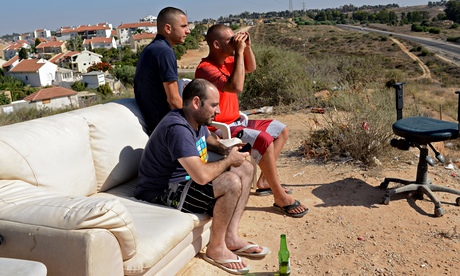


Even as efforts are on to push for statal responses to the call for BDS, the question still lingers as regards what we as individuals can do to address the daily, and historic, violence against the people of Palestine. One possible route presented itself when reading a particular disturbing news item that has emerged in the course of the current Israeli offensive on Gaza. This news item presented by The Guardian informs us that, “As the sun begins to sink over the Mediterranean, groups of Israelis gather each evening on hilltops close to the Gaza border to cheer, whoop and whistle as bombs rain down on people in a hellish warzone a few miles away.” The war on innocents, then, has been converted into a spectacle for entertainment for these settlers who have used “Old sofas, garden chairs, battered car seats and upturned crates” to convert the hillsides into an auditorium. Perversely, “On one hilltop, a swing has been attached to the branches of a pine tree, allowing its occupant to sway gently in the breeze”.


A friend who lives in Israel suggested that the news report was lacking in context. The report, she indicated, failed to mention that the assault on Gaza was a spectacle in the settlement of Sderot, a place where children typically play in bunkers.  Regardless of this fact, however, it was the realisation that a war has now become spectacle to some that forced a recognition of the fact that one of the fundamental ways in which the State of Israel is able to gain legitimacy for its existence as a Jewish state is through the scores of American and European films that have made a continuing spectacle of the Holocaust. Through these cinematic retellings, the Holocaust was the most recent genocide against the Jews and it is to ensure that such a horror never happens again that the State of Israel was set up. The complex histories that surround the Holocaust, which  indicate that the Holocaust was in fact directed against a variety of groups including Gypsies, Catholics, Communists, homosexuals and other groups that the Nazis saw as ‘freaks’ are  never elaborated to largely ignorant audiences across the world. Similarly the fact that these persecutions were largely a story of Jews in Europe is also never elaborated.  On the contrary, the establishment of Israel and its various acts of terror are celebrated as acts of heroism of a people who, once they had their own state, were determined to bring their violators to justice. In addition to the recent attacks against the people in Gaza, two other examples of this terrorism that come to mind are the hunting down of Adolf Eichmann, or the murder of those alleged to be responsible for the murder of the Israeli athletes at the 1972 Munich Olympics. Indeed, the Jewish dead of the Holocaust are converted into telegenic bodies to buttress the Israeli cause.

The simplified histories that these films tell prevents us from entering into the more complex world of the politics of Europe and Anglo-America that made it possible for Jews to be persecuted, and the essentially racist logic that allowed for the state of Israel to even be contemplated as a solution for what was essentially the problem of the (for lack of a better word) White world. In sum these movies encourage us to believe that there is such a thing as “the Jewish people” and that they suffered so much that they were justified in setting up a state in a place already inhabited by people for generations.

It is because these retellings of the Holocaust are critical to buttressing the terrorist activities of the state of Israel that I decided then to absolutely quite watching any films about the Holocaust. Further, I would also not watch any films that presented simplistic stories of European Jewry and caused the audience to feel sorry for them.

This decision was not without discomfort. Such a decision could be interpreted as the actions of a Holocaust denier. However, one can argue that rather than deny the Holocaust, such a boycott of films on the Holocaust is in fact a commitment to respect the facts of the Holocaust and bring to it the historicity that it deserves. The death of so many thousands of people deserves a better memoralization than the cheap sympathy that such films generate for a state that in fact operates no differently from pre-war Europe and the Nazi state.

At a personal level the boycott would give me the satisfaction that I am not participating in the justification of the Israeli state and its propaganda machine. If joined by others there is the hope that this otherwise individual action could have larger consequences, that we would encourage more honest tellings of this phase of European history.

In any case, any boycott against Israel must also necessarily include a boycott of those activities that operate as propaganda for what is currently a racist oppressor state.

(A version of this blog was first published in the O Heraldo dated 25 July 2014)

Monday, July 14, 2014

Culture in the U.S.A.


The lives of a number of English, and to an extent American, nobles and gentlemen from the 18th to the early 20th century was marked by a peculiar ritual called the Grand Tour. As a part of their education and exposure to the wider world, these men of wealth would leave their home shores for a tour of Europe, especially southern Europe, and in particular Italy. There they would immerse themselves in the artistic wealth generated by the Renaissance and after the passage of time, sometimes years, would come back home laden not only with experience but oftentimes books, statuary and works of art. On their return these men would go on to embellish their homes, society and the public spheres they occupied, converting a private learning into public wealth.

No Anglo-Saxon noble myself, but definitely with aspirations of being a cultivated gentleman, I recently ensured that I could turn the invitation to a university on the east coast of the USA into a Grand Tour of sorts. Over the period of a month I did what the White Anglo-Saxon Protestants of yore did, I went around main cities, accepted invitations to dinner, went to see collections of art, and drank in as much ‘culture’ as one could.
Somewhere along this voyage I met up with a friend from another continent, exchanging ideas, impressions as we strolled through the streets of New York. As is common among expats we soon got around to comparing notes about the local species. It was at this point that this friend suggested: “Oh these Americans. They have no culture. They are not like us with so many centuries of culture behind us.”

I was glad for that comment because it articulated an idea that I had been struggling with for the weeks while I was in the USA. Growing up Indian and fed on the cultural superciliousness that marks Indian nationalism this was exactly the idea that one had of Americans (from the US). They may have technological superiority and wealth, but we had a wealth of culture. My time on the East coast was disproving all of these early learnings and providing me a different way of viewing the United States.

True, this country is young, but then, so is India. Indeed, India as a state is younger than the USA. It is in fact the drawing of these random lines across history that obfuscates the way in which we perceive culture, history and the lack of it.

While the US is built largely on the memory of the white settlers of the continent, and not of the Native Americans, the cultural history of these white settlers includes the histories of the communities in Europe from which these settlers emerged. Indeed, if young American men (and some women) embarked on Grand Tours it was because of the recognition of this link, and because they were engaged in a cultural enterprise similar to that of their cousins across the pond in England. On this count, then, the United States has a long cultural history, one that gets richer and more diverse as more peoples come to its shores and assert themselves.

While much derisive attention is directed to the manner in which American history is fabricated, through the careful highlighting of any object of any significance there may be another way of looking at this cataloguing. While this emphasizing of importance may have to do with crafting a national history, it also has to do with building a public culture and a public sphere. There is the public esteeming of individuals who contribute, or have contributed to society. Museums set up by bourgeois families eventually worked to embourgeois others and create a standard public culture through non-formal education and committed both state and elites to a level of public engagement with culture that can only be emulated, not dismissed.

 (A version of this post was first published in The Goan on 12 July 2014)

Sunday, July 13, 2014

Secularism and its political culture


Writing in this newspaper a couple of days ago in the context of Pramod Muthalik’s threats to set up base in Goa, and Sudhin Dhavalikar’s opinions on pubs, drinking, and short skirts not being compatible with Indian culture, Dale Meneses sought to define to amplify what secularism ought to mean. In his op-ed, Menezes suggested that “If we are really serious about maintaining peace [ i.e. being secular] in Goan society, power needs to be shared with minority groups, and greater representation needs to be granted to marginalized groups across religion, caste, and class in Goan society and politics (and not just confined to electoral representation).”
While the argument that couldn’t have been made better, I would like to elaborate on an argument that both Menezes, and Rochelle Pinto who wrote elsewhere have mentioned but not elaborated sufficiently on. This argument pertains to the ‘minorities’ in Goa, in this context, the Catholic Church and other minority groups, to which one could add Catholics as individuals. This distinction is important to make because the Catholic Church as an institution very often has interests and agendas different from those who confess Catholicism, either as devout, or as a cultural identity.

In his discussion Menezes rightly points out that “For many secular Hindus (as well as Christians) the ideal of ‘secularism’ is only threatened when right-wing groups create a ruckus.” Leaving the secular Hindus out, let us focus on the manner in which other groups in Goa seem to have rather limited notions of what secularism is, or what it should contain. Take, for example, the manner the Catholic Church in Goa found itself on the same side of the fence as Hindu rightist groups when it opposed the knowledge session on the tourist industry catering to gay tourists. In an op-ed at the time I forwarded the argument that even while the Catholic Church may be opposed to ‘gay culture’ there were still a range of very Catholic positions that they could choose from which to deal with the fact of the proposed knowledge session. In this particular case, given by the way the official statement from the Council for Social Justice and Peace (CSJP) was phrased, what they were forwarding was not so much an opposition to the exploitation of the exploitation of the sexuality of individuals for mercenary profit, but pushing a patriarchal agenda that dovetails neatly with that of the Hindu right.

There are two points that I seek to make here with regard to the establishment of a secular atmosphere in Goa; the first is that this atmosphere depends critically on the development of nuanced political discourse, and even more importantly developing an environment where respect of difference, whether that of opinion or life choices is an absolute value. A more nuanced political discourse would have allowed the CSJP to make its stand clear, and yet not necessarily fall into de-facto alliance with the very groups that would otherwise have sought to throttle the church.

However, it is neither respect for difference, nor nuanced political discourse that animates the example that demonstrates the manner in which Goan civil society is actively encouraging blind and cussed intolerance in its midst. A report in the Gulf Times drew attention to the fact that the Fatima High School in Rivona was temporarily shut down as a result of a deadlock between the institution’s management and the Parent Teacher’s Association (PTA). The PTA was apparently irked by the fact that 13 HIV positive children had been enrolled in that school and enforced their threatened boycott of the school.

The simple fact is that HIV is transmitted only through the exchange of sexual fluids, or blood, or via a mother to child during pregnancy, labour, delivery or breastfeeding. The actions of the PTA, therefore, can either be the result of appalling ignorance, or cussed desire to discriminate. Regardless of the reason the fact is that the future of a secular Goa lies not merely in whether we “throw out Muthalik and his ilk” but rests critically on whether we are able to develop a greater acceptance for difference of any sort. On whether our responses can be tempered by information, by compassion, regardless of the circumstance. At the end of the day it is this largely public culture that will forge the basis of secularism, not merely crying foul when right-wingers engage in hate-speech, or incite or engage in violence. And though clichéd, it seems a worthy time to remember the words of pastor Martin Niemöller in the context of the rise of the Nazi’s in antebellum Germany.

   First they came for the Socialists, and I did not speak out—
    Because I was not a Socialist.
    Then they came for the Trade Unionists, and I did not speak out—
    Because I was not a Trade Unionist.
    Then they came for the Jews, and I did not speak out—
    Because I was not a Jew.
   Then they came for me—and there was no one left to speak for me.”


A version of this post was first published in the O Heraldo on 11 July 2014

Saturday, June 28, 2014

Secrets of the Goanese Namban


An exhibition entitled The Flowering of Edo Period Painting is currently on at The Metropolitan Museum of Art in New York City and will run until the seventh of September this year. Spread over two centuries between the early 1500s and 1868, and marked by rule of the Tokugawa Shogunate over the Japanese islands, the Edo period is seen to have opened up a period of political stability that allowed for a variety of arts and crafts to be systematically developed. The exhibition at the Metropolitan Museum was built around a number of screens, scrolls and other paintings from this long period.
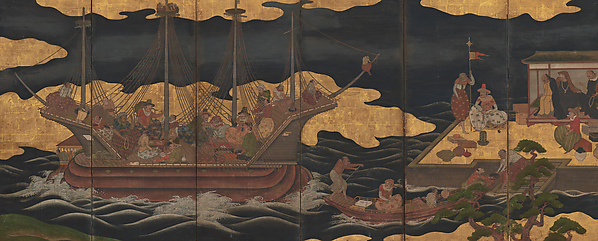
Located among the many artworks from this period, is a rather large Namban screen. While the term Namban is often associated with Japanese arts forms associated with the Portuguese expansion from fifteenth century it is worth going into the origin of the term to elaborate the point I seek to make. A Sino-Japanese word Namban was the term used for South Asians and South-East Asians and translated to Southern barbarians. At around the time of the Portuguese expansion into Asia, given that the Portuguese were emerging into Japanese waters and territory from their locations in South Asia, primarily but not exclusively Goa, the term came to be used for the Portuguese as well. Indeed, Namban screens profusely depict Portuguese in their distinctive baggy trousers and hats, arriving in ships, with their slaves, promenading under umbrellas and engaged in trade.
What struck me about this particular screen, however, was the presence of figures that within the Namban norms of depiction looked distinctly non-Portuguese. The caption accompanying the screen read: ‘In 1543, a storm blew a Portuguese ship onto the tiny Japanese island of Tanegashima, and within a year, Portuguese ships began making regular visits to ports In Kyushu. The Japanese called them Namban, “Southern Barbarians,” since they were arriving from India via a southern route. A widespread frenzy of curiosity developed about these strange new arrivals in their giant ships with booming cannons, their mustaches curling beneath their noses, the dark skins of the Goanese sailors, and their exotic clothing.’

Always the Goan first, the caption excited my imagination. Here, far away in America I was viewing sixteenth century Japanese representations of my Goan kinsmen. This excitement was not, however, without some amount of irritation. “Why Goanese? Do they not know that we prefer being called Goan?”

This annoyance was temporary, given that the preference for Goan over Goanese was  largely that of the Goan elites who lived in the city of Bombay in the nineteenth centuries. Seeking to distinguish themselves from the Goanese who were their countrymen in labouring professions, they used Goan instead. Continuing to contemplate the caption and the screen itself, I realised that the audience was being presented with dramatic possibilities to reimagine Goan-ness.


To begin with, the caption indicated that the Portuguese were known not via their location in Europe, but their location in South Asia. They were received in Japan through the same epithet reserved for South and South East Asians. If in later times Portugal asserted a European identity for the citizens of the Estado da India, then in earlier times, their own European identity was, at least temporarily, displaced in favour of a South Asian one. Indeed, delving into the life histories of the Luso-descendentes will reveal to us how so many of them did and continue to think of South Asia, and Goa, not as a ‘colony’ but home. If we have failed to recognise the ambiguity of their identities and self-definitions thus far it is largely because our perspectives have been coloured and blinded by a worldview that grew out of the context of British imperialism.


At this moment, however, I am less concerned with the Portuguese than with what this caption and the screen do for the Goan. The image of the Goanese on that screen is not one that many of us would identify with today. If one is thinking of the Goan Catholic, then one is used to images of persons in European dress. For non-Catholic Goans, one is used to images of upper-caste Hindu men in dhotis, shirts and jackets. The Goanese depicted on the screen are at odds with this image. The most dominant one is turbaned, in a flowing gown, and counting the beads of what looks like a tasbih, or Islamic rosary.

This image is fortuitous because it allows us to draw the largely marginalised Muslim into our image of Goan-ness into two very different ways. To begin with it, in a context where the various Muslim communities in Goa have been excluded from our post-colonial imagination just as the Luso-descendentes and metropolitan Portuguese, the screen asserts that the Muslim is very much central to the Goan identity.

There are other turbaned figures featured on the screen, and yet others who while not in ‘oriental’ garb but dressed like Portuguese are represented somewhat differently, largely through the colouration of their skin. There is one particular individual on this screen that particularly caught the eye. Situated below the clearly Portuguese man (identified through his cap) and the Muslim, this person is a somewhat dark skinned man otherwise dressed in Portuguese garb. Could this be a native Catholic resident in the Estado da Índia? Or is this a representation of an African in the employ or enslavement of the merchant company?

One would need to be much more familiar with the iconography of Namban art to answer these questions. For now, however, the screen allows us to complicate the histories that produce a simplistic genealogy for the question of who is Goan. It excludes the variety of slaves, African and Japanese, who were brought into Goa, and who, no doubt, mixed with locals to produce contemporary Goans.

These exclusions have occurred largely through the dismemberment of the territories that constituted the former Estado da Índia. When Goa received statehood, it was premised on making Konkani the sole official language of the state. This necessitated the excision of the largely Gujarati (and Portuguese) speaking territories of Daman and Diu. In doing so, Goa was constructed as a provincial location that was the home of Konkani speakers alone. And yet, as the namban screen highlights, Goa has been more than a small provincial location, but an international and imperial (sub) centre. It gave identity to groups of persons larger than those who could claim a mythical tie to the land.

The privileging of Konkani was premised on securing the interests of Goan identity, in particular its minority groups, like the Catholics. But history has demonstrated that this route was a red herring. Goan Catholics are treated as second class citizens as the forms of Konkani that they use are excluded from the official definition of the language. Crafting Konkani as central to Goan identity also rested on imagining Goa as a space of village communities. This confounded the claims of Muslims as being authentically Goan, and also undermines the claims of persons outside of the caste groups that dominated the village communities. Further, it obscures the role of the Gujarati merchants, Muslim and Hindu, who have associated with Goa for generations, as well as occluding their role in crafting a Goan economy that is not tied to agriculture. This history also impoverishes the histories of thousands of regular Goans who have no obsession with claiming a pure blood line to Aryan groups by ignoring the multiple groups that were found their way into the Estado.

What the imagination of Goa as a Konkani alone space has done is to allow for this territory to be imagined in Hindutva compatible terms. A return to earlier imaginations of what Goa was, and who Goans are, would, perhaps undo some of the multiple exclusions that have marked post-colonial Goan politics and lay the foundation for a more dynamic society.

A version of this post was first published in the O Heraldo dated  27 June 2014.


Saturday, June 14, 2014

Churches and temples and mosques! Oh My!


The reverend Christian theologian was sitting in the upper room and preaching to a small community that was gathered around him. This theologian had built a career around inter-faith dialogue and was talking of how Christian sites were often built over the sacred sites of other faiths. “For example”, he said “the Basilica of Bom Jesus is built over the tank of a temple and can today be seen under the altar of the church.”

This was about as much as the angry young man could take. He sprang up and challenged the old man. “You’ve got your facts all wrong” he charged. The Basilica was built on the maidan outside of the walls of the Bijapuri city of Goa. There was no temple there. And that’s not all, the church you are referring to is the church of St. Cajetan. And here too you are wrong. The church sits within what was the very heart of the citadel of the fortified Bijapuri city. The well we see today is the result of the architect’s attempt to drain the soil so that he could sink the massive foundations he needed to raise the huge dome of St. Cajetan’s. Further, we need to decide who were the bad guys, the ‘Muslims’ or the ‘Portuguese’, they both cannot have destroyed the same temple can they? That is, if there was any temple destroyed in the first place!”

That great temples were destroyed and the Goan churches of today were raised over them is a shibboleth of much popular Goan history. But this nugget of information may be more myth than actual history. The churches of Old Goa, as has already been pointed out, were built within the Bijapuri city of Goa, and if anything, the churches were built over mosques. The Cathedral is reported built over the Jama Masjid of the city.

The scene becomes ever more complex if one leaves the urban contexts of the city of Goa and heads into the villages that surrounded this core of Portuguese domination in the sixteenth century. To begin with, most people make the mistake of assuming that the countryside around the city was a Hindu space. This is a popular misconception. The land was teeming not just with Hindus (that is to say brahmanised castes) but with a variety of subaltern and untouchable groups, as well as Muslims and other social and cultural groups. If sacred sites were taken over, then these sites could have also belonged to groups beyond the brahmanised castes. Indeed, because of what we know of the history of the location of Goan churches, one could safely assume that if a sacred site was repurposed then it was the shrines of the marginal groups that suffered this fate.

In his marvelous book Whitewash, Red Stone that discusses the Goan-ness of churches in Goa, Paulo Varela Gomes makes the astute observation that most of the early churches in Goa were not built in village centres, but rather on the peripheries of villages. This was the case because there was no centre in the European sense of the term. Rather, villages were organised according to castes, each caste having its own little ward, set apart from those of the others. Within such a society, Varela rather persuasively suggests, rather than risk identifying the church with a particular group, these priests built their churches outside of the villages in spectacular locations. Think of the church of Penha da França, or that of Curtorim. Where settlements do exist around these churches, whether in the case of Margão or Chinchinim, these were later developments with the village shifting toward the church, following the lead of powerful families that sought to replicate European urban forms.

What then do we make of the fond myths that have been told and retold for generations? Take the case of Margão for instance. We are told that the (Brahmin) villagers of Margão offered any space in the village for the church, but requested that their temples be spared. Unheeding the Bishop is said to have cast a sword into the air and toward the temple of Damodar causing this temple to be displaced to make way for today’s Church of the Holy Spirit.

The strength of this story rests on the conflation of the Damodar of the story with the great lord of Zambaulim. There are, however, a number of crucial details in the popular retelling of the foundation of the church in Margão that could tell us a different story. According to legend, the Damodar in question was a brahmin male who was killed on the outskirts of the village as he returned with his bride after his death. Hell hath no fury like a brahmin spurned, even worse a brahmin who has been killed before he could realise his desires. Their tormented souls turn into Pisacha and wreak havoc on the realm of the living. It was to pacify this soul, therefore, that a shrine would have been built. A minor shrine to a demonic being is different from a central shrine of a brahmanical deity patronised by the dominant caste of the village. We can conclude therefore, that it was no great temple that was destroyed in Margão, but if at all, a minor little marker, perhaps not so different from the shrines (of all religions) that continue to spring where a person has met a violent death.

Contrary to widespread beliefs today, temples did not come up at the whim and fancy of people. There was an entire cosmology that allowed for temples to emerge. To sustain its growth the brahmanical order would first set up the temple of a brahmanical or brahmanised temple. Other deities would then be constructed as minor and hierarchical relations constructed between this main deity and the minor deities. In this process, those who worshipped the inferior deity were also crafted as inferior. This is another story, however, and it connects with the theme of this column only to the extent of making the point that we need to realise that very often, the missionaries chose to avoid sites of the dominant castes and constructed their churches outside of village centres. The myth of the destruction of temples to facilitate the building of churches over them therefore needs to be revisited and systematically examined for the facts in each case. 

(A version of this post was first published in the Herald dated 13 June 2014)