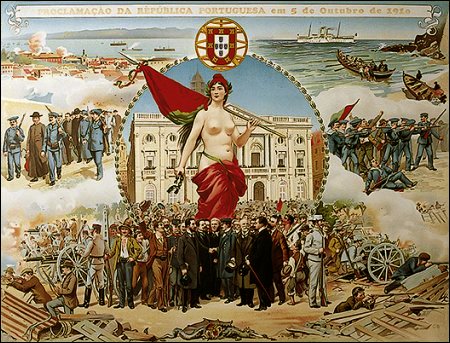
The year 2010 is a year of great significance for in this year we commemorate a number of hugely momentous political events. We mark the fifth centennial anniversary of the conquest of the city of Goa by Afonso de Albuquerque in 1510,
the centenary of the declaration of the Portuguese Republic in 1910, and six decades since the enforcement of the Constitution of India. Subsequently, this year shall give way to another, when we in Goa will mark our integration into the Indian Union in 1961.
Let us leave aside the event of 1510 for the moment. We shall have much to discuss about this event in the months to come; and I dare say that the nationalists will have even more! Let us concern ourselves however with these two Republics, both of which are appropriately ours as Goans; the Portuguese and the Indian.
There are moments in time, when one is confronted with events of such profundity, that one can understand them only as moments of rebirth. The old self passes away, and in light of the revelation before us, is reborn, rather like a Phoenix from the ashes of the old. One such personal moment of rebirth,

was the realization that the Portuguese Republic of 1910 was my own. This was a fundamental moment of rupture. Happily for me, the initiation into this truth occurred at the hands of not some nostalgic ‘Portuguese Left Over’ (PLO) – as they are so unkindly called – but via an activist of the Goan Bahujan Samaj. Standing up at an event this man proclaimed to all the Goan world, that he was first liberated when recognized as equal in 1910, under the effects of the Portuguese Republic that recognized all Goans as citizens. His reference was to his formal liberation from the caste oppression that, he will argue, continues to dog the lives of numerous ‘lower’ caste Goan Hindus, as well as to the formal recognition of equality that was given effect to via the hard work and perseverance of
Dr. B. R. Ambedkar, the Father of our Constitution.
For too many of us however, Republic Day is just one more day for nationalist ‘India Shining’ chest thumping, the offensive displays of the might of the Indian armed forces, and the cloying sweetness of ‘cultural diversity’ parades. I was the horrified

witness to a entirely serious discussion on Facebook, where a number of young Indians maintained a steady discussion on how awful it was that we had a frumpy looking woman taking the military salute at this years Republic Day parade in Delhi. Why couldn’t we have a more stylish, smarter woman as President? Why can’t she just do something for her hair!!!
Can Republic Day mean more to us? Our Bahujan Samaj activist gives us an insight into taking the Republic seriously. The declaration of republics in various parts of Europe meant the abandoning of social and legal orders that were based on feudal privileges and hierarchies. It presented the idea of a political order where all were to be equal. To be sure we realized in the course of time that these republics replaced one inequality with another. The idea of equality which was to apply to all men, was taken literally, in that women were excluded for a long time from political representation. All men however did not apply to men of colour and to colonial contexts. And yet, the mere idea of these rights were important because it allowed us to imagine different ways of relating to other human beings and assured us we did not have to always be cowed down. The promise of equality and rights was the gift of the Republican ideal. In many parts of the world, not just in Europe, the idea of the Republic is taken very seriously. It is something to continuously fight for, to ensure that these values of equality are in fact realized on a daily basis.
In India too, the constitution of the Republic is significant for the fact that it announced to a country filled with hierarchies of different sorts that these were to now be a thing of the past.

The Indian Constitution announced
formal equality to people who until that moment lacked it. This Constitution was not won easily. The Indian Constitution was defended vigorously by Dr. Ambedkar and others from ideas that could possibly reaffirm the old hierarchies. This is a project that is not as yet complete, for not only are the egalitarian ideals of the Constitution not realized in effect, but there are constant attempts to undermine these ideals. The military drills, ‘India Shining’ and the standard celebrations of Republic Day are in fact parts of this process of distracting us from the more profound significance of the constitution of the Republic.
The Goan Hindu, more specifically the elite Goan Hindu, is perhaps best placed to be able to appreciate the significance of the declaration of the Republic. With the Declaration of the Portuguese Republic, all Goans were now full citizens of the Republic. There was to be no more of the second class treatment of old. The Goan Hindu was able to now burst forth legitimately into the public arena, and burst out they did. While the Goan Hindu elite were always a significant force behind the Estado da India, the Republic allowed them to now take a more significant part in this process of governance. In allowing for the land reform legislations, and liberating subaltern Goans from the material conditions that sustained oppressive social regimes, the Constitution of the Indian Republic continued for the Goan, the promise of the republican ideals that were cut short by the interlude of the
Estado Novo.
Commemorating the year of the Declaration of the Portuguese Republic is crucially important because it marks our long and continuing journey towards equality. Erasing such an early leg of our history would serve only to obscure the length of our struggle and more easily distract us toward nationalist celebrations. Indeed perhaps this is why our Bahujan Samaj activist declared his debt to the declaration of the Portuguese Republic. In recognizing this longer history he refused the many lies that are peddled to us under the garb of nationalism. In recognizing the contribution of the Portuguese Republic he tells the story like it is. The enemy is not some possibly-foreign colonial. On the contrary, the enemy lies within. Not necessarily a person, or a group, it is a tendency to underplay the importance of this egalitarian goal and push us in other (nationalist) directions. These directions while stressing boundaries and differences detract us from the republican ideal; that is equality for all.
For this reason, therefore; Viva a República! Viva Portugal, Viva India; Viva Goa!
(A version of this post was first published in the Gomantak Times, 10 Feb 2010)
 University, made a rather interesting suggestion via email to the Chief Minister of Goa. Rather than be an occasion to mindlessly spend huge amounts of state revenue, he has suggested that the International Film Festival of India (IFFI), now held annually in Goa, be themed for the year 2010 to commemorate “Colonialism and peoples’ struggles / movements across the world”. To this already interesting proposition he adds one more laudable suggestion; rather than invite an actor or actress from Bombay, who as he says leave no ideas behind, why not invite Arundhati Roy to inaugurate the festival? Roy, he
  suggests, could also be asked to speak on “Colonialism down 500 years a topic which would be suitable considering the completion of 500 years of Goa's conquest by Afonso de Albuquerque, on 25th November 2010 and foundation of colonial rule in Asia”.


