
Showing posts with label Holocaust. Show all posts

Friday, July 25, 2014

Boycotting Israel: Fighting its propaganda machine


It is with a sense of mounting rage and upset that people from across the world have been witnessing the latest round in Israel’s persecution of the Palestinians. There have been a number of horrific reports, indicating the manner in which civilian innocents have been slaughtered, the manner in which new and unethical weapons have been used against these civilians, as Israel has bombarded Gaza day, after day, after day.
 

Even prior to this round of attacks, however, there has been a mounting call to impose broad boycotts and implement divestment initiatives against Israel similar to those applied to South Africa in the apartheid era. This call first emerged in 2005 in the face of the realisation that the state of Israel was carrying on with the project of building a wall around the West Bank despite the fact that the International Court of Justice found the Israeli project illegal. Since then the call to boycotts, divestment and sanctions (BDS) has been taken up and has been gradually increasing in strength as various groups have been to accede to this call. This call has not as yet, unfortunately, been carried over into the actions of members of the international order in a manner similar to the embargo enforced against apartheid South Africa.
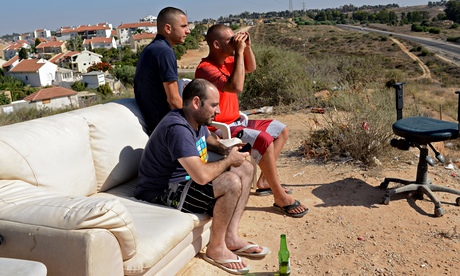


Even as efforts are on to push for statal responses to the call for BDS, the question still lingers as regards what we as individuals can do to address the daily, and historic, violence against the people of Palestine. One possible route presented itself when reading a particular disturbing news item that has emerged in the course of the current Israeli offensive on Gaza. This news item presented by The Guardian informs us that, “As the sun begins to sink over the Mediterranean, groups of Israelis gather each evening on hilltops close to the Gaza border to cheer, whoop and whistle as bombs rain down on people in a hellish warzone a few miles away.” The war on innocents, then, has been converted into a spectacle for entertainment for these settlers who have used “Old sofas, garden chairs, battered car seats and upturned crates” to convert the hillsides into an auditorium. Perversely, “On one hilltop, a swing has been attached to the branches of a pine tree, allowing its occupant to sway gently in the breeze”.


A friend who lives in Israel suggested that the news report was lacking in context. The report, she indicated, failed to mention that the assault on Gaza was a spectacle in the settlement of Sderot, a place where children typically play in bunkers.  Regardless of this fact, however, it was the realisation that a war has now become spectacle to some that forced a recognition of the fact that one of the fundamental ways in which the State of Israel is able to gain legitimacy for its existence as a Jewish state is through the scores of American and European films that have made a continuing spectacle of the Holocaust. Through these cinematic retellings, the Holocaust was the most recent genocide against the Jews and it is to ensure that such a horror never happens again that the State of Israel was set up. The complex histories that surround the Holocaust, which  indicate that the Holocaust was in fact directed against a variety of groups including Gypsies, Catholics, Communists, homosexuals and other groups that the Nazis saw as ‘freaks’ are  never elaborated to largely ignorant audiences across the world. Similarly the fact that these persecutions were largely a story of Jews in Europe is also never elaborated.  On the contrary, the establishment of Israel and its various acts of terror are celebrated as acts of heroism of a people who, once they had their own state, were determined to bring their violators to justice. In addition to the recent attacks against the people in Gaza, two other examples of this terrorism that come to mind are the hunting down of Adolf Eichmann, or the murder of those alleged to be responsible for the murder of the Israeli athletes at the 1972 Munich Olympics. Indeed, the Jewish dead of the Holocaust are converted into telegenic bodies to buttress the Israeli cause.

The simplified histories that these films tell prevents us from entering into the more complex world of the politics of Europe and Anglo-America that made it possible for Jews to be persecuted, and the essentially racist logic that allowed for the state of Israel to even be contemplated as a solution for what was essentially the problem of the (for lack of a better word) White world. In sum these movies encourage us to believe that there is such a thing as “the Jewish people” and that they suffered so much that they were justified in setting up a state in a place already inhabited by people for generations.

It is because these retellings of the Holocaust are critical to buttressing the terrorist activities of the state of Israel that I decided then to absolutely quite watching any films about the Holocaust. Further, I would also not watch any films that presented simplistic stories of European Jewry and caused the audience to feel sorry for them.

This decision was not without discomfort. Such a decision could be interpreted as the actions of a Holocaust denier. However, one can argue that rather than deny the Holocaust, such a boycott of films on the Holocaust is in fact a commitment to respect the facts of the Holocaust and bring to it the historicity that it deserves. The death of so many thousands of people deserves a better memoralization than the cheap sympathy that such films generate for a state that in fact operates no differently from pre-war Europe and the Nazi state.

At a personal level the boycott would give me the satisfaction that I am not participating in the justification of the Israeli state and its propaganda machine. If joined by others there is the hope that this otherwise individual action could have larger consequences, that we would encourage more honest tellings of this phase of European history.

In any case, any boycott against Israel must also necessarily include a boycott of those activities that operate as propaganda for what is currently a racist oppressor state.

(A version of this blog was first published in the O Heraldo dated 25 July 2014)

Wednesday, May 16, 2012

Out with the old? Advocating a measured approach to built heritage


That we ought to tear down ‘ugly’ and ‘old’ buildings was the suggestion of Mr. Armando Gonsalves in a recent column in the O Heraldo dated the third of May. Mr. Gonsalves was careful to specify however that when he recommended this demolition, he did not mean ‘heritage’ structures, but buildings that have come up in post-Liberation Goa. Among some of the buildings that Mr. Gonsalves recommends that we pull down, is the building that houses the Department of Health in Campal, as well as the Junta House in the centre of Panjim, that is home to a number of Government offices.

The Dept. Of Health, Campal.
These suggestions are hugely problematic ones to make for a variety of reasons. To begin with, there is the assumption that the idea of beauty is one that is universally held by all. The argument assumes that there is something that one can look at and immediately pronounce, ‘ugly’ or ‘beautiful’. Unfortunately, this is not quite the case. Because, as is well known, but little reflected on, beauty lies in the eyes of the beholder; beauty is not intrinsic to an element, but depends on the appreciation of the beholder. Thus, beauty is reckoned by a canon, or code or rules. If we do not know the rules to appreciate the building, or image, then we would simply fail to realize in what manner the building is an interesting, or uninteresting contribution to built heritage. Thus for example, one may look at the Junta House, or indeed the Department of Health, or the similarly styled Department of Education building in Panjim city and marvel at their ridiculousness. However, if one sees them within the context of modernist design that they were being articulated from, then they become very interesting buildings in themselves. Add to the fact that these are government buildings and the State that built them, whether it was the Portuguese State (as may be in the case of the Junta House) or the Indian State, and you realize that a statement was being made. These buildings were not meant just to house governmental departments, but were built to make a statement. Of new times, of the will and determination of the State. Once again, for these reasons alone, these buildings gain an interesting perspective, and grow in beauty in the eyes of the beholder, as well as the heritage activist.

Dept. of Education, Panjim.
If we have so far been unable to appreciate the beauty of these (and other like) buildings however, it is perhaps because of the odd contours of the word ‘heritage’ that is being provided both by Mr. Gonsalves as well as others within the area of built heritage in Goa. What Mr. Gonsalves at any rate is doing in his argument, is to limit the scope and terrain of heritage to solely buildings built before the ‘Liberation’ of Goa. While it is surely not his conscious attempt, what Mr. Gonsalves is doing is to stop Goan history with the period of Portuguese sovereignty over Goa. The rest of Goa’s architectural evolution, does not really matter. This is not an uncommon position unfortunately, and the process of selling Goa (both by State and non-State actors) as a Portuguese-Indian paradise has compounded this trend. Unfortunately, what is often seen as Indo-Portuguese heritage are often the homes of the more privileged members of Goa’s colonial society. Even more unfortunate has been the manner in which buildings from before Liberation, often articulating international styles like Art Deco have been stripped of their ornament and distinctness, to be rearticulated in a new form that seems to be slowly emerging, figuring azulejos, pastel earth tones, and harking to a rural ideal. Post-Liberation architecture, from the homes of people who got rich via tourism and earnings from the Gulf, to the apartment blocks erected by the fledgling real-estate developers, tells us a critical story of the rise of formerly subaltern groups, out of a restrictive social environment, to a more liberating one. These buildings, as ‘ugly’ as they may appear to us, even when we understand their internal vocabulary, are a proud moment in Goan history, and we cannot simply brush them aside and order their demolition! To cast only a particular genre of Goan built heritage as heritage, would result in our effective freezing of a definite kind of social relations, one that sustained the colonial presence in Goa, and this would be simply obscene!

Rearticulating an urbanTaleigao Indo-Portuguese style
More than obscene however, they will lead to a whole lot of social strife, because the association of Goa with Indo-Portuguese styles alone, and this freezing of time sometimes relied upon by heritage enthusiasts, is opposed not just by the Hindu nationalists, but a wider swathe of the Goan population than we would imagine. Take for example the incredible support that Mr. Monserrate, the MLA formerly of Taleigão, gained for projects in the constituency that scandalized one segment of Goa’s population. These projects, aimed at destroying the rural structure of Taleigão, by inserting roads and the like, was supported primarily because the rural setting, a particularly privileged locale for the Indo-Portuguese aesthetic, is not particularly appealing to those native-Goans who form Mr. Monserrate’s vote-base. That Mr. Monserrate nevertheless used elements of Indo-Portuguese design, drawing on conventions of certain kinds of European design, and interestingly rearticulated these in the projects that he initiated, however, is another matter, and one that points us in the direction of lessons that we ought to take note of.

Mr. Gonsalves’ arguments are scarier than they prima-facie appear to be, because they draw on a logic that once approved for use in the manner in which we determine which buildings can stay, and which have to go, the logic can be extended to other areas of social life as well. Take for example, the fact that Mr. Gonsalves suggests that the building of the Department of Health ought to be demolished because it does not fit in with the rest of the ‘Heritage’ zone of Campal. The logic that lies below this facile suggestion is that if something, or someone, does not fit in with the larger group, out they go. This sort of exclusivist logic is the very basis on which the vegetarian ghettos of Indian cities have, and are, been formed; where difference is absolutely not tolerated. This is the logic that eventually led to the European Holocaust that saw the calculated murders of Gypsies, homosexuals, Jews and Communists; simply because they did not fit in into the larger scheme of things. This is ofcourse not the intention of Armando Gonsalves who has led many a charitable and philanthropic event, but these are the implications of the logic that he has perhaps unwittingly used in making his suggestions.

Mr. Gonsalves also makes the error of assuming that if the buildings are ‘spanking new’ then they will replace the older buildings that he finds ugly, with a more interesting urbanscape. His assumption is that “Architecture was not such a developed art a few decades ago”. The sad truth is that, none of this is true. Architecture was just as developed a few decades ago, as it is today. There were some buildings that were perhaps more provincial or clumsy followers of international trends, and others that manifested international trends interesting. But we would know this only if we developed our understanding of the vocabulary that architects and designers have been using. Furthermore, some of the problems with the built environment in Goa, as in other places, is not simply that they are ugly, but because increasingly, every architect seems to want to make a statement; because street facades are not being maintained, because the skyline (or the roof façade of the city) is increasingly out of control, and the sense of scale is being violently disrupted, the larger sense of order that we experienced is being lost. The answer to our built heritage woes therefore, is not necessarily to pull down anything that is old, but to spend some more time figuring out what exactly is the problem, educating ourselves in larger issues of urban design, management and styling, and once we do that, to address the issue advisedly.

(A version of this post was first published in the Gomantak Times dtd 16 May 2012)