Showing posts with label Yellamma. Show all posts

Tuesday, July 14, 2015

José Gerson da Cunha, his myths and histories: Rethinking Origin Myths in Goa IV


For some time now I have been revisiting the myth recounted by Narayan Kondiba Mane, a Dhangar shepherd from the district of Kolhapur in Maharashtra. The myth tells of the birthing of the hero Parashurama and his relationship with the Goddess Yellamma. Mane’s myth suggests that Parashurama was born of the virgin Goddess Yellamma as a punishment for her violation of the sacred grove of Mahadev. Saddled with a baby, the Goddess was given aid by the Shia heroes Imam Hassan and Imam Hussein who built a residence for her on the hill of Saundati not far from Belgaum. As the title of this series of columns indicates, we can use this Dhangar narrative to rethink the central role that is often given to a brahmanically-imagined Parashurama when recounting Goa’s mythical origins
.
Rethinking the now popular Parashurama myth requires that we recognize that the centrality that the brahmanical, or Puranic, myth currently enjoys is perhaps only a century old. Prior to this period the idea that Parashurama, son of the sage Jamadagni and Renuka, created Goa by shooting an arrow into the sea was not widespread. On the contrary, this was a Puranic version alone, and each Purana, or copy of a Purana, had its own peculiar spin on the narrative.  Take, for example, the fact that there is no unanimity as regards what it was that Parashurama used to push the sea back. Was it an arrow that he shot from his bow, as is believed in Goa, or an axe as is the case further down the west coast? Further those outside of brahmanical society, and this included the vast majority of society, had limited, or no access to these Puranic stories. As Mane’s recounting of the myth of Yellamma and Parashurama indicates, there were a variety of other myths, outside of the brahmanical sphere, that provided different life stories for these personalities. How is it, then, that the Puranic myth gained the popularity that it enjoys today?


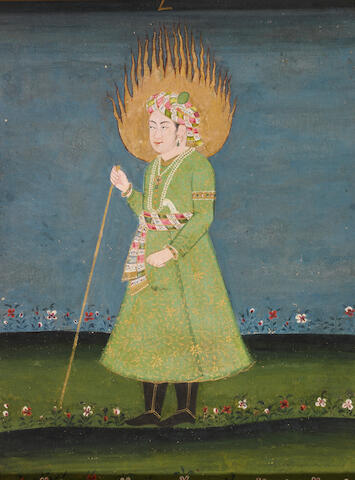
The key to this question lies in the figure of the orientalist gentleman-scholar José Gerson da Cunha (1844-1900), who operated from Bombay in the nineteenth century.  Cunha’s contribution to history was to locate a variety of the Parashurama myths and establish a single version that he would publish and present as a scientific version, as the following extract from his famous work, The Konkani Language and Literature (1881), demonstrates:


"The edition of these fragments which I published in 1877, and the translation of which I have now completed, show the work to contain more mythology than history, more fiction than truth, and this embodied in a Sanskrit which has but little regard for orthography and grammar. Difficult as it is to disentangle the thread of truth from the confused web of fiction, or of those hopeless mazes of legends and myths which everywhere abound, there are still incorporated into the work some local traditions of more or less worth, treasured up for centuries by the Brahmans of the Konkan, who consider it to be their paladium. It may in consequence be utilized by patient and critical labour, obtaining some obscure hints, defective in chronological data though they be, from which grains of historical truth may be extracted." (p.8)

This extract suggests that the version we do have of the myth was the result of his editorial interventions. While it is clear that Cunha clearly saw these texts as fanciful and mythical, it is also obvious that he sought to identify history from the piles of myth that he encountered. It is because he suggested that one could find history in these myths, and because of the locations - the Gazetteer of the Bombay Presidency and European conferences - where his works were published, that his assertions came to be accepted as history.

But why was Cunha so concerned with extracting history from this myth?  The answer is pretty straight forward; Cunha had an obsession with caste, establishing the antiquity of his own caste, and his caste’s location as that equivalent to European nobility. Consider this extract from George Moraes’ obituary of the man in the Journal of the Asiatic Society of Bombay (1964-64: 8): “Another weakness of Dr. Da Cunha was his caste complex. In his Konkani Language and Literature he never misses an opportunity of boosting the caste of the author if he happens to be of his caste, however obscure may have been his work…” Earlier in this obituary (page 3), Moraes also credits Cunha with providing an interpretative gloss that allowed the title of Shenvi or Shenoy to be understood as that of aristocracy. 

Reflecting on Gerson da Cunha, the scholar Filipa Vicente (2012) points out that his European-ness and his brahmin-ness were critical to the way in which he sought to project himself. Both were absolutely essential to his identity and worked in tandem. Where on one occasion, he was described merely as a brahmin, Cunha manifested great discomfort because this fact of his identity was separated from his Catholicism.  Vicente points out that “this declaration of his Europeanism does not necessarily signify a rejection of his Indian identity. It was precisely his Goan origins that enabled this combination of both his identities. Goa's ‘Portuguese nature’ and his own personal and family history attributed to him with the Europeanism he acknowledged, and which he wanted others to recognise in him, while also recognising his Indian Brahman identity.” In other words, da Cunha’s Catholicism allowed him to be seen as a European in European circles, while his brahmanical identity allowed him to claim the ancient and noble pedigree that he conferred on his caste fellows.

José Gerson da Cunha was writing in very volatile times, with new identities being manufactured by a variety of groups and new orders emerging, alongside an incipient Indian nationalism that privileged a brahmanical past. That Cunha’s machinations worked and were acclaimed by so many is an indication that his work fulfilled a need of a variety of persons, both Hindu as well as Catholic, then as well as currently. Perhaps we cannot grudge them the social mobility that they desired. However, it is important that we recognise that the ‘history’ that we babble about today was born from very peculiar circumstances geared towards personal agendas of brahmanical groups. It is also important that we recognise that the social mobility that these individuals and groups sort was a mobility exclusive to themselves. It engendered a mobility at the cost of that of others, namely the non-brahmanical groups. Mane’s Dhangar myth of the Goddess Yellamma, Parashurama, and the Shia Imams indicates to us that non-brahmins have different stories to tell, stories that deserve as much credit as those told by brahmins, especially because they may engender a more inclusive world.

(A version of this post was first published in the O Heraldo dated 10 July 2015)


Friday, May 15, 2015

Yellamma vs. Renuka: Rethinking Origin Myths in Goa – III

The past couple of columns have dealt with a Dhangar myth around the birthing of Parashuram that is rather different from the standard Puranic story that we in Goa have come to accept as set in stone. This Dhangar myth links Parashuram to the goddess Yellamma, and suggests that both Parashuram and Yellamma established familial relations with the Shia heroes, the Imams Hassan and Hussein.

Those who are familiar with the popular myth of Parashuram will probably respond that there is nothing in the Dhangar myth that contradicts the accepted mythology around Parashuram. However, this is not true. The Dhangar myth crafts a radically different Parashuram than from the one we are used to.

In the Dhangar myth, or the fragment that I was able to access, both Yellamma and Parashuram are not the brahmanical figures that we are familiar with. To note the difference we will need to revisit the brahmanical myth that is often relied on. In the Puranic version, Parashuram is the youngest son of the sage, or rishi, Jamadagni, and Renuka. The story goes that suspecting Renuka of infidelity, Jamadagni commanded his elder sons to kill their mother. Sensibly, these young men refused to fulfil their father’s command, which only enraged him further. Turning to Parashuram, the youngest of his sons, he repeated his command, and Parashuram obediently took up his axe and beheaded his mother. 

Unfortunately, when he did so he also beheaded a lower-caste woman, who in various versions of the myth, was either Renuka’s attendant, or a kindly woman who sought to help the hapless wife of the sage. Jamadagni was delighted that he had one son who was obedient, and promised Parashuram anything he asked for.  Apparently as much a mama’s boy as he was daddy’s, Parashuram asked that his mother be brought to life. Jamadagni acquiesced, whereupon Parashuram quickly joined heads and bodies together, and stood aside for his father to work magic. On bringing the women back to life both men realised with horror that in his haste Parashuram had switched the heads, so that the upper-caste Renuka now had the body of a lower-caste woman Yellamma, and Yellamma’s head was on the body of the upper-caste Renuka. The situation was resolved by recognising the bodies as constitutive of identity. Given that Yellamma lower-caste body now had an upper-caste head, she was granted a divine status.

One can see that there are a number of embellishments in the brahmanical myth that are missing from the Dhangar myth. To begin with, there is no Jamadagni in it. Yellamma, is not married to anyone, and Parashuram is, perhaps like Christ, born of a virgin. Of course, one could argue that the Dhangar myth suggests Shiva as the paternal figure, but the fact remains that the myth makes no reference to a sexual act between Yellamma and Shiva.

However, despite the absence of patriarchal figures, I would not go so far as to read some kind of contemporary feminist statement into this myth. There is an element of transgression that is present in both myths, and in both of these myths, Yellamma is punished. While in the case of the brahmanical Renuka is punished for harbouring sexual thoughts about man who isn’t her husband, in the Dhagar myth, Yellamma is burdened with a child for plucking a ‘forbidden fruit’ in Mahadev’s sacred grove. If Reunka loses her head in the Puranic myth, Yellamma is cast out from the company of her virgin sisters as a result of her birthing of Parashuram.

Another significant difference between the two myths, is that the Dhangar myth has no reference to Renuka. The only mother Parashuram has is Yellamma. Nor is there any reference to Yellamma’s caste.  This is perhaps the wonderful feature of the Dhangar myth in that it seems to describe a world without caste.

A further observation that could be made is that with the absence of Vishnu, and given that Shiva is seen as a pre-Vedic, or non-Vedic deity, what we have is a complete absence of brahmanical deities. All we have is a myth that speaks of the relationship between non-brahmanical, and hence indigenous deities, i.e. Yellamma, her sisters, Mahadev, and the Shia Imams, Hassan and Hussein.

What can we make of these aspects of the myth? I would be loathe to suggest that because of the absence of brahmanical deities the Dhangar myth is the original version of the myth, and that the Puranic version is a latter interpolation by wicked Brahmins. While not averse to such a suggestion, it would be irresponsible to assert this claim without substantial research with the appropriate skills. What I would rather suggest is that given the Dhangar myth co-existed parallel to the brahmanical myth, at the very least it asserts the desire of the Dhangars to have a different world view. They imagine a world where people can eat together regardless of their faith practice and their caste location, and be as one family. The myth imagines a world where eating meat is not condemned. Yellamma insists that she and her son eat with the Shia Imams even though they are eating meat. Indeed, Yellamma’s adventure in the Dhangar myth begins when she and her sisters are out on a hunt, indicating that she and her sisters did eat meat. The Dhangar myth, therefore, is alive to the contradictions of the human condition; even though it involves the shedding of innocent blood, we hunt and eat meat, not merely for pleasure, but to sustain ourselves. Yellamma’s returning of the meat to life suggests the desire to return life to the animals we consume for food. Indeed, it is worth reflecting that while the Puranic version has Jamadagni bringing Renuka back to life, in the Dhangar myth it is Yellamma, as mother of the world, who has the power to bring innocents back to life.

With this interpretation before us, we can see that rather than the Puranic version which is filled with matricide, and intolerance, the Dhangar myth of Yellamma has more to offer Goans in terms of an origin myth that would add value to contemporary political life. 

contd...

(A version of this post was first published in the O Heraldo dated 15 May 2015)

Friday, May 1, 2015

Yellamma and her Muslim family: Rethinking Origin Myths in Goa – II


Last fortnight I recounted a birthing myth about Parashuram that is rather different from the standard story that we in Goa have come to accept as set in stone. This Dhangar myth linked Parashuram to the goddess Yellamma, and suggested that both Parashuram and Yellamma established familial relations with the Shia heroes, the Imams Hassan and Hussein. 


There were a couple of interesting aspects to that myth that bear underlining. The narrative suggested that when Satyava’s sons, Bhram, Apa, Asan, and Usan, returned home with two wild goats, Yellamma called out, to them “Your maternal aunt has come! My boy should sit down with you. Let your sister join your dining row!” What is interesting about this part of the narrative is not that Yellamma referenced herself as maternal aunt or sister to the men, but that she demanded a right for herself, and the child she birthed, i.e. Parashurama, to be seated along with these men.

Those familiar with the dining habits in non-westernised parts of the subcontinent will know that the dining line (pangath or pankti) is a central marker, not merely of precedence, but also of familial and caste belonging. Who you eat with defines who you are, or how important you are. For example, a caste that considers itself superior will not sit next to those it considers inferior in the same pangath. Similarly, those who are more important, eat before those who are less so. Thus, the patriarch and those proximate to him eat before the younger, and men of lesser importance, with the women eating last of all

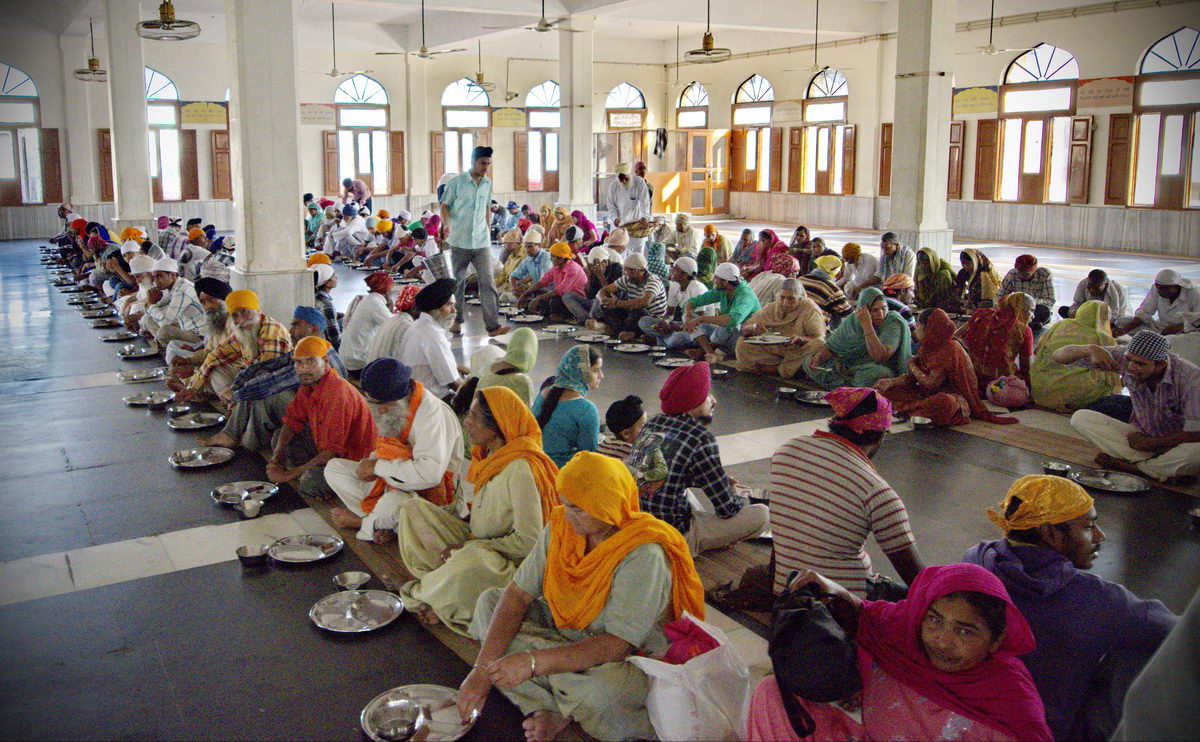
Dining in pre-colonial South Asia, an aspect that continues in some parts even today, was not a simple matter, but one that opened up space for ritual pollution. It was one of those rituals through which untouchability and inequality was, and is, perpetuated. It was for this reason that the Sikh langar (or common kitchen) stresses that everyone, regardless of caste or class, must sit together while eating. There was to be no toleration of caste and social difference within the Sikh community. It was also for this reason that so much of Indian secularism hinges on going to the homes of others and eating their food. Given that in the latter part of the nineteenth century and early part of the twentieth century people DID NOT eat with one another, something we consider so normal today, making people eat together, or eat the food of the other, was critical part of the nationalist agenda. The Indian nationalists could not imagine building a nation where people did not eat alongside with each other.

When Yellamma demands a space for herself, and Parashurama, in the dining line of the Shia heroes, therefore, she makes a number of claims. First, she recognises the validity of the Shia and Muslim men as dining partners. They are not untouchable others and inferiors, but someone she can validly eat with. Indeed, given the situation she found herself in, where she had been abandoned by her sisters, and punished by Mahadev, she was the inferior and was in fact requesting the Shia heroes to take her into their family. This equation underlines the role that the Imams Hassan and Hussein had, and continue to have, in the Deccan, that of the protectors of helpless women and children. This role for the Imams, is of course a natural consequence of their position in Shia Islam, where they are seen as defenders of justice, and partisans of truth.

Also critical to the narrative is that Yellamma and Parashurama sit down to a dinner whose main feature is the flesh of two wild goats. Yellamma, therefore, is not above eating with meat-eaters. She is willing to sit and eat with them, and integrate her child into the circle of these meat-eating men. It is another matter that she subsequently sprinkles the nectar of immortality on all the meat they had there, and gave [the dead animals] their full life-force again. However, rather than being read as evidence of Yellamma being vegetarian, it can be read as stressing her divinity, and her role as life-giving mother of all (in Kannada: Yella- everyone, Amma – mother).

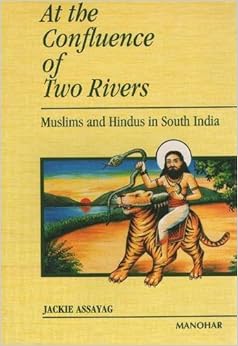
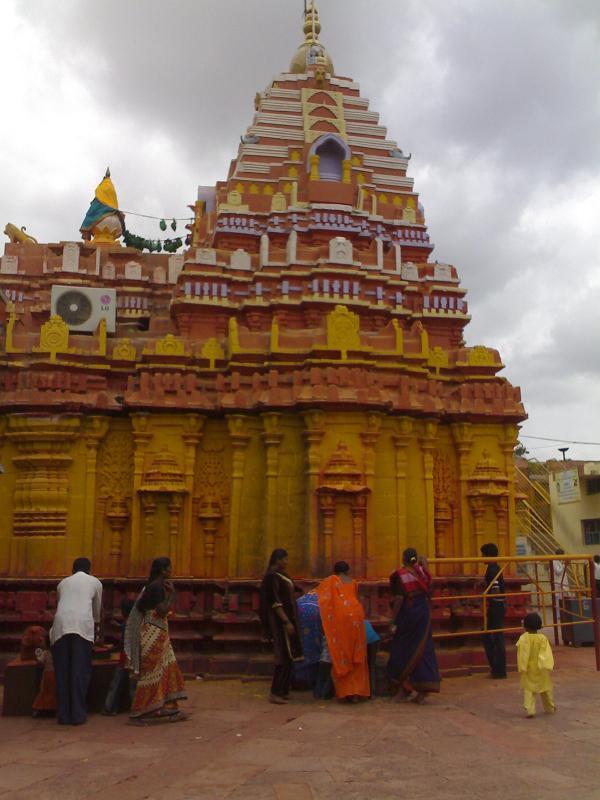
This narrative of Yellamma’s relationship with the Shia Imam’s is not the only reference to her relationship with Muslims. She also has a curious relationship with a Sufi saint by the name of Khwajah Bar Shah Wali, or simply Bar Shah. This relationship has been highlighted through the work of the French anthropologist Jackie Assayag in his work At the Confluence of Two Rivers: Muslims and Hindus in South India (2004). In this book, Assayag recounts two myths about the establishment of the site in Saundatti as sacred. One of these tells of how the goddess, afflicted with leprosy by her vengeful husband, the ascetic Jamadagni, came upon Bar Shah, who took pity on her and cured her leprosy. In gratitude Yellamma served Bar Shah faithfully for twelve years, after which the saint granted her space to settle in Saundatti, where she had remained ever since.  As would be obvious, this myth credits Yellamma’s location in Saundatti not to the Imams but to a Sufi saint. Further, it brings in aspects of the brahmanical absent in the Dhangar myth. I will deal with the brahmanical aspects of the Yellamma myths in a later column.

There is a twist to the tale, however, since when Assayag recounted this narrative to some local devotees of Yellamma, belonging to the Banajiga caste, they denied any knowledge of it. On the contrary, they provided a different story which presented Bar Shah as constantly antagonizing Yellamma though his constant cursing of her. The Banajiga narrative informs that in response to these curses,  the goddess blinded the saint, who thereafter realized his mistake and began to dutifully worship the goddess. Through this constant devotion Bar Shah was able to regain his sight, and remained indebted and devoted to the goddess from then on. It should be noted that Bar Shah’s tomb is located within the space of the various shrines dominated by the temple of Yellamma in Saundatti.

In this latter myth, the equations of power between Islamic personages and Yellamma are reversed, with Yellamma being the more powerful. What is important, however, is that in the end peace is restored and the two figures live in amity. Once again, therefore, we are presented with myths that reference the complexity of religious life in the Deccan, and indicate that Islam, whether Shia or otherwise, was a critical part of this life. 

These myths are important for those of us in Goa who are interested in non-brahmanical myths of origin. They point to us that there is a mythical realm beyond the brahmanical and must necessarily take into consideration that the spaces that are today contained in Goa, were once in the shadow of the Shia Deccan. The influences of the Shia faith still mark aspect of life in Goa, not just what we consider Hindu, but possibly Catholic as well.

Contd...

(A version of this post was first published in the O Heraldo on 1 May 2015)


Friday, April 17, 2015

Rethinking Origin Myths in Goa


Some months ago, I recollected an incident where a group of Gauda, Kunbi, Velip, and Dhangar activists from Goa were asked if they had any origin myths about Goa that would contest the more popularized origin myth of Parashuram. As I recounted, these activists were unable to offer one. What they could offer, however, were narratives of their peoples being systematically cheated of their rights in the land. It was in this context that I suggested that not every history needs to be ancient to have value. Histories can be recent and still be valid.

Imagine my surprise, therefore, when some weeks after writing that column, I came across a scholarly essay titled “Muharram Processions and the Ethicization of Hero Cults in the Premodern Deccan,” by Hugh van Skyhawk, which featured in the book South Asian Religions on Display: Religious Processions in South Asia and in the Diaspora (2008). Discussing the manner in which various sacred traditions of the Deccan engaged with each other, Skyhawk recounted an oral text of Narayan Kondiba Mane, a Dhangar shepherd from the district of Kolhapur in Maharashtra. The reason for my surprise was that while this oral text that Skyhawk translated did not deal with an origin myth for the land that was, through Portuguese intervention, to become Goa, it did contain a narrative mentioning the familial interaction of a variety of pre-colonial deities in these territories.

The narrative is about the “Canarese” Goddess Yekva or Yellamma, and begins by underlining the fact that she was the youngest and most stubborn of seven sisters: “Yekva, Mhakva, Durgava, Durgva, Margva, Jakva, and Tukva.” This youngest sister was once separated from her siblings when she felt thirsty during a hunt. Though she was unable to find her sisters, she did eventually find water in Mahadev’s pond. While at the pond, her eyes fell on a chickpea plant, whose stem she felt compelled [by hunger no doubt] to pluck. As she leaned forward to do so, however, Mahadev cried out that should she carry out this action, “blame” would fall on her. But Yellamma was not one to listen. Oh no! She pulled a twig from the bush, and instantly, a burning blister formed on her palm.

Poor Yellamma, alone and frightened, ran in pain until she could bear the pain no longer. She pricked the blister, and found in it a lump of blood, and a radiant little baby was born. And who was that baby, born from the blister on Yallamma’s hand? Parasarama, or Parasurama!

It was after having birthed the baby Parasurama and traveling some more that Yellamma finally stumbled upon her sisters. When they saw her carrying the little baby, however, the sisters cried out, “Stay away! Don’t come closer! You have made us the relatives of a bastard! We don’t want to touch you! And we don’t want you in our group! As you have borne a bastard, go away from us! Don’t ever come to us!”

The stunned Yellamma had nowhere to go now, and after much wandering, she came upon “the Musalman brothers Asan [and] Usan,” that is, Hasan and Hussein. She requested, and received, shelter from them, and spent the night on the verandah of their home. In the morning, she requested a place to live. The brothers responded by placing a stone in a sling, flinging the stone in the air and indicating to Yellamma to follow the stone, for where it fell, that place would be hers. Yellamma did as requested and followed the stone, which had fallen on Saundatti hill by this time.

She reached the hill at sundown and encountered the home of one Jagul Satyava, whom she petitioned for shelter for the night. Satyava responded that he would have gladly given her a place to stay, “but mine is a Musalman house and there will be meat.” Yellamma would not take no for an answer, however, and persuaded Satyava to let her spend the night in the house. When Satyava’s sons, Bhram, Apa, Asan, and Usan, returned home with two wild goats, Yellamma called out, “Your maternal aunt has come! My boy should sit down with you. Let your sister join your dining row!” And so it was, the narrative tells us, that Yellamma, with the baby Parasuram on her lap, sat with the Muslim boys as they prepared to eat.

The narrative also informs us that “Yallamma sprinkled the nectar of immortality on all the meat they had there, and gave [the dead animals] their full life-force again. And Baby Parasarama was accepted in the circle of the Musalman boys, and in bliss did they eat together.” Subsequently, in the morning, the four brothers erected a temple to the virgin goddess on Saundatti hill, so that there would be space for all of them. The narrative concludes that “After they had built the temple the Canarese Yallava took Baby Parasarama and stayed in the temple on the hill.”

To those of us accustomed to the neat divisions between Hindu and Muslim, this narrative would present something of a shock. Indeed, the narrative seems to have all the makings of a contemporary soap opera. According to Skyhawk, it highlights the role of the Shia heroes, Hasan and Hussein, as protectors of helpless women and children in South Asia. From a Goan point of view, however, the narrative gives us a plethora of positions from which to think about Goa. Given that the territories that would go on to constitute Goa participated both in the Canara region and the Deccan, this narrative allows us to think of a pre-colonial Goa that was not entirely brahmanical. On the contrary, it was also a space where Islam, and especially Shia Islam, held sway. Further, this Shia Islam had rather intimate fraternal engagements with the non-brahmanical faiths in the region. One could also hazard a guess that these non-brahmanical and non-Muslim deities were in latter times Sanskritised to give us brahmanical deities—like the Parashurama we know today—who have completely different histories. Indeed, it appears that the two myths are speaking of two entirely different Parashuramas.

However, there is no need to rush into readings of this Dhangar myth at this time. For now, all that we need to do is know that there are other myths that would upset the certainty of the dominant discourse. And this, as most students of the social sciences would know can only be a good thing since it opens up space for more questions and new visions.
(A version of this post was first published in the O Herald on 17 April 2015)