Showing posts with label development. Show all posts

Friday, May 29, 2015

Leading development as if people mattered


“We need to discuss this whole Golf course thing …Isn't it a good time to introduce high end tourism in Goa?”
“Those people probably are squatters who have been there for a few generations. In the grand scheme they don't matter. As long as they are offered viable alternative places what does it matter J?”
“Well, development must happen. It's inevitable….”
These are extracts from a response I elicited after posting on Facebook the reflections of my colleague Albertina Almeida on the recent events in the village of Tiracol.

What shocked me, and hence forms the basis for this column, was the absolute disregard that these messages displayed to fellow human beings. However, I need to underline that the sentiments should not be construed as restricted to this one individual. Rather, they form part of the mindset of a good portion of middle-class Goans on what constitutes development, how it should be brought about, and what are the challenges to development in Goa. It is even more important to challenge this mind-set because this dismissal of the value of human beings is a part of the complex of ideas that contemporary Hindutva rides on.

There seems to be a wide consensus on the need for Goa to shift from the current mode of tourism. We are attracting the wrong kinds of tourists, goes this consensus, either charter tourists from Europe, or low-budget tourists from India. Instead, we are told, we should focus our energies on high-end and “well-heeled” tourists. The problem, however, is that no one really seems to know how to attract these high-end tourists. The state government has presented some options, such as an oceanarium, a ropeway across the Mandovi River and other such high-cost physical infrastructure. To that extent, the author of the messages at the start of this column seems to be of one mind with the state government.

The problem with such schemes, however, is that such methods often involve pushing people off the land that they occupy, or, as the Tiracol case clearly demonstrates, occupying the lands that the locals use to generate livelihoods. In addition, it also involves, as Vivek Menezes pointed out in a recent op-ed, the violation of a number of environmental norms. Both of these cause loud protests from concerned citizens concerned that, rather than development, these projects will result in economic and ecological impoverishment. This results in delays to the proposed projects. It is little wonder then that proponents of this kind of physical-infrastructure-heavy development see people as a threat that need to be removed.

But is this the only way in which we can generate a tourist economy that would attract these high-spending tourists? Could we not think of a tourist economy that relies on investment in people and social infrastructure instead?

The following anecdote could possibly answer this question. I was once outside the new building of the State Central Library in Patto, Panjim and the sun was beating down fiercely. In this merciless environment I was stopped by a group of Slavs (Russians, or Ukranians I could not tell), looking for directions to the State Museum. It was clear that they had walked all the way from either the bus-stand or Panjim. I felt pity for them, for given my familiarity with the lacklustre state of the Museum, I knew that theirs was to be a wasted trip. It was then that I realised how misplaced so much of our thinking about tourism is. Where we often badmouth the “Russians” who come to visit Goa, we are clueless to the fact that at least some of them would have been willing to engage more substantially with Goa, and Goans, if only state and society had provided them a means to do so.

An investment in culture, in the form of a museum and the training of curators and conservationists, in the form of a state orchestra, a dance company, an opera house would perhaps demand lower levels of investment from the state but would yield greater results because it would be invested in people. As Goa’s lively traditions in tiatr and music demonstrate there is already a base that would allow such investment to multiply rapidly. An exposure to international currents in the various fields would lay the foundations for more creative locals, and a more dynamic local culture that would bring in exactly the kind of tourists that we today seem to lack. But we could do this only if we took our own people seriously.

And then there is this matter of referring to the residents of Tiracol as “squatters”. This is not the first time that I have encountered persons who are lower on the socio-economic scale, and residing in potentially high-value property, being referred to as squatters. In her op-ed essay on the Santa Inez creek in Panjim, Amita Kanekar made observations pertinent to the case in Tiracol. The persons living along the banks of the creek are often referred to as squatters. Kanekar, however, observed that these residents were in fact long-time residents of the area, being mundkars of local bhatkars. “When the bhatkars sold their lands to real estate developers, the mundkars were promised permanent homes elsewhere but given temporary ones here on the creek’s edge”. She also pointed out that it now that the bhatkars sold these lands to developers, these onetime residents were being forced to leave. Calling these displaced tenants squatters, is just one way in which their social and legal legitimacy is robbed from them.

While one hopes that the residents of Tiracol are ensured justice and the damage done to the orchards they tend is made right, there is a need for a larger debate. There is a need for us to examine the manner in which our arguments about development privilege earlier feudal relations. Pre-colonial and colonial period land relations were not just. It is not just that one family should control hundreds, if not thousands, of acres, while others do not have access to a few square metres. While I am not making an argument for expropriation of lands from former landlords, I am arguing that we cannot dismiss former tenants merely as squatters. The fruits of their constant labour in tending to the orchards and fields are what made the landlords rich.  It is in recognition of these labours that the law as it stands today recognises these people as tenants, and recognises that they have certain rights. It behoves us to respect these laws and not skew the debate to privilege a dehumanised development.

The events in Tiracol also raise another issue of vital importance. Given that the issue involves the sale of bhatcarial rights and the question of the settlement of the rights of the tenants, there is a need for us to inquire if those who purchase bhatcarial rights do not also have to be held to a higher standard than someone who is merely purchasing a smaller parcel of property. Reports indicate that Leading Hotels, the new bhatcar of Tiracol, has sought to purchase the rights of the tenants in order to have unrestricted access to the area. The price of these rights has varied from Rs 120 per square metre, then Rs 200, and finally Rs 500 according to the capacities of the individual tenants.

It needs to be recognised that in such circumstances as in Tiracol, though this would also apply to such projects as Aldeia de Goa, the transaction is not a straightforward sale of property. The person making the sale is not necessarily the canny operator in a speculative market. Very often they are making what they see as the best of a situation. The fact, however, may be that the money they received is just not sufficient to take care of their future needs, largely because they failed to take into consideration the kind of unaccounted support that the land provided them. Some would argue that this is a private matter between two parties in a n open-market transaction. I would argue otherwise. This is not a private matter because very often the tenants are selling all they have, they may lack the skills to manage the receipts of the transaction and eventually land up in poverty. The creation of poverty is a public concern and impinges on our common dream of development. As such, there is a need for us to recognize the importance of articulating a rehabilitation policy where the interests of tenants in those properties where prospective bhatcars seek to create an unencumbered right to the property are taken care of.

There is one final argument that was made in the message that deserves to be commented on. The individual who sent me the message recognized that the residents of Tiracol need to be “offered viable alternative places”. In many ways this individual articulated the seed of an ideal rehabilitation policy. Indeed, land for land has been the claim of those articulating the interests of displaced persons. They argue that money alone cannot be a suitable compensation for displacement. Rather, suitable land must be provided for the land that has been lost. The challenge, however, is that such alternative land is very rarely, if ever, available. It is especially in recognition of this fact that we need to think more seriously, not merely of compensation, but rehabilitation, where the futures of these individuals, and a concern that they are not impoverished takes centre stage.

There is a reason why India has not developed the way people expect and hope it would. It has not because development has not as yet privileged people. Development will happen, and “well-heeled” tourists will flow in, when we take people seriously, and invest in these people, support their dreams and futures. Until then, we should not expect any “Acche din”.

(A version of this post was first published in the O Heraldo dated 29 May 2015)

Saturday, May 18, 2013

Who rules? - Determining the extent of the Panchayat’s power


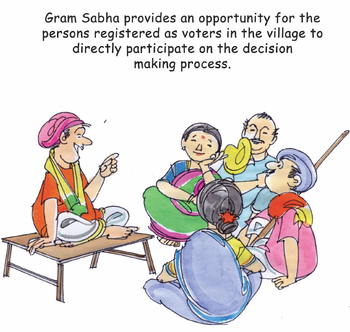
Chief Minister Manohar Parrikar was recently reported to have indicated in the course of legislative debate that he would rather have a referendum than let Gram Sabhas take a decision on the much contested developmental plans that form part of the Regional Plan. Subsequently, the Chief Minister has been reported to have suggested that Gram Sabhas are only advisory in nature, said the Chief Minister, their decisions cannot be legally binding on the panchayat.

Given that that the Chief Minister is not alone in his observations, and his opinion is shared by many developers I would like to first reference, and then engage with, the arguments presented by similarly inclined commentator in the public sphere.

Speaking in the context of migrants, Prabhakar Timble felt obliged to also suggest that, “…we notice the Gram Sabhas and Village groups of Goa opposing almost all proposals of investment or development in the village.  To a large extent, the opposition at the Gram Sabha is from those members who are defeated at the Panchayat elections. In a multi-cornered contest at Panchayat elections, the aggregate number of defeated candidates is sizeable in relation to the elected members of the Panchayat.  It is really a funny situation wherein the elected Panchayat is held hostage by the Gram Sabha under the domineering influence of the candidates who are rejected by the village electorate and who later form the active component at the Gram Sabha. I have not heard of Gram Sabha directing and recommending the Panchayat “to do” specific projects or encourage a set of economic activities in the village.”

Rather than address the issue of the legality of the Gram Sabha’s capacity to direct the Sarpanch and council, I would like to deal with the logic displayed above that attempts to undermine the validity of the discussions that take place in the Gram Sabha. Timble’s logic suggests that the candidates who have won the election are approved by the electorate, and those who have lost the election are rejected by the same body. In making this suggestion, Timble could not be further from the truth.

The “first-past-the post” method that Indian electoral system uses to determine the winner in an election is but one of several ways of doing so. In this method, the person with the highest votes wins, even if the number of these votes do not constitute a majority of the electorate, and it is possible that as a result of the multi-cornered contests that Timble draws our attention to, the winner in fact enjoys the confidence of just a minority of the electorate. Indeed, as has been pointed out, the first-past-the post method is ideally used in elections between two parties. In such a case, where electoral contests are contested by beyond three parties, it would be highly illogical to assume that the winner holds the confidence of the majority and has the right to take decisions on agendas that will hold significance beyond the five year period that they are elected for.

In a situation where the winner of an election may hold the confidence of only a minority of the electorate, it makes sense to read the result of the elections as securing the right of the successful candidate to lead deliberations in the panchayat and Gram Sabha, but definitely not to make unilateral decisions. The multi-cornered fights in the Gram Sabha are evidence of the complex nature of the Panchayats and a testament to the vibrancy political life of the electorate. The Gram Sabha then, is not only a crucial space where the tensions, and ideas can be debated and then independently voted on, but a critically important one if we are to ensure that the Panchayat is genuinely representative of democracy.

Having said this, there is a need to recognize two valid criticisms that are leveled against the operation of Gram Sabhas. The first is the criticism that given the number of persons with strong opinions, these Gram Sabhas often descend into chaos, where everybody is screaming, no one is listening, and nothing gets done. The second criticism is that oftentimes decisions can be taken that violate fundamental principles of law.

The first criticism is really a testament to the fact that a culture of debate has not yet taken solid root in our political life. The blame for this lies as much at the feet of persons outside of power, as those who hold power. Sarpanches should be required to acquire a training in how to effectively conduct debates where all sides are allowed space to present and rebut arguments. Where persons fail to cooperate with the process, the law provides for the presence of police who can be called to restore order. Unfortunately, when the police are called, it is usually to intimidate persons with opinions opposite to that of the Sarpanch who seeks to push his agenda through.

In the second case, if, and when Gram Sabha decisions have been taken in violation of basic principles of law, this opens up space for the decisions of the Gram Sabha are adjudicated by the superior courts that exist both within the panchayat system as well as outside of it. Rather than see adjudication of these allegedly faulty decisions as a problem, once more this process should be seen as a way to build up precedents for Gram Sabhas to follow, and harmonize this system of local self governance with the larger systems of state and central governance that have until date received far more importance.

The problem however seems to be that rather than allow for a more democratic state, business interests and the interests of the MLAs are working together to deny this possibility by writing off the Gram Sabhas as failures even before these institutions have been allowed to work in an ideal environment.

(A version of this post was first published in the Gomantak Times 18 April 2013)

Wednesday, June 30, 2010

Muddling about in Mapusa: Why Mapusa deserves a second chance…

This column should have appeared on the 12th of May 2010, to accompany the bandh called by the Mapusa Merchants Association (MMA), and to show solidarity with their cause. Failing that however, this column may still have some purpose, to assert the legitimacy of the demand of the MMA and renew attention to the larger issues that the MMA was drawing attention to.

The MMA organized their bandh to protest the step-motherly treatment that they allege (and is evident for all to witness) has been meted out to the once proud market complex. The association of merchants made another important observation however when they argued that it was not just the treatment that was the problem, but the manner in which the ODP (Outline Development Plan) for the town had been created. The ODP proposes expanding roads around the market complex, in a manner that would demolish large sections of this complex. The roads are designed to provide access to the communidade fields beyond the market so as to open these up for development as locations for high-rise apartments.

Given this second threat to the market it is little wonder that the MMA extended its support to the protests of other citizen groups against the Mapusa ODP. Indeed, given the centrality of the weekly Friday market to Mapusa’s contemporary identity, it is significant that a challenge to the ODP has emerged from the merchants of the market. It is indicator to all of us that it is time Mapusa makes a determined departure from the future it seems to be hurtling toward.

There was a time when people from Panjim would sniff when referring to Mapusa. Mapusa was the provincial hick town when compared to its Mandovi-bank cousin. And yet, even today if one looks closely, there is an architectural charm to Mapusa that cries out for recognition. The entire area of Feira Baixa, Feira Alta present a veritable map of the kinds of architectural trends that have passed through Goa and this trading town. Where the harmony of these stylistic jostlings is interrupted is in the high rise buildings that have come up in the past half-decade. The harmony is disrupted not because they are contemporary buildings, but because these high-rise buildings are entirely out of scale with the buildings around them, sticking out, quite literally, like sore thumbs.

Another charming area, one that deserves to be preserved as a heritage space is the residential locality of Dattawadi. Nestled around the Datta temple, the charm and heritage value of this largely Hindu middle-class locality has been unfairly ignored for way too long. Ignore someone or something long enough and they will begin to believe their lack of value. This has been Mapusa’s unfortunate fate. The destruction of Mapusa’s architectural and urban heritage will however, be not just this town’s, but Goa’s at large.

There are a number within Goa’s tourist industry who are waking up to the fact that Goa’s tourism cannot be sustained merely by the beach-bums we have so far been catering to. We need to innovate and expand, even as the beach belt continues to be a major revenue earner. In such a context, the concerted preservation and subsequent utilization of Mapusa’s heritage potential could be the next logical and crucial step. Despite being the logical option to service the beach belt, and elaborate Goa’s tourist industry it is unfortunate that Mapusa’s role has been restricted to a largely utilitarian use.

There is a little lesson for us to be learned from the protest of the Mapusa Merchants, even though it may be an unintended one. Just a very small group stands to gain from the developmental pattern of the high-rise buildings. This group is those associated with the building lobby. As evidenced by the concerns of the MMA, this development pattern hits not just the common man, but even such comfortable groups such as the middle to upper class market merchants. Taking cue from the Mapusa market as a heritage building, we can begin to sense that building from heritage benefits a larger segment. Heritage is after all what everyone already has as capital, it requires only a supporting Governmental framework (like a decent urban plan and tourist industry support) and everyone can cash in on the golden goose. Looking at existing urban settlement patterns and structures as capital allows us to realize another lesson. To pull down priceless heritage buildings is a case of killing this golden goose. It also highlights the poverty of entrepreneurial imagination. But then this is perhaps why Mapusa has gone from a charming provincial town to a dusty trading town; a total lack of entrepreneurial imagination!

The real tragedy of Mapusa however, is that this apparent lack of entrepreneurial imagination is conveying the impression of an absolute lack of a middle class in the city. Where most heritage structures in Goa have been converted to cater to high-end or middle class consumption, the almost absolute lack of such structures in Mapusa seems to suggest the lack of such a class inhabiting the city. This assumption has serious consequences for Mapusa in that it could result in a total lack of any future investment, a flight of capital, eventually turning the town into a large slum catering primarily to the lower income classes. This is not a suggestion that heritage or urban infrastructure is or ought to be restricted to the upper classes, but merely a sad recognition of the manner in which our priorities (especially urban planning) seem to stand. Indeed, one way to display commitment to egalitarian development, and heritage together would be to use the now abandoned building formerly used by St. Anne’s convent as the new location for the Mapusa Municipal Reading room, converting it into a state-of-the-art library and resource centre.

There is a time and season for everything an old lyric tells us. And so it is that if there is a time and season for something in Mapusa, it is one for urban regeneration, based on a recognition of its heritage value. To do so will ensure not just more equitable development, but also rescue the town from the dark future it seems to have consigned itself to.


(First published in the Gomantak Times 30 June 2010)

Thursday, September 24, 2009

Of Casinos and Tourism: And the poverty of the State, systems and imagination

Living across the waters these days, the rumbles within Goa are heard only as faint whispers and mumbles that nevertheless lead to a strange disquiet within one’s constitution. The recent protests of the casino employees and the re-emergence of the casino question in Goa being one such disquiet inducing whisper.

My first contribution to the casino debate would be to indicate in no uncertain terms that one cannot make the argument that while open to others, Goans (youth or otherwise) should not be allowed into casinos, since this will ruin the values, morals of Goans, as well as destroy the families for reason of the money lost to gambling. To make the distinction that both, some of the anti-casino protestors, as well as the government is making, is to make a paternalist argument. It suggests that the State be put in a position to act as a parent to citizens who are seen as akin to clueless children. This sort of demand from the State is dangerous since this is exactly the kind of demand that allows for a State to pile one such demand upon another, and eventually turn into an authoritarian State. Such a demand sets a dangerous precedent, for once you have given the State to decide what is good and bad, regardless of your personal opinion, what stops the State from subsequently colluding with extremist groups and clamping down on other freedoms of choice? In fact such actions seem to be the hallmark of the Kamat government, who has consistently used the argument of bowing to public pressure, to then clamp down on the exercise of other fundamental rights of expression.

This argument should not be construed as an argument in favour of casino tourism however. It is merely a plea that we realise that if we are serious about living in a democracy respectful of the rights of individuals, we be consistent in our demands both of ourselves, and of the State.

The casino issue allows us to have a look into the entire issue of the development of Goa. While doing so, I’d prefer to understand development in the manner in which Amartya Sen does. The wise old man refers to development as freedom in the sense that development must be seen as the creation of possibilities for the individual to realize oneself. Development is more than projects and employment opportunities, these being only means to a larger end of human fulfillment.

Tourism has been pushed as a major tool for development in Goa. And to an extent, it has helped in the project of emancipation of some segments of Goan society. Until the advent of the tourism industry, large portions of the coastal population were caught in abject poverty and servitude. The tourist boom changed that, to the distaste of most of the upper class persons of the coastal belt. For a first step this was good enough, but how has the tourism industry proceeded beyond that?

By and large any innovation that seems to be happening within the industry seems to be the result of the work of a few talented ‘outsiders’. From the Goan end of the spectrum, there is only the meaningless repetition of a formula that is increasingly pleasing nobody. We have wonderful towns (including in the hinterland, having recently visited Quepem and come away a convert!) and yet what are the cultural events on offer in these locations? Practically nothing! The attempt by the State in this regard seems practically zero. It never fails to amuse me that the depth of our Chief Minister’s suggestions for culture, invariably involves nationalism and patriotism (no doubt his RSS background talking!). On the other hand, culture has come to mean the same old boring commercialization of existing traditions.

What the State has been doing however is to milk the existing natural infrastructure for every drop it has left. Nothing goes back into replenishing the system. Take for example the palm-lined trees that are perhaps Goa’s tourist calling card. With every passing year, and the demise of the communidades, these trees grow, old, wither and die, and there is no effort to replant these trees. One would imagine that safeguarding the aesthetic appeal of the State would be one of the Dept. of Tourism’s priorities. On the other hand investment has meant giving away common property for development to corporate houses, under the pretext of moving to high-quality tourism. High-quality tourism will come however from an input of higher culture into tourism, and none of this is happening.

None of this is surprising because forging new directions falls outside of the majoritarian principles of contemporary politics.

But what does any of this have to do with the fix that the employees in the casinos are facing. My argument is that an investment of the State into the development as freedom would have prevented the employees from having only casinos and the filth that passes off as Goan tourism as an employment option. Cultural revival that would regenerate tourism would come primarily from an investment in larger processes and institutions of dialogue. A system of vibrant public reading rooms for example, offering every kind of media – print, audio and audio-visual - linked to the information highway that is the internet, would have allowed Goans even in the most rural village to gain access to valuable cultural capital. This would have allowed Goan youth to transcend being merely IT coolies, or busboys, into in fact contemplating innovation. This system in place, they wouldn’t be screaming their lungs out that the casinos are the only option they have. Having such an infrastructure, blowing up family cash in the consumption bubbles on the beach belt (why restrict our shock only to casinos?) would not be the attraction that they currently are. There would be different ways to be cool.

In conclusion, what I would like to say is that, we are at this pass, because for a number of years now, rather than build systems, we have been dismantling them to make our pickings easier. Along with all the other systems, the intellectual has also been effectively dismantled to create the lumpen proletariat that will do the bidding of the masters (do you honestly think that the casino employees protested on their own volition?) Why else is the entire debate about casinos revolving around this bizarre notion of Goan-ness? We don’t want Goan values to be corrupted, so don’t let Goans into casinos. We want Goans to be employed so we will ensure that there are casinos. How do we seek to resolve this pickle? “The CM’s main concern has been restricting Goan youth from entering casinos and we have suggested that a mechanism be worked wherein Goan youth may be restricted from entering casinos based on an income criteria.”

Truly this state seems to be turning into the Mad Hatter’s Tea party. I’ll have my tea cold, black and bitter please.


(Published in the Gomantak Times, 16 Sept 2009)