Showing posts with label Prabhakar Timble. Show all posts

Tuesday, October 29, 2013

The Battle of the Konkanis: Separating Wolves from the Lambs


Context:

In 1987 subsequent to mass demonstrations composed overwhelmingly of bahujan Catholics the legislature of the Union Territory of Goa, Daman and Diu recognised Konkani in the Nagari script as the official language of Goa. This recognition of script was used to privilege a brahmanical project of fixing the identity of Konkani in the Nagari script alone, sidelining in this process the more vibrant and older tradition of writing Konkani in the Roman script, and its largely Catholic users. Consequently, a movement for the official recognition of Konkani in the Roman script emerged as a result of a systematic campaign of suppression of cultural and literary productions in the Roman script. More recently, with the Kala Academy, the premier state-supported cultural body announcing awards for literature in the Roman script, it is being maintained by some that the Roman script may in fact destabilize the status-quo that favours the Nagari script (and therefore brahmanical hegemony), leading to a number of persons coming out seemingly making concessions to the Roman script. One such overture was made by Prabhakar Timble in The Navhind Times, Goa. Timble is a legal expert as well as the former State Election Commissioner of Goa. The following article is a response to Timble that was disallowed publication in The Navhind Times.
*
The recent statements of support in favour of the continuation of awards reinstituted by the Kala Academy for literary works in Roman script will possibly bring good cheer for the votaries of this script. However, it is important that these statements of support be examined for their logic, rather than the superficial support they seem to offer. In proposing this course of action, reference is particularly being made to the opinion piece, “Promoting Konkani Language Culture” by Prabhakar Timble in The Navhind Times dated 15 October, 2013.

While Timble seems to be supporting the recent decision of the Kala Academy to offer literary works in the Roman script to obtain awards, his real fear is that the status quo as regards the place of Konkani in the Nagari script will be upset if the demands of the Roman script activists is allowed to go further. This fear is clearly evident in his statement: “The official language accepted in Goa is Konkani in ‘Devanagiri’ script. This is a settled issue because of the sacrifice and enlightened minds of the leaders of all communities.” Indeed, the core of the demand of the Roman script is not that literary works in the Roman script get awards, but rather that Konkani in the Roman script be given its legitimate place in the Official Language Act (OLA). This demand has been made because even though this form of Konkani is an older version of Konkani, and continues a vibrant production of Konkani culture, it has been subjected to all kinds of abuse and suppression in the years since the OLA was enacted. Further, while Konkani alone may be recognised as the official language of the state, the fact is that the operation of the Act continues to give official language status to Marathi.  This has resulted in Goa having two official languages, de facto. The issue of the status of official language being awarded in favour of Konkani in the Nagari script is, therefore, by no means “settled”. Indeed, contrary to Timble’s suggestions, there are very large numbers of members of the bahujan samaj who refuse to acknowledge Nagari Konkani as a legitimate Goan language because they see it as a ploy to ensure brahmanical supremacy in Goa. Consequently, the lone Nagari Konkani newspaper that exists has one of the lowest figures of circulation, lower than Konkani newspapers in the Roman script, and many times lower than Marathi language newspapers. These bahujan samaj activists would possibly accept Romi Konkani as an authentic language, but continue to refuse to accept the Nagri version. It is in recognition of this reality of the operation of the OLA, and to ensure that Konkani in the Roman script also enjoys the status that these two other languages enjoy, that the activists for the Roman script have been agitating right from the days that the OLA came into effect.

Timble inserts a number of subtle arguments to ensure the exclusive privilege that Nagari Konkani activists seek to retain. Indeed, it is around such arguments that the votaries of both Marathi and Nagari Konkani have often ganged up against the proponents of Konkani in the Roman script. The first of these arguments is to suggest, as evidenced above, that the decision in favour of Nagari alone was made by “enlightened minds”. The suggestion, therefore, is that those who challenge this supremacy of Nagari are unenlightened “fanatics” who seek to sow the seeds of division. The problem, however, is, as Timble himself recognises, that the division already exists, perpetuated in large part by the suppression of non-Nagari Konkani by the votaries of Konkani in the Nagari script. This suppression involved state supported institutions like the Kala Academy and the Goa Konkani Akademi refusing to consider works written in the Roman script for state awards, the systematic disparagement of productions in the Roman script like the tiatr (a form of drama) and romans (novels or novellas) as lacking in standard. It needs to be recognised that the grant of awards is often not merely the establishment of a standard, but also a way for the state to extend financial support to the arts.

The other argument that Timble throws up, and one that must be subjected to greater scrutiny, is his suggestion that the “Romi script is an accident of history”. It was this very suggestion that formed the basis of excluding the Roman script from the OLA. The implications of this argument are extremely dangerous since it suggests that the people who spoke the Konkani language had a certain trajectory of cultural development already chalked when its fulfilment was interrupted. The interruption implied is clearly: the arrival of the Portuguese and the establishment of their rule in the subcontinent. If the arrival of the Portuguese is seen as the cause for this accident of history, then surely there are a number of other accidents that occurred. The most crucial of these is the conversion of a sizable portion of the Goan population to Christianity. Must this Christianity also be seen as an accident of history because its growth coincides with Portuguese rule? Timble may well suggest that this “accident” be accepted and understood, but it is because these historical facts are seen as accidents that the Roman script and its cultural productions have been consistently deprived their rightful place in officially recognised Goan culture. Even if the state celebrates aspects of Goan culture that result from Portuguese intervention in local society, these are seen as exceptions rather than the rule. Herein lies the problem where Catholics are regarded as outsiders and foreigners to the acceptable national community, and any assertion of their difference is construed as being unacceptable. This intolerance of difference is amply evident in Timble’s suggestion that “‘One language, One Script, One community’ is not a wrong dream. But, it is an ideal paradise whose time has still not arrived.” Like the other votaries of the hegemony of the Nagari script, Timble too clearly believes that difference is a problem that must ideally be erased. By this logic, one can imagine that in Timble’s paradise all persons will be Hindu as well.

In conclusion, the statements of support by persons such as Timble should be read with caution. These statements do not recognise the legitimacy of Konkani in the Roman script, nor the demand that the Roman script be given an official place in the OLA. The sole purpose of Timble’s statement of support is to ensure that the delicate balance of linguistic power that currently exists in favour of both Nagari Konkani and Marathi is not tilted towards Marathi and Konkani in the Roman script. The fact is that while Konkani in the Roman script continues to be patronised by its loyal supporters in Goa, Konkani in the Nagari script has failed to achieve this position largely because it is an artificial creation that has sought to suppress Konkani in the Roman script, and has failed to achieve the trust of the Hindu bahujan who continue to use Marathi as a weapon against this particular Konkani.

(Written along with Dale Luis Menezes this post was first published on Round Table India on 28 Oct 2013)

Saturday, May 18, 2013

Who rules? - Determining the extent of the Panchayat’s power


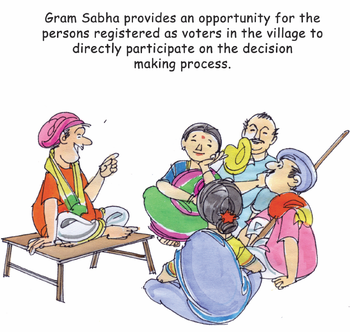
Chief Minister Manohar Parrikar was recently reported to have indicated in the course of legislative debate that he would rather have a referendum than let Gram Sabhas take a decision on the much contested developmental plans that form part of the Regional Plan. Subsequently, the Chief Minister has been reported to have suggested that Gram Sabhas are only advisory in nature, said the Chief Minister, their decisions cannot be legally binding on the panchayat.

Given that that the Chief Minister is not alone in his observations, and his opinion is shared by many developers I would like to first reference, and then engage with, the arguments presented by similarly inclined commentator in the public sphere.

Speaking in the context of migrants, Prabhakar Timble felt obliged to also suggest that, “…we notice the Gram Sabhas and Village groups of Goa opposing almost all proposals of investment or development in the village.  To a large extent, the opposition at the Gram Sabha is from those members who are defeated at the Panchayat elections. In a multi-cornered contest at Panchayat elections, the aggregate number of defeated candidates is sizeable in relation to the elected members of the Panchayat.  It is really a funny situation wherein the elected Panchayat is held hostage by the Gram Sabha under the domineering influence of the candidates who are rejected by the village electorate and who later form the active component at the Gram Sabha. I have not heard of Gram Sabha directing and recommending the Panchayat “to do” specific projects or encourage a set of economic activities in the village.”

Rather than address the issue of the legality of the Gram Sabha’s capacity to direct the Sarpanch and council, I would like to deal with the logic displayed above that attempts to undermine the validity of the discussions that take place in the Gram Sabha. Timble’s logic suggests that the candidates who have won the election are approved by the electorate, and those who have lost the election are rejected by the same body. In making this suggestion, Timble could not be further from the truth.

The “first-past-the post” method that Indian electoral system uses to determine the winner in an election is but one of several ways of doing so. In this method, the person with the highest votes wins, even if the number of these votes do not constitute a majority of the electorate, and it is possible that as a result of the multi-cornered contests that Timble draws our attention to, the winner in fact enjoys the confidence of just a minority of the electorate. Indeed, as has been pointed out, the first-past-the post method is ideally used in elections between two parties. In such a case, where electoral contests are contested by beyond three parties, it would be highly illogical to assume that the winner holds the confidence of the majority and has the right to take decisions on agendas that will hold significance beyond the five year period that they are elected for.

In a situation where the winner of an election may hold the confidence of only a minority of the electorate, it makes sense to read the result of the elections as securing the right of the successful candidate to lead deliberations in the panchayat and Gram Sabha, but definitely not to make unilateral decisions. The multi-cornered fights in the Gram Sabha are evidence of the complex nature of the Panchayats and a testament to the vibrancy political life of the electorate. The Gram Sabha then, is not only a crucial space where the tensions, and ideas can be debated and then independently voted on, but a critically important one if we are to ensure that the Panchayat is genuinely representative of democracy.

Having said this, there is a need to recognize two valid criticisms that are leveled against the operation of Gram Sabhas. The first is the criticism that given the number of persons with strong opinions, these Gram Sabhas often descend into chaos, where everybody is screaming, no one is listening, and nothing gets done. The second criticism is that oftentimes decisions can be taken that violate fundamental principles of law.

The first criticism is really a testament to the fact that a culture of debate has not yet taken solid root in our political life. The blame for this lies as much at the feet of persons outside of power, as those who hold power. Sarpanches should be required to acquire a training in how to effectively conduct debates where all sides are allowed space to present and rebut arguments. Where persons fail to cooperate with the process, the law provides for the presence of police who can be called to restore order. Unfortunately, when the police are called, it is usually to intimidate persons with opinions opposite to that of the Sarpanch who seeks to push his agenda through.

In the second case, if, and when Gram Sabha decisions have been taken in violation of basic principles of law, this opens up space for the decisions of the Gram Sabha are adjudicated by the superior courts that exist both within the panchayat system as well as outside of it. Rather than see adjudication of these allegedly faulty decisions as a problem, once more this process should be seen as a way to build up precedents for Gram Sabhas to follow, and harmonize this system of local self governance with the larger systems of state and central governance that have until date received far more importance.

The problem however seems to be that rather than allow for a more democratic state, business interests and the interests of the MLAs are working together to deny this possibility by writing off the Gram Sabhas as failures even before these institutions have been allowed to work in an ideal environment.

(A version of this post was first published in the Gomantak Times 18 April 2013)

Wednesday, September 26, 2012

Belling the Cat: On Special Status and Citizenship Rights


It has been the second case this year. A couple of days ago, a number of newspapers reported the fact that the MLA Mickky Pacheco had accused the Superintendent of Police, Mr. Allen D’Sa of being a Portuguese national. The earlier instance of such a case, was that of Ms. Valanka Alemão accusing her rival in the legislative assembly elections, MLA Caetano Silva, of being a Portuguese national, and hence incapable of representing the constituency of Benaulim.

On the face of it, it appears that both these accusations are unfortunate since what they are in effect doing is to ruin the public secret that is allowing a number of average (the popularly phrased aam aadmi) Goans to find jobs overseas, especially in Europe, and better their life chances and those of their children. By creating a public controversy about the possibility that these two men hold citizenship status in another State, what these two cases will effectively do, is draw the energies of the Indian State bureaucracy toward rooting out those Goans who hold dual citizenship. On second glance however, perhaps Ms. Alemão and Mr. Pacheco are doing the Goan population a favour since they are in effect creating the circumstances under which the Goan citizenry will have to sit up and take charge of the situation that is in effect a sword of Damocles that hangs over the heads of those who have reclaimed their Portuguese citizenship. It has been all very well that until now the enforcement by the authorities has been less than rigorous.  However, as Prabhakar Timble recently pointed out in his article in the Navhind Times, in addition to these two cases, there were also at least four cases where persons were debarred from participating in panchayat elections for reasons of holding Portuguese citizenship. The threat it seems, comes not from a possibly dispassionate citizenry, but from jealous neighbours, rivals in political contests or other familial or economic contests. We should not forget that the current legal regime not only prevents a foreign national from holding political office, but also prevents a foreign national from holding agricultural property, a situation that could possibly be used in the bitter inheritance battles that are such a marked feature of any reasonably landed family. There are good reasons necessitating therefore, a united popular response to this situation.

Fortunately for those interested in presenting a challenge to the legal regime concerning nationality, asserting their traditional and inheritable right to claim Portuguese citizenship, there already exits a somewhat active group that should logically support the right of the Goan to bear dual citizenship. For some years now, not merely citizen groups, but legislators and Members of Parliament have been demanding, through constitutional amendment, the grant of Special Status to Goa. One of the many arguments that have been marshaled for the demand of Special Status has been that this Special Status, where only Goans may purchase and trade in Goan land, is necessary to protect Goan identity. More recently, our Chief Minister Manohar Parrikar, also raised a similar issue of restricting the entry of migrants into the State to protect the same threatened Goan identity.

Upon raising this issue, Mr. Parrikar drew flak from a number of locations, and was charged with being anti-national, and secessionist. To charge a member of the RSS, with being anti-national and secessionist is laughable. But perhaps these charges were required to demonstrate the manner in which all too often the anti-national argument is irresponsibly flung despite the indubitable patriotism of the individual, and the justice of their demand. The argument that is being made is not a secessionist demand, on the contrary, it is one that needs to understand a particular history. This history was reportedly often called upon by the late Mathany Saldanha in his own arguments for Special Status for Goa. The argument of activists such as him were to point out that given that Goa was integrated into the Indian Union only in 1961, there were no Goan representative in the Constituent Assembly to secure Goan interests. As we know, right from the inception of Goa’s identity as a part of the Indian State, there have been movements that have sought to protect the identity of Goa. As such, they argue, it is now time for us to obtain Special Status, just like other smaller and threatened parts of the Indian State, to protect Goan identity in the face of inundation by larger forces.

The argument made by this segment of those demanding Special Status for Goa, can also be used to accommodate the right of Goans to hold dual nationality. If they point out that there were no representatives in the Constituent Assembly to represent Goan interests at the time of the framing of the Constitution, then it should also be underlined that the integration Goa into the Indian Union was a largely unilateral act by the Union of India, that did not respect the specificity of Goa. Indeed, as if to underline this fact, despite Nehru’s assurances, the protection of the specificity of Goa has had to be fought for in pitched battles every twenty years; 1967, 19 86-7, and since 2006.

As the article by Prabhakar Timble pointed out, the right to citizenship that Goans (and other persons from former Portuguese territories in India) enjoy is not some post-Liberation gift granted to them by the Government of Portugal, but the continuation of their legal rights from prior to the Indian action in 1961. As Timble also pointed out, if a number of Goans are utilizing this option today, it is not necessarily out of any jealous love for Portugal, but to better their socio-economic prospects. Indeed, many of those utilizing the option to regain their Portuguese citizenship continue to invest in Goa, both economically as well as emotionally. The issue of Indian insecurity in the face of citizens with dual citizenship therefore, should hardly arise, at least not in the Indo-Portuguese case (for remember we are speaking of more than just the Goans in this case).

As regular readers of this column will recollect, I have not been a supporter of the move for Special Status forGoa. This objection has been based on the fact that there has been no clear articulation of what this Special Status would mean, and what it would contain. The only consistent demand has been to restrict the ownership of land to Goans alone. This one clause will benefit, as this column has argued before, only those who currently own vast tracts of land. It will not benefit the average Goan. On the contrary it would possibly worsen their situation. However, it is clear that there are significant segments of the Goan population that are determined to gain Special Status for Goa. In such a case then, it would make sense, in keeping with the strain of arguments referred to above, that they also take up the cause of the right of Goans to retaining Indian citizenship, while reclaiming their Portuguese citizenship. To do so, would ensure that the interests of a large segment of blue collar Goans would not lose out on their domestic interests while pursuing overseas their dreams for their family’s welfare.

(A version of this post first appeared on the Gomantak Times 26 Sept 2012)

Errata:  A paragraph above reads "We should not forget that the current legal regime not only prevents a foreign national from holding political office, but also prevents a foreign national from holding agricultural property, a situation that could possibly be used in the bitter inheritance battles that are such a marked feature of any reasonably landed family."

This is a mistaken representation. The regulations prevent a purchase of agricultural property by Persons of Indian Origin. Further, there may not be a sound basis to suggest that agricultural property cannot be inherited.

This mistake is regretted.