A couple of days ago, a friend of mine, recently returned from the United States  were unsafe and unhealthy, the food served in the 5 star hotels in
 India
 were unsafe and unhealthy, the food served in the 5 star hotels in
 To get a grip on this logic however, we would have to go back in time, a couple of years when I was sharing a conversation with a friend. Speaking about the dabbawallas of Bombay  undone by sprinkling the cooked food ritually with ghee. The best route however, was to make sure that the food was cooked by some one reliable, someone who was ritually pure, and would thus provide ritually pure food. Someone from your home. It was partly for these reasons, this friend reasoned, that the dabbawallah was such a success in
 Bombay
 undone by sprinkling the cooked food ritually with ghee. The best route however, was to make sure that the food was cooked by some one reliable, someone who was ritually pure, and would thus provide ritually pure food. Someone from your home. It was partly for these reasons, this friend reasoned, that the dabbawallah was such a success in
 These ritual obsessions with purity, could explain the mania that the Indian displays for ‘home cooked food’;  the home being a symbol for the pure. It is the absence of such preoccupations in other parts of the world, that allows places as wide-ranging as South-East Asia, Europe, the Americas and not least of all, the Islamicate urban centers of the South Asian subcontinent, to have such rich street-food cultures. The elusive hygiene of the street-side food-stall in
 India
 the home being a symbol for the pure. It is the absence of such preoccupations in other parts of the world, that allows places as wide-ranging as South-East Asia, Europe, the Americas and not least of all, the Islamicate urban centers of the South Asian subcontinent, to have such rich street-food cultures. The elusive hygiene of the street-side food-stall in
 Similarly, certain ritual systems of the subcontinent consider the consumption of food is an activity that makes one vulnerable. Thus the space in which one eats is something that one ought to give attention to. For the ritually conscious then, the liminal space of the street, that is open to polluting influences of all sorts, is best avoided as a place to eat. The ideal space to eat is the space in which one is secluded, in an environment where one is safe from intrusion of the polluted and dirty outside. Once more, scientific hygiene has nothing to do with the safety of the food.
But this is not to say that scientific hygiene has absolutely no role to play in any of these choices. On the contrary, it does and in a very interesting manner. Scientific hygiene was a colonial introduction into the subcontinent, and marked heavily by racism. The brown (or black) body was seen as the repository of filth and dirt. The tropical home of these coloured bodies was similarly loaded with pestilence and illness. Colonialism, through its mechanism of the ‘white man’s burden’ offered a way out of this mess to the coloured person, through  the doctrines of scientific hygiene, urban planning and education. The elite of the subcontinent grabbed these ideas of hygiene with as much aplomb as they grabbed at the political institutions and ideas of the white man. As an illustrative case, take Gandhi’s agenda was tied as much with hygiene as it was with the setting up of the Indian nation-state. The political language of equality that Indian nationalism utilized did not however, necessarily transcend caste boundaries. In a clever move, while the dominant castes invested themselves with Western attributes, the attributes that were credited to the coloured person, were passed on to the ‘lower’ castes of the subcontinent. Thus their bodies and lifestyles, already deemed ritually unclean, were now also see as unhygienic. Just as the coloured person was seen as lacking in education, the Westernised coloured person, now projected this need for education and upliftment onto these ‘dumb’ castes.
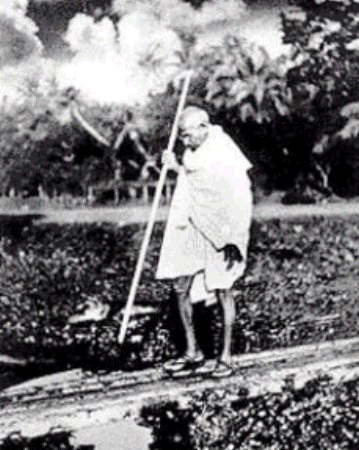 the doctrines of scientific hygiene, urban planning and education. The elite of the subcontinent grabbed these ideas of hygiene with as much aplomb as they grabbed at the political institutions and ideas of the white man. As an illustrative case, take Gandhi’s agenda was tied as much with hygiene as it was with the setting up of the Indian nation-state. The political language of equality that Indian nationalism utilized did not however, necessarily transcend caste boundaries. In a clever move, while the dominant castes invested themselves with Western attributes, the attributes that were credited to the coloured person, were passed on to the ‘lower’ castes of the subcontinent. Thus their bodies and lifestyles, already deemed ritually unclean, were now also see as unhygienic. Just as the coloured person was seen as lacking in education, the Westernised coloured person, now projected this need for education and upliftment onto these ‘dumb’ castes.
 It is no revelation that to most people in the third world, the 5 star hotel represents the developed West. It is a space where we can produce, and reproduce, ourselves as sophisticated, westernized and upper class. But as should be obvious, this westernization, and upper classness, also has casteist elements to it. Thus it is also an exclusive space, where we reject those who are not ‘people like us’. While there is no denying that a greater amount of care is possibly taken in the kitchens of these hotels, the fact is that these places are deemed cleaner, not only because they are more hygienic. They are deemed
  cleaner, because they are places where ‘people like us’ go, and where food is cooked ‘for people like us’. This is the safe space where the unknown and unclean cannot intrude, and this, perhaps above all, produces its ‘cleanliness’. In the past we had filthy cooks prepare food that was deemed ritually clean, because the cook was Brahmin (or of comparable caste groups). Or ritually suspect food could be eaten, because it was ritually purified by water or ghee. Similarly today, hotel food is produced as hygienic by the ritual mantra, yantra and tantra of shiny modern kitchens, presumed conformance to hygienic standards, and the modernity and exclusivity of their location.
Consequently then, we can make sense of the Facebook status message that started this whole conversation…
“Myth: Eating @ 5 Star hotels in
(A version of this essay was first published in the Gomantak Times Sept 8 2010)
Mantra, yantra, tantra: refer to the three necessary components of magic formula, machine or implement, and the procedure through which 'Hindu' ritual can be successfully completed.


