It’s one of
those standard questions when you meet someone new and they realise you are
from Goa, or from a place deemed foreign; “Oh! Do you know where one can get
the best Goan [insert appropriate location] food in Lisbon?” The question is
annoying on so many levels. First, there is this manner in which one gets
turned into an information hub on the exotic. The next thing you know, they
will be asking you if we use elephants to go to school. The other reason for annoyance
is perhaps because until recently I just did not know where I could find the
best Goan food in Lisbon.
It is not as if
there are no Goan restaurants in Lisbon. There are quite a few, and a good
number of them are in fact not bad. For example, I think fondly of Sabores deGoa, tucked away in the appropriately named Bairro das Colónias. But no matter
how satisfying the meal, there was always something missing, and I could not
quite place my finger on what this missing element. What I did know is that the
absence was not the lack of authenticity that one finds in ‘Indian’
restaurants. Of course, there is no such thing as ‘Indian food’. The food that
is so often passed off as Indian is the food inspired from the cuisine of the
Punjab and other parts of the North western Gangetic plains. This is but one
part of the nation-state of India. As is to add insult to this injury, most of
the restaurants that offer this Indian food, may have a dozen or so offerings
on their menu but the taste varies between three to four flavours. Shocking! It
is for this reason that most often I steadfastly refuse to go out to dinner at
an Indian restaurant. “If I wanted to eat food from home, then I would eat at
home” I protest pedantically. “In any case, the food they offer is not what my
mother would cook, and neither is it very good.” Mother, clearly, always
trumps!
Some time ago I
realised that what really bugged me about eating out, whether in an Indian, or
a Goan, restaurant was the lack of an etiquette. Take a couple of European
examples as illustrations. When one dines out in Portugal, there are invariably
three courses that occupy the meal, soup, main course, and dessert. If one went
the Italian way, one has the antipasti, primi
piatti , secondi
piatti and of course the dolce, the desserts.Each of these culinary traditions has managed to articulate a etiquette
such that there is an internal logic to the meal. One comes away having a full
and complete meal, satisfied with the final product.
This
has not been my experience with the Indian, and Goan, meals that I had in
Lisbon. If I manage to bully my companions into addressing the meal my way,
then we ensure that we get a couple of bowls of rice, and a variety of
accompaniments. But invariably, possibly due to the fact that we are addressing
not an internal logic of a culinary tradition but individual preferences of a
variety of people the result is still less than satisfactory.
My
search for the best Goan food in Lisbon, however, ended recently when I
discovered that Lis Goa, the newest restaurant in town, had added a fish thali
to its offerings. Those who have been in Goa will know of the immense
popularity of the fish thali, whether for visiting tourists, or office-goers.
The thali consists of the basic combination of rice and fish curry, with an
accompanying vegetable. Subsequently, one can elaborate on this basic offering
by adding fried fish, shell fish, dal, a variety of vegetables. The list of
possible additions is mouth-wateringly endless and it is rice links all these
various flavours together. Despite the elaboration, this is a peasant meal.
There is no fuss to it, it is honest, and it works within the logic of the
cuisine. Perhaps this is the reason for the fish thali’s almost universal
appeal to Goans who eat out. And perhaps this is why Lis Goa figured that if
they were going to represent Goan food, this is the one method through which they
could do so best.
I
have to confess that I was sold on the idea even before I arrived at the
restaurant. This was the afternoon I was going to kill all homesickness with a
lunch I could pretend I was having in Goa. There have been times when I have
built up expectations and been woefully disappointed. This was not the case,
however. This time round it was spot on. Lis Goa did not in fact disappoint.
It
is not as if the offerings on the thali were exquisite. They didn’t need to be.
The fact is that they were not bad. And they worked together. It offered one a
full meal linked around the most basic elements of food in Goa and along the
west coast – rice, fish, vegetable. My search for the best Goan meal in Lisbon
had ended.
(A version of this post was first published on 5 July 2015 in The Goan Everyday)
They say that when you step
outside your country, you are in fact an ambassador of your people to the
world. This must be true, for why else, would they ask you for example, which
are the best Indian restaurants in Lisbon? You are expected to know, whether
intuitively, or through sniffing out to satiate home-sickness, the institutions
and elements in a foreign city that incarnate the homeland when one is away. The problem with this little
Indian however, is that he stoutly refuses to go to a.n.y. Indian restaurant in
Lisbon. He will have none of it. The reason for this refusal to visit or
patronize the Indian restaurants in Lisbon is quite an involved story.
To begin with, these ‘Indian’
restaurants in Lisbon are something of a play-on-words. Invariably run by
Bangladeshis, or Pakistanis, they could more appropriately be called
South-Asian, or sub-continental kitchens. To call them ‘Indian’ is to stretch
political boundaries to unholy limits on the one hand, and to further encourage
continental (European that is) fuzziness of the world outside of Europe on the
other.To further complicate this mess is the fact that these ‘Indian’ restaurants
serve up a strange mélange. They call it Indian, but the food served is really
that strange version of Punjabi food, that perhaps even those in the Punjabs
(on both sides of the Radcliffe line) do not consume on a daily basis. Within
this state-of-affairs therefore, one would hardly go to an ‘Indian’ restaurant
to relive the flavours of one’s home, or capture the blessed scents of one’s
maternal kitchen. One would rather just
cook up, or valiantly attempt at any rate, to concoct the ambrosian delights
that mother manages to unfailing produce each day. If the process of cooking
itself is therapeutic, then what could resolve the aching nostalgia for home,
than to pound, grind and fry one’s pining away? Furthermore, there seems to be
a curious pattern to the dishes that are served up in these restaurants. Order
as many dishes as you like, the flavour of these dishes seem to vacillate between
a restricted set of flavours; perhaps four to five. When one eats as a good
amount of sub-continentals do, by mixing various foods together, reveling in
the surprises that explode in one’s mouth, this lack of variety can be quite a
buzz-kill.
There is one more reason why one
would not like to go to a sub-continental kitchen when in Lisbon (or in any
other part of the great ‘White’ world for that matter). Invariably, your
companions summon the waiter and indicate that they would like their food
spicy, ‘Extra spicy!!’ One gets the impression at these events that the point
of the meal at the Indian restaurant is not to enjoy the varied and often
delicate spicing that sub-continental food can provide, but to prove, through a
trial by fire, just how ‘native’ these white folks really are. Not amusing. Not
amusing at all!
If you do want to know where to
get the nicest, Indian food in Lisbon however, you are in luck. The nicest,
sweetest smelling dal is served up at
the canteen of the Hindu temple in Telheiras.To go by, on a cold winter’s day, and plunge your fingers into the dal-chaval, and wolf down the
accompanying veggies is to transport yourself in an instant, away from the
world of the Atlantic, to a place only you know, realizing in that instant, the
meaning of the term ‘comfort-food’.
A couple of days ago, a friend of mine, recently returned from the United States, complained about the stomach condition he had developed. What galled him most was that his illness had been caused via spoiled food served at a 5 star hotel. He had been warned, a dozen times over, that while road-side stalls were unsafe and unhealthy, the food served in the 5 star hotels in India was safe. And yet, this was not the first time 5 star food had him shuttling to and from the toilet. When I heard his story, I sat back and smiled. There was ofcourse, an explanation for why exactly his logic was not computing.
To get a grip on this logic however, we would have to go back in time, a couple of years when I was sharing a conversation with a friend. Speaking about the dabbawallas of Bombay, this friend remarked that this unique institution probably had something to do with the unique eating and dining habits of the South Asian. Caste rules as regards dining in older times restricted who we ate with, what we ate from whom, and where we ate as well, not to mention the times at which we ate. Thus, it was possible for a ‘lower’ caste person to offer food to a ‘higher’ caste person as long as it was uncooked. Where the degrees of separation between castes were lesser, then the possible pollution could beundone by sprinkling the cooked food ritually with ghee. The best route however, was to make sure that the food was cooked by some one reliable, someone who was ritually pure, and would thus provide ritually pure food. Someone from your home. It was partly for these reasons, this friend reasoned, that the dabbawallah was such a success in Bombay. It ensured a perfect system where ritually and socially privileged ‘home-cooked food’ could be delivered to you.
These ritual obsessions with purity, could explain the mania that the Indian displays for ‘home cooked food’; the home being a symbol for the pure. It is the absence of such preoccupations in other parts of the world, that allows places as wide-ranging as South-East Asia, Europe, the Americas and not least of all, the Islamicate urban centers of the South Asian subcontinent, to have such rich street-food cultures. The elusive hygiene of the street-side food-stall in India then, is less about hygiene and more about (often time unconscious) concerns for ritual purity. When we are not so sure about the social location of the cook, it is better to err on the side of caution.
Similarly, certain ritual systems of the subcontinent consider the consumption of food is an activity that makes one vulnerable. Thus the space in which one eats is something that one ought to give attention to. For the ritually conscious then, the liminal space of the street, that is open to polluting influences of all sorts, is best avoided as a place to eat. The ideal space to eat is the space in which one is secluded, in an environment where one is safe from intrusion of the polluted and dirty outside. Once more, scientific hygiene has nothing to do with the safety of the food.
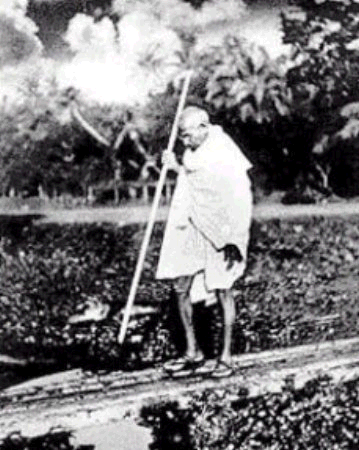
But this is not to say that scientific hygiene has absolutely no role to play in any of these choices. On the contrary, it does and in a very interesting manner. Scientific hygiene was a colonial introduction into the subcontinent, and marked heavily by racism. The brown (or black) body was seen as the repository of filth and dirt. The tropical home of these coloured bodies was similarly loaded with pestilence and illness. Colonialism, through its mechanism of the ‘white man’s burden’ offered a way out of this mess to the coloured person, through the doctrines of scientific hygiene, urban planning and education. The elite of the subcontinent grabbed these ideas of hygiene with as much aplomb as they grabbed at the political institutions and ideas of the white man. As an illustrative case, take Gandhi’s agenda was tied as much with hygiene as it was with the setting up of the Indian nation-state. The political language of equality that Indian nationalism utilized did not however, necessarily transcend caste boundaries. In a clever move, while the dominant castes invested themselves with Western attributes, the attributes that were credited to the coloured person, were passed on to the ‘lower’ castes of the subcontinent. Thus their bodies and lifestyles, already deemed ritually unclean, were now also see as unhygienic. Just as the coloured person was seen as lacking in education, the Westernised coloured person, now projected this need for education and upliftment onto these ‘dumb’ castes.
It is no revelation that to most people in the third world, the 5 star hotel represents the developed West. It is a space where we can produce, and reproduce, ourselves as sophisticated, westernized and upper class. But as should be obvious, this westernization, and upper classness, also has casteist elements to it. Thus it is also an exclusive space, where we reject those who are not ‘people like us’. While there is no denying that a greater amount of care is possibly taken in the kitchens of these hotels, the fact is that these places are deemed cleaner, not only because they are more hygienic. They are deemed cleaner, because they are places where ‘people like us’ go, and where food is cooked ‘for people like us’. This is the safe space where the unknown and unclean cannot intrude, and this, perhaps above all, produces its ‘cleanliness’. In the past we had filthy cooks prepare food that was deemed ritually clean, because the cook was Brahmin (or of comparable caste groups). Or ritually suspect food could be eaten, because it was ritually purified by water or ghee. Similarly today, hotel food is produced as hygienic by the ritual mantra, yantra and tantra of shiny modern kitchens, presumed conformance to hygienic standards, and the modernity and exclusivity of their location.
Consequently then, we can make sense of the Facebook status message that started this whole conversation…
“Myth: Eating @ 5 Star hotels in India is safe. Just had my 2nd ever experience of illness due to spoiled food served. Consequently I have warned against "road side chai" and have had it over 2 dozen times. Number of illness bouts from chai? = 0”
(A version of this essay was first published in the Gomantak Times Sept 8 2010)
Mantra, yantra, tantra: refer to the three necessary components of magic formula, machine or implement, and the procedure through which 'Hindu' ritual can be successfully completed.
It seems almost lost in the mists of time now. That time when the idea of Goa Dourada, a Goa that was Lusitanian, or Portuguese, needed to be fought with another idea. The idea that eventually emerged to contest that of Goa Dourada was that of Goa Indica; the Goa that was Indian. If one idea pointed to a Lusitanian inspiration for Goa, the other pointed more properly to a brahmanical inspiration for Goa. The support for Goa Indica was found in geographical contiguity, in Puranic legend and sundry other clues.
Now this Indic connection for Goa was not unwarranted. There was a need to overact the rhetoric overdrive of the Estado Novo,and Goa Indica played its role in this ideological battle. The question remains however, if Goa Indica managed to capture the entire essence of Goa, or was it another incomplete cliché that needs to necessarily give way to another? Where would this new cliché come from if at all? Thankfully, Mother India in her variety provides the answer to that question. In the early 1980’s a group of scholars who had suckled right at the brahmanical breast of the Mother emerged with an interesting intellectual agenda. Styling themselves the Subaltern Studies Group, this group of scholars argued that there was much in the history of the subcontinent, and the manner in which we thought about it that had to change. We had to move away from the understanding of history as the progress led by great men, to a history that features the non-elite groups, the subaltern, as agents of social and political change. This focus on the hitherto small people of history, was matched by the independent growth in the Dalit movement in India. As a result, we can today actively think of crafting a history of India based on Dalit and subaltern experiences and push back brahmanical histories from the centre-stage it has occupied till date.
One of the many problems with Goa Indica is that when it thought of the pre-Portuguese past, it thought of Goa as a brahmanical centre. The history of this pre-Portuguese past was the history of the great men and groups in the brahmanical tradition. There was, and is, no space for the non-brahmanical groups in the imagination of a pre-Portuguese Goa. Having said this though, it must be pointed out that Goa Dourada, at least when used within the Goan context, was a reference to the self-image and perceptions of the Lusitanianised brahmanical and elite groups. Between the two cliches, you have the nationalist, and imperialist imaginations of the elite and the brahmanical. If one has to redress this understanding of Goa then, at the same time not fall into Lusitanian moulds for Goa, where should we go? Where do we find the trope that will allow us to place at the centre, the experiences and histories of the Goan subaltern?
Happily it appears that we may not have to go too far. Perhaps the answer was sitting before our very noses all the time and thanks to our elitist obsessions we just didn’t recognize it!
The eating of pork is essential to any Catholic feast or festive occasion, and many assume that the consumption of pork was something that was ‘imposed’ and introduced to the ancestors of today’s Catholics by the Portuguese and the accompanying missionaries. What if however, this was not quite the story? What if pork was already a part of the Goan diet before the Portuguese came in? Would that possibly change the way in which we look at the constituents of Goan Catholic culture?
It is possible, and no doubt documented, that the missionaries urged pork on to the populace that converted to Catholicism way back in the 1500’s. However, to assume that this was the first time the converts to Catholicism had ever consumed pork is to assume that the entire population that converted was possessed of brahmanical sensibilities. If one looks around, at social groups in the rest of Mother India, one realizes that there is a good portion of the non-brahmanical population of the sub-continent that quite enjoys eating pork. We can also safely assume that these groups were insulated from the rigors of that famed beast, the Holy Inquisition in Goa, and that their pork-consumption is not a savory leftover from their missionary-scarred past. The consumption of pork then, it turns out, is not in fact some Portuguese introduction to Goan cuisine, but in fact foundationally (pre-Portuguese) Goan!
A significant social scientist in Goa, was recently contemplating the fact that the social groups, at least in Catholic Bardez, who were professional cooks were groups that in other parts of India were seen an untouchable. What caused then, this scholar wondered, for the missionary priests, to attach cooking as the traditional occupation of this group on their conversion to Christianity? If one realizes that these groups were in any case consuming Pork, and that the missionaries came from Europe with a taste for porcine flesh, then voila! One sees a natural partnership being produced!This association begins to make more sense when one realizes that the first Christians in Goa, were not members of the Brahmanical castes, but in fact the non-brahmanical castes, no doubt eager to get away from the stuffy sensibilities of the brahmanical groups. The fact is that only after the enactment of penal legislations did segments of the brahmanical groups convert to Christianity.
Realizing that the consumption of pork was a part of the pre-Portuguese culture of Goa pushes us to realize that there is much that we assume to be Portuguese impacts on Goan culture that are in fact remnants from the elusive pre-Portuguese past. To be sure there was some amount of colonial influence in the manner in which pork consumption spread. But for that matter, most of the constituents of sub-continental cuisine, are the result of the intervention of the Portuguese. It was because of the colonial transportation of American spices that we have the Indian cuisine that we are familiar with today.
In sum then, while the idea of Goa Indica was relevant and helpful, it is time we started relooking the clichés we use to describe Goa. Looking at the practices of the non-brahmanical groups in Goa, would perhaps give us another interesting angle to enter the Goan experience.
(First published in the Gomantak Times 25 August 2010)
Itinerant mendicant captures two aspects of my life perfectly. My educational formation has seen me traverse various terrains, geographical as well as academic. After a Bachelor's in law from the National Law School of India, I worked for a while in the environmental and developmental sector. Following a Master's in the Sociology of Law, I obtained a Doctorate in Anthropology in Lisbon for my study of the citizenship experience of Goan Catholics. Having worked some years at the Centre for Research in Anthropology at the University Institute of Lisbon, I am now a priest for the Archdiocese of Goa and Daman.I see myself as a mendicant largely because so many of my voyages have been funded by scholarships and grants.This blog operates as an archive of my homilies, and writings in the popular press.


 Some time ago I
realised that what really bugged me about eating out, whether in an Indian, or
a Goan, restaurant was the lack of an etiquette. Take a couple of European
examples as illustrations. When one dines out in Portugal, there are invariably
three courses that occupy the meal, soup, main course, and dessert. If one went
the Italian way, one has the antipasti, primi
piatti , secondi
piatti and of course the dolce, the desserts.
Each of these culinary traditions has managed to articulate a etiquette
such that there is an internal logic to the meal. One comes away having a full
and complete meal, satisfied with the final product.
Some time ago I
realised that what really bugged me about eating out, whether in an Indian, or
a Goan, restaurant was the lack of an etiquette. Take a couple of European
examples as illustrations. When one dines out in Portugal, there are invariably
three courses that occupy the meal, soup, main course, and dessert. If one went
the Italian way, one has the antipasti, primi
piatti , secondi
piatti and of course the dolce, the desserts.
Each of these culinary traditions has managed to articulate a etiquette
such that there is an internal logic to the meal. One comes away having a full
and complete meal, satisfied with the final product.