Showing posts with label Oscar Rebello. Show all posts

Friday, April 29, 2016

AAP: A Clear and Present Danger?


With the elections to the state legislature in the not so distant future the Aam Aadmi Party (AAP) in Goa has begun its campaigning in earnest. As is well known, AAP has been projecting itself as a credible choice on the basis of its promise to deliver good, i.e. corruption free, governance. The question, however, is whether the AAP should be judged merely by its rhetoric, or should it be examined against a broader canvas?

Recent history demonstrates that electoral decisions determined solely by the theme of corruption have ensured that we have moved from the frying pan into the fire largely because we have failed to examine the politics that these electoral options practice. Take the example of the Modi government now wreaking havoc across India. Modi was elected into power because so many people, rightly fed up with the Congress, decided that the man was a good administrator and deserved a right to govern the country. Closer home in Goa, fatigue of the never-ending corruption scandals presided over by the Congress enabled the BJP to come to power.

We now realize that in addition to merely continuing the corrupt practices of the Congress, the BJP is also committed to a kind of fascist agenda that is difficult to undo even after they have been removed from power. This is a kind of moral corruption that is difficult to undo largely because, as I will go on to show, Hindu nationalism itself is never challenged. As such, when evaluating AAP in Goa it is imperative that their proximity to the agents and logics of Hindu nationalism must be strictly evaluated.

An evaluation of the AAP along this axis must begin with a statement by Dr. Dattaram Desai, the AAP candidate for North Goa in the previous Lok Sabha elections in 2014. At that time, Desai indicated in a local newspaper along the lines that he saw no problem with the RSS and that it was just another nationalist organization. When Desai was confronted on this matter at a public meeting conducted by the AAP he denied that he was a part of the RSS, and denounced the RSS as a communal organization. However, it seemed that he did so largely because he had been hounded into that position after being asked a series of leading questions. Desai had been asked at that meeting to issue a public statement to the effect that he did not approve of the RSS, something he agreed to, but one that, to the best of my knowledge, was not issued. Desai continues to be a leading member of AAP in Goa, and in light of his past comments, this fact should be a cause for concern.

At the above mentioned meeting Dr. Oscar Rebello, also a prominent member of the AAP in Goa, sought to clarify issues regarding the links between the RSS and AAP. Using characteristically simplistic logic, Rebello pointed out that he had friends in the RSS, but that did not necessarily make him a member of the RSS. Rebello’s logic may be simplistic, but it is often winning in its presentation. Of course one cannot, especially in a small place like Goa, deny people entry into a party because they were once members of the BJP. Perhaps they may have, as is suggested in the case of Desai, realized that the BJP will not deliver.  But the problem with the RSS, and more importantly Hindu nationalism, lies in the logics that we internalize owing to a lifetime of being immersed in it. If these logics are not actively challenged we too become part of the Hindutva machine.

In this context, the decision of the AAP in Goa to name its outreach program the Goa Jodo campaign is quite disturbing. Why privilege Hindi in a state with no lack of local languages? Because a non-Hindi Goan-ness is suspect? How is this position different from that of most Hindu nationalists and the implicit understanding that it is primarily Hindi and Hindu culture that defines Indian nationalism? One should bear in mind that Hindi nationalism, as one can surmise from the old slogan “Hindi-Hindu-Hindustan” has never been far away from Hindu nationalism. This desire to run with the Hindi-wallas can also be seen  in the video of Desai’s response discussed earlier, where it appears that Rebello refers to Desai as Dr. Desaiji. Now one is entirely at liberty to add honorifics to people’s name. The problem emerges when one realizes that the ji has become popular in Goa with the rise of Hindu nationalism in the past couple of years. The question emerges therefore, can we rely on such a group to assert the rights of Goans which necessarily runs against Hindi and Hindu nationalism, such as the demand of Special Status, and assert our right to be different within India?

But it is not merely the local AAP that has disturbing connections with the RSS or is blasé about Hindu nationalism. Pamela D’Mello writing for an on-line magazine pointed to the disturbing relationship of Dinesh Waghela to Hindu rightist outfits. Waghela was charged with setting up AAP in Goa, and at that point just like Desai went on record, to suggest that he did not see what was wrong with people from the RSS joining the party.

What also needs to be pointed out is that AAP’s insistence on its promised good-governance as a central reason for being a choice in the upcoming elections partakes in the Hindu Right’s pushing of strong administrators, whether Modi or our very own Parrikar. This is not to suggest that good governance is not an important issue. It is. However, we need to recognize that a limited understanding of corruption, and governance emerges from the very upper-caste and middle-class reasonings that have generated the Hindutva upsurge in the country. It is this kind of unthinking of, and challenge to Hindutva logics that is critical and necessary if AAP in Goa should emerge as a safer option than it currently seems to be.
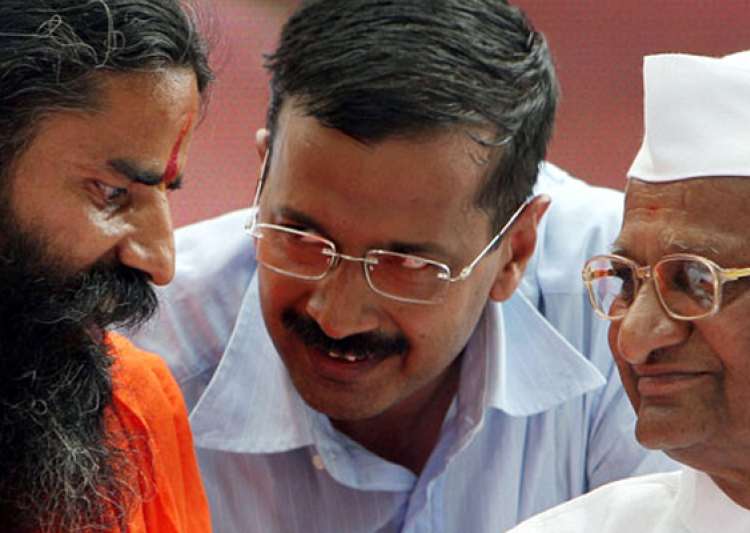

Most disturbing of all, however, are the actions of the party supremo, Arvind Kejriwal. Kejriwal has had no problem in the past drawing such Hindu spiritual leaders like Sri Sri Ravi Shankar and Baba Ramdev into his movement. Right from the get go therefore, Kejriwal has violated secularism by mingling the Hindu religion with his politics. More recently, despite the livelihood and environmental violations involved in setting up the venue for the World Culture Festival on the banks of the river Yamuna, and in contravention of his own position on corruption, Kejriwal saw it fit to attend the event, and kowtow before Ravi Shankar.  As distasteful as this may be to some, it is not necessarily out of character for unprincipled political leaders who need to engage in populist measures if they are to stay in power. It is, therefore, precisely because AAP Goa will have to play by established rules of the game once it is in power, that we need to evaluate them stringently before they get into power. In light of this, AAP Goa’s connections to soft Hindu nationalism present a clear and present danger.

(A version of this text was first published in the O Heraldo dated 29 April 2016)

Wednesday, July 13, 2011

On Secularism: Moving beyond Goa’s politics of personality

The opportunity popped up, some days ago, to read the reflections of Dr. Oscar Rebello on the Medium of Instruction (MoI) ‘controversy’. The discussion in this column will focus not on the issue of the inclusion of English as a State-supported MoI, but on Dr. Rebello’s observations that have some implication for the manner in which we in Goa understand secularism.

In his column, Dr. Rebello argued that ‘Uday Bhembre; Arvind Bhatikar; Prashant; Pundalik & Hema Naik; N. Shivdas and many other stalwarts in the BBSM movement specially the youth brigade I know well, are the finest, secular and principled individuals in Goan society. Just because they take a position on a cultural issue does not make them communal. Indeed, if the crazy bats from the Sangh were to run riot terrorizing minorities in Goa, some day, these individuals would be in the front line of fire defending secularism.’

This is an interesting formulation of secularism that Dr. Rebello proposes; it suggests that one is secular not because of what one does, but because of who one is. Or rather, one is secular because of one’s history, and based on the understanding of that history of one’s actions in the future. The actions in the present, both seen and unseen, can be safely ignored when determining a person’s secular credentials.

Dr. Rebello’s is not a unique position, but shared especially among some members of the diocesan hierarchy in Goa. A suggestion that the actions of one of these gentlemen, but especially Dr. Bhembre, verged on the communal, one is greeted with a stunned silence, followed by ‘But he is one of Goa’s most secular individuals!’

There is no need to debate Dr. Bhembre’s secular credentials. Indeed, perhaps there is a need for us in Goa to move away from the politics of personalities and of the personal. This column would like to however, challenge these understandings of secularism that are based on this cult of the personality.

To counter this focus on the personality, perhaps we should recognize that secularism is not an inherent quality in any of us. It is a process that we engage in, where we continuously try to rise above the politics and interests of our personal locations, and work to make the public space more accommodating of the choices of others. We do not impose our own social, familial and other prejudices onto the public space. It must be emphatically stressed, that to be able to do so is not an easy task; which is what makes a secular society so difficult to reach. Secularism, is the rough and narrow path of the pilgrim. It is not a pedestal we can climb on it (though, it has to be recognized, one can also so easily fall off pedestals!)

To recognize secularism as a process, rather than as a state-of-being, would allow us to recognize the fallacy of Dr. Rebello, and segments of the Goan Church hierarchy’s, understanding of secularism. One could very well be un-secular, or communal, despite one’s previous contributions to the fabric of the Goan public sphere. Indeed, when one challenges the idea that a person is inherently secular, then one is able to evaluate, based on the actions in the present, if this individual’s actions in the past, were an attempt to be secular, or were in fact even then mixed up in a more restricted social agenda. The problem with many a secular society, not just in Goa or in India, is that all too often, in the attempt to forge a secular society, the preferences of a segment of people gets foisted, often unconsciously, as the secular ideal. The sad truth is that when these groups are faced with the realization that their idea of the secular is not shared by others, they are too entrenched in their positions to now make way for dialogue. The case of the MoI ‘controversy’ in Goa, is perhaps a case in point.

Much energy has been invested by the people mentioned by Dr. Rebello in the paragraph extracted from his essay, to set up Konkani as the basis of a secular society in Goa. What they have, perhaps unwittingly, not realized however, is that Konkani does not capture the extent of the desires of much of the populace, and neither have the contours of official Konkani managed to encompass the various Konkanis that exist in Goa. Thus, as harsh as it may be, despite the value of their past commitments, and their antipathy to the extremism of the Sangh, their ‘a position on a cultural issue’ could in fact make their position contrary to the realization of a secular public environment. Indeed, it is precisely our positions on cultural issues, not our family or personal history that makes or breaks our commitment to the realization of a secular society.

Dr. Rebello makes another interesting observation in his essay. He argues that ‘In India it is simple. The majority Hindu can choose to be communal or secular. The minorities have no option but to be secular. We are blessed that a large percentage of Hindus in our society choose to remain inherently secular.

Dr. Rebello’s observation can be phrased another way. Issues are secular when a majority of the majority Hindus deem an issue secular, and communal when the same majority deems it communal. The option for the rest then is to dance to this tune, or opt out.

Within this frame, we could possibly read Dr. Rebello's exculpation of the individuals he describes as secular, as the position that an individual caught between the personality politics of Goa's small society, and the larger politics of Indian secularism, is forced to take. Indeed, Dr. Rebello starts off by exculpating these individuals, and then breaking ranks with the position they take in no uncertain terms. We would do well to not ignore the manner in which Dr. Rebello deals with this dilemma, and not dismiss Dr. Rebello as either hypocritical, or the puppet of powerful groups in Goa, as indeed, some have more recently been wont to do. One could in fact read Dr. Rebello's reflections as the strategy of a peace-maker. Rather than standing up and reveling in polemics and denunciations, Dr. Rebello, has kowtowed at the altar of personality, thus ensuring that his position is not a personal attack, and simultaneously taken the position that he feels is the proper position to take. This is not an easy task, and is wonderfully demonstrative of the kinds of compromises that we sometimes need to take to bring warring groups to the table to talk. As the biblical praise goes, 'Blessed are the peace makers, for they call be called children of God.' There is a need to move out of the overwhelming reliance that Goan politics places on personalities, and Dr. Rebello's move, while not entirely satisfactory, may perhaps be one way out.

Having said this however, it should also be pointed out, that there is a danger in assuming, as Dr. Rebello does, the natural secular position of the minority. Too often, it is assumed that if one toes the line of the self-proclaimed leaders of minority groups, one is secular. Thus, if the self-proclaimed Catholic leadership (whether this leadership be of the laity, clergy or of the diocesan hierarchy) determines that a position is in the Catholic interest, then any Hindu who supports this position, is deemed to be secular. This however may in fact not be the case. Once more the history of Konkani provides us an example. For a variety of reasons too complex to get into in this column, the Catholic leadership determined in the 1960’s and subsequently, that Konkani represented the Catholic interest. Thus any person who sang a similar tune, was deemed secular. What was not inquired into at that point of time however, was why were these 'Hindus' (in fact only a segment of the Goan Hindu population, almost clearly defined by caste) in fact supporting the demand for Konkani? Herein lies the problem.

Just because this minority leadership phrases the issue in a particular manner, it does become secular. As should be obvious from a study of the history of the demands of segments of the North Indian Muslim leadership, merely supporting a minority leadership interest, does not necessarily contribute to a secular society. On the contrary, it confounds the situation, since interests are now assumed to be necessarily based on religion alone, and the interests of the religion are the interests of a usually small group of elites within this religious grouping.

The secular society is like the messianic kingdom; not something that already exists in fact. It is something that will come. For this coming, we need to need to walk a pilgrim path continuously examining our actions, for the slightest move may upset earlier actions. Also, we may often mistake the straight and easy path for the secular, when in fact it is the tortuous that leads us to this secular kingdom.

(A version of this blogpost was first published in the Gomantak Times 13 July 2011)

Wednesday, March 23, 2011

Learning from Egypt II :Picking out the greys from the black and white

Last week, when attempting to draw lessons for Goa from the Egyptian revolution, this column pointed out that the problems with Goa’s socio-political activism lay in the compromises effected by the elite leadership of these movements. Presented as an example, were the appeals by the Convenor of PINC to not vote for the panel proposed by Babush Monserrate. What was also stressed however, was that the attempt was not to demonise the elite/middle class leadership. On the contrary, the attempt was merely to raise a cautionary voice, so that we can benefit from the sensitivity they bring, but also know when to move on.

Another opportunity to follow this train of thought was presented in a recent essay penned by the Convenor of PINC, Dr. Oscar Rebello, no doubt in personal capacity, in the Herald under the title, ‘Meeting up with G.H.A.N.T.I.’ The essay highlights the manner in which this particular social segment of Goa has much to offer socio-political change but also the limitations of its imagination.

Dr. Rebello wrote movingly of the manner in which the ghanti is ostracized and blamed for situations that are in fact the product of Goa’s internal problems. There is much to learn from this argument that, to his credit, Dr. Rebello has unceasingly articulated at every possible moment in his public role. However, we should spare a thought to an uncomfortable fact. Being a member of Goa’s cosmopolitan classes, the fears of cultural difference that the migrant (of whichever economic hue) wave brings to Goa is less of a threat to De. Rebello, than to the Goan whose social universe is largely rooted in the structures of ‘traditional’ life. This ‘traditional’ life may perhaps be a bigoted existence that deserves to change, and this migrant the best option for it. Indeed, the threat of the ghanti is very often raised by another segment of the leadership of Goan social-political movements. Small time village bosses, made significant through the fruits of working overseas, the ghanti is a symbol of the local changes that threatens to void their years of hard labour. While not sympathising with their attempts at rabble rousing, we need to recognize that the process of change is not easy for persons without the substantial cultural capital that Dr. Rebello is lucky to have. The question before us, persons like Dr. Rebello (and self?) is how do we intervene in the process to make it easier and understandable?

Dr. Rebello’s essay could perhaps be one part of his personal efforts, and in doing so, he opens the door for a discussion that may otherwise have not commenced. There would be no discussion however, if we only agreed with what he had to say. Disagreement with his position, or indeed that of any other, does not imply that he is wrong, and the response to his positions correct. Such clear options are only theoretically available to us. However, the responses could point to the problems inherent in the suggestions made.

Before disagreeing with aspects of Dr. Rebello’s argument however, we need to point out the other spaces where we agree with him. Dr. Rebello is spot on when he says that ‘The youth in the slums unlike their parents are rebelling for being treated like toys without dignity.’ The migrant will remain a threat to the Goan order only as long as they are in a position where they are forced to operate as a vote bank. Aiding their access to better conditions of labour, educational and employment options for their children works to the interest of the niz Goencar. For the children of these migrants, Goa, and its diverse cultures, are the only home they know, and culture they are intimate with.

The first of my problems with Dr. Rebello’s formulations stems for this understanding above, that of a Goan culture that while it can be contained with the box called Goa, is in fact plural and diverse. If Dr. Rebello has often asked us to not target the ghanti, he is also typically elite in his urging us toward ‘unity’. This unity that Dr. Rebello urges us toward however, seems to be not so much unity as uniformity. Unity lies in deciding to stick together while recognizing our differences and agreeing to respect these. Uniformity on the other hand rests on the rejection of difference. Take for example the manner in which in the course of the GBA’s mobilisations, those persons who sought to raise the issue of Romi Konkani were told to shush up. The GBA leadership at the time told them in no uncertain terms that the Roman script issue was not to be part of the GBA’s agenda. As the fantastic turn out at the rally demanding Government aid to English medium schools indicates, the hegemony of Devanagari Konkani is a singular part of the problems impacting Goa and Goans, regardless of caste or religion, or indeed ghantiness or otherwise. Discussing our problems with Konkani, or anything else, requires that we recognize our differences and stop trying to suffocate these out of existence.

Perhaps these ideas stem from the larger group that Dr. Rebello associates with, ersons whose names figure in PINC, and were part of the GBA leadership at the time. These figures seek to create a Goan nationalism, a single Goan national community. Such nationalists are incapable to tolerating internal difference. To these nationalists I ask, why do you not want to recognize that there are different groups in Goa? Groups who may respond to the term Goan, but do not necessarily see themselves as part of the same community. Or are only grudgingly together? Creating a national community of Goans, will not resolve Goa’s problems. Addressing the larger demands of these groups, building a community that recognizes each others differences probably will.

The second disagreement with Dr. Rebello is the suggestion that it is private profits that are responsible for Goa’s ills. This is only a part of the problem. Undoubtedly some groups, like the real estate lobby, and the politicians that harvest this greed make private profit. However, both these groups are able to exploit a larger need of the Goan peoples which is the need for capital to transition to the new economy. The tragedy is that the money they make does not seem to be resulting in the collective and social institutions that can support them in this transition but the further breaking up of collective infrastructure. This may sound like a quibble, but it is imperative that we recognize that genuine need fuels much of the silence and support for the politicians who enable the privateering that is destroying Goa. If we can recognize this need, we may in fact open up more doors for understanding the nature of the challenge that Goa faces.

To conclude let me reiterate once more. The elite groups of Goa have something to contribute to socio-political change in our society, however their thinking stems from their sometimes narrow agendas and is the result of their social location. We need to work with them when we can, and disagree vehemently when their positions block equitable social change rather than support it. It is not a case of black or white, but selecting from our choice of greys.

(First published in the Gomantak Times 23 March 2011)