Showing posts with label Salcette. Show all posts

Saturday, October 13, 2012

Wandering through halls with a hundred doors: Book Review of Let Me Tell You About Quinta


Ever since the Indian army marched in and annexed the Portuguese State of India to the Union, Goan society has been involved in an incredibly intense churning. This churning has occurred as Goans sought, and continue to seek, their location within the larger Indian polity; as they sought to make sense of the rapid changes that overturned the social structures of a highly stratified society held in place through late Portuguese imperialism; as new elites emerged and waves of, until-then, foreigners landed up to radically transform the Goan landscape. A churning that has been on for some decades now, it would not be wrong to say that this process reached a particularly intense moment in the past couple of years. It is within this context that Let me tell you about Quinta should be read, evaluated and appreciated. A good number of Goan, and non-Goan artists, musicians and writers have attempted to grapple with the upheavals that have beset Goan society, and it must be said that Let me tell you is clearly one of the finer products of that churning.

Set in the village of Carmona, Let me tell you about Quinta is narrative that spans three generations (including an illegitimate one) of a Catholic bhatcar (i.e. landed Goan) family and its multiple Others. Weaving between time-periods, pre-colonial, colonial and the post-colonial, the narrative is punctuated by the voice of the initial narrator of the epic, and the figure closest in time to us; the readers. Indeed, the delicate texture of time that this narrative produces is one of the finer features of this book, fine-grained in its attention to detail, yet never leaving one exhausted from the burdens of history. And yet, the central protagonist of the narrative is clearly Quinta do Santo Antonio the highly contested property that, like so many Goan homes and properties of the late-colonial epoch, framed the emergence, lifestyles and the eventual dissolution of one class and the burgeoning of another. This grand Goan home, like others in the territory, measured carefully the lives its owners would lead, and mapped the relationships they would enjoy or suffer with their relatives and minions; living on, even as the eaves of these homes eventually come crashing down. It should be said, that one could use this one book as a fairly effective way into getting into a broad and yet sensitive understanding of Goan society and its history.
Let me tell you however, does not limit itself to merely weaving its tale via reference to the quotidian. On the contrary, the magical or the enchanted trespass quite frequently into the tale, be it in the form of birthing fluids that deluge automobiles, women who speak quite casually to spirits that tattle tales of buried wealth, and curses that eventually ruin families. If it were just this however, Let me tell you would fall well into the realm of fantasy, or magical realism. However, because the fantastic that the narrative presents are from well within the vernacular traditions of Goa, this book is poised quite comfortably within the realm of contemporary mythology. The most exciting feature of this book therefore is not the deft weaving of Goan history, or its sociological insight, but the manner in which it has done both of these while integrating the same into the spiritual traditions of the land. Most efforts on this front, especially by Goan Catholic authors tend to tumble headlong into an embrace of brahmanical myth, as they thrash about seeking to recreate the history of a Hindu past that they believe they have lost. Not so Let me tell you, that catholically embraces the fluid movements of Goan history while simultaneously rooting itself in a living and breathing mythological traditions of village Goa, or perhaps more appropriately village Salcette (the taluka within which the novel is so firmly set.)

Because Let me tell you emerges from out of this great Goan soul-searching, because it is located within the mythos of the Goan space, and because it is cognizant of the nuances that time has wrought on this space, it is an intensely political text. Like the time-frame of the narrative, this commentary is pronounced upon various locations of Goan time, not restricting itself merely to the contemporary moment. However, because it is Quinta that is the central figure of the book, the most fundamental comment is the lament for the loss of the Goan homes and the families that built them. Take for example this hugely evocative “‘What a life’ wrote Preciosa to Sun, ‘this was a land of open door, now we have to lock ourselves in to avoid people.’”  And yet, while the narrative mourns the passing of an age, because it reflects on the morality of the actions that built and sustained those home, and eventually came to pass, it is a cathartic lament, creating through this narrative the legitimate space for those former subalterns, the minions of homes like Quinta do Santo Antonio who have now come to succeeded to the Goan earth that they were so long disinherited from.

For the dexterity with which Savia Viegas weaves these many projects together, for its breathless and graphic storytelling, the book is an intellectual delight even if one is not interested in Goa, its politics or its history. Indeed, because of the manner in which it involves itself with the genealogies of a creole society, a number of readers have commented on, and drawn parallels with the works of Marquez and Allende. However, those unfamiliar with the nuances of Goan cuisine, language, hierarchies and idiosyncrasies may at times find it difficult to navigate and make sense of the narrative. Viegas, or the publishers Penguin, would have been well advised to include a glossary along with the narrative. However, one could also perhaps simultaneously discern from this lack of a glossary, the decision to pluck Goa away from its location as an aberration, where it is merely ‘a small part of India’ and return to it its universal significance. While on the subject of language, it should also be said that the few forays that the narrative makes into other languages, be it Hindi, Konkani or Portuguese detract from the breathless beauty of the narrative. One can understand the temptation to invoke the vernaculars to give a flavor of the land, but given Viegas’ skills that have thus far been acclaimed, these little flourishes serve only a cloying flavor that could have well be dropped. Introducing the vernacular tongue into a text written in a different idiom is seldom easy, and this attempt is not Viegas’ brightest moment. There is another grumble associated with language and this one involves the dropping of the accents that communicate the sounds of the Portuguese language used in the book. This, along with spelling errors, is often a ‘mistake’ committed by Anglophone publishers of texts that invoke languages other than English. For a text that seeks to weave the Portuguese language convincingly into its narrative however, this is an appalling oversight. 

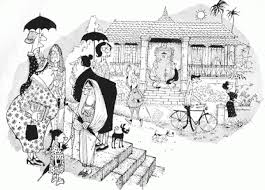
The last of the grumbles associated with the production of this book involves the images located in the text. Five in number, Viegas commences each part of this four-fold narrative with a pictograph assumedly crafted by her hand. These images share an interesting relationship with the text. Not quite a show-and-tell, it is as if these images are the remnants of the dreams from which the narrative was born. Given that these images would been executed in colour, and given their association with the text, it is a shame that they appear in the book not in the lavish colour or Viegas’ no doubt technicolour dreams, but in muted and disappointing shades of greys.

Savia Viegas’s book is a delight at so many levels; so do, do let her tell you about Quinta.

Let Me Tell You About Quinta
By Savia Viegas
Penguin Books India, New Delhi, 2011, 254 pp., Rs 299
ISBN 0143415220

(This review was first published in Biblio: A Review of Books Sept-Oct 2012 as Land of Open Doors)

Thursday, August 9, 2012

The Taxi gangs and Mafia of Goa? Placing issues in perspective


Since around May this year, there have been a number of reports on the manner in which the tourist-taxi system in Goa works. This attention has been ensured thanks to the reportedly aggressive behavior by the taxi-operators (taxistas), by their request to the government to handle the disputes between the taxi-operator associations in North and South Goa, and the demand by a variety of organizations to ensure that the operation of these taxis is regulated by meters in these taxis.

Given that the taxi system could, and must, operate as a viable supplement to the public transport system in our state, it would be in our best interest to ensure that this segment of the public transport system is well-regulated and accessible to all. Having said this however, it is also necessary to assert that one cannot ensure the fair and honest resolution of a problem by demonizing one party and laying all of the blame at their feet. This is exactly what seems to be happening however, via the various newspaper reports, where it is the taxistas alone who are being faulted as being exploitative, demanding ridiculously exorbitant charges, as well as violently aggressive towards their customers.

The aim of this column is to suggest a more sympathetic viewing of the taxistas, one that moves away from demonizing them, so that we could move toward a just resolution of the problem. As such, the first task would be to question whether the manner in which we view the taxistas is not in fact tinted by class-based prejudices. A recent article in The Goan allows us to place this possibility in context, given that it uses two highly inappropriate words, mafia and gangs, for the informal associations of the taxistas. These words demonstrate the manner in which these groups are not only being demonized but are effectively being criminalized. It is not surprising that these adjectives were being used for groups from South Goa given that there is a long Goan history of depicting the working class Saxticar as unthinking, hot-headed and violent. Every major Goan population has relied on the mass mobilization of Saxticars, but simultaneously has cast them as mobs without political savvy, setting in process this tendency to criminalize the Saxticar. This may also have to do with the kind of class-relations that marked colonial Salcette, given the large landholdings in that taluka, the unequal and oppressive relations between landlords and tenants, the tendency for the dominant class to see the genuine demands of the tenant class as illegitimate, and a situation where there was largely no option for the tenant but to acquiesce or revolt.

The article in The Goan, indicates that there are clashes between the various taxista groups in South Goa, where for example the taxistas in Margão, prevent taxistas from outside the city to operate, but while doing also locates a good reason for this behavior. This tabloid indicates that the State has thus far been remarkably absent in regulating the taxi-system, whether it is among legitimate taxi-operators, or private vehicles operating as taxis. In the absence of a fair and constant regulative presence therefore, it is little wonder that the field of taxistas has turned into the free-for-all that is being reported. Anecdotal observations further indicate that this free-for-all is also the result of the manner in which the State and elected representatives over time have, in the process of creating vote-banks, in fact created the problem by indiscriminately making available more cars for use as cabs, than the market is able to support. Given this situation of excess supply, it is little wonder that the taxistas are keen to ensure that they make as much money from their customers as they can.

Furthermore, while there have been many stories that present the customers as the victims of the predatory taxistas (as no doubt a good number may be), we must also place this plaint in perspective. As Jorge Fernandes, spokesperson for the South Goa Registered Tourist Taxi Association spokesperson is reported to have said “… without a formal meter, it’s the tourists that loot the local taxi operators and not the other way round as propagated by few vested interested people”. Bear in mind that it is not only the middle-class (whether Indian, or Goan) customers who are used to browbeating service providers into the cheapest possible deal, but also the tourists who visit Goa, who are famously known to have perfected skills of bargaining to ensure that services are offered at unsustainable rates.

What also bears comments, is that there is also something odious about the suggestions that are being made, and accepted by the taxista associations, of etiquette classes that the taxistas need toattend. It would be great if the taxistas were able to attend courses that would provide them a greater sense of the world, the nuances of the multiple social orders that they cater to, and the social skills required to do so. However, we shold ensure that such a program does not begin from the assumption that the taxistas in themselves are lacking. Such a course should not slip into one that urges taxi-drivers to wear shoes and socks, and perhaps prompting them to open doors for customers once they reach their destination. Such course content would emphatically NOT be about etiquette. It would be a class-based, Hollywood-fantasy inspired, desire of elitist segments of our society to convert service providers into servants. If the Goan taxista has a sense of self-worth that makes him (since it is invariably a him) feel that the customer should also acclimatize to their sensibilities then we should in fact recognize that it has been this sense of self-worth that has even from colonial times marked off the Goan as different and special in the subcontinent. Where providing a taxi service is a way out of many individuals and families from earlier feudal relationships, we cannot in the process of upgrading the industry, push these groups back into conditions of servitude

Finally, the demand for a meter fails to take into consideration that Goa’s spatial arrangement, being deceptively ‘urbanesque’, is unlike other urban locations that are marked by a high population density needing, and willing to pay for transportation. It is quite possible for a taxi to be hired from the airport (in South Goa), to take the customer to Tivim for example, which not only does not offer a high-density market, but is also many precious petrol-kilometers away from the taxistas eventual destination. Any regulatory system, whether meter or otherwise, will have to take into consideration these logistical issues and the complexities of the market that the taxistas operate in.

The suggestion this column makes, is not that relations between the taxistas and their customers is absent of manipulation and aggression, but that this behavior is in fact being overdramatized because of the inherent class biases that we hold. Further, this column suggests that the behavior that reportedly exists in the taxi service industry is the result of a system, deliberated created by the political elite of the State. This is a clear indication of that oft-used Sanskrit aphorism, Yatha Raja, tatha praja (as the ruler, so with the people). This system of looting the system while there is stuff to loot (what ecological economists have called the tragedy of the commons) is not peculiar to the taxistas, but is a marked feature of the entire system in Goa, from political elites, to mining and other aspects of the tourist industry. In such a case, why blame the taxistas alone, and why start with them, definitely small fry in the larger picture, first?

Clearly then, what is required is not merely the introduction of meters into taxis, but the presence of a genuine regulatory system, one that does not operate merely to punish, but to ensure fair and equal treatment for all involved. Thus we do need a greater presence of the State in this scenario, but it is not merely a punitive police State, but a justice-concerned regulatory State. This latter State, most of us will acknowledge has been more than absent from Goa for a good many years. Furthermore, it is important for us to take off our prejudiced blinkers, stem the criminalized perspective from which we view the taxistas, and recognize that while actively contributing to the mess that the taxi-system in Goa is, they are as much victims of the system, and it would be more appropriate to see their behavior as the result of the position that they have been cast into.

(A version of this post was first published in the Gomantak Times 8 Aug 2012)