Over the past
couple of weeks I have been viewing back episodes of the British murder mystery
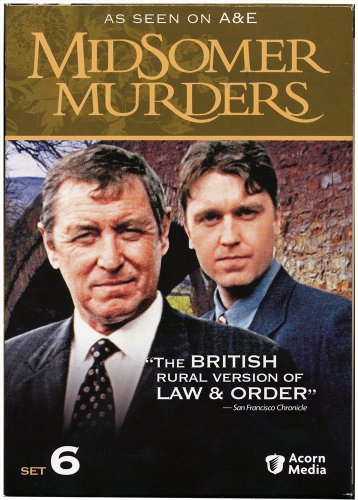
TV series Midsomer Murders. Set in
the fictional English county of Midsomer, the series revolves around the
efforts of Chief Inspector Detective Barnaby, who is attached to the CID of a
town called Causton, to resolve the murders that afflict the county.
A possible
reason for the attraction is that the series is a loving dedication to the English
countryside, and to the imagined English way of life. Midsomer Murders elevates what it sees as English reality with
great aplomb. There are long loving shots of breath-taking English countryside.
Added to this are the details that are worked into the stories: a focus on
contemporary English villages, the age-old social institutions, the rituals of
these institutions, the relationship between the gentry and the village-folk.
So lovingly ethnographic is the gaze of this series, that despite the glut of
murder and nastiness that fills these episodes one can’t help but feel how
wonderful it must be to live in rural England.
After a
substantial period of time, when I was more than a dozen or so episodes into
the drama, a rather discomfiting thought hit me. The series contained an
overwhelming number of white persons! It seemed as if there were no persons of
colour in the episodes. That is when I started actually looking for people of
colour and sure enough, not a single person in evidence!
Reflecting on
this situation I was reminded of an
article that discussed the problems of race in video games. Mounting
responses to the standard apologies that one gets, the author Bao Phi phrased
one that has remained with me ever since, and seemed particularly appropriate
in the case of Midsomer’s
disappearance of English people of colour. The apology normally reads “Games
like Final Fantasy and Dragon Age are based in European folklore and there were
no people of color in Medieval Europe.” Phi’s response is clever and hits the
nail bang on the head: “Actually there were people of color in Medieval
Europe.You know what?There were more actual people of color in
Medieval Europe than there were REAL FIREBREATHING DRAGONS OR PEOPLE WHO COULD
SUMMON MOTORCYCLES OUT OF THIN AIR WITH THEIR MAGIC POWERS.”
This response
makes it so obvious that the constructions of our fantasies are not as innocent
as we make them out to be, but invariably involve a choice. That there were
more murderers in fictional Midsomer than people of colour suggests that the
producers of the show wished to show was that there was no space for people of colour in real English life and the
England of the imagination.
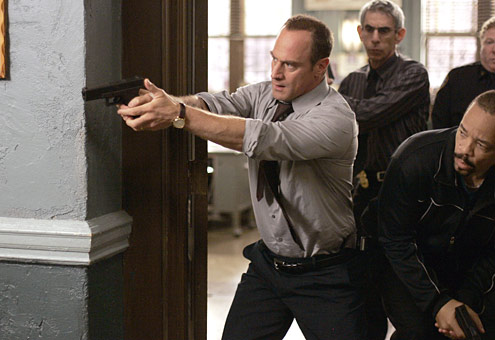
Something else
that struck me about Midsomer Murders
was the dramatic way in which it contrasted with American versions of the
similar genre like Castle, or Law & Order: Special Victims Unit.
In the episodes that I have seen, Chief Inspector Barnaby and his associate
have practically never been shown with a gun. American versions of this genre,
however, are replete with the presence, and use, of guns. It should be pointed
out that I am unfamiliar with the way in which the police and detectives in
England actually operate. It is possible that just as the non-depiction of
people of colour highlighted the way the producers of Midsomer wished to imagine England, perhaps the depiction of a folksy
and unarmed police detective is also far from English reality. However, what is
important is the manner in which the ideal comportment of the police are
depicted. As suggested earlier, just as with advertising, television series
such as Midsomer Murders are
important because they set up an ideal world that we then look for in real
life. To this extent, Midsomer Murders
suggests that the use of guns is an aberration, while the American series
normalise the use of guns suggesting that the ONLY way in which law and order
can be enforced is via the use of guns.
Because
television is so ubiquitous in our lives it forms the basis of our expectations
of reality. For the great Indian middle class that feeds off American
television, American drama series offer a vision of what life in the USA is
like. Seeing police with guns, all too often their demand is that police in
India also be armed with guns. What they do not see is the kind of racist and
gratuitous violence that is meted out by police in the US to persons of colour,
and the fact that this violent tendency is aggravated by the carrying of lethal
weapons. Of course, given the caste-based nature of the Indian middle class, it
is perhaps something that they would not care too much about. Nevertheless, it
bears remembering that once unleashed, the spiral of violence is difficult to
contain.
It is not
uncommon to hear howls of protest whenever social justice issues are raised
vis-à-vis films and episodes on television. “Oh, but this is just fantasy” it
is claimed. Another standard trope is, “but film is about stereotypes!” Indeed,
televisual representation may be about stereotypes, but these representations also impact on our expectations of reality. It is for this reason that it is
critical that the representations in film and television are not simply
shrugged off as fantasy, but challenged not only to embody reality, but also
embody a just reality that we would like to see translated to reality.
I am always afraid when I
go to watch a film that features Goa or Goans, because of the host of problems
that plague their representation. These problems were more than painfully
obvious in the recent films Finding Fanny
(2014) and The Coffin Maker (2011). As in these films Goa is invariably depicted
as a land of natural beauty, a veritable paradise. This representation hides not
only the challenges being posed to its environment, but also the profound
cultural conflicts that are ripping resident communities apart. For their part,
Goans are depicted as fun and pleasure-loving folk, non-achievers given to
drink, of easy virtue, and marked by childlike simplicity. Such a
representation effaces the fact that far from being easy, Goan communities,
Catholic and others, are in fact marked by strong moral codes that regulate
sexual behaviour.
It was thus with relief
that I concluded my viewing of Nachom-ia Kumpasar
(Let’s Dance to the Rhythm), the
latest Konkani language film directed by Bardroy Barretto. A musical, the film
is bereft of the problematic and insulting clichés that guide so many Indian
language films about Goa and Goans, and is a must see since it is a fabulous
contribution to Goan, and Konkani language, culture.
There are two tensions
that guide the narrative of the film. The first is the love affair between the
crooner Donna and the musician and composer Lawry Vaz. This love affair
provides the meat for the entire film, regaling the audience through the 164
odd minutes of the film. The other tension, however, and in my opinion the more
interesting, is that of the complicated relationship between the Goan, and in
particular the Goan Catholic, and the Indian state. Indeed, I would argue that
the love story is merely a foil for the more assertive political complaint.
The film begins with a
grouse; that Goan musicians who contributed substantially to the unforgettable
melodies of the Hindi film industry were, and still have, not been given their
due. Despite Goans contributing to writing, composing, and arranging the music,
the credits invariably went to the established names within the film industry.
But this is not all; at the conclusion, the film informs us that the brilliant
music that poured out of the Goans in Bombay since the 1930s was forced to suffer
a sudden and abrupt death thanks to the Prohibition that was imposed in Bombay
by the chief minister Morarji Desai in 1950. Prohibition ensured that the night
clubs in the city had to shut down, forcing the destruction of the cultural
life of the city that these Goan musicians had contributed vibrantly to. This
cultural life has been lavishly documented by Naresh Fernandes in Taj mahal Foxtrot: The story of Bombay’s Jazz Age (2011). With no
avenues for live performances, these musicians took up employment in the film
industry. Once again, despite their role in producing the cult hits that went
on to define the soundscape of Hindi film music, these musicians remained
unacknowledged. The final words are particularly poignant: “After a final
flourish in the 70s, the curtains slowly came down.There was no finale. No
calls for an encore. And no applause.”
In presenting this
complaint to the larger public, the film makes a more profound contribution
than it may have realised. It is articulating a long held, but rarely voiced,
opinion that the contributions of Goan Catholics to India are often ignored,
and their cultural life not considered valid, or even legitimate. What the film
does is to make obvious that the ignoring was not unconscious but in fact a
systemic activity. To this extent it draws attention to the injustices that
have governed the operation of the Indian state, where some communities are
marginalised and erased, even as their works and efforts are appropriated by
the North Indian upper-caste groups who seem to have emerged as the ultimate
beneficiaries from the creation of post-colonial India.
A common response to
political complaints that are articulated by marginalised groups, and
especially in the case of Goans who voice protest about the way in which they
are represented, is to dismiss the complaints. What Nachom-ia Kumpasar also does, though
perhaps unconsciously, is to mount a rejoinder to the filmic representations of
Goans. If the film Bobby (1973) set
up a standard for how Goan, and Catholic, women in India were understood, then Nachom-ia offers an alternative way in
which to deal with extra-marital sexual relations. As indicated earlier, the
film revolves around the love story of Donna and Lawry. However, unbeknownst, to
most characters in the film, until it is far too late, Lawry is in fact a
married man. This crushes Donna, even more so when she realises that Lawry has
not only been hiding the fact of his marriage, but persists in the affair while
also hiding the fact that his wife is pregnant. It is only when Lawry is
congratulated by members of the band that he and Donna belong too that Donna
realises that she has once again been duped by the man she loves. The tears
that Donna sheds, the portrayal of the conflicts that Lawry encounters, and the
statements of a variety of characters in the film, clearly indicate that love
leading to marriage is the ideal within the community that Donna and Lawry
inhabit. Rather than offer up a caricature of a community, the film engages
with the conflicts that often crop up in communities, whether Goan or
otherwise.
The other element of the
caricature of Goans and Indian Christians that the film engages with is the
relationship of Goans to alcohol. Just as in the lives of most Goan Catholics,
alcohol is present throughout the film, be it when persons are drinking at
home, at feasts, or in the public space of the tavern. The naturalness of
alcohol in social life, as well as the virtues of drink in moderation, are in
fact actively highlighted by the presence of the lone alcoholic in the film.
The fact that he is the sole alcoholic makes the eloquent point that while
drink is ubiquitous in the Goan lifestyle, not everyone is an alcoholic. The
advice that this alcoholic gives Donna when she begins her own disastrous
descent into alcoholism makes the relationship between the Goans and alcohol
very clear. In the words of the character played by the tiatrist Prince Jacob, one drinks for one of two reasons, either
out of happiness, or due to sadness and the desire to forget. Forgetting, he
advises, is not possible through alcohol. This moment, that draws its gravitas
from the Latin maxim in vino veritas,
ensures that alcohol and alcoholism in the film are not merely tropes employed
to titillate, but are evidence of community wisdom and advice. It is also worth
noting that the alcoholic is humanised. He is not a drunk just for the sake of
being drunk. That he is able to offer Donna such sage advice means that he has
turned to alcohol for particular reasons. This is in sharp contrast to Bollywood
representations of Goan alcoholics where one only understands them as being
buffoons who drink for no apparent reason.
The manner in which this
advice was communicated to Donna via the otherwise comic figure made one more
feature of the film strikingly obvious: the power and strength of the tiatr. Those familiar with this Konkani
language drama tradition will recognise the extent to which the film is provided
substance by the formulae of tiatr.
The tiatrist and comedian John
D’Silva plays the role of Logic, Lawry’s aptly-named manager and sidekick,
through the whole film, while Prince Jacob, a well-known practitioner in the
genre, does a brilliant job of playing the alcoholic. While both tiatrist play
supporting roles, it is in fact their performances that guide the film and gives
it depth and solidity. D’Silva demonstrates his versatility and the capacity of
tiatr by operating as more than just the
comedian. He also effects a smooth transition to the manipulative manager who
gets Donna to sign an unfair contract that will prevent her from singing with
anyone besides Lawry. Speaking with those involved in the production of the
film I was given to understand that D’Silva was also responsible for shaping
the screen play to ensure that it spoke to diverse Goan audiences and did not
remain entirely an “intellectual” exercise.This engagement with the film and indeed the success of the film points
to the vitality of tiatr.
It is through these tiatrist and the multiple Konkani
speaking actors in the film that one is also witness to the breadth of Goan
Catholic Konkani language forms. The Konkani is peppered with words that have
Portuguese origin, but have over time been hammered into shape to become
uniquely Konkani. Sadly, in recent times this diversity has come under threat
through the acts of the state of Goa. Since the recognition of only
Nagri-scripted Konkani as the official language of the State of Goa, in 1987,
the state has supported only the Nagri script and Sanskritic version of the
Sarasawat Brahmins in the territory, and suppressed all other forms of the
language. Introducing the audiences to the diversity within the Konkani
language spoken among Goans is a highly laudable feature of this film. A particular target of ire was the language form
that gave birth to the tiatr and cantaram, which used words of Portuguese
origin, and was written in the Roman script. More recently, voices have been growing in protest
against this suppression. In referencing these language forms the film has become
one more tool for those struggling to gain recognition for Konkani in the Roman
script.
If there is one short coming
of the film it is the fact that the lead actors are not Konkani speakers. Their
discomfort with the language is obvious and jars against the fluidity with
which the other actors speak the language in all its nuances and inflections. A
case in point is the stellar performance of Meenacshi Martins, who plays
Donna’s mother. In addition, one suspects that it was this unfamiliarity with
the language that ensured that the emotional range of these actors and their
engagements with each other was not elaborated but restricted to monosyllables
and facial gestures. This shortcoming could have been overcome by casting experienced
tiatrist in these lead roles.
The location of this
film’s storyline in both Goa and Bombay is another issue linked with the
recognition of tiatr and other
cultural forms of the Catholic labouring castes and classes from Goa. For a
long time tiatr artists in Goa were not
recognised by the government of Goa given that most of these artistes were
based almost entirely in Bombay. As Nachom-ia
so clearly shows, Bombay was the space where the labouring Goan Catholics
seemed to have been able to assert themselves outside of the suffocating shadow
of the landlord, and the social positions that caste and the comunidade system
meted out to labouring groups. Celebrated by dominant-caste Goans as the
embodiment of village democracy, the comunidade system ensured the communal
management of village lands by an oligopoly of dominant caste families to the exclusion
of everyone else. While claiming descent from the founders of the village, these
oligarchs saw other villagers as merely living in the village, rather than
constituting the village.The position
of marginalised castes was ritually inscribed and marked at every event of
village life. It was to also escape this ritual and quotidian humiliation that
so many Goans migrated to Bombay and further afield.
What is interesting is
that it was exactly at the time that the labouring Goan Catholic in Bombay was
churning out music, film, literature, and a range of novel cultural forms that
pro-Indian Goan nationalists like Tristão de Bragança Cunha (1891 – 1958) and
Luis de Menezes Bragança (1878- 1938) were haranguing Goans for their inability
to engage in vibrant cultural production. The former of these two nationalists
has today been integrated into the pantheon of Indian heroes as ‘The Father of
Goan Nationalism’. In fact Bragança Cunha’s analysis of the problem in his famous
tract The Denationalisation of Goans
(1944) has become the bedrock of the delegitimisation
of the cultural practices of Goan Catholics. Bragança Cunha argued that Goans, and especially
the Goan Catholic had become denationalised as a result of adopting a culture
that was imitative of the West. In the face of the kind of cultural production
that marked the life of the labouring Goan Catholic in the city of Bombay these
assertions are bizarre! If taken seriously they can only mean one of two
things. First, as was the case with the rest of their upper-caste and landed
elite brethren, these two nationalists ignored and disparaged the cultural innovations
of the labouring Goan. The other possibility is that the intended audience, and
the subject, of their nationalist rhetoric were the Goan Catholic elite alone.
In either case what is revealed are the limitations of the current deities of
the pro-Indian Goan nationalist pantheon, and their irrelevance in the face of
the vibrant cultural life of the labouring or bahujan Catholic.
The tragedy is that this
space was destroyed even as the labouring Catholic began to gain in confidence and
recognition First, as the film argues, by the Prohibition that marked the
beginning of the end of Bombay’s cosmopolitanism, and secondly through the
manipulations in Goa that ensured that the language and culture of these
labouring Catholic was excised from the realm of state recognition precisely
through reliance on the skewed analysis of the type offered by Bragança Cunha.
What Bragança Cunha and his ilk had done was to adopt a racist understanding of
what culture and Indian-ness meant and scripted anything seemingly connected
with Europe outside of this definition. This scripting did not bother them
unduely because these nationalists were able to assert their Indian-ness by
falling back on their upper-caste identity.That it was a nationalist
Gandhian ideology at work in the Bombay of the 50s and Gandhians in Goa who
masterminded the displacement of Konkani in the Roman script from official
recognition should give us ample proof of the upper caste Hindu hegemony that
Gandhian ideology underscores. In addition it should warn us that the
contemporary problems that minority groups in India face have roots that lie
deeper than the current obsession with finger pointing at the BJP alone.
The final accolade that
the film deserves is for casting the spotlight on Lorna, that icon of Goan
culture. It is widely suggested that the love story of Donna and Lawry is based
on her relationship with Chris Perry. The final segments of the film, which suggest
scenes from Lorna’s rapturous return to the Goan stage, indicate just what a phenomena
she was and continues to be. Lorna is an icon of Goan culture not merely for
the songs she gave, and continues to give, life to, but for the kind of
sexuality that she embodies. Her voice does not contain the sickly saccharine and
shrill sweetness that marks so much of Hindi film music and embodies virginal,
self-effacing purity. Her voice is an earthy one that can roar if there be need
for it. The woman that her voice gives life to is conscious of her sexuality and
vocal about her desires. It is this kind of mature sexuality that Palomi Ghosh,
the lead actress who plays Donna, fails to capture. Rather than the strong
woman of Lorna’s life story, for the most part one sees the depiction of a
slightly nervous, giggly girl. This is such a shame. One wishes that the lady
is memorialised through the naming of a public institution or space after her.
Failing that, this film will be one that will memorialise those artists who
despite their substantial productions and innovations seem doomed to be kept
out of the Indian and statal imagination.
Nachom-ia Kumpasar is a great film devoid of the
humiliating clichés that are the stock of Indian filmic depictions of Goan
Catholics. The film achieves this feat not because it emerges from within the
community, but because it engages politically with the history and the ethos of
the community and unapologetically airs a long-held grievance.
A version of this post was first published in Round Table India. My thanks to them for the opportunity. The text was subsequently translated into Konkani by Dale Luis Menezes and published in the March 2015 edition of the magazine Gulab.)
The sad
truth about The Coffin Maker (not yet released)
is that it is a very bad re-articulation of the Hollywood film Meet Joe Black (1998). Set within the
context of the lifestyles of New York’s corporate elites, the latter film
focussed on exploring the idea of Death taking on a human form to experience
the variety of human emotions, crafting a complex story involving multiple
characters. In contrast, The Coffin Maker
attempts to set this exploration within a Goan context. The result is a
narrative about the interaction of Anton Gomes, the eponymous coffin maker, with
Death in the weeks prior to the former’s death. The film vaguely attempts to
deal with the complexities of human emotions, but effectively restricts itself
to love. Failing dramatically in this attempt, the film constantly lapses into
pop-philosophy, among other things, comparing love to warm buttered bread, and
boyhood lust. In short, if Meet Joe Black
was somewhat limited as a film, The
Coffin Maker is an unmitigated disaster, whose errors are compounded by the
fact that it also sets the story within the shell of an ethnographic
description of Goan society that it dramatically misunderstands and misrepresents.
Born in the
context of Goan experiences with democracy in the late 1800s, a much-bandied
Goan idiom suggests that when there are two Goans in a room, one can expect
three opinions. One opinion that all
Goans nevertheless share is that they are tired of the manner in which they and
their state have been represented by the Indian media. Featured in this year’s
edition of the Goa-based International Film Festival of India (IFFI), The Coffin Maker gained some attention in the local press by being represented as the first Indian film to have gotten
Goa right. Hence the large turnout of locals at the special screening of the
film the day after the conclusion of the festival. While, true to form, local
opinion may have been divided at the end of the film, there were nonetheless
many who were visibly and vocally upset at one more film getting Goa and Goans
so dramatically and offensively wrong.
The film
commences with the standard trope of the drunk Goan Catholic. In this film that
character is Alloue, the grave-digger of the village where The Coffin Maker is set, who remains drunk through the film. Like
many Indian film productions, this one too perpetuates the long standing trope
of using drunken Christians to provide comic relief while not contextualising
them, or their alcoholism. However, Alloue is not the only alcoholic in the
film, given that the coffin-maker Anton Gomes, played by Naseeruddin Shah,
similarly seems to have a troubled relationship with alcohol. The film portrays
Gomes taking swigs of a potent liquor, perhaps feni, straight from the bottle
that he carries to work in his bag of tools. To compound the image of Goa being
a land of drunks, the film contains another gratuitous scene where Anton is
seen dining with his wife where they imbibe enough alcohol to dance drunkenly in
the streets of Panjim. That one does not see Goans consuming alcohol anywhere
else in the entire film only goes to reinforce the suggestion that when Goans
drink alcohol, they drink to get drunk.
The use of
this trope could have possibly been forgiven were it not for two facts. First,
this film suggests that it is representing the ‘real’Goa. Secondly, this film compounds the problems of stereotyping
Goans by adding to the cache of usual stereotypes. Given the manner in which
the film has clearly sought to highlight what it considers ‘traditional’ and ‘authentic’
Goan life, and focuses on one individual and his story, this film is clearly
not attempting to be a regular Bollywood masala flick. In not doing so, it
seems to tread into the realm of the ethnographic documentary. However, this
effort is so marked by bad research that the faux authenticity worsens matters
by convincing non-Goan audiences that this is the ‘real Goa’. Thus, for
example, in its ill-researched enthusiasm to reproduce Goan village life, the
film has almost every local use the Konkani variants for mother****er and other
allied cuss words with alarming frequency. While it is not being suggested that
Goans do not swear, the profusion of swearing was so bad, and so out-of-the ordinary, I began to cringe chronically after a certain point in time.
While billed
as a bilingual film in Konkani and English, there is in fact very little
Konkani in the film beyond the mispronounced Konkani cuss words. The English
that the film has the Goans speak is in fact an extremely bad representation of
the Bombay-English that developed in colonial Bombay. This form of English was
popular among various kinds of residents of colonial Bombay, like the East
Indians, Goan Catholics and Parsis, and was present in Goa only as a minority
language form of Bombay-returned Goans. There are a variety of Konkani-English
language forms present in Goa, but the fact is that none of these were
represented in the film. This film is in fact multi-lingual given that, thanks
to the shoddy execution, the actors often fall back on North Indian exclamations,
expletives (madarch**d, behench**d), and Hindi as well. The film
is also marked by its use of Portuguese, which keeping in form with the way in
which other languages are used, is mispronounced, and appears in unlikely
social locations. Looking at this liberal use of language, one could well say
that this film is been marked by the aesthetic use of language. Language is
used not necessarily to convey the dialogues between characters, but merely to
effect aesthetic flourishes to give the audience an ‘authentic’experience of what Goa is allegedly like.
It is in the
overwhelming presence of such flourishes that The Coffin Maker reveals itself not merely as a badly-researched
film, but one more addition to the orientalist representation of Goa, Goans and
in particular Goan Catholics. As is well known, in his book titled Orientalism the celebrated scholar
Edward Said argued that European powers represented the Middle East as
"almost a European invention ... a place of romance, exotic beings,
haunting memories and landscapes, remarkable experiences".The success of Orientalism as an explanatory
concept lies in the fact that it can be used to demonstrate the manner in which
hegemonic, or colonial powers, similarly represent cultures and peoples that
are either colonized or incapable of representing themselves. Just as the
Middle East or South Asia was represented by the European colonial powers as
places of mystery, romance, and landscapes, so too are Goa and Goans by the
Indian media. This media produces Goa not as it exists, but as a space for
Indians to lose themselves in European exotica. Thus, even though Portuguese was
always a minority language, and has practically died out as a publicly spoken tongue,
the film forces it into the mouth of a street-food vendor. Similarly, even
though all statues of Portuguese heroes were torn down from public spaces
subsequent to Goa’s integration into India, and Vasco da Gama is
hardly a daily reference even to those steeped in Goa’s Portuguese past, the
film still insists on inserting references to the non-existent statues of
Vasco-da-Gama into the dialogue between characters.
Displaying
the standard orientalist disregard for exactitude in relation to social reality,
the film joyfully plays with the social structure among Goan Catholics,
marrying the daughter of a doctor to a carpenter’s son. Seeking to exemplify
the imaginary essence of Goa, the film pulls out features that an Indian
audience or a visiting Indian to the territory is likely to identify as key
features of the state. Thus, this bizarrely mismatched couple is made to reside
in a home that is popularly misrepresented as a Portuguese home and is in fact
typical to Goa’s upper-caste elites and colonial middle-class. That the
internal arrangement of the home bears no resemblance to how such homes were,
and continue to be, used is another feature that the film seems blissfully
unaware of. What the film definitely was aware of, and sought to draw the
audience’s attention to, was the existence of caste among the Catholics in Goa.
More sensitive members of the audience could perhaps see the shame of caste as
responsible for Anton not wanting his son to also become a coffin maker. Nevertheless,
even this possible reference to caste was unfortunately left at the level of a
flourish, since when Anton goes on to command his son to become anything else, he
inexplicably references only other ‘lower’-caste and ‘lower-status’ jobs like
those of a tailor and a carpenter, even though Anton’s son is a college-going
student. The references to caste, therefore, once again works to cast the
Catholics in Goa as weird aberrations who are neither properly Hindu, nor
properly Catholic; cultural bastards, or accidents of history.
The most
damning way in which this film demonstrates its orientalising tendencies is how,
despite locating the story in Goa, there is only one non-Catholic character in
the film. This runs against the hard facts of Goan demography and reveals the
manner in which the film seeks to create a Goan Neverland for its audiences.
This representation of Goa as practically devoid of non-Catholics is both a lie
as well as politically irresponsible since Catholics in Goa are not only a mere
26 odd and reducing percent of the population, but also a culturally embattled
minority. Thus, while their existence is fetishized by films such as The Coffin Maker, their cultural mores
are actually under threat. Take, for example, the manner in which the Roman script
in which most Catholics write Konkani has, until recently, been denied governmental
support; or the manner in which their cultural and literary productions are
deemed as lacking standard. A creeping Hinduisation of the state ensures that
the dietary preferences of Goan Catholics - pork and beef - are prohibited from
state premises, as was the case during the course of the IFFI. More disturbing
is the fact that the misrepresentation of Goa as Catholic (and hence Western
and European) territory is used as fodder by local Hindu rightists to
aggressively assert that the true
character of Goa is brahmanical. The
recent statement by Goa’s Chief Minister that Catholics in Goa were in fact culturally Hindu being a case in point.
The Coffin Maker is thus best
described as a film that seeks to represent Goa from within Indian perceptions
of what Goa ought to be like. Consequently, if there is one relationship that
the film manages to capture perfectly, it is the relationship between that of
India and Goa. Where every Goan character in the film speaks a vile patois, Death, played by Randeep Hooda,
is the only character to speak the English of India’s educated classes. India
then intrudes into the orientalist Goan Neverland only in the form of death.
This is not an inappropriate cameo in the context where India and its elites,
either through state practice or representative norms, seem to wilfully push
every minority group within its boundaries to the brink of collective death.
Itinerant mendicant captures two aspects of my life perfectly. My educational formation has seen me traverse various terrains, geographical as well as academic. After a Bachelor's in law from the National Law School of India, I worked for a while in the environmental and developmental sector. Following a Master's in the Sociology of Law, I obtained a Doctorate in Anthropology in Lisbon for my study of the citizenship experience of Goan Catholics. Having worked some years at the Centre for Research in Anthropology at the University Institute of Lisbon, I am now a priest for the Archdiocese of Goa and Daman.I see myself as a mendicant largely because so many of my voyages have been funded by scholarships and grants.This blog operates as an archive of my homilies, and writings in the popular press.
 Over the past
couple of weeks I have been viewing back episodes of the British murder mystery
TV series Midsomer Murders. Set in
the fictional English county of Midsomer, the series revolves around the
efforts of Chief Inspector Detective Barnaby, who is attached to the CID of a
town called Causton, to resolve the murders that afflict the county.
Over the past
couple of weeks I have been viewing back episodes of the British murder mystery
TV series Midsomer Murders. Set in
the fictional English county of Midsomer, the series revolves around the
efforts of Chief Inspector Detective Barnaby, who is attached to the CID of a
town called Causton, to resolve the murders that afflict the county. A possible
reason for the attraction is that the series is a loving dedication to the English
countryside, and to the imagined English way of life. Midsomer Murders elevates what it sees as English reality with
great aplomb. There are long loving shots of breath-taking English countryside.
Added to this are the details that are worked into the stories: a focus on
contemporary English villages, the age-old social institutions, the rituals of
these institutions, the relationship between the gentry and the village-folk.
So lovingly ethnographic is the gaze of this series, that despite the glut of
murder and nastiness that fills these episodes one can’t help but feel how
wonderful it must be to live in rural England.
A possible
reason for the attraction is that the series is a loving dedication to the English
countryside, and to the imagined English way of life. Midsomer Murders elevates what it sees as English reality with
great aplomb. There are long loving shots of breath-taking English countryside.
Added to this are the details that are worked into the stories: a focus on
contemporary English villages, the age-old social institutions, the rituals of
these institutions, the relationship between the gentry and the village-folk.
So lovingly ethnographic is the gaze of this series, that despite the glut of
murder and nastiness that fills these episodes one can’t help but feel how
wonderful it must be to live in rural England. After a
substantial period of time, when I was more than a dozen or so episodes into
the drama, a rather discomfiting thought hit me. The series contained an
overwhelming number of white persons! It seemed as if there were no persons of
colour in the episodes. That is when I started actually looking for people of
colour and sure enough, not a single person in evidence!
After a
substantial period of time, when I was more than a dozen or so episodes into
the drama, a rather discomfiting thought hit me. The series contained an
overwhelming number of white persons! It seemed as if there were no persons of
colour in the episodes. That is when I started actually looking for people of
colour and sure enough, not a single person in evidence! 

 Something else
that struck me about Midsomer Murders
was the dramatic way in which it contrasted with American versions of the
similar genre like Castle, or Law & Order: Special Victims Unit.
In the episodes that I have seen, Chief Inspector Barnaby and his associate
have practically never been shown with a gun. American versions of this genre,
however, are replete with the presence, and use, of guns. It should be pointed
out that I am unfamiliar with the way in which the police and detectives in
England actually operate. It is possible that just as the non-depiction of
people of colour highlighted the way the producers of Midsomer wished to imagine England, perhaps the depiction of a folksy
and unarmed police detective is also far from English reality. However, what is
important is the manner in which the ideal comportment of the police are
depicted. As suggested earlier, just as with advertising, television series
such as Midsomer Murders are
important because they set up an ideal world that we then look for in real
life. To this extent, Midsomer Murders
suggests that the use of guns is an aberration, while the American series
normalise the use of guns suggesting that the ONLY way in which law and order
can be enforced is via the use of guns.
Something else
that struck me about Midsomer Murders
was the dramatic way in which it contrasted with American versions of the
similar genre like Castle, or Law & Order: Special Victims Unit.
In the episodes that I have seen, Chief Inspector Barnaby and his associate
have practically never been shown with a gun. American versions of this genre,
however, are replete with the presence, and use, of guns. It should be pointed
out that I am unfamiliar with the way in which the police and detectives in
England actually operate. It is possible that just as the non-depiction of
people of colour highlighted the way the producers of Midsomer wished to imagine England, perhaps the depiction of a folksy
and unarmed police detective is also far from English reality. However, what is
important is the manner in which the ideal comportment of the police are
depicted. As suggested earlier, just as with advertising, television series
such as Midsomer Murders are
important because they set up an ideal world that we then look for in real
life. To this extent, Midsomer Murders
suggests that the use of guns is an aberration, while the American series
normalise the use of guns suggesting that the ONLY way in which law and order
can be enforced is via the use of guns. Because
television is so ubiquitous in our lives it forms the basis of our expectations
of reality. For the great Indian middle class that feeds off American
television, American drama series offer a vision of what life in the USA is
like. Seeing police with guns, all too often their demand is that police in
India also be armed with guns. What they do not see is the kind of racist and
gratuitous violence that is meted out by police in the US to persons of colour,
and the fact that this violent tendency is aggravated by the carrying of lethal
weapons. Of course, given the caste-based nature of the Indian middle class, it
is perhaps something that they would not care too much about. Nevertheless, it
bears remembering that once unleashed, the spiral of violence is difficult to
contain.
Because
television is so ubiquitous in our lives it forms the basis of our expectations
of reality. For the great Indian middle class that feeds off American
television, American drama series offer a vision of what life in the USA is
like. Seeing police with guns, all too often their demand is that police in
India also be armed with guns. What they do not see is the kind of racist and
gratuitous violence that is meted out by police in the US to persons of colour,
and the fact that this violent tendency is aggravated by the carrying of lethal
weapons. Of course, given the caste-based nature of the Indian middle class, it
is perhaps something that they would not care too much about. Nevertheless, it
bears remembering that once unleashed, the spiral of violence is difficult to
contain.