 Last week this column discussed the peculiar traditions that mark the beginning of the academic term in the university and associated institutions in Lisbon, when students dress up in an antiquated dress (traje) and engage in ragging (praxe) the new students (caloiros).
Perhaps it is the wistfulness that comes with age, but there is something remarkably heart-warming about seeing young men and women, dress up and attempt to be adults. Traje it appears is also about self-importance, when these young people can shed their regular sneakers and clothes, and dress in capes, suits, and trot around in formal shoes. This self-importance however also comes at the cost of engaging in a sometimes disrespectful and humiliating manner with the caloiro. But all of this pales in comparison with the somewhat distressing features of the institutional format in which all of this praxe is carried out; elements that make it look, at least superficially, scarily fascist in appearance.
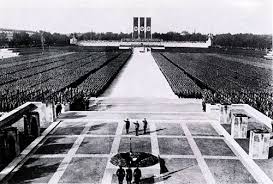 Fascism in its European version had an obsession with spectacle. Thus there is a concert between uniforms, a massing of people (or bodies), and the choreographing of ritual performances for this proto-mob to follow. Added to all of this, was the fascination with the medieval, and more particularly Roman imagery, thus salutes, banners and flags, oh yes, lots of flags.
Fast forward to an institute in Lisbon, that is the basis for the observations of this column, and you have a disturbingly similar correspondence to these elements of populism and fascism. The traje of the senior students is only part of the uniformed element of the praxe spectacle. The senior students in their black robes in fact operate as ‘officers’ to the recruits to the little armies of caloiros that they amass from their department. Each department enforces its own little ‘uniform’ onto their caloiros, of articulating a clever theme for the group. In addition to persecuting their individual brands of praxe, the senior students of the departments, also march the caloiros from time to time, to a courtyard in the institution, where caloiros and senior students from all the departments gather. Each department carries its own little Roman-standard-like banner, and one beholds the different groups, marked by their colours, yet united in the noisy ritual they perform together. It is an infernal din that they create together, each department yelling its chant, trying to outdo the other departments, giving the impression of a revolution or war at hand.
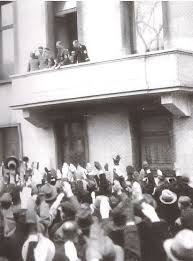 The most disturbing element of this entire performance however is the ‘Fuhrer balcony’ that gets incorporated into the process. The ‘Fuhrer balcony’ is the name given to the balconies that either got built on to buildings, or were used by the Fuhrer to address the adulating masses of the Nazi Reich. In any case, there is something profoundly hierarchical about a group of persons being addressed by a select elite located on an elevated platform, whether a stage or a balcony. In the case of praxe in this particular institution, in almost every setting they have chosen, a balcony has manifested itself. From this balcony, the directions for the entire performance are called out via a microphone, by a group of senior students in traje. Some of these are actively engaged in the process, others, lounge about ever so casually, marking their superiority by an apparently disinterested manner; the militarist manner of the whole drama terrifyingly obvious.
 As pointed out in the last column, praxe, and the rituals that go with it, are subject of some debate in Portugal, many disapproving of it for its apparently rightist tendencies. From the manifestations in this particular Lisbon institute, these critics may have knocked a nail smack on the head!
(A version of this post was first published in the O Heraldo 2 October 2011)
 As the Non-Motorized Zone
(NoMoZo) initiative progresses toward its third installment, there are two
broad cautions that is appears we need to keep in mind. The first is that
without the leaders of this initiative indicating quite clearly the direction
they intend to take, and the larger principles that animate the initiative,
NoMoZo could well turn into just another feel-good event organized at regular
intervals. There is no doubt a larger intellectual framework for the project
and it would be worthwhile to share this with the larger public, both those who
turn up with such enthusiasm for NoMoZo, as well as those who do not. This act
of sharing would impart to NoMoZo, which already brims over with popular
energy, a democratic element, in so far as democracy ideally involves an
element of information and consciousness. Without these two elements, an
initiative, no matter how popular, would remain merely populist.
As the Non-Motorized Zone
(NoMoZo) initiative progresses toward its third installment, there are two
broad cautions that is appears we need to keep in mind. The first is that
without the leaders of this initiative indicating quite clearly the direction
they intend to take, and the larger principles that animate the initiative,
NoMoZo could well turn into just another feel-good event organized at regular
intervals. There is no doubt a larger intellectual framework for the project
and it would be worthwhile to share this with the larger public, both those who
turn up with such enthusiasm for NoMoZo, as well as those who do not. This act
of sharing would impart to NoMoZo, which already brims over with popular
energy, a democratic element, in so far as democracy ideally involves an
element of information and consciousness. Without these two elements, an
initiative, no matter how popular, would remain merely populist.


