Showing posts with label Delhi. Show all posts

Friday, February 6, 2015

Solidarity in Times of Vandalism: Why the Minorities need to work together


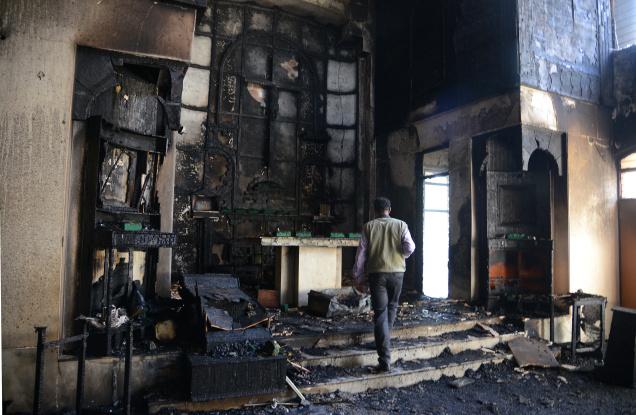
There has recently been a lot of anxiety amongst the Christian communities in India owing to the desecrations and violence targeting Christian churches especially in the city of Delhi. There have been five attacks on churches in the capital of India since December 2014, the latest being the vandalization of the Church, and desecration of the Blessed Sacrament in the church of St. Alphonsa in Vasant Kunj earlier this week.

In the face of earlier attacks on churches the focus of Christian leaders turned towards the Prime Minister. These leaders report that the Prime Minister did not say anything that would reassure them. What makes it worse is that Prime Minister Modi has chosen to keep absolutely mum over these incidents. Public silence in this case can only be interpreted as his unwillingness to restrain the Hindu Right and make sure that law and order is maintained. This silence is not surprising however. We need only think back to his role in the pogrom in Gujarat in 2002. It took days for the State machinery to get things under control, and significantly Modi has been held responsible for allowing the violence to continue. Old habits, it appears, die hard.

I doubt that this tendency towards silence played on the mind of a member of a prominent Catholic business family when he suggested in conversation with me that Modi was a good administrator and “should be given a chance.” It is the limited perspectives of the elites of the community that one should also mourn. That this individual did not see managing genocidal violence as part of good administration says a lot about the milieu in which he moves.


What is worse is the fact of complicity of the state in fueling the acts of violence. A number of the victims in Gujarat indicated that the police refused to help them, claiming that they did not have orders to do so. Further, the police failed to place leaders of the violence under preventive detention. In the case of the violence against Christians, this chilling pattern is re-emerging. There has been news of visas being deliberately withheld from Catholic Bishops who were to visit from the Vatican to attend a liturgical conference organized by the CCBI (Conference of Catholic Bishops of India). More recently, persons peacefully protesting the violence against Christians and the lack of state action were set upon by the police, beaten and dragged into police custody.

These events are in fact very much in keeping, not only with the history of Modi, the BJP, but also the supposedly secular Indian nation-state. The hostility of the Indian state to the minorities of India, is a matter of record. In fact, in a scenario resembling the recent denial of visas to visiting Bishops,  soon after India achieved Independence the Indian state took an aggressive stand against Christian missionaries of foreign nationality in India. That issues did not escalate, as seems to be the case now, is largely because the Indian and Hindu nationalism of the time was more focused on destruction of the Muslim communities in India. Christians were, at the time, seen as “harmless”.

While the Muslims in India were being harassed and butchered across the country the Christian communities in India were by and large silent. On the contrary, these Christian groups in India played along with the logic that it was “the Muslims” who were to blame, rather than Hindu nationalists. Indeed, even in the face of these attacks, some Christian leaders are still shortsighted enough to suggest ‘“We are peace-loving people. If it had been another community, Muslims, khoon kharaba ho jaata” (Blood would have been shed)’
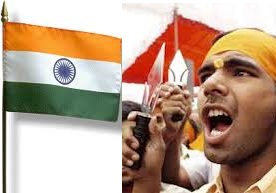

These Christians failed to see that the problem is not Muslims, but in fact Indian nationalism itself. They fail to see that playing the ‘good’ minority, as opposed to the allegedly troublesome Muslim minority, is not going to help. Rather, it plays straight into the hands of the cussed nationalisms in India. In fact, one could argue that playing into the hands of Indian/ Hindu nationalism has been a part of the agenda of the Catholic Church in India. Whether it was the foreign missionaries at the time immediately prior to Indian independence, or the largely upper-caste hierarchy of the Catholic Church subsequently, working towards creating good Indians has been a part of the Indian Catholic programme. This has been done in a variety of ways, either through the misguided policy of inculturation, which sought to make Catholicism in India more 'Indian', i.e. upper-caste Hindu-like, or by urging a strong sense of patriotism, which normally translates to an unblinking acceptance of nationalist rhetoric. This irrationality has ensured that we swallowed the Indian nationalist narrative, saw the Indian Muslim as the trouble-maker and tried to place as much distance between them and ourselves.

There is little distinction between Indian nationalism and Hindu nationalism. The difference is largely a matter of degree, since both are built on the idea of the upper-caste Hindu as the de facto Indian. Contrary to the spiel that we have been fed since the beginning of the Indian nation-state, these nationalisms do not tolerate difference. The tolerance is merely cosmetic. When push comes to shove, as has happened in so many cases, the minority group is made to feel the pinch.

It was in light of this reality that for some decades now the Christians in India were asked to mobilize along with Muslims in India, and see the latter groups as allies rather than enemies.  There was, unfortunately, no real interest demonstrated by Christian groups. I can recall efforts in Goa that attempted to involve the hierarchy and the laity of the Catholic Church. Where the hierarchy was interested, the laity were not. The hierarchy too, had its own reservations as to how far they would, or could, go. All too often, and not just in Goa, the interest lies in engaging in superficial ‘inter-religious dialogue’, rather than lending shoulders to political battles. A significant political battle that we in Goa could lend support to is the need that the Sunni Muslim communities in Margão have for a burial ground. The existing burial ground is too small for the existing population and all efforts to secure a larger ground have met with resistance, largely from Hindu nationalist groups, but often supported by Catholic bigots.

Too often, Christians in Goa are so in the thrall of racist stereotypes about Islam and Muslims that we fail to see the diversity that exists within these groups. Despite the complex history of Islam within coastal south India, of which Goa is part, Islam itself is written off as a violent religion. Additionally, we are blinded by the nativist logics that see Goans as either Hindu or Catholic. Muslims have no space in this vision of Goa even though Islam has had a long presence in the territories that are today Goa, and many Catholics in Goa would have had Muslim ancestors. The reason we are blinded to these histories and realities is that Goan histories have been written almost exclusively by persons from upper caste backgrounds who want to privilege their putative Hindu pasts. They wish to embellish their pasts as Hindu, largely because they have long seen the writing on the wall, India works best if you are upper-caste Hindu. Indeed, as I illustrated elsewhere, it is the caste bias among Catholics in India that has ensured that the superficial inter-religious dialogues that take place are often biased in favour of Hinduism, rather than Islam.

Making alliances with Muslims does not necessarily mean working with all kinds of Muslim organizations. It would first require us to first embrace Muslims and their worlds, get to know them and understand them better. It is only after having effected this embrace that we can become alive to the diversities and differences among them. It would mean learning to identify those Muslim organizations that are no different from the RSS and working with those organizations that are open to democratic ways of social organization.

In the final analysis it may perhaps be the lack of internal democracy within the Catholic Church in Goa that stands in the way of effecting solidarity with Muslims groups. There is no doubt that the Catholic Church in Goa is appallingly lethargic and I would like to suggest that the reason lies in the manner in which it is organized and the manner in which internal dissent is dealt with. A group that is itself compromised, and comes out against Hindutva only when its direct interests are pinched is hardly going to be able to provide leadership to other beleaguered communities, or even associate meaningfully with them. It appears that our many years of lethargy is beginning to show and our pigeons are now coming home to roost. May God protect us.

(A version of this post was first published in the O Heraldo on 6  Feb 2015)

Friday, December 26, 2014

The Grinch who steals Christmas: Holidays and the Hindutva state


Original illustration by Angela Ferrao
We live in interesting times. Sometime around the middle of this month the press broke reports that the Union Government wanted to mark the twenty-fifth of December, birthdays of Hindu nationalist leaders Atal Behari Vajpayee and Madan Mohan Malaviya, as ‘Good Governance’ day. Towards this end, the media informed us, schools would remain open, and students would be encouraged to participate in a national essay writing competition. Howls of protest rang out across the country, and the Ministry of Human Resource Development hurriedly rubbished these reports. There was no question of having schools open on Christmas Day, they assured the country and added that the competition was voluntary and entries could be submitted virtually.

For the moment then, the crisis seemed to have receded. Nevertheless, the episode refreshed my memory over two earlier episodes involving holidays. One is an event that lies within the public domain, the other a personal memory that I would like to share and reflect on.

The first episode dates back a number of years, when the government of the then Chief Minister of Goa, Manohar Parrikar, contemplated withdrawing the public holidays on the Good Friday and the feast of St. Francis Xavier. As can be expected, there was a hue and cry then too, until this controversial move was undone, with Parrikar later suggesting that the move had been an error.

The second episode dates from the time when I was working with an NGO in Hyderabad. I realised with some shock that this corporate-funded entity had not declared Eid (I forget which of the two Eids it was) a holiday. On the contrary, it was marked as an optional holiday. If one chose, for religious reasons, one could take the day off, but the rest of the office would continue working. I also recall being told that one could take the day off, but I would be merely eating into my own stock of optional holidays. I recollect sensing the suggestion of the threat that I would be compromising my days of Christian celebration were I to take the day off to commemorate the feast.

I was quite upset by this scenario. I had recently returned from Patna where I had a number of Muslim friends and had been sucked into a series of Eids, weddings, and other celebrations. Even though I was bereft of this network in Hyderabad, I could not contemplate an Eid that was to be spent working, instead of feasting with friends. It hurt, but rather than create trouble and stand up for a principle I was not yet sure of, I went to work that Eid day, mournfully walking past masses of men praying at the mosques along the route I took to work.

These memories were swirling around my head these past couple of days I realised that the issue of cancelling holidays, or restricting these holidays is much more important than showing disrespect or disregard for religious minorities. On the contrary, such governmental actions ensure that religious boundaries are hardened and religions are formed into water tight compartments. The learning from Hyderabad was just that, you can choose to be a Catholic and take your holiday, or you can choose to show solidarity with Muslims. We are not preventing you from celebrating Eid, but you need to make a choice. Similarly, had the feast of St. Francis Xavier continued to have lost its holiday, a great number of Catholics would have still taken the day off to visit Old Goa and venerate the relics of the saint. This option would perhaps not have been so definite for those Goans who are not practicing Catholics but still venerate St. Francis Xavier. It is possible that they would have continued with their daily routines. Similarly had the holiday on Good Friday been cancelled it would not only have complicated the possibility of having clear roads for the public processions that mark Good Friday, it would also have complicated the participation of non-Catholics, who light up the streets, and offer incense to perfume the funeral path of Christ. 

We must remember that we live in an environment where thanks to the threat of an aggressive Hindu nationalism, all religious groups have been hardening their identities and castigating what are called syncretic practices. When a government restricts a holiday, therefore, or fails to provide one, it is lending its own strength against these already existent social pressures. The issue of cancelling holidays therefore does not merely impact on the group for whom it is most significant. It impacts all, preventing communal celebrations, visits, exchange of sweets. It goes towards creating a fractured society.

It is in this context that we should evaluate the clarifications of Smriti Irani, Minister for Human Resources Development, on the issue of celebration of ‘Good Governance’ day, as well as the subsequent note from the Prime Minister’s Office that mandated various officers to mark ‘Good Governance’ day.  What is clear is that rather than let Christmas day be, the Central Government has identified the twenty-fifth of December as the day to commemorate ‘Good Governance’ day. The essay competition will continue apace even though the event will be restricted to submissions over the internet. Further, various officers of the Government were expected to attend and conduct commemorations linked to the theme of good governance.

What this effectively amounts to is providing an alternative to the celebrations of Christmas that have become a major feature across India. One does not need to be Christian, nor indeed have Christian friends to celebrate the day. Regardless of their religious persuasion, people engage in secular celebrations of this feast by organising Christmas parties, arranging visits from Santa Claus and the like. The fact is that thanks to a variety of factors, a number of Indians, and especially urban and upwardly mobile Indians are ‘culturally Christian’. They have imbibed many Christian and/or western cultural traditions and celebrate them as if these traditions are their own. That these aspects are not strictly religious is not important, it is in fact exactly the point, that the festival has ceased to be religious alone, but is a cross-communal secular festival. Indeed, if one is to take the historical novel, The Mirror of Beauty seriously, Christmas, or Bada Din was a significant festival in Delhi by the time of the last Mughal emperor, and avidly celebrated by the Mughal elites.

Given the kind of pressure that Indian society places on students to excel and gain laurels, one can imagine that children would be encouraged, if not pressured, to take part in a national competition that could get them national recognition. Remember we live in a country where even a certificate of participation is regarded as useful. As such, having a competition at the time of the Christmas holidays, with a submission on Christmas day, no matter that the submission can be made virtually, ensures that one has created a substantial diversion from the pleasures, and significance, of Christmas. In addition to these competitions, the low-key government commemorations of good governance  that continued even while the holiday was still officially on clearly indicate that the conspiracy to steal Christmas is, therefore, still on.

It should be noted, however, that it is not only the BJP government that is engaged in a project that dismisses Christmas. A variety of organisations in India, including academic and non-governmental, as well as those patronised by the nominally secular-liberals think nothing of hosting significant retreats immediately prior to, or soon after Christmas day. This scheduling ensures that very often Christians have to either opt out of Christmas, or the event, or spend a good part of Christmas day in travel. And, as I pointed out earlier, this callous scheduling does not impact Christians alone, but fractures the possibility of non-Christians in participating in what is a wonderful feast of familial gathering. The loss is communal.

We live in a country where the plethora of holidays we enjoy is often castigated. Over the year these holidays have been vilified merely as days free from work. What this vilification does not recognise is that holidays are a way for us to indicate that an event is important enough for us to take time off work and engage with each other. Even if we choose to not engage with other communities, the holiday continues to be a mark that this other community is important. It is this tradition of honouring those who are unlike us that is at stake when holidays are so callously countermanded.

Feliz Natal! Have a blessed and joyous Christmas season!

(A version of this text was first published in the O Heraldo dated 26  Dec 2014)


Wednesday, July 20, 2011

Left, Right and Centre: or, Jerry Pinto ko Gussa Kyon Aya

On 14 July, a day after the latest violent attack in the city of Bombay, NDTV put together a panel to discuss the issues flowing out of this occurrence. One of the guests invited to participate in this discussion was Jerry Pinto. Jerry Pinto is an articulate voice from Bombay, a litterateur and journalist. When he was invited to join the discussion however, Jerry Pinto exploded and he let the host and the other participants have it.

Why did Jerry Pinto get annoyed? Unfortunately for us, in losing his poise, Mr. Pinto seemed to have lost the opportunity to make calmer and more collected an argument. However, because he lost control and let his emotions run loose, it seems his breaking from the script, allowed us to understand a couple of issues regarding the manner in which the latest attacks on Bombay are being responded to.

Initially fazed by his outburst, Nidhi Razdan, the host of the show eventually ventured to try and gain control of the situation. ‘Tell us how you feel!’ she cooed, ‘what is going through your mind.’ Tell us how he feels? But surely madam, he was telling us exactly how he felt! He was telling us that he felt awful, that the city he was a part of had been attacked, and that the manner in which NDTV sought to deal with the issue was to merely harvest the grief, he called it a ‘camera rape’, of those who had lost friends or family for the benefit of its TRPs.

What seemed to enrage Mr. Pinto further however, was the fact that while it was Bombay that had been attacked, it had taken all of 31 minutes for the host of the show to invite a Bombay voice into the discussion. And when this Bombay voice was summoned into the discussion, it was not to ask for an independent opinion to be articulated, but for this Bombay voice (that of Jerry Pinto) to perform the usual monkey-trick of responding to that cliché ‘the resilient spirit of Bombay’.

But in her response to Mr. Pinto’s further fusillade, Ms. Nidhi Razdan, provided a further demonstration of the manner in which NDTV is part of a larger system that harvests grief and other sentiments born from vulnerability, for its centralizing purposes.

Mr. Pinto’s first couple of responses to the invitation to join the discussion was to ask why the issue had become something that would be discussed by ‘Delhi people will talk about, in Delhi, as if it had nothing to do with Bombay.’ As with his remark discussed earlier, this was part of a demand that Bombay, and its citizens, be addressed, and asked to participate more meaningfully in responding to the blasts. There was sentient life, Mr. Pinto was suggesting, outside of Delhi. Through the blasts, this life had been temporarily deprived of agency, and what NDTV was doing by engaging with citizens of the city so superficially was to add to the sense of helplessness. To this thread of thought, Mr. Razdan, responded ‘But, Mr. Pinto, don’t get upset, Mumbai is a part of India, and so we are all upset’. And later ‘Mumbai is a part of India, and that is why people in Delhi will talk about it’.

Ms. Razdan has internalized nationalist logics so completely that it appears she did not realize how infuriating, and at the same time painfully hilarious, her trite formulations were. Thus she glibly compared the violence and disturbances in Kashmir (‘the State of Jammu and Kashmir’ as she so touchingly put it) to the violence and disturbance in Bombay. Indian nationalism has so effectively tailored her vision that she is unable to see the radically differences that both cause and attend upon the violence in these two radically different spaces. She also failed to see that one of the central points that Mr. Pinto was making is that just because it is an Indian city, it does not allow for persons in Delhi, to hijack the issue and determine the contours of the response to the incident.

If Mr. Pinto was speaking from his heart, then the panel in Delhi was ‘discussing it as if nothing had ever happened’, or discussing the matter ‘in abstractions’. What was being discussed in the NDTV studio was the imperial Indian response to the occurrence in Bombay. In that studio in Delhi, the trauma and emotions of the people in Bombay, were being harvested by NDTV, and through the public policy comments by the members of the panel, converted into a ‘national issue’ and the path that India would now have to take. Interestingly, in the course of this national policy discussion, it fell to just one person, Mr. Mani Shankar Aiyer, to point out that the possible culprits could also be Col. Purohit, thus disrupting the Hindu nationalist rhetoric that had until then quite calmly held sway.

While Mr. Aiyer remained the sole sensible, balanced voice in the discussion, had there been more sentient voices from Bombay perhaps the response would have been more appropriate to the moment. How does one reach out to a city that is both hurting and afraid? Perhaps that option would have allowed us a route out of the clichés that both Ms. Razdan, and subsequently a dramatically drenched Barkha Dutt offered the viewer.

There is much that is deeply disturbing about NDTV (and other similarly placed TV news channels in India). The least troublesome is the fact that they harvest and manipulate the emotions of viewers for the sake of their TRPs, and to create a jingoist nationalist audience that is unable to do more than bay for blood in name of the greater glory of India.

More bothersome however is the fact that NDTV seems consistently unable to respond to the more complex thoughts that are presented to it in the voices that it sometimes brings into the studios. NDTV has its own little script, one that is based on the interests and aspirations of a small group of middle-class nationalists in Delhi. Indeed, this class can well be said to be the inheritors of the multi-ethnic, pluri-religious 'nationalist class' that effectively determined 'national' agendas in the first few decades of Indian independence. It is their narrow and self-serving agenda that largely determines the manner in which an issue will be responded to, and this is the perspective that they force everyone else to internalize, limiting scope for any divergent thinking in this large, complex and diverse country. What this group and NDTV does not seem to realize however, is that Jerry Pinto's outburst, was only a sign of the times. There is a very genuine fatigue with the manner in which 'Delhiwallas', a code-word for this group of self-obsessed elites from all parts of the country, divert and demand attention and all manner of resources to their narrow, limited interests.

(A version of this post was first published in the Gomantak Times 20 July 2011)