 Julio
Ribeiro’s interventions in various national newspapers over the last few months
have consistently made a case about the predicament of the Christian
communities in India. However, no other article seems to have grabbed the
attention of the national media than the
one in which he asserted that he felt like a foreigner in his own country.
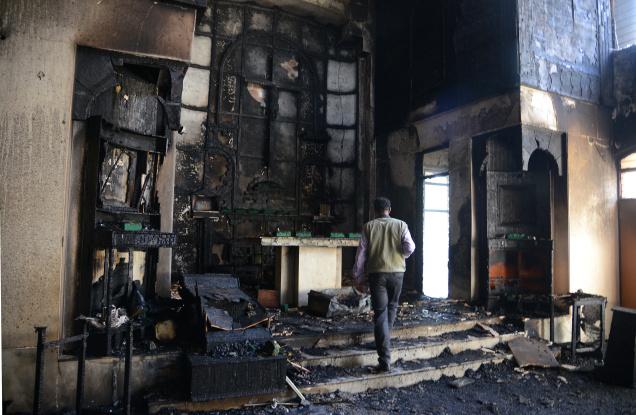
Ribeiro’s assertion followed the increase in violent attacks against Christians,
and their churches and saints across India. At a time of crisis, like the one
India is facing at the current moment, it would be expected that those who face
persecution from the Hindu Right would stick together. But, as much as we need
to stick together to offer a common resistance, it is also important that we
use this moment to engage in fruitful discussion so that we may work out the
way forward. It is in this spirit that we offer this critical response to the
recent op-ed authored by Ribeiro.
Julio
Ribeiro’s interventions in various national newspapers over the last few months
have consistently made a case about the predicament of the Christian
communities in India. However, no other article seems to have grabbed the
attention of the national media than the
one in which he asserted that he felt like a foreigner in his own country.
Ribeiro’s assertion followed the increase in violent attacks against Christians,
and their churches and saints across India. At a time of crisis, like the one
India is facing at the current moment, it would be expected that those who face
persecution from the Hindu Right would stick together. But, as much as we need
to stick together to offer a common resistance, it is also important that we
use this moment to engage in fruitful discussion so that we may work out the
way forward. It is in this spirit that we offer this critical response to the
recent op-ed authored by Ribeiro.Following on the cliché of every crisis offering an opportunity, we suggest that rather than compromise with Hindu nationalism the present moment should be used as a moment to deepen the experience of Indian citizenship. Hindu nationalism should be seen not as a sudden entrant into Indian politics, but a force that has frustrated the realisation of the constitutional promises of egalitarian citizenship since the very beginning of the Indian state. Even as Ribeiro protests his current discomfort, his formulations unfortunately remain within the realm of Hindu nationalism and we propose to point a way out of the crisis, both for him and other embattled groups within the Republic.
Our primary difference with Ribeiro stems from the fact that we differ in chronology. He inquires whether it is “coincidence or a well-thought-out plan” that violence against Christians intensified after the BJP government came to power. While it is true that there has been an escalation of violence against Christians since the Modi-led Government came to power, the systematic targeting of Christians has been a part of the history of the Indian nation-state since Independence, and some would argue in the course of the national formation itself. We would like to draw attention to the Niyogi Committee Report published in 1956 that held activities of Christian missionaries and conversions to be a threat to the Indian state. The Niyogi Commission, it should be pointed out, was the product not of an openly Hindu Rightist political party, but the Congress Party. The Report was subsequently followed by the passage of multiple Freedom of Religion bills that seek to limit the right to conversion. Later, in the 1960s, the Catholic Bishops Conference of India (CBCI) faced a good amount of trouble when, in the words of Cardinal Simon Pimenta, foreign missionaries in India “had been asked by the government to leave the country – visas were not being renewed; no fresh visas were issued for others who had been detailed by their superiors for work in India”. Such instances indicate the persistent hostility with which Christian activity and groups have been viewed in India.
As many studies of the history of Christianity, and conversion movements in India have emphasised, Indian nationalism has seen the conversion to Christianity as the conversion to a ‘foreign’ religion, and thus an act violative of the very soul of the Indian nation. Further, conversion to a ‘foreign’ religion was viewed as a challenge to India’s spiritual self-sufficiency. The problem that Christians have had in India, therefore, clearly predates the current government, even though the arrival of the current government has seen a scary intensification of activities. In other words, the problem with Christianity could be said to be part of the national make-up, and not merely an agenda of the BJP and the Hindu Right alone. The recent intensification of violence against Christians can be seen as a culmination of decades of such suspicion and violence.
Contrary to Ribeiro’s suggestion that Hindutva violence emerged full-grown with the Modi Government, our argument is that the history of Indian nation-state has seen a steady deepening of Hindutva, rather than constitutional citizenship. Reviewing this longer history it becomes obvious that conversion to Christianity, or the threat of conversion, is a primary reason for the hostility of the Indian state and its elites to Christianity. As long as Christians do not rock the boat, it seems that they are tolerated. This has caused a number of Christians, Ribeiro included, to distance themselves from conversion. Ribeiro captured a common perception among some parts of Indian Christian society when he suggested in an interview to the Economic Times that “some fringe Christian groups convert people in large numbers but the government should find out who they are and take action against them. Mass conversions should be opposed as they create problems in society but it is a thing of the past”.
In making a case for the toleration of only stray and individual conversions to Christianity, and asking for governmental intervention in case of mass conversions, Ribeiro is merely toeing the problematic position of the Indian state. In addition to this, he is taking up a position that is marked by his upper-class and upper-caste location. Indeed, it would be our argument, that any resolution of the problem of Christian groups in India can be resolved only if we are able to address the caste and class issues head on.
Mass conversions, whether to Christianity, Islam, or Buddhism, have been measures of social protest against brahmanical violence that is daily visited upon marginalised social groups in the subcontinent. To ask for a halt on such conversions on the grounds that they cause problems in society is to not only miss the mark completely but to in fact articulate the Hindutva position! Rather than create problems in society, these conversions draw our attention to the problems that would fail to otherwise garner attention from the privileged segments of Indian society. More importantly, when they convert from Hinduism, these communities are not merely changing their religion, but in fact adopting a route toward the deepening of their citizenship experience. In casting off Hinduism, they are making an emphatic claim that they are ready for a new experience of life, hitherto unavailable under the contemporary political conditions of the Indian nation-state.
All too often rather than extend the protection of the law state functionaries stand by or participate in the persecution of Dalit groups, making mockery of the egalitarian constitutional provisions. To these groups, therefore, conversion is a critical part of realising Indian citizenship as promised by the Indian constitution. Hindutva’s problems with conversion stem precisely from the fact that these social processes challenge the upper-caste hegemony that Hindutva is based on. Indeed, early anti-caste mobilizations such as that of Mahatma Phule in Maharashtra, and E.V. Ramasamy in the Madras Presidency, drew actively from missionary rhetoric against caste, setting up an early confrontation between Christian proselytization and the upper-caste elites that have dominated the Indian national project.
Upper-caste and upper-class Christians deal with mass conversions, and seek to secure their comfort within the national narrative, by finding space for themselves within brahmanical mythologies, and associating themselves with brahmanical individuals and groups. Take, for example, Ribeiro’s employing the cliché “accident of history” that members of his social group, not excluding priests from this group, use to describe the process through which their ancestors converted to Christianity. It is as if they wish they had rather not been converted. There is a shame associated with their Christian present that they strive to wash off. A strategy often used by this group, is evidence in the manner in which Ribeiro brings his ancestors and the Parashurama myth into his complaint against Prime Minister Modi. He argues that his ancestors were possibly converted forcibly, in the kind of mass conversions that he would get banned. Ribeiro then suggests a brahmanical heritage for his ancestors, linking himself to the Saraswat brahmin Defence minister Manohar Parrikar. The journalist Rajdeep Sardesai recently drew a huge amount of flak for bragging about his Saraswat connections to two ministers in the national cabinet. If Sardesai was pilloried for his casteism, there is no reason why Ribeiro should be let off the hook either. After all, both Sardesai and Ribeiro are seeking different forms of security through their caste fraternity. To be fair to Ribeiro, he has been honest in an earlier article about his upper-caste location. The problem, however, is that he does not go far enough and his protest remains at a rhetorical level. Merely recognising one’s problematic location is not enough. This recognition needs to be translated into corrective action as well.
If one looks at conversion movements in India (whether in Islam, Christianity or Buddhism) outside the frame of Indian nationalism and upper-caste locations, the element of protest against casteism within those movements is glaringly obvious. A sensitivity to the caste question would also ensure that rather than feel obliged to answer for the crimes of the Inquisition, Christians in India would be able to question the reasons why this particular episode is being raised, and who is raising it. Although we do not wish to downplay the seriousness of the Inquisition, nonetheless, we are also against the charge that the Christians of India today need to solely bear the burden of these crimes. The fact is that Ribeiro and many upper-caste Christians along the Kanara and Malabar coast are uncomfortable with the history of Christianization in the sixteenth century and thus employ the cliché of this history being an “accident”. What such an understanding does is to paint all conversion to Christianity as “forced”, when in fact there is also evidence for voluntary conversions. The manner in which upper-caste Christians from Goa, the Kanara and Malabar coasts understand conversion and Christianization is not very different from the Indian nationalist position, and is de facto a Hindutva position.
While the existence of some amount of forced conversions cannot be denied, Ribeiro has very little evidence to show that his ancestors were forcibly converted. On the flip side, there is solid research to indicate that within the core territories of the Portuguese Estado da Índia, conversions were undertaken, among other reasons, because it was seen that the new religion offered ways in which people could escape their location within the local hierarchy. We would argue that it is important that the voices of brahmanical groups among Indian Christians not be privileged at this moment in Indian history. We make this argument largely because this leads to skewed understandings of the history of Christianization in India and its ramifications in contemporary times. Rather than forcing a challenge to the violence of the casteist order that is fundamental to the Indian state these voices often urge a negotiation and compromise with it. If the Christians in India are to wriggle out of the mess that they find themselves in then it is imperative that the challenge be directed not only at the BJP government and its masters in the Hindu Rightist organisations, but also at the language and logic of Indian nationalism.
The manner in which the compromise with Indian nationalism is effectuated is strikingly obvious in the manner in which Pakistan and Muslims are framed in Ribeiro’s recent interventions. In speaking on behalf of Christians to be left alone, Ribeiro indicates that Christians are a “peaceful people”. Ribeiro then contrast Christian peacefulness with Muslim belligerence when he suggests that if the Hindu “extremists later turn their attention to Muslims, which seems to be their goal, they will invite consequences that this writer dreads to imagine”. A similar statement was made in Delhi at the time of the attack on the church in Delhi’s Vasant Kunj neighbourhood. In that instance, the priest suggested that ‘“We are peace-loving people. If it had been another community, Muslims, khoon kharaba ho jaata” (Blood would have been shed)’.
This peaceful versus belligerent contrast seems to be a general malaise amongst Christians in India. As Nidhin Sobhana remarks, “Over the years, in several Christian gatherings, across caste groups, I have been a mute listener to thick accounts of the enemy. I know of Christians who refer to Muslims as ‘Anti-Christ’. For me, the single most important feature of these descriptions is their startling similarities to Caste Hindu descriptions of Muslims. It is as if they share a common word bank of epithets to describe Muslims. The image of the bearded enemy, walking down the street after his evening prayers is programmed in one’s mind. The scale of hatred may vary from indifference, antagonism to explicit acts of hostility. However, the image is fixed, unchanging”.
What Ribeiro and other Christian leaders do not seem to realise is that this trope of Muslim violence is not only one of the founding tropes of Indian nationalism, but also that it is born from the same logic that is now directing its ire against Christians. As the scholar Rupa Viswanath has recently pointed out, Indian political history has been marked by the manner in which the political elites have sought to constitute majorities, and manage minorities. This may have been part of the logic that Ribeiro recounts where he was sent to Punjab to manage a separatist violence which was fuelled by a long-standing resentment towards Indian state repression. While the details of the separatist movement in Punjab are too complex to get into here, it needs to be pointed out that the Sikh militants were a creation of the postcolonial Indian state. They were born from the requirement, during the late 1970s and early 1980s, to win votes from an electorate swaying away from Indira Gandhi’s Congress after her widely criticised ‘emergency’. In other words, religious identities were used to manage complex political problems. This strategy was perpetuated by sending in a Christian, member of another minority group, to act as a moderator. This choice hid the fact that this Christian addressed the resolution of the conflict not from his faith tradition, nor from his marginalised location within the national body, but from the position as an empowered functionary of the Indian state.
What Viswanath means by constitution and management is very much in line with our use of the term minoritised, in preference to the more usual option of minorities. Both these perspectives suggest that ‘majorities’ and ‘minorities’ do not exist, rather they are actively produced. Crudely put Indian nationalism is a product of upper-caste, especially Hindu upper-caste, desires to control the destinies of the subcontinent. This process was managed largely through the constitution of a Hindu majority. A critical moment in the constitution of this majority was when Gandhi sought to prevent the assertion of Dalit difference from Hinduism, and through the Poona Pact ensured that they would be considered Hindus. It was this production of a Hindu majority that resulted in the creation not of equal citizens, but a variety of minority groups. As Ribeiro’s example demonstrates, rather than mobilize alongside other minoritised groups it was now left for the minorities to play the role of diligent pupils before a bad-tempered school-master, vying to outperform each other as the ideal minority. An excellent example of how this plays out is once again provided by Ribeiro when he indicates “it warmed the cockles of my heart that ordinary Hindus, not known to me, still thought well of me and would like to be friends 25 years after my retirement….” In other words, to prove his innocence Ribeiro insists that he has the goodwill of “ordinary Hindus”. In other words, play by Hindu rules, or suffer the consequences. Two groups, the Parsis, and western-educated Christians have fulfilled this role within the Indian nation-state, largely because led by upper-caste leaders they played by the casteist rules of the Indian nation-state.
One group that historically did not quite play by these rules were segments of the upper-caste Muslim elites of colonial India. H.M. Seervai, former Advocate General of Bombay, jurist and author, opines in Partition of India: Legend and Reality, that M.A. Jinnah’s object was not partition but ‘parity’. It was their failure to play along with caste Hindu majoritarianism that earned the various Muslim communities of India the wrath of the Indian nation-state. Rather than being recognised as victims of Indian nationalism, they have been unfairly cast as violent trouble-makers.
Ribeiro’s suggestion that the Modi-led government seeks to make “India a saffron Pakistan” are equally blemished. These comparisons, unfortunately, are driven by the Islamophobia that has been a foundational element of Indian nationalism. So enthralled have we been by this fear of Muslims that we have been blinded to the manner in which Hindutva was taking firmer root all around us. It is not that India has only now become saffron. It always was. On the contrary, as this text keeps emphasizing, the shade of saffron has merely become deeper in the past few months.
In sum, rather than cast ourselves against similarly beleaguered Muslim communities in India, it would make much more sense to challenge the narratives of Indian nationalism. This challenge to Indian nationalism would require that rather than seek to effectuate a temporary compromise with Indian nationalist logics, we should perhaps go back to the drawing board and rethink the way in which we would like to see the future of the India project.
The final argument that we would like to make involves reflecting on the irony that it has been Ribeiro, a former strong man of the Indian state, who has come out in anger against the Modi government, which celebrates precisely this kind of strong man politics. As Ribeiro has rightly pointed out, there are a number of Christians who have faithfully served the Indian state, often compromising their religious ethics in its service. Some would argue that Ribeiro’s own record in terms of human rights is not without blemish. This is not the point we would like to stress however. What we would like to point out is that despite his committed service to the Indian nation-state, the same state seems unwilling and unable to secure his safety, and that of his community. This should be a valuable lesson for the various minoritised groups who believe that they can use Hindutva to climb up the social ladder. Hindutva has been crafted to secure the hegemony of the upper-caste Hindu groups that dominate various parts of the Indian state. Non-Hindu upper castes groups, and Hindu bahujan groups may tussle for second place, and indeed individuals within these groups may ascend to power. However, Hindutva will not allow entire groups parity. Increasingly it appears that the destiny of these groups is second-class citizenship, or genocidal destruction. If we desire parity, then it is imperative that we recognise that the fault lies not in the Hindu Right alone, but in the structures of Indian nationalism.
While we sympathize and empathize with the insecurities faced by Julio Ribeiro and his need to speak out against the growing violence against Christians in the country, it is also important to highlight what we see as the conceptual flaws in his argument and the manner in which he positions himself as a Christian and as an Indian. There is an option that is opening up to various Christians as well as other minoritised groups in the country. We can continue to play by the rules of casteist India, or we can challenge the norms and rework the way in which the India project is run.
(A version of this post was first published in the DNA India as a two-part article on 27 March 2015, and 28 March 2015
This post was written with Dale Luis Menezes).
This post was written with Dale Luis Menezes).









_800X600_slider_main.jpg?1361943179)


