Monday, September 2, 2013

The academic, economic and emotional politics of Konkani


To,
The Editor,
Navhind Times.
We write this letter to indicate that we found the article “Konkani Bhasha: Its Academic, Economic and Emotional Viability”, that appeared in your newspaper on 17 Aug 2013, lacking in terms of conveying the real story regarding the health of the Konkani language.

This article which ostensibly discusses the future development and status of Konkani, including the forces that work for the strengthening of the language, has nowhere, not even once, made a mention of the Roman script, nor of the cultural and literary productions in that script, nor of the institutions engaged in giving the script and its productions new life. Allow us, therefore, to present an alternative narrative about the academic, economic and emotional politics of the Konkani language.

The article commences with a paean to Shenoi Goembab (Varde Valaulikar), in an attempt to situate him as the origin of the literary development of the Konkani language. While there can be no doubt regarding Varde Valaulikar’s contributions to Konkani literature, it should not be forgotten that he was but one of the many supporters of the language and cultural production in it. Notably, while the article makes a case that it is just a small segment of the Konkani-speaking population that is attempting to safeguard the language, reality is entirely to the contrary. The Konkani language acquired its first mass base largely through, but not restricted to, the literary efforts of working class Goan Catholic migrants in Bombay, and the simultaneous articulations of the language on the stage through the associated arts of Tiatr and Cantaram. Tragically however, this literary tradition has been stifled by the policies followed by the official Konkani language establishment since the adoption of the Official Language Act of the State. Nevertheless, Konkani continues to thrive via Tiatr and Cantaram, not merely in the State, but in various parts of the country, most notably Bombay, as well as globally, once again in places where Goan Catholics have migrated in search of employment. Tiatr shows, festivals and competitions receive widespread public patronage and run houseful on a regular basis, in towns as well as villages of Goa. So popular are these performances that it has also led to a thriving business in the sale of CDs and DVDs of these shows. While on the topic of the cultural productions of the Roman script, allow us to highlight the contribution of Romans (Konkani language novels in the Roman script) writers to Konkani literature, amongst whom Reginald Fernandes was the most towering figure, and is believed to have written over 200 books.

Also worth mentioning is the role played by the Konkani language establishment, especially the Goa Konkani Akademi (GKA), in stifling the Konkani language as embodied in the Roman script, and the dialects other than the Antruzi variant identified with, and claimed by, the Saraswat caste.  The GKA has since inception been formed largely by members of the Saraswat caste, and caste-groups and individuals allied with this caste. If anything, this only further contributes to the limited narrative that the article proffers about Konkani and its alleged proponents.

The article quotes Pundalik Naik speaking of the apparently uphill battle that the GKA has waged to raise Konkani to this dubious level of merit. What is not highlighted is the perhaps grimmer battle that this institution and its allied partners have waged against persons writing in the Roman script. Whether in the Kala Academy or the GKA, contributions in the Roman script used to be rejected for competitions, on the basis that Devanagari alone was the official script, and hence the Roman script could not be recognised. As if to add insult to injury, subsequent to these discriminatory rejections, and clearly without reading these works, submissions in the Roman script were routinely dismissed as “lacking in standard”. Rather than attempt to support litterateurs who used the Roman script to achieve these levels of standard, these persons were starved of state support, as they were forced to work in Devanagari and the Antruzi dialect exclusively. With official Konkani’s highly sanskritised form and rejection of Konkani history, we would like to highlight that this was akin to requiring Hindi litterateurs to write in English! Myopic measures of this nature are precisely what have curtailed the growth of literary traditions when, in fact, the rich diversity of Konkani in its many scripts and dialects should be lauded for the fertile possibilities they allow for multifarious growth. The Kala Academy, however, thankfully appears to be changing its policy, as obvious from a recent notice dated Aug 27, 2003, that it has extended the scope of its annual literary awards to include works in Konkani in Devanagari as well as Roman scripts.

Furthermore, the official guardians of the culture of the State systematically went out of their way to ridicule Tiatr suggesting that it similarly lacked standard. This, despite the fact that reputed scholars like Pramod Kale, Rowena Robinson, and Goa University’s Rafael Fernandes have recognised the dynamism of the tiatr form.

The story of Konkani since Liberation, and especially since the adoption of the Official Language Act, has therefore been a history of the destruction of an organic and vibrant language in order to prop up the artificial language dreamed up by a small segment of the Goan polity, more obsessed with Brahmanical purity and pedigree than the health of a polity and a language. Not only does this serve to limit literary and linguistic possibilities based on caste and class, but it also undercuts avenues of growth outside of the limited imagination prescribed by such intention.

To its credit, the essay does refer to the Chief Minister indicating that “it is important that we include various dialects in our writing.” However, this stray phrase would not make much sense to a reader unfamiliar with the quiet but intense battles being conducted behind closed doors. Further, this recognition by the Chief Minister has come about as a result of intense efforts not only to reviving organic Konkani, but also to give it political recognition. Yeoman service in this regard has been rendered by the Dalgado Konknni Akademi, Romi Lipi Action Front, and the Tiatr Academy of Goa, three multisectarian fora that have acknowledged the problems that have been caused by the exclusionary strategies of the official Konkani language establishment. As a result of their efforts, one can notice a certain renaissance as artistes long starved of state support now have a sense that their language is not something to be ashamed of, but one they can be both proud of and productive within.

We would also like to point out that the whole idea of a single “mother tongue” has been severely criticised in more recent scholarship, pointing to the fact that the real geographies of any language are much more complex. Indeed, it has been the insistence on colonial, racist, and out-dated notions of a single mother tongue that has resulted in the complicated tensions between those who prefer to use Marathi as public language, and those who prefer to use Konkani, and the wicked suggestion that the demand that state support be offered to schools that provide primary education in the English language is anti-national.

Giving that these essential facts were missing from the article, we believe it risks misrepresenting the complexity of the Konkani language in Goa. As such, we would appreciate it if the editor gave prominent space to this letter as a way of recognising the diversity of the Konkani language, and especially the presence of the Roman script, and non-Antruzi dialects.

Jason Keith Fernandes, Taleigāo – Goa
Dale Luis Menezes, JNU Delhi/ Quepem – Goa
R. BeneditoFerrão, Porvorim – Goa

(A version of this letter was first published in the Navhind Times, in the My Take section, on 2 Sept 2013)

Saturday, August 31, 2013

Europeans of An Other Colour: Why the Goans are Portuguese


On 13 May, 2013, the Goan Ethernet was aflame with outrage at statements made by Sir Andrew Green, chairperson of Migration Watch, and carried in the Daily Star and the Daily Mail. The Daily Star reported, “An Indian national from Goa can obtain Portuguese citizenship if their parents were Portuguese citizens prior to 1961,” and quoted Green as saying, “They can then move straight to the UK with their family. On arrival they can avail themselves, immediately, of all the benefits available to UK citizens.” The Daily Mail seems to have been spurred on by Green’s statement, going on to claim that “[a] number of Indian nationals from the former Portuguese territory of Goa are thought to have taken advantage of the loophole. Indians living in Goa can claim they have Portuguese heritage and so claim Portuguese citizenship. They can then move directly to Britain - without ever having to visit Portugal - and bring a family without meeting any qualification test.”
Given the manner in which the matter regarding Goan access to Portuguese citizenship has been reported in the British press, as academics studying Goa and the Goan community, we believe that there is a need to redress such misrepresentations and firmly call out, not only the wilful amnesia about Britain’s imperial past, but also the Anglo-centric interpretation of colonialism, the post-colonial, and de-colonised world order that motivates such representations. In so doing, our aim is to address not merely a need for Goans and others of former Portuguese India to assert the legitimacy of their actions, but to also enable a view of the global order from a position that is more respectful of the formerly colonised.

Addressing the aforementioned inherently Anglo-centric bias of the colonial and post-colonial context requires commencing with a review of the Western European encounter with South Asia. This engagement traces back to the late 15th century with the Portuguese “discovery” of the sea-route to the fabled Indies. It resulted in the establishment of what came to be known as Estado da Índia Portuguesa, or the Portuguese State in India, which was centred in Goa in 1510. The boundaries of Portuguese India, which extended to other enclaves beyond Goa were firmly fixed only in the 18th century in the face of contestation with, not just local, but other European powers as well. As a result of this early entry into South Asia, by the time the British departed from the subcontinent upon handing over power to two nation-states - India and Pakistan - the Portuguese State in India would outlast their English counterparts and have existed for approximately 450 years. This Portuguese state was markedly different from the one that the British had created in the course of their time in the subcontinent. Most significant, for the misrepresentations that we seek to correct, was the fact that through the length of its presence in the subcontinent, the Portuguese state attempted to recognise natives as citizens, or bearers of rights equal to those of persons from the metropole. As a consequence, Goa was represented by non-white parliamentary representatives from 1834 when the declaration of the constitutional monarchy in Portugal created the space for a national parliament. These rights were extended universally in 1910 with the commencement of the First Portuguese Republic, only to be eclipsed somewhat during the course of the dictatorial Estado Novo, or New State, headed by Dr. António Oliveira Salazar. Nonetheless, the rhetoric of equality was firmly established and constantly referred to by Portuguese Indians, whether living in Goa, or as migrants to British India or, indeed, British East Africa where many Goans lived and worked, as bearers of Portuguese citizenship. Within this colonial framework, even if only in legal theory, racial and cultural difference was in fact surmountable.

This situation was certainly different from that existent in British India, or in any other part of the British Empire for that matter, where the only status enjoyed by the natives was as that of subjects of the British crown. As a result, one could argue that it was the failure of the British state to extend the much coveted status of imperial citizen to the comprador British Indian elites that caused members of that echelon to then set up their claim for independence from the Crown. The nationalist claims that these elites initiated rested on the creation of a national culture that accepted the racial and other differences that the British colonial system enforced. This situation ensured that extant differences were perpetuated rather than challenged.

The Portuguese State in India came to a definitive close with the actions of the Indian state in 1961, when the Indian armed forces invaded the Portuguese territory of Goa. While an anti-colonial movement was afoot in the region, the eventual decolonisation of Goa cannot be said to have resulted primarily from the anti-imperialist movements of its own soil due to the military intervention of the Indian state and its subsequent denial of the right of self-determination to the Goan populace. Additionally, in an imperialist act that was echoed in the newly independent nation’s actions in Kashmir and the north-east of the country, the formerly British India unilaterally integrated the territory of Goa into itself. If India was able to get away with this, it was because the developing post-colonial order was awash in racist and ethnocentric perspectives engendered to a large degree by British colonial practices. These were predicated on the assumption that territorial contiguity and the presence of the Hindu religion across the geographic expanse, though not exclusively or without diversity, gave India ample right to take over marginal territories such as Goa and Kashmir.

The significant fact that the Goan people were legally Portuguese citizens was given short shrift and eclipsed by an act of the Indian parliament that bestowed on them Indian citizenship. Hindered by an effectively xenophobic understanding of Indian-ness, and its relationship with the countries that surround it, in contrast to many other legal regimes, the Indian state does not permit its citizens to hold multiple nationalities. Therein, unlike British Indian subjects, in being made a part of the Indian state, Goans and other Portuguese Indians lost their Portuguese citizenship, and the ability to be both South Asian and European, only to have Indian citizenship thrust upon them, and be fixed as solely Indian.

It was only subsequent to the normalization of relations between India and Portugal that a number of former citizens of the Portuguese State of India were able to reclaim their Portuguese citizenship. It is precisely because of the unfounded allegations of the Daily Mail that it should be stressed that these Portuguese Indians are not petitioning for new citizenship, nor exploiting a loophole. What they are doing is reclaiming a legitimate right that was lost owing to the actions of the Indian state. There is no need for them to prove their Portuguese character as the Daily Mail suggests, for their parents, if not they themselves, were Portuguese, and 450 years of Goa being a part of Portugal has made those Goans as Portuguese as any other person in continental Europe who holds Portuguese citizenship. The Daily Mail’s claim is profoundly offensive since it is based on the racist assumption that only Caucasians can be Portuguese and European. This assumption is of course buttressed by the fact that the colonial practices of states like Britain considered only whites to be properly British or European.

The British nation’s historical record when it comes to matters of who is deemed British enough is a controversial one. Note that in the 1960s and 70s, the aftermath of decolonisation in East Africa and Africanisation policies, emergent from impoverishment due to colonisation, saw the vilification and expulsion of Asians who were then denied entry to the United Kingdom despite being holders of UK passports as colonial subjects. In 1972, when 50,000 Asians were expelled from Uganda by Idi Amin, the very notion of the Commonwealth was proven to be one in name only because, by 1968, the right of colonial-era UK passport holders to enter Britain had been withdrawn in response to an increase in economically induced out-migration from Kenya in 1967. It is important to stress here that not only were Asians – Goans included – in East African countries because the British administration of those colonies had recruited them, but also that their labour had benefitted the Empire. Goans were given British subjecthood to serve the colonial administration in many cases. In so much as Goans were nominally British, their UK passports served more as travel documents than a guarantee of citizenship rights, as became painfully evident in the post-colonial period. While Goans and other colonised groups had been British “enough” to serve the regime, it became apparent that was no longer the case once their usefulness had been outlived. This was a profound abdication of national  and legal responsibility, not least for the racialised political climate induced by years of British colonial rule in Africa. In fact, the colonial legacy continues to reveal itself as is the case with the revelation this year of the destruction of records relating to violent and deadly atrocities committed against Kenya’s Mau Maus who rebelled against British rule.     

For all the problems that Portuguese colonialism produced, and the racism that accompanied it, what must be underscored is that it is also differentiated by the legal rhetoric that recognised, and continues to recognise, the multiple groups outside of Portugal as equally Portuguese. Thus, the Portuguese Indians who recover their Portuguese citizenship and then migrate, not merely to Britain but across the world, trace a path similar to other Portuguese nationals who are currently in flight from a Portugal laid low by the European crisis. Portuguese legal history and flows of migration are often ignored by the largely Anglo-centric understanding of the world. The recognition of the Lusitanian milieu allows for a reconstruction of European-ness outside of the racist frameworks that currently delimit it.  It permits a corrective to the manner in which the post-colonial world was constructed along racist lines, restricting the ability of persons to freely move internationally. While white privilege has ensured an ease of travel for some, the accompanying racism leads to the outcries as evidenced in the reports by the Daily Star and Daily Mail, as well as the ritual humiliations of non-white travellers at embassies, consulates, and immigration check-points globally. In challenging this racism that underlies the statement attributed to Sir Andrew Green, there is also an option opened up for Europe wherein the racism that undergirds the European project can be challenged, and in re-understanding the flows of capital and populations that have contributed to European hegemony today, the current crisis can be utilised as a way to reimagine the European Union’s association with the world outside itself and as the product of its own history.

(Co-authored with R.Benedito Ferrão and first published at Kafila on 31 Aug 2013.)

(I would also like to recognize the efforts of The Goan Voice in drawing our attention to the reportage of Green's statements.)


Saturday, August 24, 2013

The Itinerant Mendicant: The tenderness of faith

Many years ago, while wandering through the seemingly unending galleries of artworks at the Alte Nationalgalerie in Berlin, I came upon the works of Adolf vonMenzel. Particularly striking among his works, and yet not among the more celebrated, nor indeed among the larger canvasses he painted, was one titled Kircheninneres (Barocker Altar). As the title suggests, the image is of a Baroque altar, even though Menzel does not detail the altar, but only hints at its complex forms through dark brush strokes. The altar is illuminated only through tiny lights indicative of candles, while its bulk is illuminated from the day light that pours from a window behind the altar, and onto the worshippers who gather around the communion rail of the altar, like an orientalist’s imagination of pagans before their idols. Indeed, the figure of the Catholic priest at the altar is not very clear, and contributing to the possibly ‘pagan’ nature of this image are the clouds of incense that rise from the foot of the altar. The question I faced then, and which remains unresolved is, what exactly was Menzel attempting with this image? Was he mocking the Catholic faith? Or was he alluding to the profound devotion of the Catholics he encountered? 


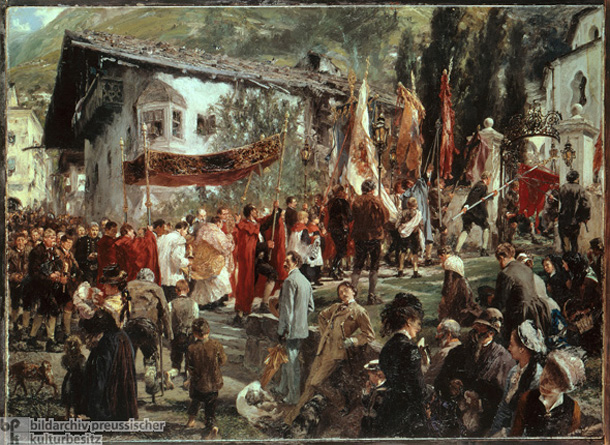
This image of the Baroque altar is not the only image where Menzel captured the rituals of the Catholic Church. Located in the Neue Pinakothek in Munich is a canvas depicting the procession of the Blessed Sacrament celebrating the Feast of Corpus Christi in the Austrian village of Hofgastein. Once again, along with the images of persons devoutly engaged in the procession, Menzel has sneaked in images of dandies and other lofty folk who are clearly spectators, but don’t seem particularly interested in the scared ritual. Rather, they seem to mock the ritual as some engage in conversation with each other, others stand apart and stare at the procession, and one young man in particular, actually looks out of the canvas and straight at the viewer.

Regardless of Menzel’s intentions, what definitely comes across from both these canvasses is the devotion of the Catholics involved in the rituals being represented. In both canvasses one finds people completely lost in the ritual that they are participating. Indeed, it is perhaps for the fervour of the devotees around the Baroque altar represented in Kircheninneres that this particular image is one of my more favourite, returning to me over, and over again. One such occasion was on a recent visit to Vienna. 

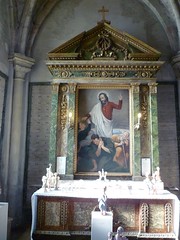
Competing for attention with the displays of imperial power, were some of the Catholic temples in various parts of the city’s core.  One of these churches was Michaelerkirche or the Church of St. Michael the Archangel.  Now one does not expect to see tender displays of devotion in Europe anymore given the extent to which European society has become secularized, but this church of St. Michael, as indeed other churches within the historical core of Vienna, displayed a number of touching displays of devotion.  Thus for instance, on my visit to St. Michael's, I found a fresh little posy of flowers resting on the side altar in front of the icon of St. Jude, and the wall behind it crammed with plaques of stone thanking St. Jude for his intervention in the lives of these devout. This was not the distant relationship with Catholicism that one would have expected in this largely secular city, but something akin to the devotion of the women one finds kneeling in front of the Baroque altar that Menzel depicted. At the same time however, the altar to St. Jude was a simple altar located close to the more ancient part of the Church and quite unlike the fancy alabaster crafted high altar that would have probably formed the more obvious subject for Menzel’s work. There is a profound lesson located somewhere in this contradiction, but like the answer to the question about the artist’s intention, I am quite unable to find it.

(A version of this post was first published in The Goan, 24 Aug 2013)