 I
read with some concern the news that the Government of Goa is officially
celebrating the tercentenary of the birth of Sant Sohirobanath Ambiye. Towards
this end, the government has chosen to rename the Government College in Pernem Sant Sohirobanath Ambiye College of Art and Commerce, publish a compilation of his
works, as well as establish a chair in his name at Goa University for research
in Marathi language and Goan Marathi literature.
I
read with some concern the news that the Government of Goa is officially
celebrating the tercentenary of the birth of Sant Sohirobanath Ambiye. Towards
this end, the government has chosen to rename the Government College in Pernem Sant Sohirobanath Ambiye College of Art and Commerce, publish a compilation of his
works, as well as establish a chair in his name at Goa University for research
in Marathi language and Goan Marathi literature.
All
of these actions are a matter of grave concern not only because they violate
the constitutionally guaranteed secular character of the Indian state, but
because it also represents the creeping manner in which recent times have seen
a systematic saffronisation of cultural space within Goa.
 While
there are many understandings of what secularism constitutes, the common sense
understanding within India is that the State will desist from promoting one
religious tradition over others. In the case of renaming the college of Pernem,
this understanding of secularism is exactly what the government of Goa has
violated. This act of the state government has privileged a Hindu faith
tradition over all other traditions within the State (and the country). It
would be unthinkable that a Muslim or Christian saint would be honoured by the
Indian or Goan state in this manner. To do so would raise cries of “pandering
to minorities” and “pseudo-secularism”.
Given that similarity of treatment is fundamental to the practice of
secularism, it seems that state government must necessarily change its decision
regarding the renaming of the Government College in Pernem.
While
there are many understandings of what secularism constitutes, the common sense
understanding within India is that the State will desist from promoting one
religious tradition over others. In the case of renaming the college of Pernem,
this understanding of secularism is exactly what the government of Goa has
violated. This act of the state government has privileged a Hindu faith
tradition over all other traditions within the State (and the country). It
would be unthinkable that a Muslim or Christian saint would be honoured by the
Indian or Goan state in this manner. To do so would raise cries of “pandering
to minorities” and “pseudo-secularism”.
Given that similarity of treatment is fundamental to the practice of
secularism, it seems that state government must necessarily change its decision
regarding the renaming of the Government College in Pernem. But
this is not the first time that the state government has demonstrated its bias
in promoting a particular brand of Hindu faith traditions. The choice of Sant Sohirobanath
does not seem to be innocent, but part of a larger trend where members of the
Saraswat caste have been held up as embodiments of Hindu culture, which is then passed off as Goan culture. Take, for example, the manner in which under the
earlier tenure of Chief Minister Parrikar, in 2002, his government sought to
commemorate the 125 birth centenary of Varde Valaukikar, also known as Shenoi Goembab,
as Konkani Asmitai year. While Valaulikar has garnered some fame as a proponent
of the Konkani language in the Nagri script, what has largely been suppressed
is the fact that he was an activist for the Saraswat caste who sought to create
a space for this caste group in the city of Bombay. This action was part of a
larger movement that sought the creation of a homeland for the Saraswats in Goa,
with the specific intent of allowing them to dominate it as their fiefdom.
But
this is not the first time that the state government has demonstrated its bias
in promoting a particular brand of Hindu faith traditions. The choice of Sant Sohirobanath
does not seem to be innocent, but part of a larger trend where members of the
Saraswat caste have been held up as embodiments of Hindu culture, which is then passed off as Goan culture. Take, for example, the manner in which under the
earlier tenure of Chief Minister Parrikar, in 2002, his government sought to
commemorate the 125 birth centenary of Varde Valaukikar, also known as Shenoi Goembab,
as Konkani Asmitai year. While Valaulikar has garnered some fame as a proponent
of the Konkani language in the Nagri script, what has largely been suppressed
is the fact that he was an activist for the Saraswat caste who sought to create
a space for this caste group in the city of Bombay. This action was part of a
larger movement that sought the creation of a homeland for the Saraswats in Goa,
with the specific intent of allowing them to dominate it as their fiefdom.
There
is also the choice of D.D. Kossambi whose name has been employed to distinguish
the ‘Festival of Ideas’ that the state government has organised in Goa since
2008. In itself this particular action is innocuous, and yet when viewed with
the other choices of the state government one begins to see a larger pattern
through which Saraswat patriarchal
figures alone are identified as worthy of honour. There have been other men who
have been honoured, but as in the case of the naming of the auditorium of the
Ravindra Bhavan in Margão, this has often been after a bitter struggle for such
recognition by bahujan groups.
_at_Panjim,_Goa,_India_01.jpg) More
disturbing is the choice of the relatively unknown figure of Krishnadas Shama
to identify Goa’s premier intellectual centre, the Central Library. Set up
under the Portuguese rule, this institution benefitted tremendously from the
efforts of a number of native sons, not least of whom was Ismael Gracias, a
significant curator of this public institution. Given that secularism has often
accompanied a republican culture that privileges persons who distinguish
themselves in the realm of public service, it is a shame that individuals like
Gracias were passed over in favour of Shama. In fact, not much is known about
Shama except that he is the possible author of brahmanical texts, like the
Mahabharata, in proto-Konkani. While Konkani nationalists have chosen to
promote Shama as the father of the Konkani language, this is merely a dubious
assertion given that Shama could have been associated with propagating
brahamanical myths among a local population that was profoundly influenced by
Jainism, Buddhism and Islam. To this extent, Shama too emerges not as a secular
figure, but one aligned with promoting brahmanical hegemony. With this history
in mind, it appears that this choice of Shama is in keeping with the Sangh Parivar’s
attempts to brahmanise Hinduism, destroying all other forms of non-brahmanical Hinduism,
and leaving brahmanical groups in complete control of this complex faith tradition.
More
disturbing is the choice of the relatively unknown figure of Krishnadas Shama
to identify Goa’s premier intellectual centre, the Central Library. Set up
under the Portuguese rule, this institution benefitted tremendously from the
efforts of a number of native sons, not least of whom was Ismael Gracias, a
significant curator of this public institution. Given that secularism has often
accompanied a republican culture that privileges persons who distinguish
themselves in the realm of public service, it is a shame that individuals like
Gracias were passed over in favour of Shama. In fact, not much is known about
Shama except that he is the possible author of brahmanical texts, like the
Mahabharata, in proto-Konkani. While Konkani nationalists have chosen to
promote Shama as the father of the Konkani language, this is merely a dubious
assertion given that Shama could have been associated with propagating
brahamanical myths among a local population that was profoundly influenced by
Jainism, Buddhism and Islam. To this extent, Shama too emerges not as a secular
figure, but one aligned with promoting brahmanical hegemony. With this history
in mind, it appears that this choice of Shama is in keeping with the Sangh Parivar’s
attempts to brahmanise Hinduism, destroying all other forms of non-brahmanical Hinduism,
and leaving brahmanical groups in complete control of this complex faith tradition.
Add
to this the choice of the state government to name one of the stadia set up for
the Lusophone games after Syama Prasad Mookherji, founder of the Bharatiya Jana
Sangh, and an associate of the RSS.
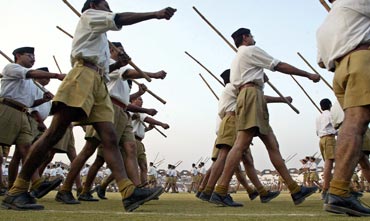 The
choice to name the college after this brahmin saint should also be seen in the
manner in which the Parrikar-led government sought to hand over government
schools to RSS-backed ‘educational’ institutions. Clearly, through these
various choices in naming public institutions, the Parrikar-led BJP government
is seeking to create a legitimacy for the RSS and its program of Hindutva.
The
choice to name the college after this brahmin saint should also be seen in the
manner in which the Parrikar-led government sought to hand over government
schools to RSS-backed ‘educational’ institutions. Clearly, through these
various choices in naming public institutions, the Parrikar-led BJP government
is seeking to create a legitimacy for the RSS and its program of Hindutva.
Seen
in light of these various facts, it becomes obvious that the celebration of the
centenary of this largely
anonymous Sant Sohirobanath, is a part of a larger programme
to saffronise the Goan public sphere. In his defence of the state government’s decision to officially celebrate the centenary of this saint, Nandkumar Kamat
has suggested that “Saints of all religions belong to the whole mankind [sic because
their sainthood helps us all to be good human beings.” While this may be true
in principle, under a secular regime the choice of integrating them into daily
life is an option of individuals, not an obligation of the state. The
government in this case is integrating this saint into the official culture of
the territory.

Persons
who would object to the protest we mount in this letter would no doubt point to
continued state support for the exposition of the relics of St. Francis Xavier
every decade. There is a difference, however, in that as far as my
understanding goes, the exposition of Saint Xavier is organised by the church,
and the state steps in largely to coordinate public order. The initiative rests
largely with the Catholic Church which is the primary celebrant. In the case of
Sant Sohirobanath on the other hand, it appears that it is not a civil society
organisation that is seeking the support of the state, but the state that has
taken it upon itself to celebrate the event officially. This is a crucial
distinction and must be underscored.
 The
action of the state government is not merely a violation of the secular nature
of the state, but tantamount to laying the grounds for communal conflict in Goa.
With its choice of setting up a chair in the Goa University under the name of
this saint for the study of Marathi literature in Goa, the state government is
effectively further saffronising Marathi culture and literature in Goa. Most
people will recollect the manner in which ever since the 1960s the Marathi
language had been twined with Hindu nationalism in Goa. However, it should not
be forgotten that while Marathi in Goa has a brahmanical heritage, it also was,
and continues to be, the language of dalit-bahujan assertion against
brahmanical hegemony in our state. To this extent, the Marathi language can
also be the source of a profound commitment to a secular polity. To name a
chair after a religious figure pollutes the secular aspects of the tradition of
the Marathi language in Goa, and complicates the resolution of historical
differences that since at least 1961 have deliberately sough to keep Hindu and
Catholic bahujan suspicious of each other’s traditions.
The
action of the state government is not merely a violation of the secular nature
of the state, but tantamount to laying the grounds for communal conflict in Goa.
With its choice of setting up a chair in the Goa University under the name of
this saint for the study of Marathi literature in Goa, the state government is
effectively further saffronising Marathi culture and literature in Goa. Most
people will recollect the manner in which ever since the 1960s the Marathi
language had been twined with Hindu nationalism in Goa. However, it should not
be forgotten that while Marathi in Goa has a brahmanical heritage, it also was,
and continues to be, the language of dalit-bahujan assertion against
brahmanical hegemony in our state. To this extent, the Marathi language can
also be the source of a profound commitment to a secular polity. To name a
chair after a religious figure pollutes the secular aspects of the tradition of
the Marathi language in Goa, and complicates the resolution of historical
differences that since at least 1961 have deliberately sough to keep Hindu and
Catholic bahujan suspicious of each other’s traditions.
The renaming
and other celebrations of Sant Sohirobanath by the government of Goa must be
protested vociferously, not merely because it violates the secular fabric of
constitutional governance in the state, but also because it is part of a
blatantly casteist agenda in Goa.
(A version of this post was first published in the O Heraldo on 22 Aug 2014)


