Saturday, May 25, 2013

The Itinerant: Homophobia’s silent victims


In some parts of the world the 17 of May was commemorated as ‘International day against Homophobia’. I would not have known of this day had it not been for a post of Facebook that read: “Since my childhood until my teens..There were those who offended me, beat me, humiliated me (some returned here to find me on facebook) because I was not boyish enough. Today is a special day in 100 countries in the world. I have no regrets, just hope that you today will be as happy as I am.”

Reading this post a couple of facts became obvious. First, challenging homophobia does not demand that we love homosexuals. It does not require that we agree to what is termed as ‘the gay agenda”. It only requires, even as we continue to disagree with the demands of the gay rights movements, that we restrain for any acts of violence against people who we assume to be homosexual.

Indeed, the logic of ceasing homophobic violence is made obvious by the contents of the Facebook post shared above. Much homophobic violence is often justified on the basis of the homosexual’s alleged sexual predations on heterosexual men. Homophobic violence is justified on the basis of these heterosexual men feeling violated by the homosexual man’s sexual attention. And yet, what kind of sexual attention or predation is a pre-teen, admittedly non-macho boy capable of? Anyone familiar with life in schools will recognise that the violence against boys who are not man-enough is a quotidian fact. Unfortunately, this violence is meted out to these kinds of gentle boys not merely by macho schoolboy bullies, but by practically everyone around. They are mocked and humiliated by other boys, by girls, by adults in positions of guardianship, namely teachers, relatives and often enough parents as well. The tragedy of this all, is that most of the time, a number of these boys do not turn out to be homosexual, but actively heterosexual men. What they do carry, however, are painful memories of their childhood and adolescence.

It appears then homophobic violence is a much broader form of violence than merely beating up homosexual men for making a pass at a heterosexual. It encompasses violence that is visited on innocents merely because they do not meet societal norms of what a man, or indeed, a woman should look like. Homophobic violence is not visited merely on men, but on women, and girls as well. It would encompass the treatment meted out to women who prefer the sexual company of other women, or women who do not act feminine enough, or girls who are referred to as tom-boys.

Looking at the issue from this perspective, it becomes clear that homophobic violence is not merely the desire to punish people with same sex desire, but to discipline people into behaving in a manner that is deemed socially acceptable. Boys must behave in a particular manner, and girls in a different manner. Do not do so, and you will face humiliation and violent repercussions. This violence then gets carried over into adult relations, where if a woman does not behave in the way she ought to, society around her condones her disciplining. This disciplining as we well know, often extends to rape. Rape is not about sexual desire, it is about power, and often about the power to discipline.

The challenge to homophobic violence is does not simply benefit homosexuals, it makes space for a world with less sexual and other violence. Think about that the next time you give in to homophobia.

(First published in The Goan on 25 May 2013)


Saturday, May 18, 2013

Who rules? - Determining the extent of the Panchayat’s power


Chief Minister Manohar Parrikar was recently reported to have indicated in the course of legislative debate that he would rather have a referendum than let Gram Sabhas take a decision on the much contested developmental plans that form part of the Regional Plan. Subsequently, the Chief Minister has been reported to have suggested that Gram Sabhas are only advisory in nature, said the Chief Minister, their decisions cannot be legally binding on the panchayat.

Given that that the Chief Minister is not alone in his observations, and his opinion is shared by many developers I would like to first reference, and then engage with, the arguments presented by similarly inclined commentator in the public sphere.

Speaking in the context of migrants, Prabhakar Timble felt obliged to also suggest that, “…we notice the Gram Sabhas and Village groups of Goa opposing almost all proposals of investment or development in the village.  To a large extent, the opposition at the Gram Sabha is from those members who are defeated at the Panchayat elections. In a multi-cornered contest at Panchayat elections, the aggregate number of defeated candidates is sizeable in relation to the elected members of the Panchayat.  It is really a funny situation wherein the elected Panchayat is held hostage by the Gram Sabha under the domineering influence of the candidates who are rejected by the village electorate and who later form the active component at the Gram Sabha. I have not heard of Gram Sabha directing and recommending the Panchayat “to do” specific projects or encourage a set of economic activities in the village.”

Rather than address the issue of the legality of the Gram Sabha’s capacity to direct the Sarpanch and council, I would like to deal with the logic displayed above that attempts to undermine the validity of the discussions that take place in the Gram Sabha. Timble’s logic suggests that the candidates who have won the election are approved by the electorate, and those who have lost the election are rejected by the same body. In making this suggestion, Timble could not be further from the truth.

The “first-past-the post” method that Indian electoral system uses to determine the winner in an election is but one of several ways of doing so. In this method, the person with the highest votes wins, even if the number of these votes do not constitute a majority of the electorate, and it is possible that as a result of the multi-cornered contests that Timble draws our attention to, the winner in fact enjoys the confidence of just a minority of the electorate. Indeed, as has been pointed out, the first-past-the post method is ideally used in elections between two parties. In such a case, where electoral contests are contested by beyond three parties, it would be highly illogical to assume that the winner holds the confidence of the majority and has the right to take decisions on agendas that will hold significance beyond the five year period that they are elected for.

In a situation where the winner of an election may hold the confidence of only a minority of the electorate, it makes sense to read the result of the elections as securing the right of the successful candidate to lead deliberations in the panchayat and Gram Sabha, but definitely not to make unilateral decisions. The multi-cornered fights in the Gram Sabha are evidence of the complex nature of the Panchayats and a testament to the vibrancy political life of the electorate. The Gram Sabha then, is not only a crucial space where the tensions, and ideas can be debated and then independently voted on, but a critically important one if we are to ensure that the Panchayat is genuinely representative of democracy.

Having said this, there is a need to recognize two valid criticisms that are leveled against the operation of Gram Sabhas. The first is the criticism that given the number of persons with strong opinions, these Gram Sabhas often descend into chaos, where everybody is screaming, no one is listening, and nothing gets done. The second criticism is that oftentimes decisions can be taken that violate fundamental principles of law.

The first criticism is really a testament to the fact that a culture of debate has not yet taken solid root in our political life. The blame for this lies as much at the feet of persons outside of power, as those who hold power. Sarpanches should be required to acquire a training in how to effectively conduct debates where all sides are allowed space to present and rebut arguments. Where persons fail to cooperate with the process, the law provides for the presence of police who can be called to restore order. Unfortunately, when the police are called, it is usually to intimidate persons with opinions opposite to that of the Sarpanch who seeks to push his agenda through.

In the second case, if, and when Gram Sabha decisions have been taken in violation of basic principles of law, this opens up space for the decisions of the Gram Sabha are adjudicated by the superior courts that exist both within the panchayat system as well as outside of it. Rather than see adjudication of these allegedly faulty decisions as a problem, once more this process should be seen as a way to build up precedents for Gram Sabhas to follow, and harmonize this system of local self governance with the larger systems of state and central governance that have until date received far more importance.

The problem however seems to be that rather than allow for a more democratic state, business interests and the interests of the MLAs are working together to deny this possibility by writing off the Gram Sabhas as failures even before these institutions have been allowed to work in an ideal environment.

(A version of this post was first published in the Gomantak Times 18 April 2013)

Sunday, May 5, 2013

The Itinerant: In the Womb of Holy Mother Church


Within the Roman Catholic faith, the church is hailed as a holy mother, referencing her capacity to nourish and sustain. And indeed, one of the nice things about being a Catholic is that as long as there is a functioning Catholic Church in the vicinity, there is always a constant in one’s life. No matter where in the world you go, or what language they speak there, the liturgy of the Mass is unchanging. As a result, all you have to do is follow the mass with your own responses in the language you are comfortable in, and almost instantly, even if only for the duration of the mass, you have a home even in the most foreign of locations. This scenario can lead to a number of rather interesting experiences, where you realize that through this standard ritual of the Mass, one can also reach out to the individuals around, or alternatively be profoundly touched by the same people.

Take for instance my experiences while in the city of San Francisco, almost two decades ago. Located some three blocks away from my home on the edge of the Mission district, and its steeples clearly visible from my bedroom window, was the Church of St. Paul’s. While I did not really engage with members of the parish, the strongest memory I carry back of the church is the voice of the lady who led the choir every Sunday. Strong and matronly, but by no means untrained, her voice contributed to the more moving experiences I have had in that church. Even today, though I often cannot recollect the internal architecture of that church, I can close my eyes, and recall from memory her voice ringing out through that Church, and embodying the faith experience of my time in San Francisco.

While living in Lisbon, I found my spiritual home at the Chapel at Rato, as much for the eloquence of the priest Tolentino Mendonça who prays the Mass, as for the, as yet anonymous, voice of the man who leads the choir every alternate Sunday. Who knows what it is in the voice of this man, but when, accompanied by his guitar he sings the Psalm, there is something profound that moves among the congregation. Indeed, so moving is his voice that newcomers to the congregation often look up to try and glimpse into the choir loft, and determine the owner of that voice. If you are among the faithful, and you ever make it to Lisbon, a service at the Chapel at Rato must be a part of your itinerary for both these reasons.

It is as a tourist that I have had the most bemusing experience as a church goer. Believing that a space opens up in a completely different manner if one uses the space, I often attempt to attend Mass in the more spectacular churches of places I visit. Attempting to do so in the Mesquita of Cordoba, I walked up the evening of my arrival and inquired of the guard on duty what time the daily mass at the church within was scheduled. “It is not for Muslims, only for Catholics” was his response twice over, until I could beat it into his consciousness, that despite my possibly Moorish features, I was indeed Catholic, not Muslim and had not the faintest intention of recovering the monument for the glory of Islam by offering namaz inside. (Of course I don’t see why anyone should object to a Muslim wanting to offer namaz inside a space that was originally built for congregational prayers, but I am not Cordovan, and that was not my battle).

Once inside the Mesquita the next day, my faith in the experience of these spaces being different when used rather than just gawked at, was rewarded not only through the smells and bells that inform the Catholic experience of the Mass, but especially when in the course of exchanging the peace of Christ, through a smile and the grasp of my hand, I was made even if for a moment a member of that church’s believing community.

(A version of this post first appeared in The Goan dated 27 April 2013)

Tuesday, April 23, 2013

The Itinerant: From Pais Vasco to Panjim


If you were a student, living in the mid 2000s in Oñate, a mountain town of the Basque country, then your entry into San Sebastián would be via train. As you pulled into the station, and then subsequently headed out of the station into the city you would pause for a moment. Was there not a faint resemblance to Panjim city? Did it not feel as if the train station was located where the Patto development now is? Did the bridges across the Rua do Ourem not correspond to the bridges across San Sebastián’s Urumea river?


The resemblance of Panjim to this Basque city can be quite confounding. Not only do both cities lie at the mouths of rivers, but they both also encompass a stretch of beach that is actively used by its denizens for recreation. Add to these coincidences the Miramar palace that sits above the city’s famous beach, echoing Panjim’s own Miramar. Like Panjim, the city too is marked by a number of elegant promenade spaces. This latter feature however, dates back to the royal patronage that it enjoyed in the not too distant past, laying the basis for much that is spectacular in the city.

What makes San Sebastián truly breath-taking however is not the drama of its geographical location, a combination of being encircles by beach, river, sea and hills. Neither is it the food; Basque tapas (pintxos) are arguably the finest in Spain. Nor is it the spectacular architecture that constitutes a good amount of the centre of the city. What makes the city breath-taking is when you realise that a good amount of effort and energy has gone into making the city accessible to users of non-motorized vehicles. It is perhaps this reaching out in multiple senses that makes this city all the more enjoyable. 

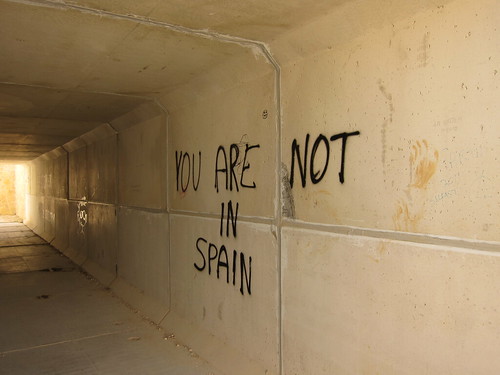
It is, however, more than spatial features that create the sense of similarity between these two widely separated towns. Indeed, both San Sebastián and Panjim share an uneasy relationship with the country within which they are today located. If Goa superficially rests easy within the embrace of Mother India, then the same need not necessarily be said for San Sebastián. Part of the restive Basque country (Euskal Herria), one could, in the period of this itinerant’s visit, find much graffiti on the streets that testified that not all Basques thought themselves Spanish. Slogans like “Gora Euskadi” cheered on a sense of a distinct Basque identity, while other slogans (Euskal Presoak Euskal Herrira) dragged ones attention to the fact that all too often political prisoners were incarcerated outside of the Basque country, so as to make visits by their families a complicated affair.

Another feature that both San Sebastián and Panjim share is that they both enjoy more than one name. San Sebastián also has a Basque (Euskera) name Donostia, while Goa’s capital is known as Panjim in English, Ponnje in Konkani, and Pangim in Portuguese. What perhaps distinguishes San Sebastián from Panjim, is that the former city, following a feature common in the rest of the Basque country, provides space for both versions of the name. This usage is a result of Spain’s efforts to accommodate a variety of regional identities, and indeed nationalisms into the idea of the Spanish nation-state. Now here is something that one would want to see replicated in Goa! This replication would make sense given that in recent days there has been some talk of sharpening the similarity between the two cities. If this is a project that is to be taken seriously, then this is not a project that should end with physical infrastructure. On the contrary, this is a project that must include an agenda that will balance the skewed directions of Goa, and Panjim’s cultural policy.

(A version of this post was first published in The Goan on 23 March 2013)

Friday, April 5, 2013

The Itinerant: Saint Christopher’s wardrobe


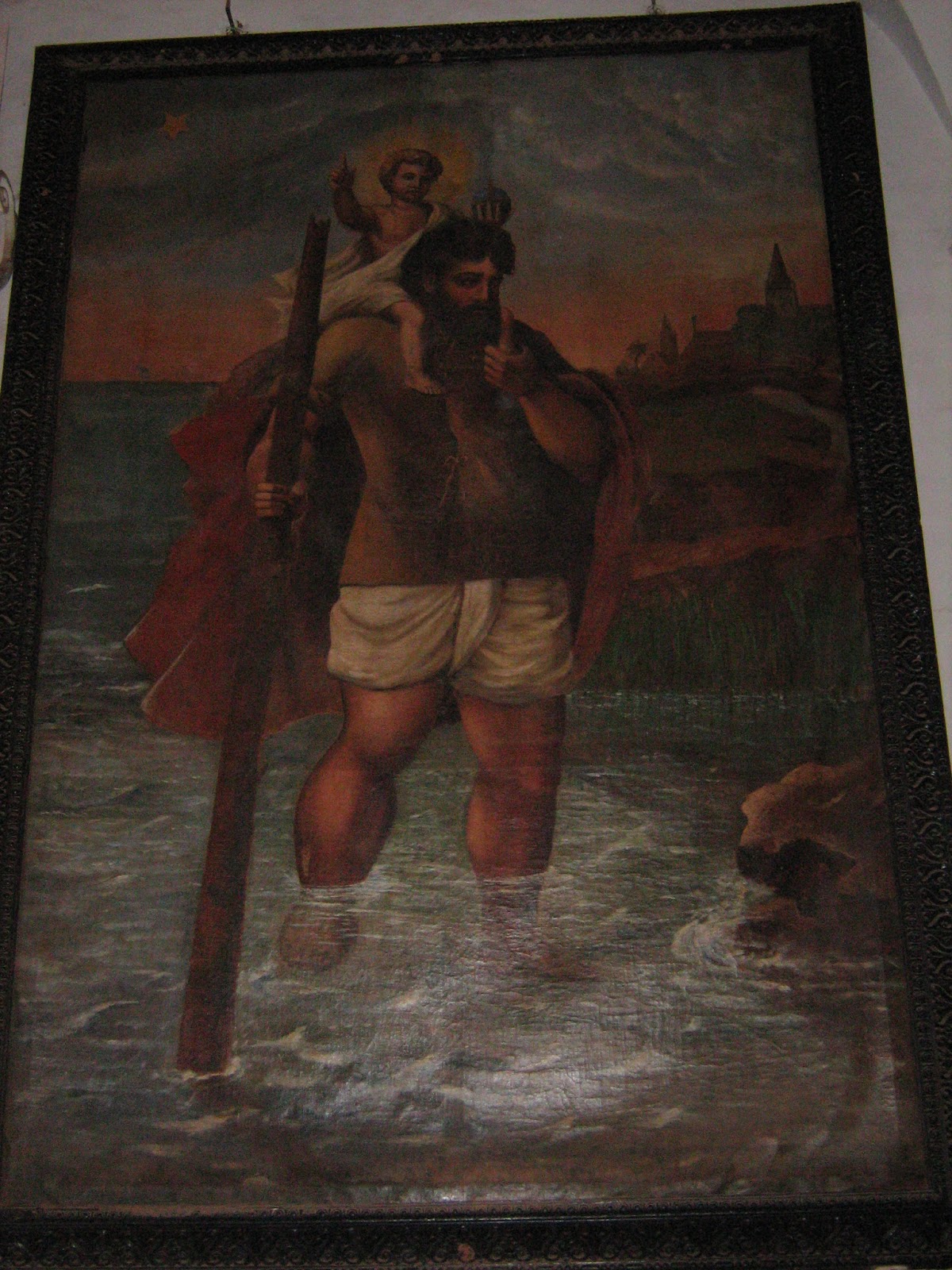
St. Christopher in the Cathedral in Toledo.
The Cathedral of Toledo, in Spain, hosts on one of its walls a monumental painting of St. Christopher. St. Christopher, legend tells us, started out as Offero, offering his services to people to help ford a river. He remained Offero, until one stormy evening, he forded the river with a child on his shoulders. Particularly insistent on crossing despite the storm, on reaching the other side, the child revealed himself as the infant Jesus and indicated to Offero, that since he had carried Christ that evening, he would hence forth be called Christ-offero.  In offering his shoulders to Christ it turns out, Offero not only gained a name, but provided for the Catholic church, the patron saint of travelers.

The depiction of Christopher in the Cathedral in Toledo wears what medieval depictions of European saints are normally depicted wearing, a long tunic, that is, in the case of Christopher, hitched up at his waist so as to not get too much of the garment wet. The same saint is depicted, on a somewhat smaller scale, but no less dramatically in the Cathedral in Old Goa. This depiction of the saint, at least with respect to his garments differs dramatically from the depiction of Christopher in Toledo.


Detail of the image of St. Christopher in the Se, Old Goa.
This Christopher in Old Goa, hangs immediately to the left of the main entrance of the Cathedral, and has been the subject of some excitement in the field of art history. Amateurs and professionals have pointed out that this St. Christopher wears what some would call a dhoti or a langoti. What is often left out however, is that this is not the only piece of native clothing that the Goan Christopher is wearing. If one looks very closely, one realises that the shirt that Christopher is wearing in this version, has rather peculiar features. It looks akin to the many versions of the Persian jama that filtered into the sub-continent. This shirt, does not boast buttons, but the front of the shirt is held together by knotted strings, just like the many varieties of the jama or angarakha are even today held together.

St. Christopher's wardrobe in Goa

Ibrahim Adil Shah, Sultan of the post Bahmani State of Bijapur
When the art historians realized that St. Christopher in Old Goa was wearing a dhoti, they forwarded the argument that perhaps the artist who painted the image of the saint, was not Catholic, nor European, but a native and a Hindu. In doing so, they seek to stress the Sanskritic nature of pre-Portuguese Goa. If however, we recognize that the garments of the saint are composed of more than just the dhoti, but this jama shirt as well, then our view of the possible identity of the artist must necessarily be complicated. There is no need for us to make the argument that the artist was in fact Muslim. However, we must recognise the fact, that if the artist was in fact native, then the vocabulary of the artist was more than just Sanskritic, but one that was at home with the Persianate and broader Islamicate fashions that had been dominant along the west coast ever since the ascendancy of the Bahmani Sultanates in the Deccan. It points out to us that Goa’s pre-colonial history, and its pre-colonial peoples were a culturally complex lot.

(A version of this post first appeared in The Goan dtd 16 April 2013)